Fires Driven by Santa Ana Winds Destroy Homes

A fire broke out in Malibu on Wednesday, November 6. Smoke is seen along the coast.

BROAD FIRE:

A fire broke out on five acres near Pacific Coast Highway in Malibu Bluffs Park, around 9 a.m.

Santa Ana winds rapidly expanded the fire to about 50 acres near Pepperdine University. Dubbed the Broad Fire the fire damaged two beachfront homes.

Around 10:15 a.m., the city urged residents along Malibu Road between Webb Way and PCH to shelter in place. Northbound traffic on PCH is stopped at Malibu Canyon and PCH.  Around 11 a.m., wind gusts in Malibu were at 35 to 45 mph.

Forward progress of the fire was quickly stopped, in part because flames ran into the greatest fire break of them all: the Pacific Ocean. If the fire had started further inland, it could’ve been catastrophic for even more homeowners in the area. The Los Angeles Country Fire Department said

The National Weather Service’s Los Angeles office reported wind speeds up to 51 mph and relative humidity levels of 11% in the fire area. Much of Southern California is under a red flag warning, signaling extremely critical fire conditions.

Southern California Edison also preemptively shut off power for more than 46,000 customers, including more than 12,000 in Los Angeles County on Wednesday. Power shutoffs are being considered for more than 200,000 customers due to the risk, the company said on its website.

MOUNTAIN FIRE:

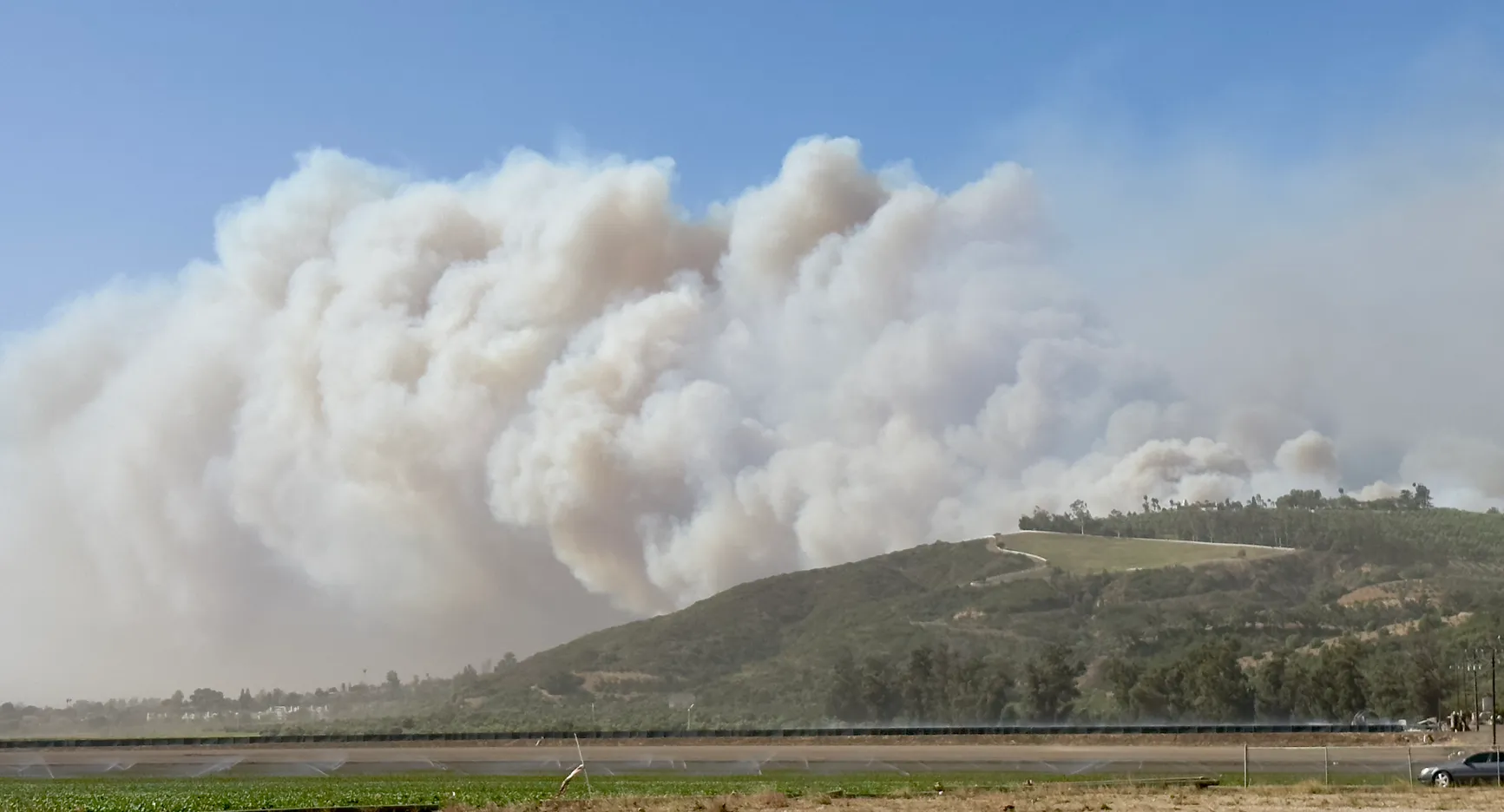
Homes were, and are being, destroyed by the Mountain Fire.

The Mountain Fire began deep in the hills above Somis and Moorpark in Ventura County and was driven by the winds and pushed it towards the ocean.

Mandatory evacuations were ordered soon after it started and by mid-morning it had grown to 1,000 acres. Dangerous Santa Ana winds fanned the blaze, which ignited near the 7900 block of Bradley Road and Balcom Canyon Road shortly before 9 a.m. The Mountain Fire, as it has been named, reportedly jumped Highway 118, near Camarillo Heights, shortly after 10:45 a.m.

Winds had been clocked up to 80 mph in the area. By late afternoon, the fire had grown to 10,458 acres and at least a dozen homes have been destroyed, according to news reports. The cause of the fire is under investigation and there was no containment as of 4:30 p.m.

Ventura County Fire Chief Dustin Gardner in a news conference described sustained winds of 50 mph with gusts over 80 mph in the area of Wednesday’s Santa Ana-whipped blaze. Firefighters from Santa Barbara, Los Angeles, Kern and Orange counties as well as Cal Fire responded to help.

“Every helicopter, every fixed wing aircraft, everything we’ve been able to get a hold of is here fighting this fire,” Gardner said, at a 4 p.m. news conference. “It is moving at a dangerous rate of spread. This fire has spotted more than 2 1/2 miles out in front of itself.”

He urged those who get an evacuation order to leave, saying this is not a fire that someone can wait to see what happens.

“Bushes are burning, grass is burning, hedgerows are burning, agricultural fields are burning, and structures are burning,” Gardner said. “This fire is moving dangerously fast.”

The Ventura County Sheriff’s Office posted a video on social media, saying the Mountain Fire was quickly moving toward Saticoy.

Highway 118 was closed in all directions in the Somis area, California Highway Patrol officials said.

Southern California Edison has shut off power in sections of Thousand Oaks, Newbury Park, Camarillo, Somis, Simi Valley, Santa Paula and Piru, among other areas. The utility company had lines de-energized to prevent electrical equipment from sparking a fire — outages called Public Safety Power Shutoffs, or PSPS.

“We really do it as a last resort to protect our communities, especially when these weather conditions elevate the risk of wildfire,” said Diane Castro, a company spokesperson.

As the fire pushes towards the ocean, there are more neighborhoods that could be in danger.

Smoke billows up from the Mountain Fire in Ventura County.

RED FLAG WARNING:

A National Weather Service “Red Flag Warning went into effect at 11 a.m. November 5 and will continue until November 8 at 11 a.m.  There was a prediction of low humidity and 60-80 mph winds. For the City of Los Angeles, forecasts predict the most significant risk to be Wednesday morning through Wednesday night, with the strongest gusts affecting the mountains and foothills throughout the City of Los Angeles, with possible isolated gusts of 80-100 mph.

Parking Restrictions in high-risk area (all of Pacific Palisades) went into effect 8 a.m. today, November 6 and will continue at least 24 hours. Red Flag Warnings alert residents to extreme wildfire events.

It is suggested that residents who live in Very High Fire Severity Zones take the following steps:

  • Sign up for NotifyLA alerts and encourage your neighbors to do so as well.
  • Leave your phone on to receive Notify LA alerts even if you are sleeping and don’t use “do not disturb” mode during high-risk weather.
  • Monitor LAFD Alerts to see updates on Red Flag Parking Restrictions and active fire incidents in the City of Los Angeles.
  • Put your go-bag by the front door. Ensure that you have all essential items ready.
  • Plan multiple evacuation routes in your home in the event of a fire.
  • Establish two meeting places outside your home: one you can walk to and another you can drive to. Inform all household members of these two meeting places.
  • Park off-street. Back your car into your driveway or garage, leaving streets clear for emergency vehicles.


Posted in Accidents/Fires | Leave a comment

Veterans Day Ceremony at the Pier Sponsored by Post 283

A Veterans Day ceremony will be held at the Santa Monica Pier and hosted by Post 283.

Veterans Day, November 11, will be the site of a super celebration hosted by Post 283 at the Santa Monica Pier. This will serve as the launch for Ronald Reagan American Legion Post 283 national Alumni Ambassador campaign. The event will start at 11 a.m.

Bring the entire family to the pier, there is free parking for those attending the event. There will be free passes to ride the amusement park rides and roller coaster for children attending.

There will be a Blackhawk/Chinook flyorver and a Humvee/JLTV convoy.

The West Point Drill Team will perform, and music will be provided by the 300th Army Band.

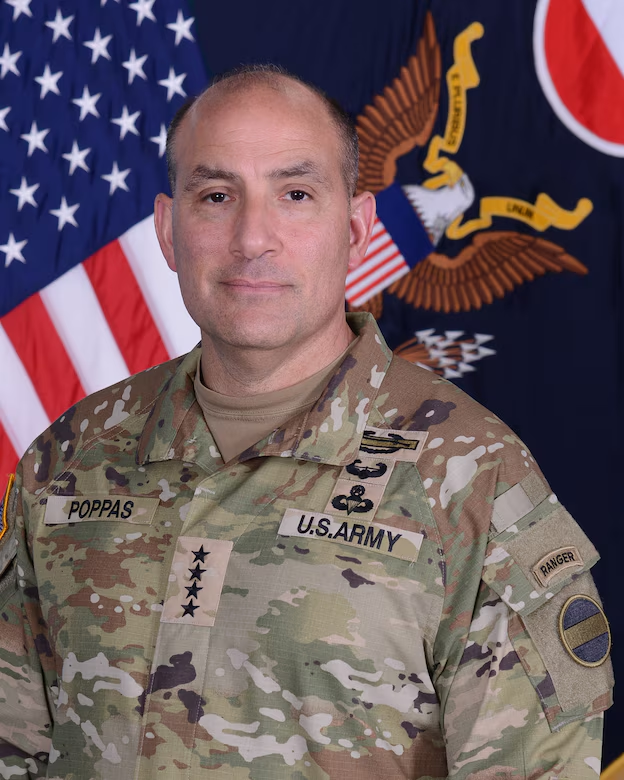
General Andrew Poppas

General Andrew Poppas will be the distinguished guest speaker. He became the 24th commander of United States Army Forces Command, Fort Liberty, N.C., on July 8, 2022. As commander of the U.S. Army’s largest organization, he commands 212,000 active-component soldiers and 174,000 members of the U.S. Army Reserve, while also providing training and readiness oversight to the Army National Guard. In total, the Forces Command team includes more than 710,000 soldiers and 13,000 civilians.

In addition to his Bachelor of Science degree in National Security Affairs from the U.S. Military Academy, Poppas holds a Master of Science degree in Occupational Education from Kansas State University. He is also a graduate of the Defense Language Institute, the U.S. Army Command and General Staff College, and a fellowship at Harvard University.

Also speaking will be former NFL star Andrew Whitworth. An offensive tackle, he played 11 seasons with the Cincinnati Bengals and five with the Los Angeles Rams. He retired in 2022, as the oldest tackle in NFL history and was the oldest offensive lineman to win a Super Bowl. The 40-year-old was part of the Rams team that defeated the Bengels 23-20 in Super Bowl LVI.

After retiring in 2022, Whitworth joined Amazon’s Thursday Night Football crew as an analyst.

Former NFL Rams player Andrew Whitworth.


Former Post 283 Commander Jim Cragg said, “This will be an epic event in an iconic location that will honor our veterans and soldiers. “

After the ceremony, 95.5 KLOS DJs/singers will provide entertainment.

“We want everyone in attendance to not only realize how great our military is but also be ever so proud to be associated with the greatest team in the world,” Cragg said. “This is a great way to uplift and elevate the public’s perception of our veterans.”


Posted in Holidays | Leave a comment

Hochman Defeats Gascon: Prop.36 Passes

Hochman Defeats Gascon in LA Country District Attorney Race

Nathan Hochman

By RACHAEL GAUDIOSI

Los Angeles County will be getting a new district attorney, with former federal prosecutor Nathan Hochman handily defeating incumbent George Gascón, whose progressive policies swept him into office four years ago but made him a target of critics who accused him of being soft on crime.

Semi-official results from Tuesday’s election showed Hochman with 61.5% of the vote, and Gascón with 38.5%.

Gascón has defended his record while in office, denying allegations that his policies have led to an increase in crime and insisting that statistics show actual drops in many categories. But Hochman disputed that claim and said he would ensure people serve appropriate punishment for their crimes.

“We’ll go back to just two things — the facts and the law,” Hochman told his supporters gathered in Beverly Hills Tuesday night.

While the votes were still being tallied, he told his backers that “the voices of the residents of L.A. County have been heard and they’re saying enough is enough of George Gascón’s policies and they look forward to a safer future.”

The Association of Deputy District Attorneys, which represents county prosecutors, hailed Hochman’s victory as a “pivotal moment in the fight to return balance and accountability to the justice system and to prioritize public safety in a county that has seen a dangerous decline under the failed leadership of George Gascón.”

There was no immediate statement from Gascón. But Cristine Soto DeBerry, executive director of Prosecutors Alliance Action, issued a statement praising his dedication to public service and said Hochman’s win does not mean the end of a more progressive approach to criminal justice.

“I’ve been a supporter of Nathan since he ran for Attorney General, and he was the one I chose in the primary,” said Doc Dale, a dedicated supporter. “I’m expecting a big win tonight,” Dale added, underscoring the widespread support Hochman has garnered from those who feel a firmer stance on crime is needed.

On Wednesday morning, he released a statement conceding the race to Hochman.

“The rightward shift across America last night is heartbreaking,” Gascón said. “Democrats have a long road ahead, but the work is more vital than ever and our commitment will not waver. Nevertheless, I have called Mr. Hochman and wish him the best as Los Angeles County’s next District Attorney.

He continued: “I’m deeply proud of what we’ve accomplished over the past four years and grateful to the communities who have been and will always be the heart of criminal justice reform.”

Hochman addressed his victory in a brief message on X. “The rightward shift across America last night is heartbreaking,” Gascón said. “Democrats have a long road ahead, but the work is more vital than ever, and our commitment will not waver. Nevertheless, I have called Mr. Hochman and wish him the best as Los Angeles County’s next District Attorney.

He continued: “I’m deeply proud of what we’ve accomplished over the past four years and grateful to the communities who have been and will always be the heart of criminal justice reform.”

(Editor’s Note: Hochman Defeats Gascon first appeared in the Westside Current in November 6 and is reprinted with permission.)

Proposition 36 Passes Easily

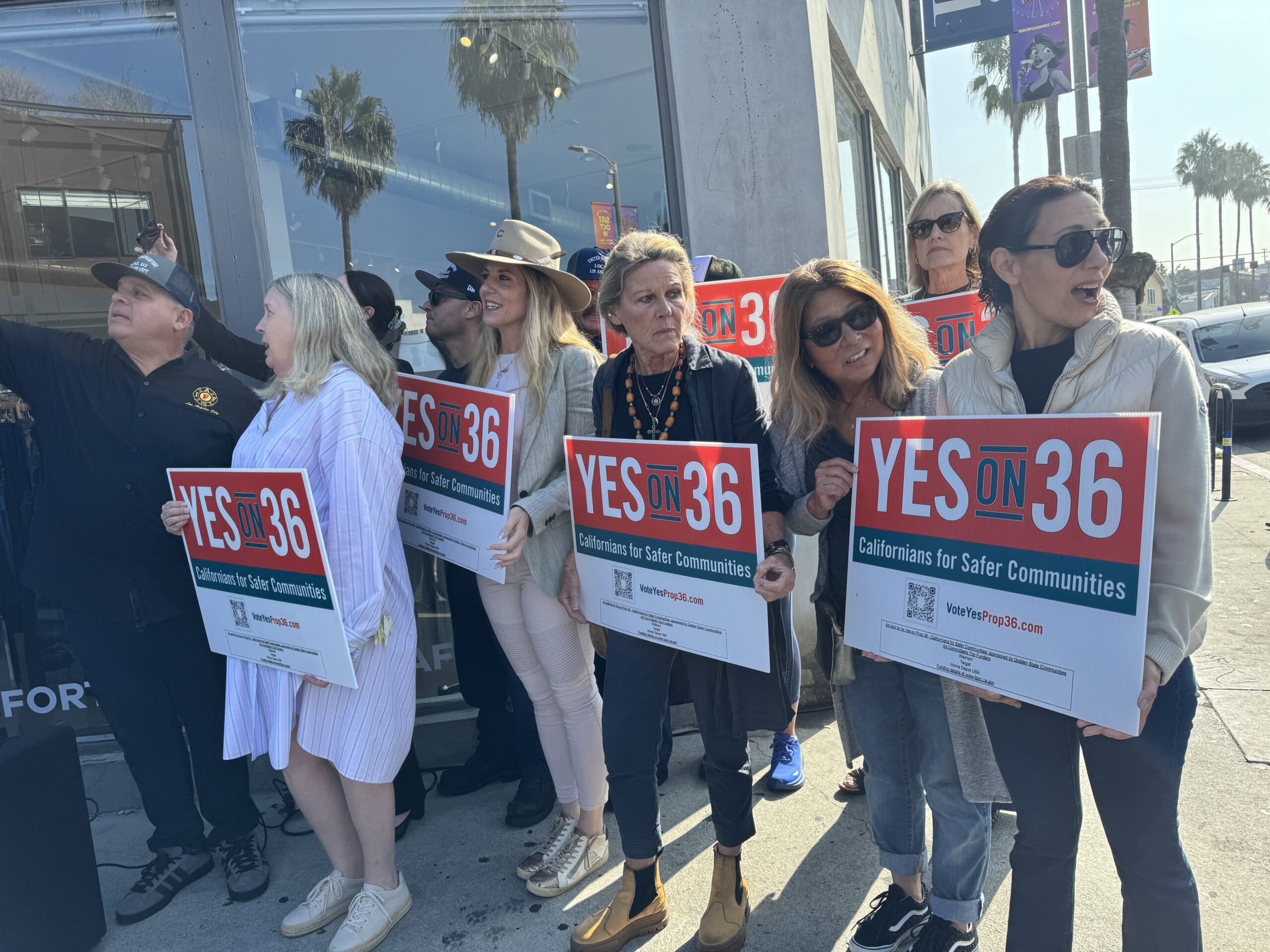
Rallies were held in support of Prop. 36

BY SUE PASCOE

California Proposition 36 was overwhelmingly passed by voters 70.4% to 29.6% (as of November 6). The ballot measure only needed a simple majority to pass. The Proposition was opposed by Governor Gavin Newsom and District Attorney George Gascon. Many felt that Prop. 36 was a way to overturn the damage done by Prop.47.

In 2014, voters passed Prop. 47 which was supposed to help California prison overcrowding by turning some drug and theft crimes into misdemeanors. That proposition allowed shoplifters who stole $950 or less in goods to be charged with a misdemeanor instead of a felony.

Now under Prop. 36, the theft could be classified as a felony and up to three years in prison if the offender has “two or more past convictions for certain theft crimes (such as shoplifting, burglary or carjacking).”

Prop. 36 requires some felonies, such as drug dealing drugs such as fentanyl to be served in state prison and not county jail. It also establishes “treatment-mandated felony,” which allows those charged with drug possession, who do not contest the charges to complete drug treatment and have the charges dismissed instead of sent to jail. If they don’t finish treatment they could serve in state prison for up to three years.

Supporters of Prop. 36 raised about $16.8 million to get it passed, while its opponents raised $7.7 million to defeat it, according to figures from CalMatters.

More about Prop. 36 can be found on September 29, Circling the News (“The Simple Facts about Proposition 36) click here.

Posted in Crime/Police, General | Leave a comment

Viewpoint: The Day After: November 6

By CHAZ PLAGER

Well, folks, that’s it. Today’s the day after election day. We all took our chips, some bet on blue, some bet on red, but in the end, the house won, the margaritas don’t taste so sweet when it’s on your own dime, and the Cocteau Twins asked if it was Heaven or Las Vegas; we got Las Vegas. Now that cherry-colored funk is sweeping the nation just outside your window, and the headache only gets worse.

I can’t lie to you and say it’s not going to be bad, because it is. Things are going to cost more, women in several states are going to lose their right to abortion and birth control, we’ll lose international support, and education of American children will slip back 66 years.

If you think that we’re safe from all this because we’re in California, I hate to break it to you, but Donald Trump has pledged to end the Department of Education, which, despite its relative ineffectiveness, still mandates the teaching of slavery and LGBT rights.

And if you have been following what’s happening in Florida and Texas, you’ll know both states are trying to ban books, as well as burn them. Parents, concerned individuals, really, anyone reading— remember that your school district might try to pass an innocent little initiative. “This book just doesn’t seem fit for kids,” they’ll say. “I just feel like showing the kids the gays at such a tender age will confuse them.” That’s the word— confuse. Kids are smarter than you think! My 8 year-old cousin understands how gay people work better than his uncle could.

Fight tooth and nail to keep your kids educated about topics inconvenient to a Trump administration. That means slavery, civil rights, LGBT rights, immigration, etc. Take an initiative to get your kids reading, whether about these topics or other ones. It was my love of reading that led me to read John Lewis’ biography back in fifth grade, right after Donald Trump was elected, and so I grew up knowing how and why to oppose him.

The worst thing you can do is let your despair drive you to inaction. Apathy is worse than death— death feeds the bugs and the plants, apathy creates nothing but a vacuum. Turn your anger into action and ensure that your children aren’t receiving an education less than what you want.

Keep calm, though. As residents of California, we’ll keep most of our rights, and as residents of a wealthy area, we’ll be able to keep afloat. Best case scenario, those coming tax cuts to the wealthy may benefit us, if the new Propositions don’t take everything else. (Also, did you know LASAN raised residential sewer rates?)

My sincerest prayers to the kids growing up right now, who might lose everything they knew as reality. Godspeed! If God’s not with you, I am.

(Editor’s note: Chaz Plager wrote his first piece for CTN in 2020 and over the three years he’s written more than 80 stories, while taking a full class load at PaliHi, including APs. He is currently a freshman at U.C. San Diego, where he is a Japanese and business dual major.)


Posted in News, Viewpoint | 5 Comments

Woman’s Club Bazaar Offers an Early Shopping Opportunity

If one wants a unique gift for the holidays, the Woman’s Club Holiday Gift Bazaar on Sunday November 9 will offer the perfect opportunity.

Open from 11 a.m. to 5 p.m. at the clubhouse at 901 Haverford Avenue, there will be free admission. The venue will be the site of more than 40 vendors, with a variety of gift ideas.

No one will go hungry because there will be a cake and bake sale. And just for fun, there will also be a festive basket raffle.

There will be clothing vendors, such as 27 Miles Malibu (cashmere), Gini & Albert (shoes and boots), Taroobi (hand embroidery) and Malibu Road (woman’s clothing). Jewelry options abound including: Charmed Jewelry, Anna Lusinchi, Cynde’s Jewels, Del Pozzo and LE Jewelry.

But what about gifts? There’s Creations by Hellena, E. Dupuy Studio (pottery, ceramics), Ellegant Creations, Gifted by Risa, Lovely Little Bags in LB, Sol’ General Store and Tanzi Handmade.

There are numerous art vendors, such as Fran Santelli, Allen Maa, ART Couture, Brenda Anderson, Mary Kinzelberg, Zony Garden and JP Garabedian Art.

A percentage of all vendor sales will go towards PPWC’s grant program. The grants support nonprofit and charitable organizations in Pacific Palisades.

Posted in Holidays | Leave a comment

Matthew Perry’s Sunset Mesa Home Sells

New home owner Anita Verma-Lallian with her Panditji, who gave Perry’s former home a blessing from a deck overlooking the backyard, the pool and the Pacific Ocean.
Photo: Instagram

Anita Verma-Lallian, an Arizona-based developer and movie producer based in Scottsdale has purchased Matthew Perry’s home in Sunset Mesa of Pacific Palisades for $8.55 million.

On Instagram, Verma-Lallian said her real estate agent told her that she wanted to show her an amazing “off-market” property.

“The moment I walked into the home, I absolutely fell in love with the features, especially the view of the Pacific Ocean,” Verma-Lallian said. “I believe every property has a history that we may or may not know about, and every home carries the energy that the current owner brings to it. I am Hindu, and it’s customary to do a blessing and prayer anytime you buy a new home. We were so lucky to have our Panditji [Hindu spiritual leader] from Arizona come to the house to do the blessing.”

Perry star of “Friends,” had purchased the 3,500-square-foot, midcentury modern house, on 0.4 acres on Blue Sail Drive in Pacific View Estates, near the Getty Villa in August 2020.


He did extensive renovations on the 1965 four-bedroom home, including adding a pool that had a red LED-it bat signal at the bottom.

In October of 2023, the 54-year-old was found unresponsive in the backyard hot tub at the property. His death was initially classified as a drowning, but the Los Angeles County medical examiner later said it was caused by the “acute effects of ketamine,” and that the actor had also had opioids in his system.

The actor who played Chandler Bing on Friends was public with his battle with addiction, which he wrote about in the book published in November 2022 (Friends, Lovers and the Big Terrible Thing).

The past August 2024, his personal assistant, Kenneth Iwamasa two doctors, Salvador Plasencia and Mark Chavez and two others Erik Fleming and Jasveen Sangha were charged with providing Perry with ketamine. Fleming, Iwamasa and Chavez have pled guilty and all face jail time but are cooperating with authorities.

Salvador Plasencia and Jasveen Sangha have pled not guilty.

Verma-Lallian on Instagram said “We chose to honor the positive aspects of the previous owner’s life, his immense talent, and all the joy he brought to so many people.   The decision to purchase the home had nothing to do with the previous owner, just our love of the home. We do plan to keep some of the design elements. The batman logo in the pool is definitely staying.

It’s a piece of paradise that is filled with light and the perfect vacation home for us. Can’t wait to make new memories in it,” she said.

Overlooking the pool and the ocean from the home on Blue Sail Drive.                                                               Photo: Instagram

Posted in General | 1 Comment

Remembering What Is Important

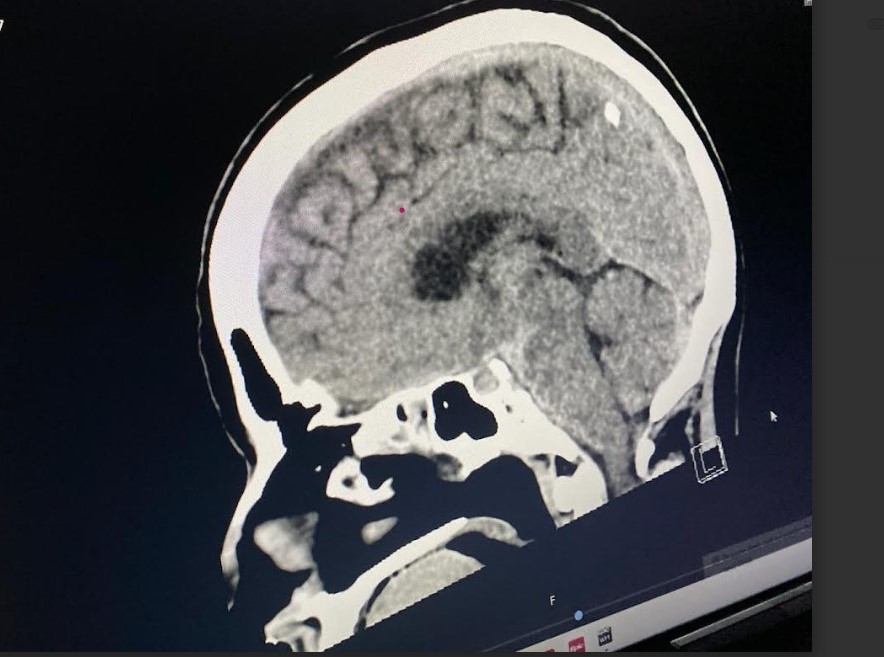
My sister’s brain shortly after the bleed was found.

My little sister and I call her that, not only because she is two years younger, but she is petite, a mere 5”2” (I’m 5’9”). Had we grown up anywhere else but the Rosebud Reservation, most likely she would have been a gymnast, from the time we were little she could do one-handed cartwheels.

And for whatever reason, my sister and I often found ourselves together in trouble for disobeying orders.

She is also funny, fiery, outspoken and force to be reckoned with.

She is the sibling who lived closest to my mom for many years. Once my dad died, she and her husband regularly drove 60 miles to Mission, my mom’s home, to take care of the things that needed done. Eventually, with her husband Bill, my sister moved my mom to a house next door to theirs in Martin, population 937. My brother-in-law died of pancreatic cancer in 2023.

My mom turned 95 on September 21, and my sister arranged the party. She called me on September 5, to tell me the details. She put announcements in the local papers, had recipes pulled so that she could make a white cake, with almond flavoring, a dark chocolate and strawberry cake and there would be ice cream.

Then everything changed.

Around 10 p.m. on September 6, I received the following text from my niece about my sister. “An air ambulance is transporting my mom to Rapid City. They suspect an aneurysm, but they will run tests. Please pray.”

There is a small hospital in Martin, but when there are emergencies, they stabilize the patients and then fly them to a regional medical center in Rapid City, South Dakota.

When the helicopter landed in Rapid, my sister’s older daughter met the emergency crew, and sent a text to the family. “She is very cold, her head and neck hurts. Waiting for the doctor.” My brother and his adult son, an ICU nurse by profession, went to the hospital, too.

“It hurts when she talks and it hurts when we talk,” my niece said.

My second sister, also a nurse, suspected a brain bleed.

The doctor tested her for Covid (she’s had several Covid shots) and meningitis. Negative and negative. They did a lumbar puncture/spinal tap, and the doctor said it “looked like red Kool-Aid.” My sister’s severe headache continued, and more tests were ordered, including neurology – a cerebral angiogram.

She was diagnosed with a subarachnoid hemorrhage. They called it a “thunderclap headache,” which is defined as an extremely painful headache that comes on suddenly, like a clap of thunder. This type of headache has the most intense pain at its onset. People who have had a thunderclap headache often describe as unlike any headache they’ve ever experienced.

Thunderclap headaches strike without any warning and rare, they occur in less than 50 out of 100,000 adults each year. Sometimes there’s no underlying medical cause to them, but other times they’re a sign of very serious underlying conditions that involve bleeding in and around your brain.

It’s important to seek medical attention immediately to rule out life-threatening causes of a thunderclap headache.

Two siblings are in California, one in Wyoming and two in South Dakota. As we waited for text updates from our niece, we googled the different medical terms.

My sister would undergo more tests to determine where the bleed was in the brain. We clung to the doctor’s comment that “blood vessels could heal themselves.”

Over the next week, my sister suffered light sensitivity, leg cramping, severe headaches and went through more procedures. She was put on pain medication.

On September 9, physical therapy came to the ICU and had her stand up.

They did a transcranial Doppler (ultrasound of the head) on September 10, but after two and a half hours, they still hadn’t found what they were looking for. Her pain continued.

September 11, she had another brain scan and was scheduled for a subsequent cerebral angiogram the next day.

Then the neurologist reported “good news” that she had a perimesencephalic nonaneurysmal SAH (Subarachnoid Hemorrhage), which “if you have a brain bleed, it’s the best type to have.”

Regardless of the cause, a SAH is often has a substantial mortality and high morbidity among survivors. Prehospital care is critical and involves triaging the patient with attention to the airway, breathing, and going to a hospital with neurocritical/neurosurgical expertise.

The overall global incidence of aneurysmal SAH was 7.9 per 100,000 person-years. Around the world, Japan and Finland have higher cases of subarachnoid hemorrhage for reasons unknown. In the U.S. it occurs between 10 to 14 out of 100,000 individuals for year.

On September 14, the hospital discharged her. My sister who doesn’t have a dishwasher asked if she could do dishes, And the doctor said “Yes.” That gave everyone in the family hope that she was going to be okay. She was driven the two-hours home by her daughter.

What the medical staff failed to do before discharging her was explain what my sister needed to do for rehab. When they sent her home, she was still in severe pain, her legs were cramping and spasming. She was using a walker. There were no orders about how to best control her pain and the timing for medication. There was no recommendation for how many times she should be getting up or other steps she should be taking to rehabilitate.

My mother’s birthday, which my sister arranged before going into the hospital, went without a hitch. My sister used a walker to briefly see family and then went back to bed.  Every day is a challenge as she tries to deal with the pain. She’s walking more, which helps the cramps in her legs, and also helps the blood drain.

She continues to work on getting back to “normal.”

I can’t speak for my siblings, but for me, I was so scared I was going to lose her.

It reminded me to focus on what I think is important in life, family, friends.  . . .and to be grateful for the people who have helped define who I am.

(Editor’s note: Two months after the brain bleed, my sister continues to improve. She has gone back to work as a bookkeeper at a local motel and the whole family continues to pray for her continued healing.)


Posted in Health | 6 Comments

Inside the Push to Target L.A.’s 45,000 Homeless in the Fight for Votes

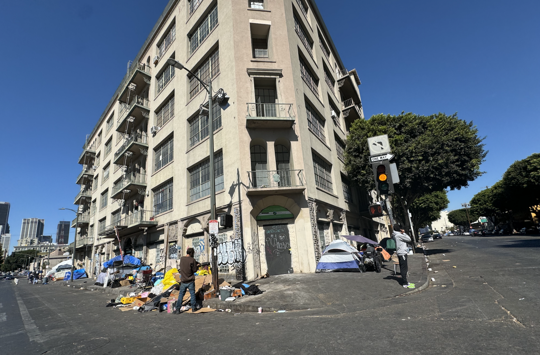
Downtown Skid Row residents have become the targets of voter registration efforts.
Photo: JAMIE PAIGE

(Editor’s note: this ran on Westside Current on November 4, 2024, and is reprinted with permission.)

By JAMIE PAIGE, RACHAEL GAUDIOSI, CHRIS LEGRAS

A homeless man named Robert stood on the corner of 5th and Los Angeles on Skid Row. The city’s noise and the ammonia stench were backdrops as he tried to remember the last few days. He stood among clusters of tents, makeshift shelters, shopping carts, and personal belongings that spilled onto the street. Like many homeless people in Los Angeles, he has difficulty recalling basic details of his life, like where he’d had his last meal, and even where he’d slept last night.

When it comes to more nuanced details, he finds himself at a complete loss, such as whether or not he is registered to vote.

“I think I registered somewhere,” he said, eyes narrowing as he strained to recall the details. He remembered there was a group, someone who seemed willing to help, but little else. “Honestly, I just did it.”

In Los Angeles, where every vote can influence tight political races, a growing number of campaigns have turned to an unexpected community: the city’s 45,000 unhoused residents. This demographic, larger than the population of many other U.S. cities, has become a potential electoral asset amid recent changes that ease voter registrations.

The Westside Current launched a months-long investigation, interviewing over 300 homeless individuals and examining thousands of records. The findings highlight deep-seated confusion among the homeless: many weren’t sure if they were registered, didn’t know where to pick up their ballots, and couldn’t remember how they registered in the first place. The resulting data revealed a system that, while designed for inclusivity, is susceptible to manipulation, raising critical ethical and legal concerns.

Under California law, individuals without a fixed address can register to vote using shelters, the cross-streets where they sleep, or nearby parks and service centers as the address where they live. Consequently, thousands of homeless individuals have registered with unconventional addresses—including locations such as Whole Foods, cannabis dispensaries, jails, and harm reduction centers. While this change aims to give homeless people a voice in local politics, it also creates opportunities for potential exploitation of those who are mentally or emotionally vulnerable.

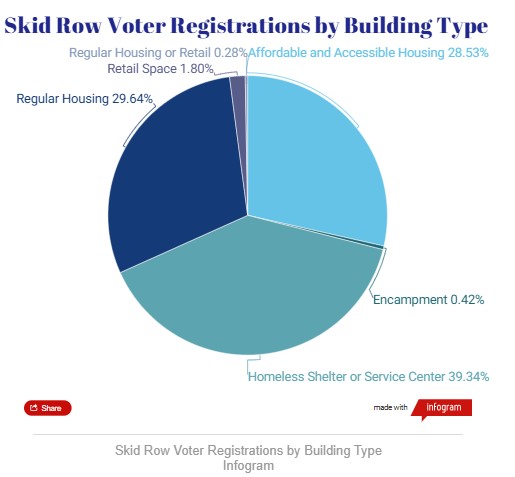
According to Los Angeles County Registrar-Recorder Dean Logan, there are now at least 800 registered voters using intersection addresses and 5,500 more who list shelters or service centers as their addresses.

“They can register to vote, list the cross-street where they spend most of their time, or the shelter they’re staying at, which ensures they get the most localized ballot,” Logan said.
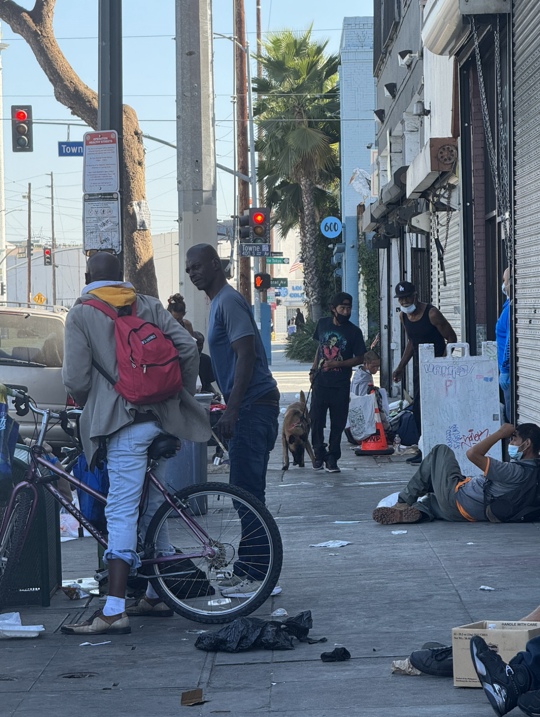
People stand outside a harm reduction center recently listed as a new site where voters have registered.
Photo: JAMIE PAIGE

A Homeless Voting System That’s Ripe for Exploitation

Melba Strouth, a resident of the Cecil Hotel in the Skid Row area, is listed in a voter database as a recently registered voter. However, Strouth expressed uncertainty about how or when she registered, speculating that she may have done it online. Although she has not yet received her ballot, she seemed unconcerned about the delay, explaining, “It takes them a minute to go through the mail at my building.”

At the San Pedro House, a homeless facility at 647 San Pedro Street, where a mandated voter registration meeting was held, a resident insisted she had not registered to vote, despite Los Angeles County records indicating otherwise. When informed of her active registration, she still claimed she hadn’t completed the process and was planning to register soon. Unbeknownst to her, a valid absentee ballot had already been sent in her name to this location.
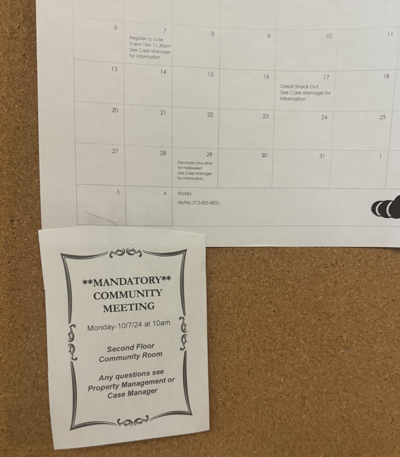
A notice mandating attendance at a voter registration meeting is posted on a building in Skid Row.
Photo: JAMIE PAIGE

Ruth, another resident of a homeless facility just up the street, expressed surprise upon learning she was registered to vote. She noted that she hadn’t received a ballot in the mail, although an information packet had arrived.

Another woman at the 6th Street Place affordable housing facility told us she could not access her mailbox to fill out her absentee ballot because she lost her mailbox key.

Several residents in a dilapidated building on San Pedro Boulevard recalled a recent voter registration drive yet could not identify its organizers. “We were mandated to go,” one resident said. Records indicated that numerous individuals in the building were registered under the same apartment number.  We asked if they were told how, when, and from whom they would get their ballots. They couldn’t answer these questions.

In Santa Monica’s Christine Reed Emerson Park, Rex, a homeless individual from Denver, recounted how he was encouraged to register to vote shortly after arriving in Los Angeles. “They came around and made sure all of us were registered,” he said. However, he did not receive a ballot and did not know where it was sent. He couldn’t recall who organized the drive.

Homeless Voters Increase but Verification Lags

In just the Skid Row area, 259 voters are registered at homeless service centers or nightly shelters. Among these were The Weingart Access Center with 55 voter registrations, The Midnight Mission with 63, The Union Rescue Mission at 23, and The Los Angeles Mission with 53. Only 102 voters included a contact number- 36% were out of service.

At the Downtown Women’s Center, 24 people registered to vote within the last few weeks. Only three of the nine provided phone numbers are currently in service. Two of the numbers we called were owned by different people entirely, with no association to the registered voter whatsoever.

Out of the over 700 Skid Row voter registrations we analyzed, less than half (42%) provided phone numbers associated with their name and address. After eliminating numbers that are currently out of service or invalid, just under 27% of these records have a viable callback number. Our list also contained 13 addresses at probable retail spaces, only one of which included a phone number. It had a full mailbox and we received no return call.

This issue is particularly significant because, according to the Los Angeles County Registrar’s Office, ballot verifications often rely on a simple phone call when irregularities arise—such as non-standard addresses like cross streets, or when a signature doesn’t match the one on file.  If the person can’t be reached the ballot is thrown out or “rejected”, but we will have to wait until after November 5 to uncover statistics on how often this happens.

Along with Skid Row homeless service shelters, affordable housing units also saw an atypical increase in voter registration, bringing in nearly 200 new voters within the last couple viable weeks of voter registration.

In addition, three crisis centers show up on the list of newly registered voters. More than 80 ballots will be mailed to The Corner of Hope Mental Health Service Center, The Volunteers of America Alcohol Services, Los Angeles Centers For Alcohol and Drug Abuse, and The Homeless Health Care Los Angeles Center For Harm Reduction.
What Happens When Ballots Get Delivered to Homeless Voters? 

We asked a Midnight Mission representative, who explained that when ballots arrive, they are held for individuals and placed in their designated mailboxes. If unclaimed, the ballots are sent back to the post office. When asked about the process for verifying the identity of the person receiving the ballot, the representative acknowledged they weren’t certain how that step was handled.

Enter ballot harvesting—where third parties collect and submit ballots on behalf of voters.  Recent changes to the state’s ballot collection rules have added layers of complexity to California’s election process. Before 2013, only disabled or ill voters could designate someone –typically a family or household member– to return their ballots. But in 2016, Assembly Bill 1921 was passed. It allows any individual to collect and return ballots – including paid or volunteer workers for political committees or organizations– as long as they are not compensated per ballot returned.

While the bill aimed to increase voter participation, evidence suggests these changes may also lead to the exploitation of vulnerable populations that struggle to keep track of their registration status and voter mailing address.

Steve Brown, formerly unhoused in Venice, described tactics he witnessed, such as payments of $10 offered for registration. “That’s drug money to someone out here, and they’ll take it, not knowing what it all means,” he said, adding that “they prey on the homeless because they know no one’s going to check.”
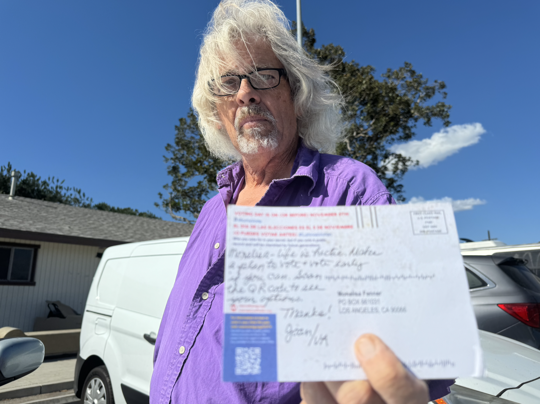
Steve Brown holds his late wife’s voter information. Despite submitting her death certificate multiple times, he has struggled to have her removed from the county’s voter list.                                                                                                                                                             Photo: JAMIE PAIGE 

Brown also expressed frustration with the repeated arrival of his late wife’s ballot, despite numerous attempts to remove her from the voter rolls. “Every time it comes, I feel this deep frustration. She’s gone, and I don’t want her used like this,” he said, adding that his efforts to rectify the issue have been met with bureaucratic roadblocks. “It’s exhausting. I can’t deal with it anymore, especially with politics being what it is.”

A recent arrival from Arizona was interviewed in Venice and told us he was encouraged to register despite planning to stay in the area for only a few days. He described being approached and guided through the entire process by a group who assured him he was eligible to vote in Los Angeles due to his temporary stay. He did not say what address his ballot was being sent to.

Another instance involved a woman living in her van, who said she participated in the registration process for the $10 offered. She recounted how a group approached her, offering to help with registration and to return her completed ballot when it was ready to be mailed. Though she wasn’t entirely clear on the specifics of her eligibility, she went along with the process. “They made it sound like I should do it right then,” she said, noting the group’s persistence in having her agree to complete and return her ballot. Again, she did not say what address her ballot would be sent to, or how she would be contacted to complete it when it arrived.

Previous reports by CBS documented alleged cases of individuals being offered cash or cigarettes in exchange for signatures on ballot documents. While some organizations and advocacy groups genuinely seek to empower homeless voters, the dependency on outside assistance has also opened a door for potential misuse, making Skid Row a focal point in the ongoing battle over ballot security and voter autonomy. In 2020, the Los Angeles County District Attorney’s Office charged four men with participating in that scheme.

When Does Empowerment Become Coercion?

Among the most active groups involved in ballot harvesting efforts in Los Angeles is the Democratic Socialists of America (DSA), which promotes voter engagement as part of its strategy. The DSA’s website provides canvassers with a step-by-step guide to assist voters aligned with their preferred candidates throughout the voting process, often offering to deliver completed ballots directly to election offices to prevent them from “getting lost in the mail or city bureaucracy.”

The guidance from DSA canvassers is thorough: after verifying whether the voter has received their ballot, canvassers often prompt them up to three times to locate and complete it while reinforcing the message that their votes should align with DSA values. Some canvassers even assist with signing and filling out ballots, marking “Volunteer” as their relationship to the voter—a seemingly benign detail but one that raises accountability concerns, mainly when the same volunteer names repeatedly appear on multiple ballots. We asked the county registrar for data on how frequently this occurs in an email that has yet to be returned.

Mimi Kennedy, Advisory Board Chair for Progressive Democrats of America, described these tactics to reach homeless voters as “aggressive canvassing” and called them “wrong.” She underscored that her primary mission has been to secure paper ballots as a standard for election integrity—a cause she has championed since 2002. She noted that responsibility for ballot and election oversight falls not with the County Voter Registration office but with the Sheriff’s Department.

Overall, Voting Security Measures Are Working

Signature verification, initially intended as a safeguard, has introduced its own barriers: over half of the ballots flagged for mismatched signatures in the 2022 state audit were left uncounted, often due to inconsistencies in handwriting among seniors, disabled individuals, and those experiencing homelessness. In the 2022 primaries, the rejection rate for signature discrepancies averaged 0.7%, climbing to 1.01% in the general election, with variations across counties.

In Orange County, Registrar of Voters Bob Page recently outlined their extensive security protocols in response to public concerns. With 85% of voters expected to use mail-in ballots, Orange County has invested $4 million in expanding its sorting and verification capacities.

Signature verifications are carefully matched with public records, and ballots flagged for discrepancies are promptly returned to voters for confirmation. Page emphasized the thoroughness of these measures, aiming to reassure the public amid heightened scrutiny.

Back in Los Angeles, it’s unclear if anything will change to safeguard the votes of the homeless population. Our investigation will continue after the election, as we reconnect with the same individuals to see if they voted, whether their ballots were counted, and if those ballots successfully made it through the process.

“I’m going to see if my wife’s ballot was used. It’s not right. This isn’t right,” said Brown. “I’ll vote. We need to get people the real help they need.”
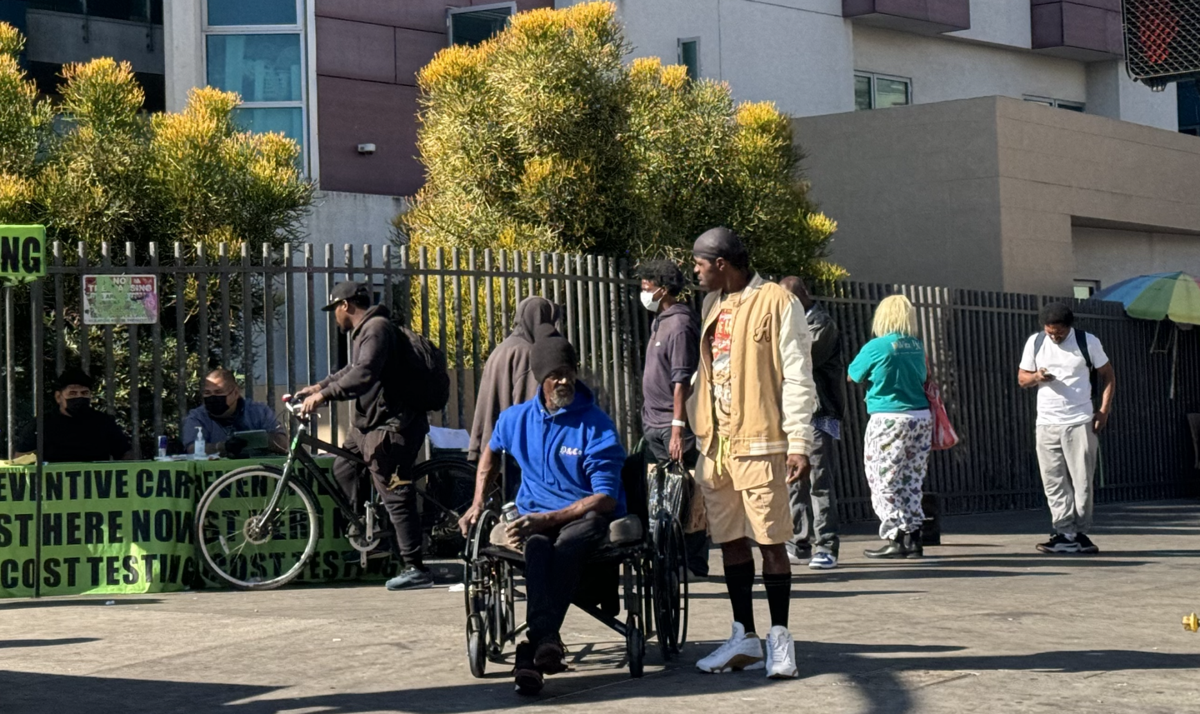
Downtown skid row and the registration of people without an address or phone number have raised issues about being able to authenticate signatures or other information.
Photo: JAIMIE PAIGE


 

Posted in Homelessness | 1 Comment

City Is Paying Settlement Claims for Hoffman vs. City of Los Angeles

Palisades and other Los Angeles residents are receiving checks through a class action lawsuit, Hoffman vs. City of Los Angeles because of sewer litigation.

The City overcharged certain customers of L.A. Sanitation for residential property sewer services (May 4,2016 through June 30, 2022). As part of the Settlement, the City agreed to create a $57.5 million Settlement Fund, to change the way it determines the Dry Winter Compensation Factor. (Editor’s note: this lawsuit does not reflect the current sewer increases that went into effect this fall.) click here.

Payments to authorized claimants began on October 22, 2024. The mailing of all payments will be completed by October 29, 2024.

In August 2017, plaintiffs Adam Hoffman and Samuel Jackson filed a lawsuit against the City, alleging that the city overbilled residential sewer service charges by manipulating what was known as the Dry Winter Compensation Factor (DWCF).

The city’s sewer charge structure is based on volume, but residential properties do not have sewer meters, so sewer bills are based on customers’ incoming water meter readings during the rainy season.

To ensure that customers’ sewer service charges reflect the volume of sewage they generate, and not a greater amount that would be caused by including water used for outdoor irrigation, the city implemented the DWCF, which is applied to the water usage to determine sewage billing.

Hoffman and Jason alleged that the city improperly inflated the DWCF and did not base its calculation correctly, resulting in overcharges. They also maintained an accounting was needed to determine the amounts allegedly overcharged and needed to be given back to ratepayers.

The plaintiffs also alleged that Los Angeles was not complying with some of the requirements of Prop. 218, which was passed by California voters in November 1996 and was designed to constrain local governments’ ability to impose assessments. In June 2021, a judge found that DWCF was “arbitrary and capricious” and that the city had acted in violation of the state constitution.


Posted in Crime/Police, Environmental | 11 Comments

Palibu Chamber Mixer Will Be Held

The next Palibu Chamber Sunset Mixer will be held at the Bruce Lurie Gallery on Via de la Paz. Gallery owner Lurie is on the right.

Palibu, the Malibu Pacific Palisades Chamber of Commerce, announced that the last Sunset Mixer of the Year will be held from 5 to 7 p.m. on Thursday, November 7 at the Bruce Lurie Gallery, at 873 Via de la Paz.

Members and guests are invited to mix and mingle on the patio and inside the gallery in the “old town neighborhood” shopping area along Via de la Paz. Everyone is invited to meet owner Bruce Lurie and enjoy the artwork, while networking with PaliBu Chamber members and other Malibu and Palisades entrepreneurs and business owners.

There will be libations, appetizers and special cookie cakes by Bunce Bakes. Bunce Bakes is a gluten-free, dairy-free, soy-free, nut free, bakery in Malibu. “We never use bleached or refined ingredients or added sugar,” said founder and CEO Alison Bunce.

There is a $20 fee for members and $30 fee for non-members. Questions? Contact Barbara Bruderlin at [email protected] regarding the mixer. To find out more about PaliBu,  click here.

The Bruce Lurie Gallery was established in the early 1980s in New York’s East Village. Lurie has a history of launching emerging artists into the main-stream art scene, including assisting Leo Castelli in showing Jean-Michel Basquiat’s early works. “We were actually the first gallery in Chelsea from 1989 through 2001.

After 9/11, Lurie made a decision to move out of New York. He was in Miami from 2004 to 2008, before relocating to the West Coast.

Lurie’s Gallery focuses on establishing emerging to mid-career artists specializing in cutting edge pop art, street art, abstract minimalism, photography and a wide range of monumental sculptors.

Owner Bruce Lurie also advises clients on acquiring and selling secondary market art collections. The store is open from noon to 6 p.m. Tuesday through Saturday click here.


Posted in General | Leave a comment