Not Content with Fraud and Incompetence, the Homeless Industrial Complex Has Resorted to Extortion

(Editor’s note: This piece was first printed on November 9 in the all aspect report, dubbed occasional & unconventional opinions & investigations. The author is a lawyer, journalist, muckraker and Californian. This is a must read for anyone concerned about the homeless or the homeless spending.)

By CHRISTOPHER LEGRAS

Fifty-five homeless nonprofits organized under GLACH (Greater Los Angeles Coalition on Homelessness)to lobby for the passages of Measure A. As a group, they are now making demands.


When will Angelenos finally say “enough?”

It was probably inevitable. The Los Angeles Times reported today that an organization called the Greater Los Angeles Coalition on Homelessness (GLACH, presumably pronounced like a dry heave) is calling on the City to pay more for interim housing sites operated by scores of “nonprofits.”

GLACH, which represents 55 of those nonprofits click here claims its members aren’t “getting paid for the full cost of the services they provide at the city’s ‘interim’ housing facilities,” and therefore is demanding that the City “significantly” increase how much it spends. Otherwise, the nonprofits may “demobilize” as many as 1,488 beds in 14 facilities. The demand comes at a time when the City faces a severe budget crisis that likely will degrade essential services.

Ladies and gentlemen, this is called extortion. “Nice homeless shelter you have here. It’d be a real shame if anything was to happen to it.”

If there is one thing the Homeless Industrial Complex does not lack, it’s cold, hard cash. Ten years ago, in 2015, the City’s homeless population was 25,686. This year, it’s 45,252, an increase of 76%. Over that same period, the Los Angeles Homeless Services Authority’s (LAHSA) budget grew from $125 million to $875 million, a 700% increase. Many nonprofits have enjoyed similar explosive revenue increases.

A sampling of nonprofits have seen their budgets skyrocket over the last few years:

Weingart Center. 2019: $13.8 million, 2023: $107 million (a 775% increase in four years)

People Assisting the Homeless (PATH). 2018: $47.7 million, 2023: $160 million (a 335% increase in five years)

Venice Family Clinic. 2018: $46 million, 2023: $90.1 million (a 195% increase in five years)

PATH is hiring and looking for applicants to join its work force.                                                   Photo: PATH Website

Nevertheless, Rowan Vansleve, president of the nonprofit Hope The Mission, told the Times that homeless service providers are losing so much money that they may have to curtail services at many sites.

Hope The Mission reported $50 million in revenue in 2022, the last year for which its IRS Form 990 is available. That was up from $7.7 million in 2019, an increase of 650% in three years. The organization’s reported assets grew from $762,254 to $20.3 million, an increase of 2,563%. In that same period, L.A.’s homeless population increased by 18%. Yet they’re out of money?

Overall, the homeless population in the City and County of Los Angeles has roughly doubled in a decade. The budgets of LAHSA and many homeless nonprofits tripled, quadrupled, quintupled, and more in half that time. Now they’re asking for even more, even though County voters just approved another $1 billion per year via Measure A, and are threatening consequences if City officials don’t capitulate. They’re literally saying, “Give us more money, or we’ll start throwing people back onto the streets.”
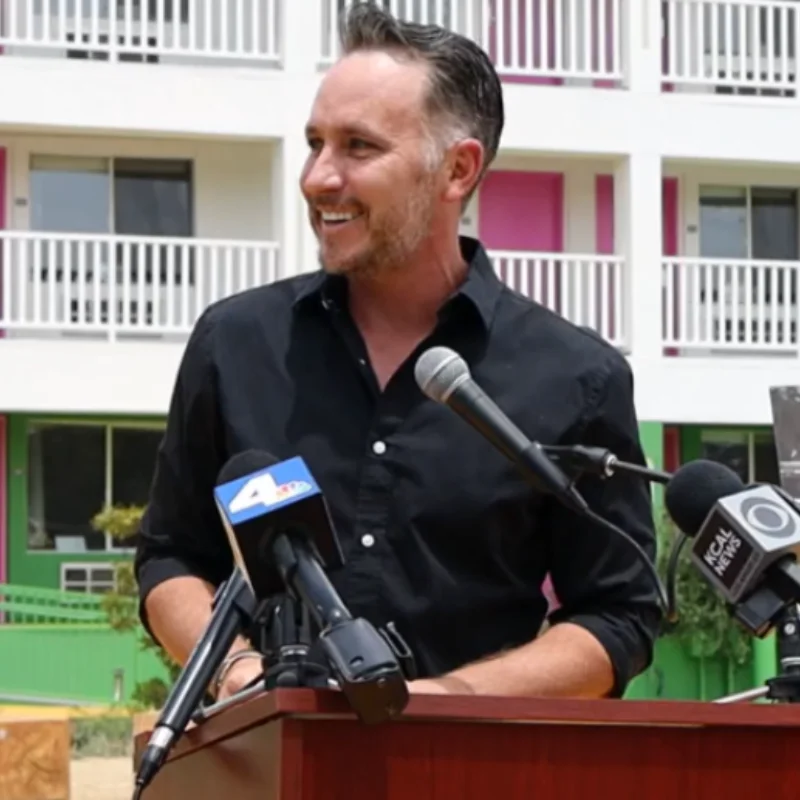
Rowan Vansleve

Vansleve was dire, if not menacing, telling the Times, “This is a clear warning that the homeless services system is on the verge of collapse.” Mind you, in the 2022-23 fiscal year the City of Los Angeles spent $1.3 billion on homelessness. That’s 10% of the City’s total budget, to service 0.12% of the population. Despite that largesse, which doesn’t even include unknowable millions more spent by faith organizations, neighborhood groups, and food banks, as well as countless individual handouts, donations, gifts, and other acts of charity, Vansleve and the rest of the Homeless Industrial Complex want Angelenos to believe the system is “collapsing.”

If these nonprofits really are in such bad financial straits, it’s not for lack of money, it’s a result of mismanagement, fraud, and waste. Interviews conducted with hundreds of homeless people throughout L.A. County by myself and other local journalists leave no doubt that a majority of nonprofits are predatory, fraudulent operations. Services are illusory, support is nonexistent, but the money keeps on flowing.

To offer just one of myriad examples, last summer I captured video of employees from Venice Family Clinic (2023 revenue: $90.1million) distributing hypodermic needles and glass pipes to drug addicts in two Santa Monica public parks.

VFC charges the Los Angeles County Department of Public Health more than $3,000 an hour for the three hour, once a week so-called “harm reduction” program. At no point was anyone offered any sort of support, counseling, or referrals. The employees all but tossed bags of 10 needles at the addicts, who then walked away. In many cases they did not exchange so much as a word.

When I attempted to engage the employees, with my press credentials displayed, they rolled up their windows and literally drove a few feet away, several times. They ignored a Santa Monica police officer’s instructions not to park in a protected bike lane. Overall, as the video plainly shows, their demeanor was best described as cagey. Why?

Maybe it has something to do with the fact that VFC is charging taxpayers more than $3,000 an hour for a program that costs, at the absolute most, a few hundred bucks. VFC pockets the rest. And again, we are supposed to believe there’s a funding crisis?
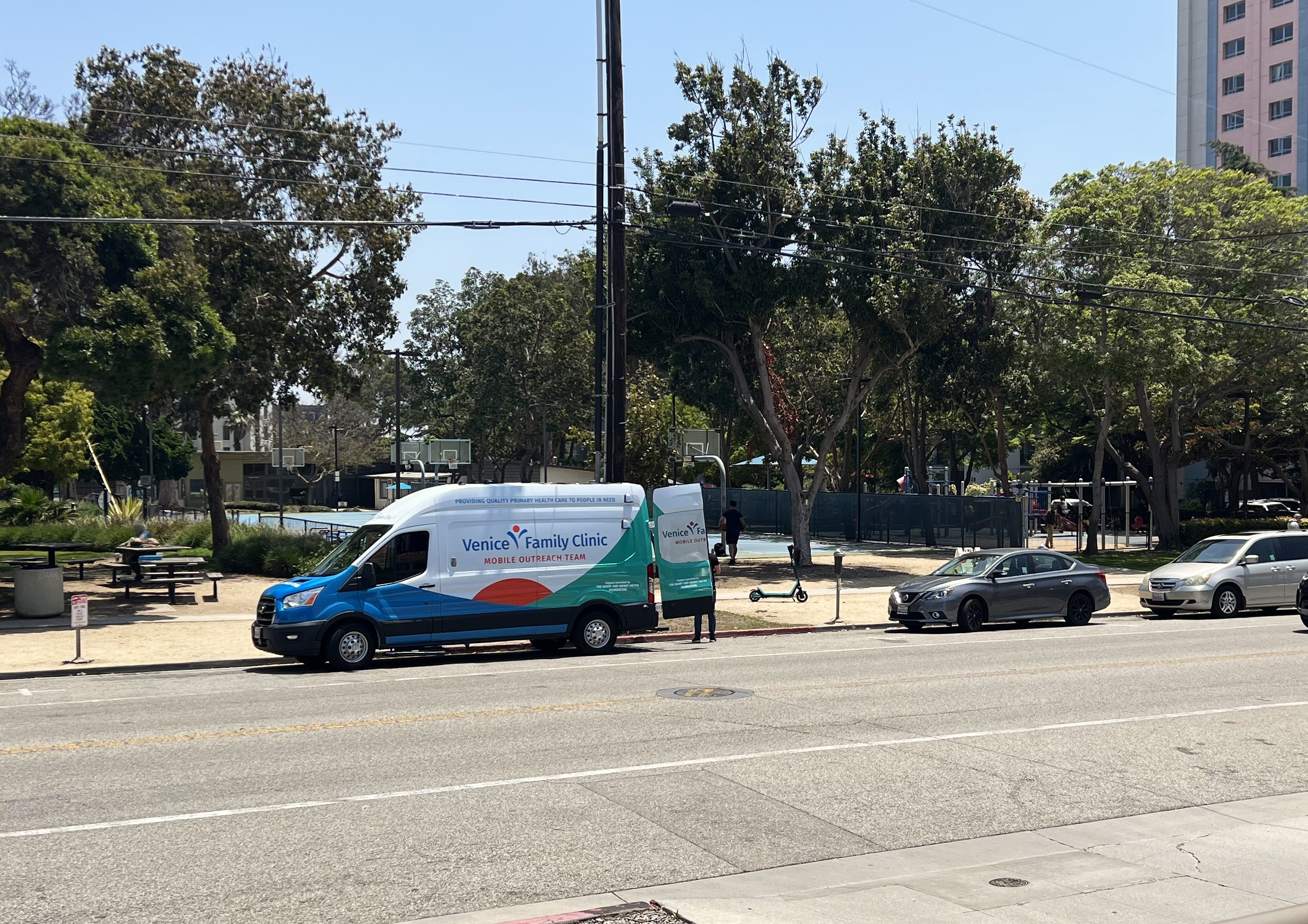
Venice Family Clinic van distributed needles at a Santa Monica Park across from Saint Monica High School and near a children’s playground.

Nothing shady going on here, folks….

Not to be outdone, GLACH’s president, Jerry Jones, is demanding the City increase its payment per shelter bed to $139 per night. For the mathematically inclined, that works out to $4,170 per month. For a cot. Not a room, not an apartment, not “permanent supportive housing” – a cot. You can rent a nice house on the West Side for that kind of money. You can Airbnb a guest cottage in Malibu.

GLACH doesn’t exactly seem like a reliable source. It appears to have been created specifically   for the purpose of campaigning for Measure A. It maintains a skeletal website that reveals nothing about who’s behind it. Also, disgraced former L.A. City Councilman and Homeless Industrial Complex advocate Mike Bonin is among the few people who follow the group’s X/Twitter feed, which is another hint that they aren’t among the good guys.

The basis upon which GLACH makes its $139/night demand is a third party analysis conducted by a Rockland, Maryland, based firm called ABT Associates that was delivered to LAHSA last August (one may reasonably ask why the City and County of Los Angeles, home to UCLA, Cal Tech, USC, Cal Poly, Loyola Marymount, Pepperdine, Occidental, the Claremont Consortium, and myriad research institutes and think tanks like the RAND Corporation and the Milken Institute, all with deep local knowledge, outsourced the job to an outfit in the Old Line State).

All you need to know about the study is on page 18, where the authors report, All survey data was self-reported by the homeless service providers operating the [interim housing] sites” (emphasis mine).

Follow the logic: A coalition of self-interested homeless nonprofits that by all appearances was created specifically to campaign for a ballot measure that will provide billions in new taxpayer dollars to those same nonprofits is engaging in political extortion on behalf of those same nonprofits, justified by a survey that was based on self-reported data from those same nonprofits.

Any questions?

Mayor Karen Bass

You might think City leaders up to and including Mayor Karen Bass would be outraged. You might think they would not only not capitulate to the nonprofits’ threats, but demand far greater transparency, accountability, and results. You might think they’d roll some heads.

If you think these things, you probably don’t live in L.A. With few exceptions the political class’s response to the nonprofits’ demands amounts to a collective, “Meh.”

At a news conference in the San Fernando Valley on Thursday, Bass said, “I will tell you one thing: We have no intention of closing facilities and putting people out on the street. Fortunately, with Measure A, we are not going to have to put people out on the street.” She may as well have been given her talking points by GLACH. It’s entirely possible she was. She could have saved her breath and just said, “uncle.” The Times also quoted Councilmembers Bob Blumenfeld and Monica Rodriguez, who merely expressed concern about how to pay the higher rates.

There’s an old Jewish saying that the definition of “chutzpah” is the young man who murders his parents, then begs for the judge’s and jury’s sympathy because he’s an orphan.

LAHSA, the nonprofits, GLACH, and the rest of the Homeless Industrial Complex certainly have chutzpah. They’ve wasted billions of taxpayer dollars while preying on human misery and suffering, and now they’re crying that they don’t have enough money and all but holding 1,488 homeless people hostage.

When will Angelenos wake up?

When will Los Angeles residents realize that giving nonprofits more money is not the key to helping the homeless.

Posted in City, Homelessness | 2 Comments

Two Private School Hold Classes on Veterans Day

Village School, a tk-6th grade private school was in session on Veterans Day.

Village School and Seven Arrows held school today, despite this being a national holiday, Veterans Day. The holiday celebrates and remembers all who have served in the military, both in wartime and peacetime, living and dead.

A resident and a veteran was asked how he felt and he said, “it was disgraceful that the school was being held on Veterans Day.”

One Seven Arrows parent was asked, and he said, that maybe they teach about Veterans Day in the classroom.  There are numerous veterans in Pacific Palisades and perhaps they are speaking to local classrooms.

But most belong to Ronald Reagan American Legion Post 283, which held a rally at the Santa Monica pier with numerous dignitaries.

Past Legion Commander Lieutenant Colonel Jim Cragg (retired) is heading a “kickoff” of an Alumni Ambassadors Campaign for the American Legion Nationwide to help educate in the classroom.

But for the Vets, who work as teachers, guards and bus drivers at those two schools, they did not have the day off, either.

Village School Head John Evans and Seven Arrows Head Margarita Pagliai were contacted and asked why it was decided to have school, today, on this Federal holiday.

Pagliai returned CTN’s call and explained “We take Veterans Day seriously. We think its important to honor our vets.”  She said that sometimes when there’s a holiday and students have the day off, they don’t understand the importance. She said at school there’s a specific curriculum for each grade and that the kids are made to think about the importance through relatives, such as grandparents, who may have been vets. “We’re working to make the day authentic and real,” she said.

Pagliai welcomed an introduction to Cragg, so they could possibly work on a program for next year.

Evans never responded with the reasoning for keeping Village School open.

President Woodrow Wilson commemorated the first anniversary of the World War I armistice in 1919. It was originally called Armistice Day.

“To us in America, the reflections of Armistice Day will be filled with solemn pride in the heroism of those who died in the country’s service and with gratitude for the victory, both because of the thing from which it has freed us and because of the opportunity it has given America to show her sympathy with peace and justice in the councils of the nations,” he said.

Following World War II and the Korean War in 1954, the word armistice was changed to veterans to honor veterans of all American wars.

The purpose of Memorial Day and Veterans Day is different. Memorial Day is meant to honor all who served and gave their lives for their country.

Severn Arrows Elementary School was held today on Veterans Day.

(Editor’s note: My father, grandfather, several uncles and now my nephew and son have or are serving in the military. I am proud of them. If for any reason California came under attack from a foreign country, this wealthy enclave would be the first to request the military, even though there seems to be disdain by some for the people who choose that career.)

Posted in Schools | 3 Comments

Kesler Wins Class III Northwestern Division with Essay on Freedom

The winner of the national seventh grade essay contest on freedom is from Martin, S.D. , a town of less than 1,000 people.

The American Legion Auxiliary annually sponsors an Americanism essay contest. While visiting in South Dakota, this editor learned of a local youth who won the National Essay Contest for his essay on Freedom. It seemed appropriate to run it for Veterans Day.


What Does Freedom Mean to Me?

By Kesler Brunsch

In America, we have a luxury some people don’t get. And it’s really special. That special thing is called freedom. And to a lot of people, that is something they can only dream about. Freedom lets us take our life into our own hands. It’s really great, and I love it. But what is it? What does it mean to be free?

Well for a lot of different people, in different places, for different reasons, freedom had a different meaning. For some people it’s the freedom to buy and sell things to make a profit. To another, it’s the ability to speak out about what they believe is right and wrong. To someone else, it can mean to get an education and improve their quality of life. Everyone had a different idea of freedom and that’s okay, because with freedom, there is no wrong or right answer.

To me, freedom is the ability to change, and in American, change is important.

Freedom is important. America itself was built upon the idea of freedom. Because when people are leashed and controlled, they become obedient robots to the system, and on one ever grows or improves or changes. But when people are unleashed they are set free.

They begin to grow, learn and expand their horizons and create something amazing, and that thing is – America.

That is why America is so special. It has people from all over the world coming together to create the greatest country on Earth. Sadly, this causes some people to want to take our freedom and have it for themselves, so it has to be protected, and it is. The people who protect it are our friends, family, and people we care about. Except they care about us so much that they fight for us and some of them die. Others are hurt and scarred physically and mentally forever. That is why they deserve to be respected and honored at the very least, because without them, we wouldn’t have freedom

America is an amazing place on earth that allows us to be free. Freedom had a different meaning for everyone and that’s okay. I love being free because it lets me be myself. The reason I have freedom is because of the people who fight for our freedom and I thank them for that. Thank you.

(Kessler in the local paper, the Martin Booster, said that he likes art, drawing, playing guitar, riding his bike and helping is dad out at the ranch. He is 13 and in the seventh grade.)

About the Contest:

Students (grades 3 to 12) explore the fundamental rights and freedoms citizens enjoy today. Each year’s contest has a different theme; one student in each category per division is awarded a prize. There is a category for students with special needs. On the national level, winners receive $50 and a $50 donation in the student’s name will be made to the Children of Warriors National Presidents’ Scholarship fund.

There are six classes: grades 3 and 4 (150-250 words), grades 5 and 6 (250-300 words), grades 7 and 8 (350-400 words), grades 9 and 10 (450-500 words) and grades 11 and 12 (450-500 words). Students with special needs, the essay should correspond to the student’s grade level.click here.

This year’s theme is “What doe America the Beautiful meant to me (regarding veterans and our military)?” Contact Post 283 Auxiliary President Ruth Kahn to see what the deadlines are this year for Unit 283 [email protected]


Posted in General | 1 Comment

Palisades Squeezes Past South East

Max Hejazi scored a touchdown on a pass from Jack Thomas.
Photo: RICH SCHMITT/CTN

The Palisades High School Football team, which is ranked fifth in the LA. City Section Football Division 1, squeaked past the 12th ranked South East Jaguars 35-32 on Friday, November 8.

The Dolphins now will face the fourth-ranked North Hollywood team on November 15. Other results in the bracket was top-ranked Eagle Rock beating Crenshaw (16th) in a nail-biter 8-7. Venice and Westchester were the other Western League teams in this bracket. Venice (3) lost to Franklin (14) 28-17, but Westchester (7) advanced with a win over Huntington Park (10) 44-40.

The Dolphins are now 9-2 for the season with the win, but the first playoff game wasn’t pretty. At the beginning of the season, the Dolphins accumulated large penalties, but the athleticism of the team was able to cover those mistakes.

In this game there were more than 225 penalty yards against Pali, which kept South East in the game.

“That was one of the reasons the game was close,” said Dylen Smith after the game, who emphasized the Dolphins will start working immediately on their upcoming game against North Hollywood.

“It’ll be a physical game, but we’ll be ready for it,” he said.

Pali Quarterback Jack Thomas threw for 227 yards and four touchdowns while Max Hejazi picked up 93 receiving yards and three touchdowns.

Harrison Carter rushed for 101 yards.
Photo: RICH SCHMITT/CTN

On the ground, Harrison Carter rushed for 101 yards, while also picking up 60 receiving yards.

On the game-opening kickoff, Junior Nico Townsley picked up the ball and ran it for 60 yards to score the first touchdown, and kicker Jack Malloy made the PAT. Twenty-seconds in the game, the Dolphins were up 7 to 0.

The Jaguars couldn’t move the ball and had to punt. Pali followed suit and punted.

Then the Dolphins stepped in to help their adversary, in the first of many penalties, the Dolphins gave the Jags 15 yards, which moved the ball the Palisades 34 and two plays later the Jags were on the board with a touchdown. When Palisades went offside on the attempt at the PAT. The Jags took the opportunity to go for the two-point conversion and thanks to Pali, were up 8 to 7.

In their next turn on the field, the Dolphins had a false start, a personal foul and unsportsmanlike conduct, before junior, Lehenry A Solomon, scored the team’s second touchdown.  Malloy kicked the second of his five PATS.

With penalties, the Dolphins had to kick off from their own 25, which meant South East easily moved into field goal position, and at the end of the first quarter the score was 14-11.

The second quarter started well with a pass from Thomas to Hejazi in the endzone to score a touchdown, but. . ..then the penalties against the Dolphins started adding up again and midway through the second quarter, Pali already had given the South East 77 yards. The Jags capitalized on the penalties and scored another touchdown.

Senior Jake Treibatch, once again led in tackles with 9, three solo and six assists.

This game should have been a blowout for Pali but wasn’t because the team accumulated 21 penalties.

Quarterback Jack Thomas continues to be stellar on the field.
Photo: RICH SCHMITT/CTN

Posted in Sports | Leave a comment

Local Veterans Visit Corpus Christi School

Lieutenant Colonel Jim Cragg (retired) took questions from Corpus Christi students.
Photo: RICH SCHMITT

Two local veterans, past Ronald Reagan Post 283 Commander Jim Cragg, and Post member Ranee Rubio, spoke to elementary and middle school students at Corpus Christi on November 9, prior to Veterans Day, which will be held on Monday, November 11.

Lieutenant Colonel Jim Cragg (retired) is heading a “kickoff” of an Alumni Ambassadors Campaign for the American Legion Nationwide.

“Americans have heard the story of the ‘broken Veteran’ for so long that young people associate Veterans with combat trauma, and we need to fix that,” Cragg said. “We need to show the population that Veterans are leaders, team players, and strong members of our communities.”

He said the intention of the Ambassador Campaign “is to encourage Veterans across the country to engage with young people and show them what makes Veterans special in American society.”

Cragg has prepared a presentation, “Who Are Military Veterans?” which is also available for other schools in the area.

He asked if students knew the difference  between Veterans Day and Memorial Day, and then explained that “Memorial Day is a time to remember those who gave their lives for our country, particularly in battle or from wounds they suffered in battle,” and “Veterans Day honors all of those who have served the country in war or peace – dead or alive- although it’s largely intended to thank living veterans for their sacrifices.”

Rubio and Cragg explained that when they were younger, they studied in school, participated in extracurricular activities, made friends and dreamt about the future.

Cragg said the decision to join the military is varied. For some, it is the chance to give back to this country for all the freedoms they had while growing up.

For others, it’s a chance to travel and learn about other cultures, make lifelong friends and learn new skills. Yet, other veterans take advantage of higher education/college, which is paid for by the government.

The different branches of the military include Army, Marine Corps, Navy, Air Force, Space Force and Coast Guard and enlistees can choose from several career options, such as military intelligence, engineer, doctor, food service, cyber systems musician, mechanic, drone pilot, photographer, public affairs, pharmacist and communications.

Space Force was established in December 2019 and was the first new branch of the armed services in 73 years. With the Air Force, it is part of the Department of the Air Force. The Space Force Guardians organize, train and equip personnel in order to protect U.S. and allied interests in space and to provide space capabilities to the joint forces.

Cragg also spoke about the National Guard, which is a group of military members that serve on a part-time basis. Every state and territory has a National Guard. Those members, under the state governor’s command, usually respond to domestic emergencies like natural disasters.

Cragg and Rubio told the students that Veterans share the following core values: 1) loyalty to the U.S. Constitution, one’s unit and other service members, 2) duty to fulfill one’s obligations, 3) respect, 4) selfless service (put the welfare of the Nation, the unit and one’s subordinates before your own), 5) honor, 6) integrity, and 7) personal courage (face fear, danger or adversity, whether physical or moral).

Veteran Ranee Rubio spoke to local students on Friday.
Photo: RICH SCMITT

Posted in Holidays | 1 Comment

“The Outsiders” Opens Tonight, November 7, at Palisades High School

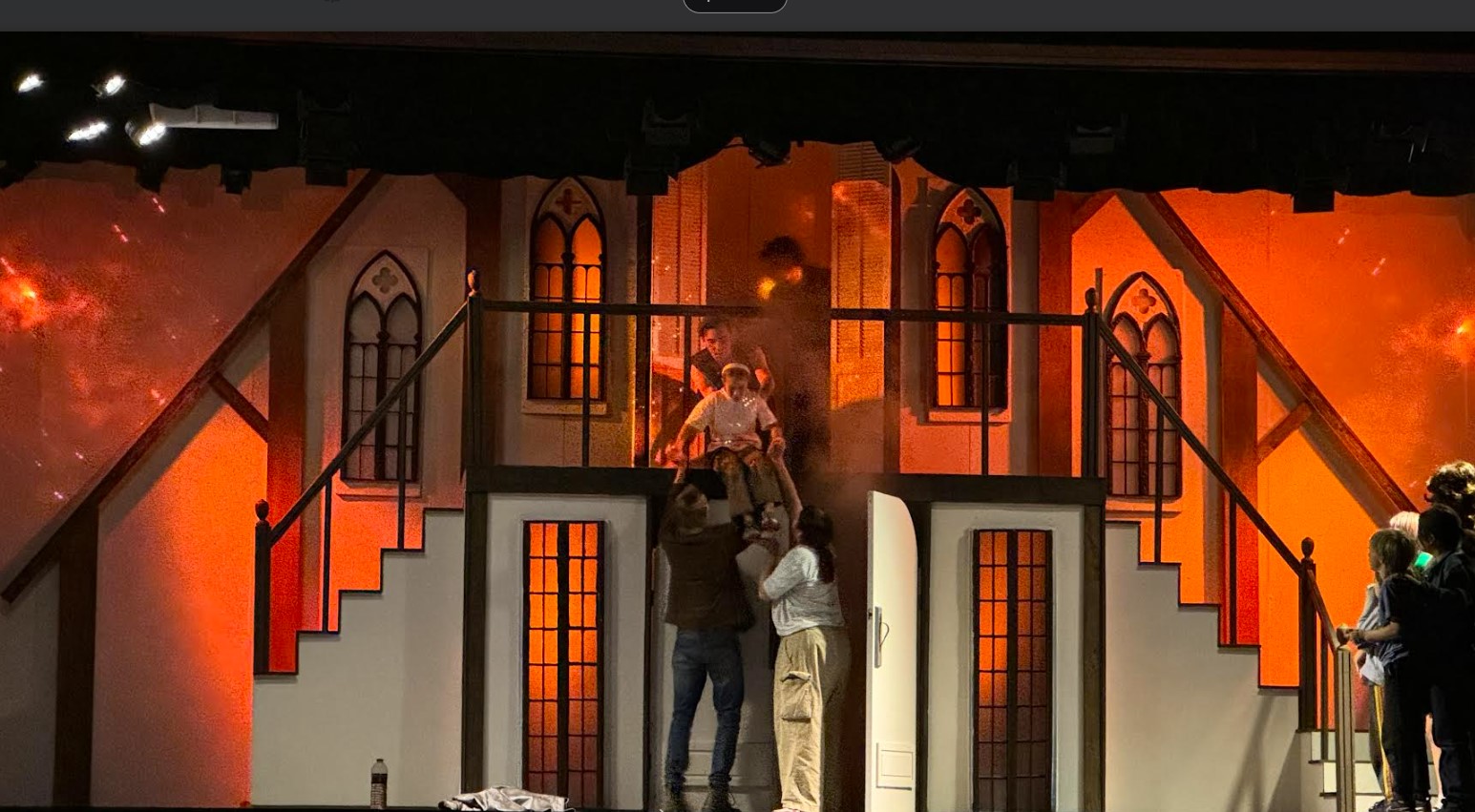
A child is rescued from a fire in the play, The Outsiders, at PaliHi.

Palisades High Schools has an amazing amount of talented actors and it is on display in a play The Outsiders, which opened tonight, Thursday, November 7. The full-length play was adapted by Christopher Serge in the 1976 book by S.E. Hinton.

This is an impressive show, under the direction of Cherie and Monique Smith.

Many of PaliHi’s shows are girl “heavy” just because there are so many fine actresses, but this play gives the males the chance to shine and they do. Ponyboy (Sam Jacobson), Johnny (Jaz Bennassar), Darry (Charlie Rosen), Sodapop (McCoy Rudy), Dallas (Jude Waxman Lee), Two-Bit (Blake Altournian), Steve (Jackson Luul), Billy (Brooks Franco), Bob (Ivan Munn) and Randy (Callum Gantz) are authentic, genuine and audience members feel their pain as they work their way through the unfairness of social labeling/grouping.


Members of the cast of “The Outsiders.”


The book is often assigned in English classes in local schools, and now, is also the winner of 4 Tony Awards on Broadway. (The cast will perform this year in the Macy’s Thanksgiving Day Parade.) Hinton’s message of realizing who you are and finding one’s group, resonates with all ages.

The Outsiders is based in Tulsa, Oklahoma, and centers around a group of teenage boys who are divided into two social and competing groups the Greasers and the Socs. The Greasers are known for fighting, their greasy hair and shoplifting – and are the poor kids who live on the East side of town.

The Socs, short for Socials, is a rival gang of rich, spoiled kids from good families who live on the Westside of Tulsa. They lack discipline and are bullies.

Hinton, who was 16 when she wrote the book wrote, “The characters—Dallas, who wasn’t tough enough; Sodapop, the happy-go-lucky dropout; Bob, the rich kid whose arrogance cost him his life; Ponyboy, the sensitive, green-eyed Greaser who didn’t want to be a hood—they’re all real to me.

“Many of my friends are Greasers, but I’m not. I have friends who are rich, too, but nobody will ever call me a Soc—I’ve seen what money and too much idle time and parental approval can do to people. Cool people mean nothing to me—they’re living behind masks and I’m always wondering ‘Is there a real person underneath?’”

The stage adaptation deals with real people, seen through the eyes of Ponyboy, a Greaser on the wrong side of life, caught up in territorial battles between the have-it-made rich kids—the Socs—and his tough, underprivileged “greaser” family and friends.

While hiding out with his friend Johnny, he recites:

Nature’s first green is gold, Her hardest hue to hold.
Her early leaf’s a flower; But only so an hour.
Then leaf subsides to leaf. So Eden sank to grief,
so dawn goes down to day. Nothing gold can stay.

“Robert Frost wrote it,” Ponyboy tells Johnny. “I always remembered it because I never quite got what he meant by it.”

After saving children from an inferno, Johnny tells Ponyboy “… I’ve been thinking about the poem that guy wrote. He meant you’re gold when you’re a kid, like green. When you’re a kid everything’s new, dawn. It’s just when you get used to everything that it’s day. Like the way you dig sunsets, Pony. That’s gold. Keep it that way. It’s a good way to be.”

There are a few surprises in this production. When children needed to be rescued from a fire, several Palisades Elementary siblings make their stage debut.

This reviewer is always amazed at the set and the adjustments made on a stage that was never designed for plays/musicals. Residents will not be disappointed, and are encouraged to attend just to marvel at the creativity. To see a promo, click here.

The Outsiders will be presented at 7 p.m. on November 8, 9, 14, 15 and 16 in Mercer Hall, 15777 Bowdoin Street. Tickets can be purchased on GoFan.com


Posted in Reviews | 2 Comments

Tickets Available for Exceptional “Nutcracker” Performances


Tiler Peck and Roman Mejia are performing in Westside Ballet’s 2024 Nutcracker.                                          Photo: SARAH MADISION PHOTOGRAPHY

One of the loveliest and most beloved holiday traditions is the Westside Ballet’s Nutcracker. Always magical from the grand Victorian party to the Land of the Sweets, where characters such as the Peppermint Candies and the Marzipan Mirlitons come alive, Westside Ballet’s Nutcracker remains a visual feast that blends both the familiar and the innovative.

This year the production stars New York City Ballet Principals Tiler Peck and Roman Mejia, infusing star power into a cherished tradition. Westside Ballet alumna Tiler Peck is the Sugar Plum Fairy and is joined by fellow NYCB principal Roman Mejia as her Cavalier.

The pairing offers an extraordinary display of talent, echoing the spirit of legendary productions at New York City Ballet. As the magic unfolds on stage, Peck and Mejia’s dynamic artistry promises to make this Nutcracker truly unforgettable.

Tiler Peck performs as the Sugar Plum Fairy.
Photo: SARAH MADISION PHOTOGRAPHY

Additionally, the production has new backdrops and scenic elements designed by Ian Lovell, which  update snow and portal scenes.

Dancing on the Broad Stage will be 125 dancers garbed in 225 different costumes. Anyone who has ever attended this lovely event can attest to the magical and whimsical evening this Nutcracker provides.

And for pure sweetness, look for the talented 12 dancers from Pacific Palisades ages, 10 to 16, who dance in many of the scenes. (Look for a future story about some of the Palisades dancers).

“For generations, so many people have considered our annual Nutcracker performances the start of the Holiday Season and our  2024’s production will be truly world-class,” said Martine Haley, Artistic Director. “It feels fantastic to be back out, supporting the greater Santa Monica community with internationally renowned stars, a live symphony orchestra, and stunning new set designs. Topping last year’s 50th-anniversary production is a major challenge, yet we believe we’ve done just that!”

Westside Ballet of Santa Monica’s The Nutcracker is a living tribute to the legacy of its co-founders, Yvonne Mounsey and Rosemary Valaire, who established the company in 1973, with a mission to bring the highest caliber of classical ballet to Southern California.

Mounsey, who was a principal dancer with the New York City Ballet under George Balanchine, infused the Westside production with the authentic spirit of Balanchine’s choreography. Westside Ballet’s Nutcracker preserves the classic elements of E.T.A. Hoffmann’s “The Nutcracker and the Mouse King” and Marius Petipa’s original staging, while weaving in Balanchine’s iconic style. Mounsey pioneered the role of Center Spanish at New York City Ballet.

The Nutcracker will be held at the Eli and Edythe Broad Stage at the Santa Monica College Performing Arts Center, 1310 11th St, Santa Monica. Tickets are $65 and can be purchased online at westsideballet.com/NutTix

Show Dates and Times:

Saturday, November 30: 1 pm and 5 pm*

Sunday, December 1: 1 pm and 5 pm*

Friday, December 6: 7 pm

Saturday, December 7: 1 pm and 5 pm*

Sunday, December 8: 1 pm and 5 pm*

(*Tiler Peck & Roman Mejia performing.)

Sponsors for the Nutcracker: The Nutcracker production is made possible in part by grants from the City of Santa Monica, Los Angeles County, and the State of California—with past grants from the Rotary Club and a LA County COVID-19 Arts Relief Fund—and from sponsorships from local Santa Monica individuals, businesses, and organizations including  Santa Monica College Public Policy Institute, The Huntley Santa Monica Beach Hotel, Urth Caffe, Morley Builders and LA Philanthropic Committee for the Arts.

Posted in Arts | Leave a comment

What Is It? # 46

This is a French country cherry wood tilt-top table. It has been identified as a Wine Tasting Table that was made around 1880. My wife Daniele and I bought it in Dijon, the capital of Burgundy.  I believe this circular table was used at special wine tasting events hosted by vineyards of the region to display and sample their cellar’s products.

It was kept in the tilt up position between events. The cherry wood probably came from the adjacent southerly province of Rhone, which is a major cherry growing region. Internet ads show a few similar tables that sell for around $2000.

(Editor’s note: Palisades resident Howard Yonet has an interesting collection of curios from around the world and with his permission, Circling the News is publishing one a week. About the collector: Dr. Howard Yonet was born in Brooklyn in 1934 and attended Brooklyn College. He went to Baylor Medical School and then returned to do an internship at Bellevue Hospital. Yonet completed his residency at the Manhattan V.A. and the Montefiore Hospital. During this time he went skiing in Vermont and the Catskills, and while traveling found barns filled with early American pieces. This led to his interest in American Antiques.

In 1965, he married Daniele, who was originally from Nancy, France. During the Vietnam War, Yonet was drafted as a medical officer and stationed in Landstuhl, Germany (1966-1969). This was close to the French border, which meant he and Daniele and could visit her family.

While abroad, the Yonets took weekend trips through France and Italy, purchasing many interesting pieces at flea markets.

The family settled in Pacific Palisades in 1970 and Yonet practiced general radiology until 2006. He continued to acquire antiques and collectables at estate and garage sales and the Salvation Army Store. He also enjoyed looking for collectibles while traveling in Montana, Idaho, Colorado and Massachusetts. Daniele’s family helped add to his collection.)


Posted in What is it? | 1 Comment

Do Poor Choices Cause Homelessness?

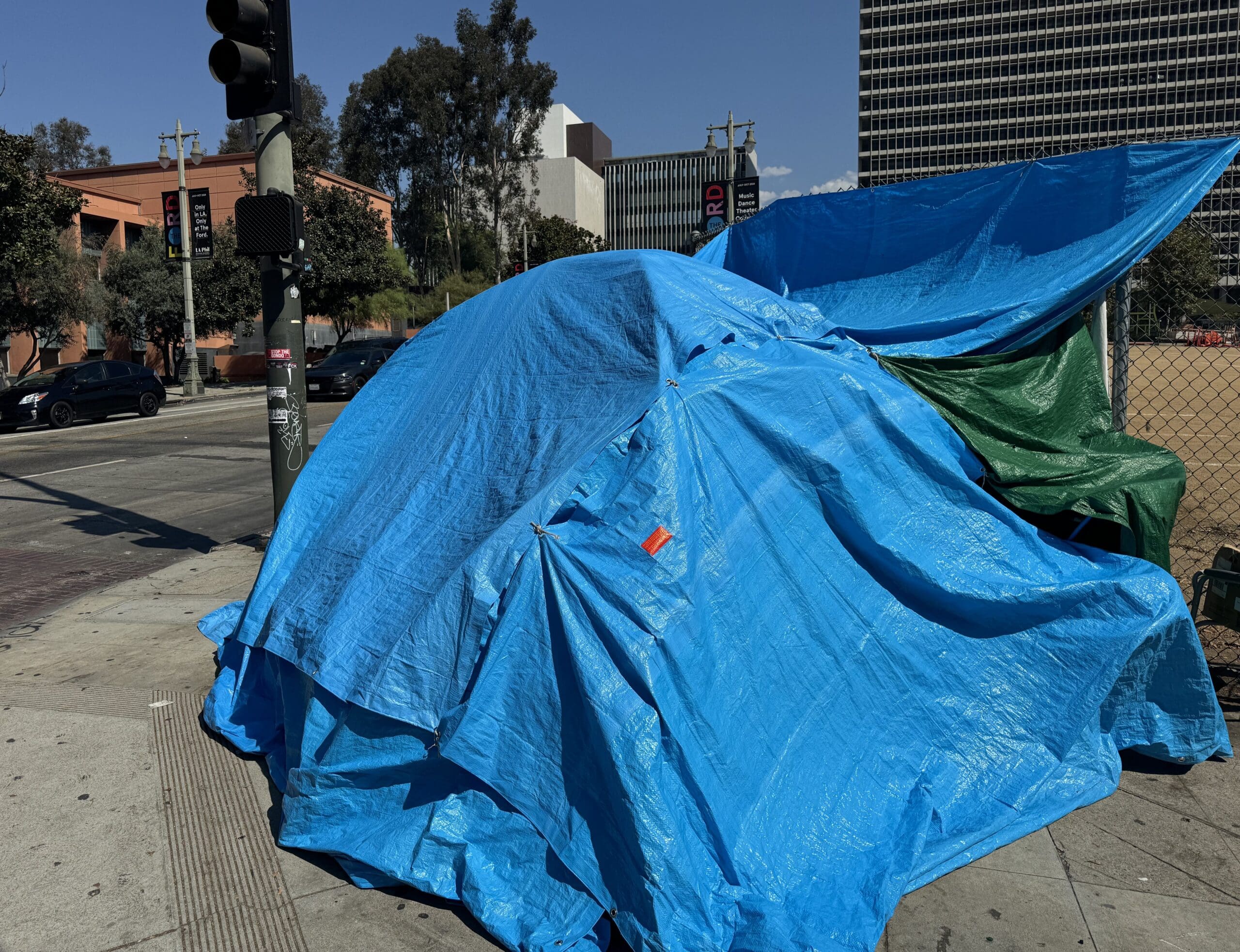
There are numerous homeless who live on the streets downtown near City Hall.

(Editor’s Note: This Article first appeared on November 4, 2024, in CityWatch and is reprinted with its author’s permission.)

By TIM CAMPBELL

This column probably isn’t about what you may think given its title.  It’s not about the life decisions some people make that may result in them becoming homeless.  As I’ve said many times before, people are homeless for a huge number of reasons, and some are not always within their control.

Rather, I am talking about the deliberate, planned decisions made by elected leaders.  Have their decisions, now and in the past, made the homelessness crisis worse? The answer, unfortunately, is an emphatic yes. The worst decision federal, state, and local leaders have made is embracing the Housing First model as a one-size-fits-all solution.  By prioritizing housing before treatment or any other intervention, the City has deliberately chosen the most expensive and time-consuming solution to homelessness, and yet, leaders can’t understand why homelessness hasn’t decreased.

As  Jack Humphreville recently wrote, LA is broke.  The Council adopted a budget based on unrealistic revenue targets (e.g. Measure ULA is generating about half its projected revenue), and unsustainable long-term spending commitments. Many departments have incurred substantial budget reductions as the city tries to achieve the semblance of a balanced budget.

According to the City’s budget detail, $968 million has been set aside for homeless programs in fiscal year 2024-25; while this is a 25 percent reduction from the previous year (mostly driven by Measure HHH and COVID relief money drying up), it is still seven times the amount budgeted in 2016. Recently, the state decided to send the City an additional $160 million from the sixth round of Homeless Housing and Assistance Program (HHAP) grant funding.

Once plugged into the budget, it will bring the City’s total homeless funding to $1.1. billion, slightly less than fiscal year 2023-24. Of the $968 million, at least $117 million is dedicated to acquiring and developing homeless housing ($37.2 million in ULA and $80 million in HHH).  As former City Controller Ron Galperin reported, units cost between $500,00 and $660,000 each, with some approaching $1 million.

There is no statutory requirement for the city to build separate housing units for every homeless person in LA.

Rather, that is a deliberate decision on leadership’s part. That decision causes ripple effects throughout the homelessness system.  Forcing people to wait for housing has burdened Los Angeles with one of the highest rates of unsheltered homelessness in the country.

According to the latest Point In Time (PIT) counts, about 50 percent of the homeless people in San Francisco were unsheltered; in New York, which has a “shelter-forward” policy, it is around five percent. In LA County, unsheltered homelessness exceeds 70 percent of the homeless population.  (For some reason, local leaders saw this as a reason to brag, since it represented a 12.7 percent increase in sheltered homelessness—2,584 more people out of a total population of 75,312).

According to the City Controller’s 2022 report  on the use of Measure HHH funds, only five percent of HHH funding has been designated for interim housing, which is less expensive and quicker to provide than permanent housing.

The report states, “Despite a mounting death toll of unsheltered residents, the City has focused almost exclusively on building supportive housing—typically from the ground up—which is expensive and takes several years to complete”.

Leaving thousands of people unsheltered on the streets increases other costs.

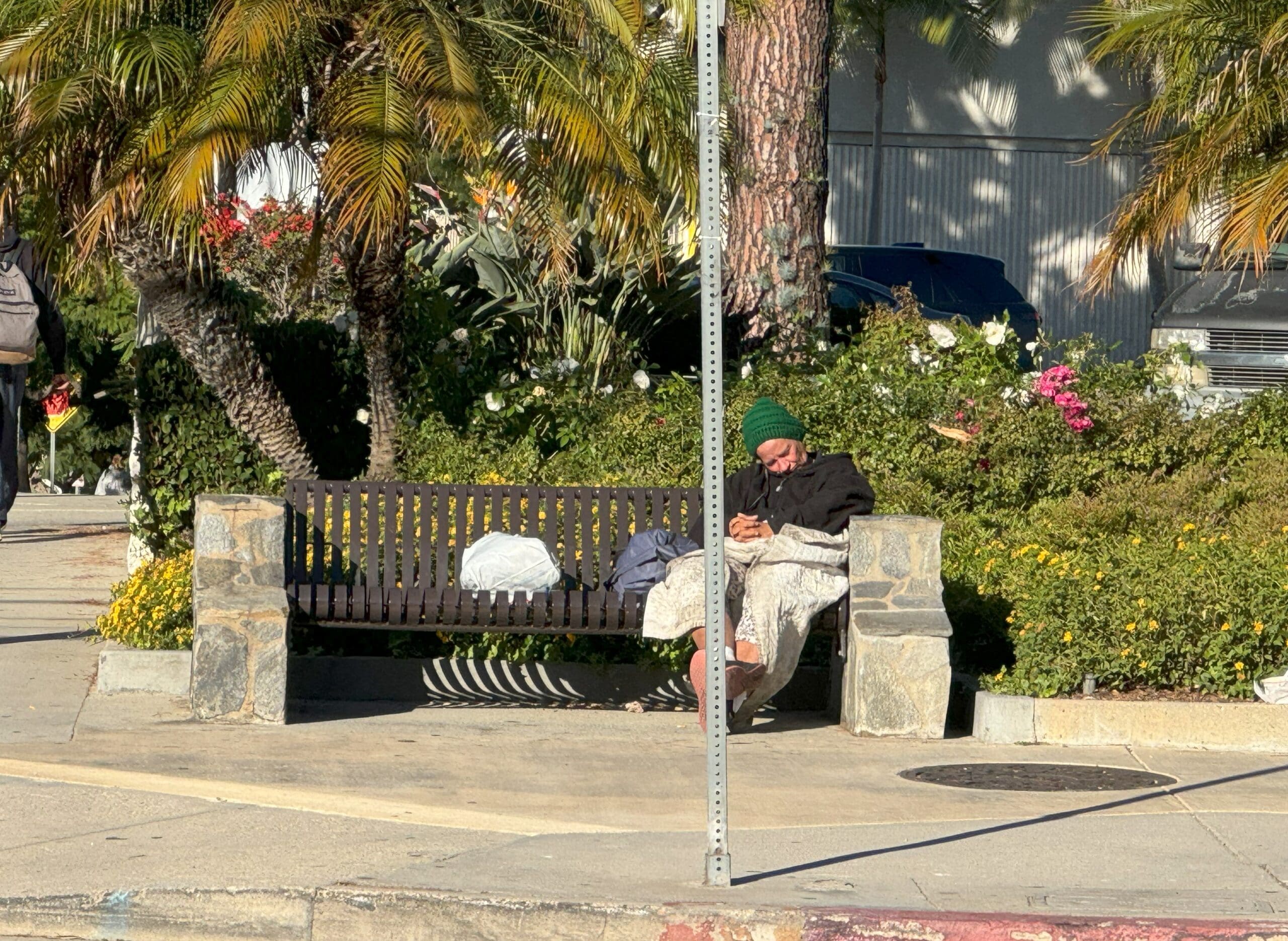
This homeless woman has been living near Via de la Paz. She has been offered help.

According to the City’s budget detail, it spends at least $50 million on CARE and CARE+ encampment clean-ups, even though people often move back the same day.  Because of the dearth of interim and transitional housing, people often wait months for a bed.

Leaving people on the street, many of whom have serious mental health or addiction problems, is both dangerous and costly.   An LA Times article from 2021 reported 54 percent of fire calls were related to homeless encampments. MacArthur Park and its surrounding community have descended into near-chaos as it has become home to open-air drug sales, many of which are made to the homeless people populating the park, and disturbed people roam nearby streets.

The City spends $2 million on street medicine, in addition to the millions the County departments of Public Health and Mental Health, as workers search for and try to treat the unsheltered population.  Because the unsheltered homeless are transient and mobile by their nature, providing consistent care is almost impossible.

The current housing-focused system is expensive, wasteful, and ineffective.  For the hundreds of millions spent, no more than a few thousand people have been housed, and many of them fall back into homelessness due to lack of support services. It is a system that will never meet the needs of more than 75,000 unhoused people.

An effective alternative to new permanent housing construction is the use of temporary buildings like Sprung Structures to quickly build interim shelters, where people can receive centralized and consistent services in a safe, clean environment. In September, I spoke with a representative of the RPM Team, a company that works with Sprung Structures to create temporary housing throughout the country, including the cities of San Diego, San Francsico, and Tracy in California.

RPM provides a wide range of shelter facilities, from simple dorm-style units to complete navigation centers, with separate buildings for client services, showers, kitchens, and meeting spaces. The costs are a fraction of new permanent housing.  The representative estimated the cost for a full-service facility for 125 clients at $3.5 million, or about $28,000 per bed.  Providing new permanent housing for 125 people at $600,000 per unit would cost $75 million, and that does not include services or support facilities. The RPM representative said a new shelter can be up and running in as little as six months, far shorter than the years it takes for new construction.

Properly designed Sprung Structures are a far cry from the “carceral” facilities many advocates condemn.  They can be segregated by gender and familial relationships, and have space for private storage, as well as communal spaces for socializing. Sleeping areas provide some privacy by using partial walls between beds.  Navigation centers contain private offices and treatment space where clients can meet for job counseling, medical exams, and mental health sessions.

Sprung Structures, or any other congregate housing, are not perfect solutions.  At best, they offer semi-private sleeping arrangements, and by their nature, they have to offer structured meal services and shared bathrooms.  Properly staffed and managed, however, they can serve far more people and serve them more consistently than any amount of street outreach.

Advocates have two primary arguments against congregate housing: the lack of privacy and its unpopularity with the unhoused.  To some extent, both arguments have validity.  No congregate shelter can offer 100 percent privacy.  While many provide secure storage of personal items, they are limited in the amount a client can bring into the facility. Surveys have shown that, while many homeless people will accept congregate shelter, they strongly prefer private rooms.

Unfortunately, there are two problems with that preference; as previously noted, it is prohibitively expensive and time-consuming to build, and it can be as isolating as life on the street.  A survey by an advocacy coalition shows 45 percent of people in “Inside Safe” rooms have received no social services of any kind, and 75 percent have never obtained mental health services. Nearly four in 10 don’t know who their case managers are.  People are moved from the streets to a motel room, and then left to their own devices, and in many cases, to fight their own demons without help.

Providing permanent, private housing for every unhoused person is financially irresponsible, unnecessary, and virtually impossible.  The homeless population is neither monolithic nor static.

Many people—as much as 60 percent in some surveys– lift themselves out of homelessness with no assistance; for these, entering the shelter system would actually prolong their homelessness, and unnecessarily burden interim housing availability.

A man is living in his van on Sunset, near Temescal Canyon Park. There is nothing police can do because there are not signs that prohibit long-term parking.

Los Angeles’ homeless population is so much larger than any other city, housing everyone would consume even more money than it does now. Assuming there are no reforms to current programs,  it would cost $20 billion over 10 years to reduce homelessness to “functional zero.”  Of course, that assumes current programs are effective which they are not. Twenty billion dollars would require doubling the $1 billion per year the City spends now, and because current programs have had virtually no effect on homelessness, there is no reason to think the extra money would do any good.

In addition, anywhere between 50 and 65 percent of the unhoused population suffers from untreated mental illness or substance abuse issues and would require consistent treatment and supervision. That burden falls on the County, which we know from auditors reporting to federal Judge David Carter, cannot meet its obligations to the current shelter and housed population. Housing every homeless person would make the situation worse, because the County’s workload would increase astronomically.

As compassionate as it may seem to aspire to provide all homeless people with a home of their own, government has an obligation to use its limited resources to benefit as many people as possible.

Creating private housing units at a cost of more than a half-million dollars each would benefit a small portion of the homeless population; increasing the budget to house everyone would rob equally valuable and necessary programs of funding. On the other hand, creating more temporary and interim shelters would allow some people to stabilize their finances and exit homelessness on their own. Those needing more intensive services could receive them in a stable environment, instead of sending teams randomly searching for clients in the streets.

Of course, this would require a fundamental policy shift among government and provider leaders, many of whom have vested ideological and financial interests in maintaining the status quo. It would also require restructuring of the service system, so providers are held accountable for delivering effective services to their clients.  It would be extraordinarily difficult to make such foundational changes, but the rewards could be life-changing—and life-saving—for thousands of people currently stranded on the streets with no hope for meaningful help.

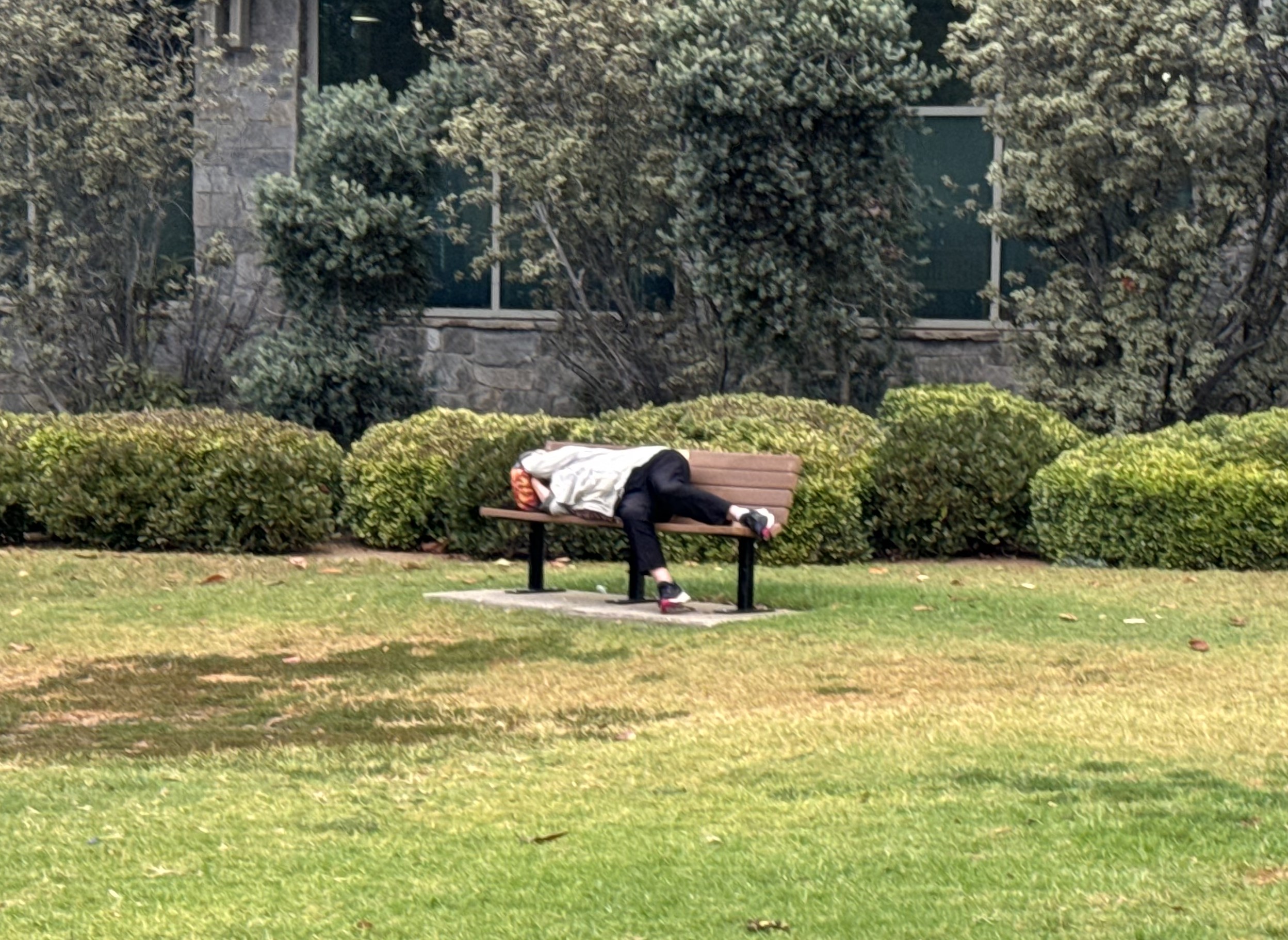
Homeless sometime sleep in the park, so they can use the Palisades Library to charge phone or the Rec Center for bathrooms.

(Tim Campbell is a resident of Westchester who spent a career in the public service and managed a municipal performance audit program.  He focuses on outcomes instead of process.) 

Posted in City, General, Homelessness | Leave a comment

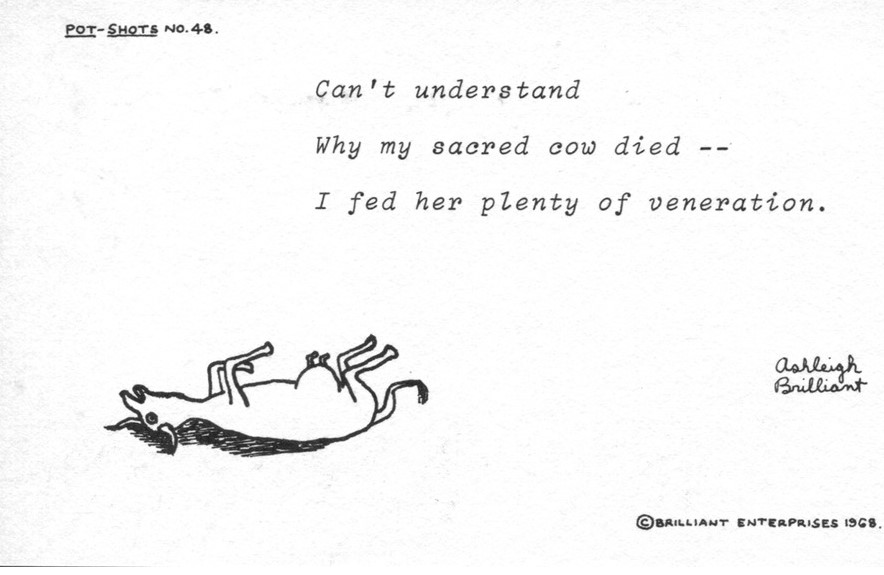
Pot Shot #33

Ashleigh Brilliant writes:

WHAT EXACTLY IS A “POT-SHOT” OR “BRILLIANT THOUGHT?”

Pot-Shots are epigrams, composed according to the following very strict rules.

The length must never exceed 17 English words. Note that this is a maximum. Some Pot-Shots are much shorter. Hyphenated words count as a single word.

Pot-Shots must be easy to translate into other languages. Therefore there can be no use of rhyme or rhythm, idioms, puns, or other word-play.

Pot-Shots should be capable of being appreciated in all times and cultures. Topical and cultural references must be avoided.

Every Pot-Shot should be as different as possible from every other one.

Every Pot-Shot must be totally original, and unlike anything else the author, or anyone else, has ever said before.

The words of a Pot-Shot must be able to stand on their own, and not require any illustration in order to be understood or appreciated.

Whatever is being said should be worth saying and said in the best possible way.

NOTE: These are ideal standards, and I myself have failed to meet some of them occasionally — but in general I have adhered to them quite scrupulously

Posted in Pot-Shot | 1 Comment