Palisades Newcomer Club Seeks Clothing Donations

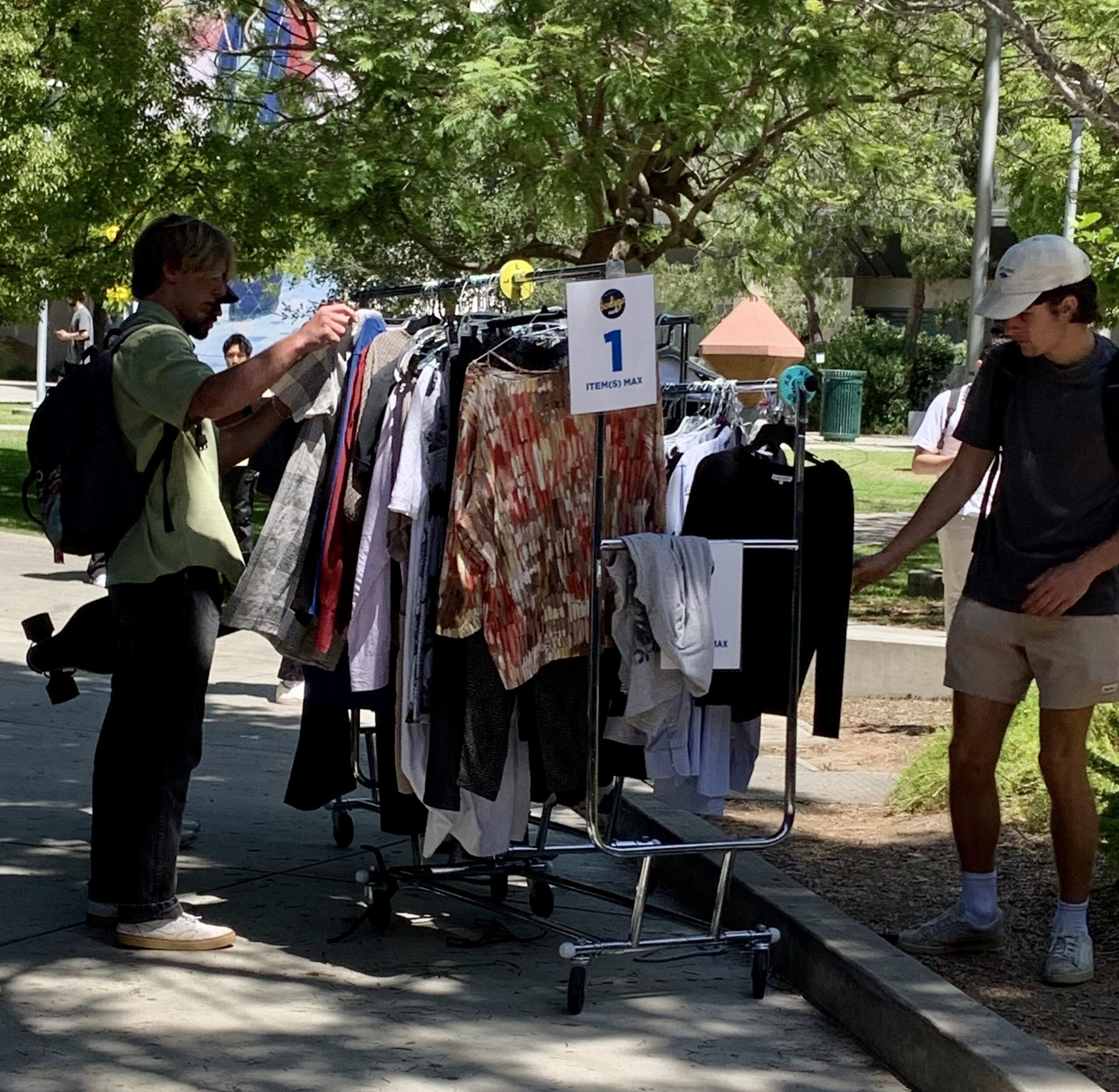
The Palisades Newcomer Club Community Engagement Committee is partnering with BOCA and Laya to help students at Santa Monica College, who may need additional or specific clothing items.

Newcomer’s Peggy Levin said, “Every donation goes directly to SMC Bodega Rack, providing students free access to a collection of curated, gently used clothing to support their personal and professional needs. Your generosity directly translates into degrees, careers, and dreams achieved.”

This clothing drive, “Giving Thanks(giving)” winter clothing drive will supply the Bodega Rack, a store, located at Santa Monica College. Needed are clothing for men and women and included sweaters, jackets, coats, sweatshirts, hoodies and jeans.

On November 9 from 2 to 4 p.m., Friends of the Bodega Rack will be in front of Laya, at 1406 Montana Avenue in Santa Monica, to assist with residents’ donation of gently-used winter clothing.

On November 16 and 17, from 2 to 4 p.m., Friends will be in front of BOCA at 970 Monument in Pacific Palisades to accept donations.

Newcomers, Laya and BOCA agree that real help is needed for nearly three out of five SMC students, who are experiencing basic needs insecurity. To learn more about how to support SMC students, visit foundation.smc.edu. Santa Monica College Foundation is a 501(C)3 Non-profit Organization; Tax Id#95-6047779

Posted in General | Leave a comment

Emergency Airlift from the Mountains

Numerous injured hikers/bikers are airlifted off local trails.

(Editor’s note: This story ran earlier on CTN, and when a reader asked a question about helicopters and airlifts, it seemed appropriate to remind people of the process.)

By SARAH STOCKMAN
Staff Writer
Have you ever gone hiking or mountain biking in our local mountains and witnessed an airlift firsthand? I’ve seen a handful of them and find them pretty amazing to watch, if rather loud. Every time I see one I find myself wondering how the process works, so I contacted the Los Angeles Fire Department and spoke with Captain Tom Kitahata of Station 69 and hoist operator Joel Smith of Station 90 to find out more.

When a distressed hiker or mountain biker in Temescal Canyon, Will Rogers State Park, or Topanga State Park above the Highlands calls 911, the call goes out to either Station 69 or 23 and Air Operations Station 90 in Van Nuys, prompting an immediate response. The air ambulance team at Station 90 jumps into action. “Approximately from the time we get the ring and travel down to the Palisades it’s 7 to 10 minutes,” Joel Smith said.

Simultaneously firefighters from either Station 69 or 23 try to reach the distressed person, even if they’re miles from a road. Six to eight firefighters hike in carrying a rolled plastic stretcher, a backpack with medical supplies, a portable defibrillator, and medications like morphine in case the patient doesn’t want to be or cannot be transported by helicopter.

“The reason we do is that depending on where we are, we might get there faster,” Captain Tom Kitahata said. “Then we’re there to help package the patient.”

By “package,” Kitahata means load the patient onto the gurney and wrap them in plastic to protect them from the wind and the downwash from the chopper as they are hoisted upward.

Two helicopters from Station 90 respond each time. “For any hoist we have a hoist ship and a HELCO [helicopter coordinator] ship,” Smith said. “The HELCO ship flies above and positions itself where it can see the ground.”

This is because the rescue ship can only coordinate with the HELCO ship, so the HELCO’s job is to see the victim and relay messages between the ground team and the other helicopter.

Although the Air Ops team responds to every 911 call, not every patient is airlifted.
“We typically airlift individuals if they are unable to walk out on their own power or they have become stranded in locations that are too dangerous to attempt to walk out,” Public Information Director for the LAFD Peter Sanders said.

Some people opt not to be airlifted to a hospital. “It depends on the severity of the injuries and illness,” Smith said. “Some people don’t want be lifted.”

The types of injuries Stations 69, 23 and 90 respond to vary. “We go on quite a few mountain-bike crashes and also for dehydration issues [in the summertime],” Kitahata said.

Smith says they have rescued people for all manner of reasons. “From my experience, there is a little bit of everything,” he said. “We go on a lot of lost-hiker calls.”

Adverse weather is the biggest hindrance to the helicopter rescues, especially fog. “We can’t do hoist operations if we’re flying in the clouds,” Smith said. “We have to see the victim on the ground.”

If the victim is airlifted, they are flown to a local hospital. “Any of the area hospitals are within five minutes,” Smith said.

Kitahata says the most common one is UCLA’s Ronald Reagan Medical Center in Westwood because it has a trauma center and a good helicopter landing pad. Ideally if the patient needs to be transported to a hospital they are taken by the helicopter because Los Angeles traffic can be a hindrance to ground ambulances. If a patient is airlifted to a hospital it costs as much as an ambulance ride.

“We do not charge the public to airlift them,” Sanders said. “However, if they are transported to the hospital via helicopter they receive a bill similar to one they would receive if they were transported by ground ambulance.”

Posted in Accidents/Fires | 1 Comment

Attention Artists! Art Show November 16

The Palisades Art Association is hosting a Juried Art Show on Saturday, November 16. Artists, who specialize in all art forms, are welcome to participate. There will be a $10 fee for each artwork submitted and artists may submit up to three pieces.

Drop off is between 9:30 and 10:30 a.m. at the Palisades Branch Library community room, 861 Alma Real Drive.

A reception will be held at 1:30 p.m. and awards will be announced at 2 p.m. Takedown is 3 p.m. This is an excellent opportunity to view work by local artists. https://www.pacificpalisadesartassociation.com/

Posted in Arts | Leave a comment

Pali Elementary Halloween Parade Displays Clever Costumes

It appears that “dinosaurs” are not extinct.
Photo: RICH SCHMITT/CTN

On Halloween, many elementary school students cannot contain the excitement of the day to concentrate in the classroom. The idea of “trick-or-treating” seems to take priority over anything a teacher might be trying to present.

Luckily, Palisades Charter Elementary has found a way to channel the excitement. The entire school meets the morning of Halloween on the yard and a parade of costumes takes place.

The school’s principal, Juliet Herman, welcomed photographer Rich Schmitt to capture the excitement of students in Transitional through fifth grade.

Everyone was excited during the Palisades Halloween parade on Thursday morning.
Photo: RICH SCHMITT/CTN

Palisades Elementary has about 425 students and is one of the top elementary schools in the state of California. It is ranked 8 out of 10 by Great Schools. Its test scores are far above the state average with 77 percent of students performing at or above grade level in English and 72 percent of students scoring similarly in math.

Parents through P.E.P. (Palisades Enrichment Programs) raise money for the school, art (computer animations, drawing, sketching, graphics, painting), computers, performance arts, physical education, Spanish and music (choir, instrumental music and vocal lessons) are extras provided.

According to U.S. News, Pali is #22 out of all LAUSD elementary schools, #41 out of all California Charter Schools and #436 in California Elementary Schools.

After marching around to display costumes, these girls sat to watch others.
Photo: RICH SCHMITT/CTN

Posted in Schools | Leave a comment

Daylight Saving Time Ends November 3

Daylight Savings time ends at 2 a.m. on Sunday, November 3. Clocks in California and in most of the United States will “fall back” an hour. hour.

One resident wrote, “Didn’t we in California vote not to turn clocks back?”

In 2018, California voters overwhelmingly approved Proposition 7, which would have permanently adopted daylight savings time.

The way Proposition 7 was written, meant it also had to be passed by the state legislature (Assembly and Senate).  It did not, because the legislative session ended before it was voted on.

Even if California legislature had passed it, the final approval would still have to come from the U.S. Congress.

But, Arizona and Hawaii do not observe daylight savings time and do not change clocks twice a year. Federal law allows a state to exempt itself from DST.

If California voters had passed a bill in the state Legislature that says this state would go on standard time year-round, there would be no requirement for U.S. Congress to give approval.

In March of last year, the U.S. Senate passed the “Sunshine Protection Act,” which would have made daylight savings time permanent in the U.S.

The bill died in the House of Representatives because there was a disagreement over whether it should be permanently daylight-saving time or standard time.

The disagreements were based on geographical location, not party affiliation. Those in tourism areas generally favored DST, those in rural farming locations favored standard time.

Groups such as the American Academy of Sleep Medicine and the National Sleep Foundation, preferred permanent standard time.

In March 2024, U.S. Senator Marco Rubio reintroduced the Sunshine Protection act to make DST permanent. The bill would require approval from the Senate and the House, and the president’s signature. “We’re ‘springing forward’ but should have never ‘fallen back.’ My Sunshine Protection Act would end this stupid practice of changing our clocks back and forth.” Rubio said.

His 2022 bill was passed by the Senate, but the House never voted on it.

Daylight saving time was first observed by the United States in 1918 and has been implemented and repealed in the last 100 years.  It was created primarily to reduce energy consumption and promote commerce.

The Uniform Time Act of 1966 established the current system of biannual clock changes between standard time and daylight-saving time.

President Nixon signed a bill in 1974 to make daylight saving time permanent for two years as a way to address the nationwide gas shortage.

President Ford signed legislation only nine months later that reinstated the switching of the clocks. His move was based on public approval.

A May 2024 YouGov poll found 58% of Democrats and 63% of Republicans support making daylight saving time permanent. Of those who supported locking the clocks in a 2022 Monmouth University poll, 44% preferred permanent daylight saving time (the time we observe from March to November).


Posted in News | Leave a comment

Halloween Carnival “Frighteningly” Successful

Angry Birds were among the guests at the Marquez festival.
Photo: RICH SCHMITT/CTN

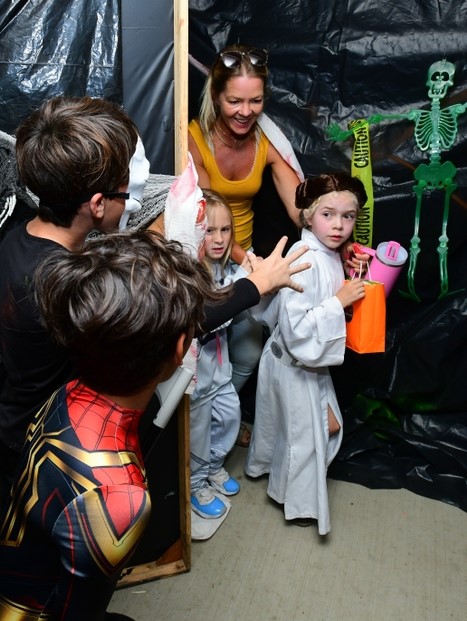
Many children and adults had a chance to try out their Halloween costumes early at the Marquez Halloween Festival.

This annual event, which was open to the public, was held October 20 at Marquez Elementary Charter School. Entry to the event was free, but tickets were needed for the carnival games, the haunted house and the food.

Each class sponsored a booth, such as the lollipop pull, the duck pond and graveyard golf. There were inflatables, a dunk tank and a Sports Zone Camp, filled with lots of balls and balloons.

There was something for everyone at the Marquez Halloween Carnival.
Photo RICH SCHMITT/CTN

Once again, the fifth grade created a perfectly scary haunted house – “Enter, if you dare.”

There were performances by Fancy Feet Dance Studio, the Palisades Dance Studio, Gerry Blanck’s Martial Arts Center and the Tae Ryong Taekwondo School.

There was a special performance by Palisadian singer/songwriter Matty Gottesman.

All money raised from the event will be used to support the Friends of Marquez, the parent-run nonprofit that funds supplemental educational programs to enrich the curriculum offered to all students at this elementary school.

Principal Dr. LaTanya Reeves oversees the school that is ranked in the top 5% for overall test scores for all elementary schools in California. The school is ranked in the top 10 percent for both math and reading proficiency.

Marquez fifth graders crafted a haunted house for younger students to bravely walk through.
Photo: RICH SCHMITT/CTN


Posted in General | Leave a comment

What Is It? # 45

With a four-day pass from Landstuhl Army Hospital, where I was stationed, my wife Daniele and I drove about 150 miles to the Burgundy (Bourgogne) province of France in the late fall of 1968 to sightsee and to taste the new wines of the season.

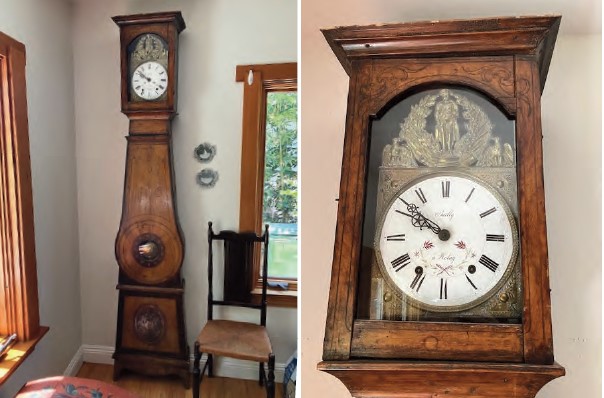
We drove through Dijon; the capital city of Burgundy and spotted a brocante (a semi junk dealer). In his barn was this old pine artistically stained and decorated country French grandfathers clock covered with dust.

Its rounded bulge in the middle accommodates the long pendulum swing. The clock was originally powered by heavy weights and a chain pulley system. Surrounding the face of the clock is the figure of Napoleon embossed in bronze. His hand is tucked into his shirt.

Therefore, I think this clock was made sometime after 1825. On the enamel face is painted “Bailley a Nolay” which is the name of the clock maker located in Nolay, a charming medieval town on the outskirts of Beaune. These towns are prosperous and beautiful due mainly to the wine business and tourism.

Bailley was a successful clock maker until the late 1800’s when their old mechanisms were outmoded by more precise spring clocks from Switzerland and Germany. Bailly went out of business around 1875.


(Editor’s note: Palisades resident Howard Yonet has an interesting collection of curios from around the world and with his permission, Circling the News is publishing one a week. About the collector: Dr. Howard Yonet was born in Brooklyn in 1934 and attended Brooklyn College. He went to Baylor Medical School and then returned to do an internship at Bellevue Hospital. Yonet completed his residency at the Manhattan V.A. and the Montefiore Hospital. During this time he went skiing in Vermont and the Catskills, and while traveling found barns filled with early American pieces. This led to his interest in American Antiques.

In 1965, he married Daniele, who was originally from Nancy, France. During the Vietnam War, Yonet was drafted as a medical officer and stationed in Landstuhl, Germany (1966-1969). This was close to the French border, which meant he and Daniele and could visit her family.

While abroad, the Yonets took weekend trips through France and Italy, purchasing many interesting pieces at flea markets.

The family settled in Pacific Palisades in 1970 and Yonet practiced general radiology until 2006. He continued to acquire antiques and collectables at estate and garage sales and the Salvation Army Store. He also enjoyed looking for collectibles while traveling in Montana, Idaho, Colorado and Massachusetts. Daniele’s family helped add to his collection.)


Posted in What is it? | 1 Comment

George Wolfberg Park Wins Award

George Wolfberg Park at Potrero

Three urban parks, including George Wolfberg Park in Potrero Canyon, were presented with the Chairman’s Award at Los Angeles Business Council’s 54th Architectural Awards held on October 18 at the Beverly Hilton.

“This year’s honorees reflect how architecture can build vibrant, inclusive spaces that serve the public good,” said Los Angeles Business Council (LABC) President Mary Leslie. “From reimagined parks like George Wolfberg Park to other projects across the city, these designs foster progress and enhance community life.”

The three parks to receive awards were: The Wishing Tree Park, The Port of Los Angeles Wilmington Waterfront Park and Wolfberg.
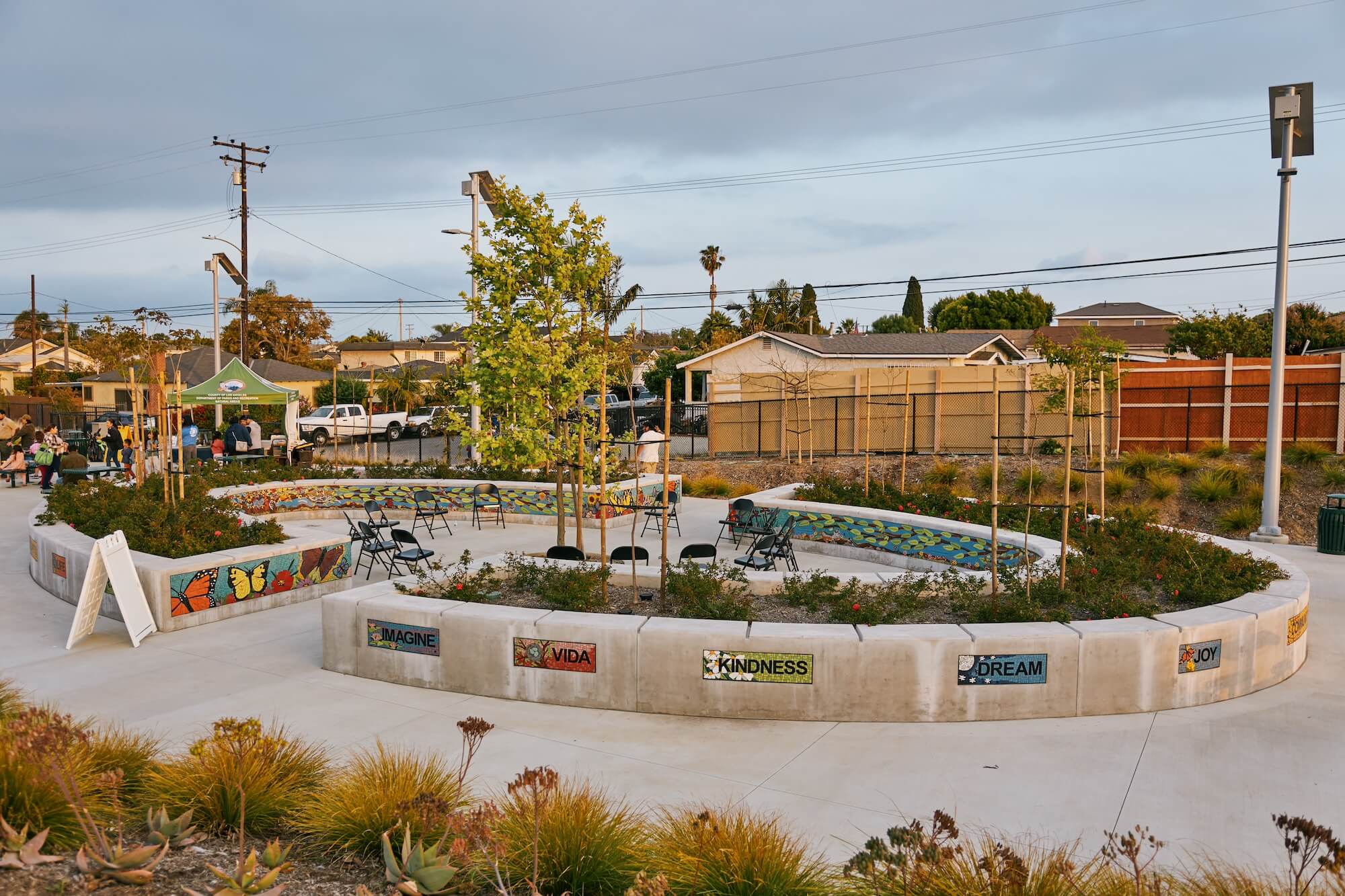
Wishing Tree Park

The Wishing Tree Park transformed a superfund site into an 8.5-acre park in the underserved neighborhood of West Carson: the landscape architect was MIG.

The Wilmington Waterfront Promenade offers an upland, bluff, tidal steps and a play area in a highly industrial area: the lead landscape architect was Sasaki.
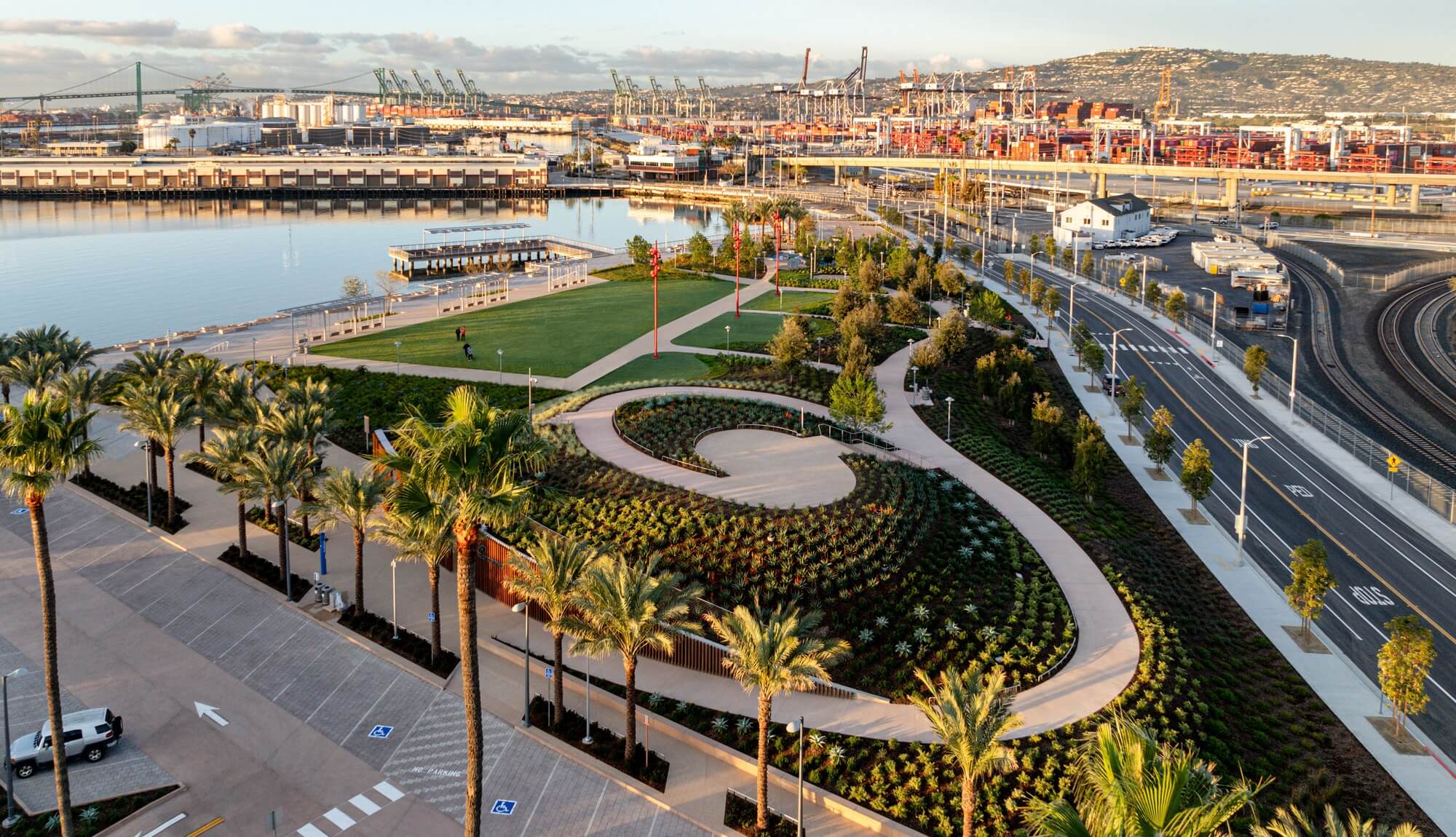
Wilmington Waterfront Park

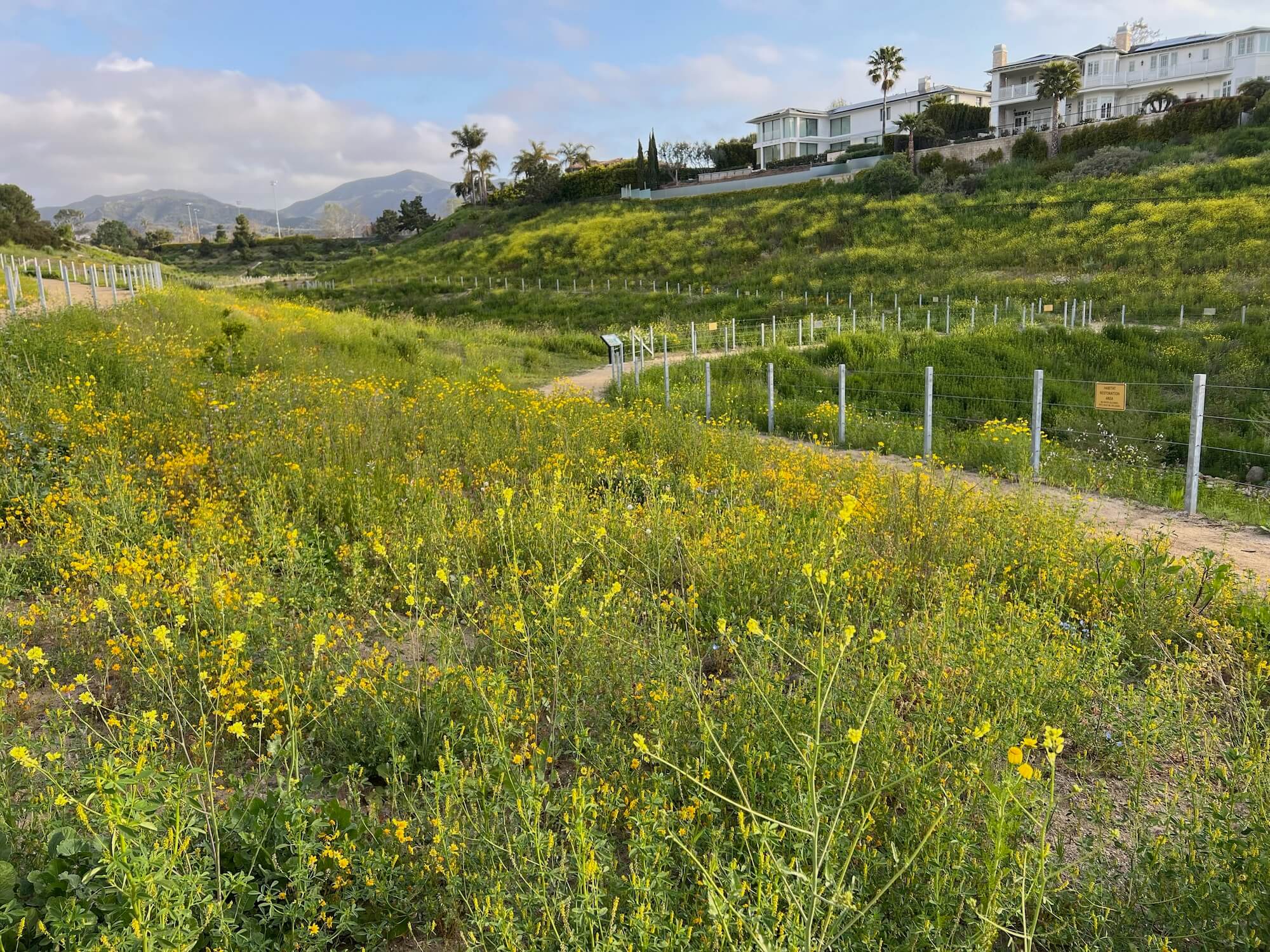
Wolfberg Park was recognized because it spans 46 acres of steep slopes along the coastline of Pacific Palisades and the unstable slopes of Potrero Canyon needed to be stabilized.

To accomplish that, the team buttressed infill at a 2:1 slope and simultaneously restored a natural habitat. A new drainage system was installed with natural tan colored terrace drains as well as a pump station and storm drain that control water in canyon. The landscape architect was the City of L.A. Architectural Division, which collaborated with Marrs Services to design the park.

“These exemplary projects,” said LABC Chair David Nahai, “reflect the bold vision and determined teamwork of residents, civic organizations, and government leaders to enhance their communities by creating vibrant greenspaces.”

Community Impact Awards went to the Culver Studios (architect: Gensler),  Television City (architect: RIOS), Radford Studio City (architect: Som), Sunset Glenoaks Studios (architect Bastien and Associates), FOX Future  (architect: RIOS), Echelon Studios (architect: RIOS) and Sylmar Studios (architect Ware Malcomb & CMS architects).

Other awards also included the categories of retail/restaurants, housing, mixed used and education projects, such as LAUSD Cleveland High School Modernization, architect PBWS. (To view the award winners, https://labusinesscouncil.org/54th-architectural-awards/)

The Grand Prize Award went to the Netflix Egyptian Theatre, with architect of record Studio 440 Architecture and architect Gensler.

Opened in 1922, the Egyptian hosted the world’s first movie premiere, introduced the red carpet, and became an icon of Hollywood’s Golden Age. Later declared a historical landmark, the venue fell into disrepair until the American Cinematheque renovated and reopened it in 1998.

In 2020, Netflix purchased the Egyptian and partnered with the American Cinematheque to restore the theater’s original design and grandeur, retrofit the building’s structure, and install state-of-the-art projection and audio technology. Studio 440 Architecture and Gensler led the design and contracted EverGreene Architectural Arts for the two-year project.

EverGreene investigated and did a microscopic analysis of the existing interior finishes in the Egyptian Theatre. Once that was done, the company started the actual conservation and restoration.

According to the L.A. Business Council, “Treatments included conserving, repairing, and/or recreating flat and decorative plaster elements; prepping surfaces for refinishing; painting flat surfaces and reinstating decorative stencils and patterns; restoration and/or refinishing of some doors and windows; restoring and/or replacing some exterior tiles; and restoring and/or replicating certain metal elements.

The Egyptian reopened in late 2023.

Posted in Parks | 3 Comments

Pot Shot #32

Ashleigh Brilliant writes:

WHAT EXACTLY IS A “POT-SHOT” OR “BRILLIANT THOUGHT?”

Pot-Shots are epigrams, composed according to the following very strict rules.

The length must never exceed 17 English words. Note that this is a maximum. Some Pot-Shots are much shorter. Hyphenated words count as a single word.

Pot-Shots must be easy to translate into other languages. Therefore there can be no use of rhyme or rhythm, idioms, puns, or other word-play.

Pot-Shots should be capable of being appreciated in all times and cultures. Topical and cultural references must be avoided.

Every Pot-Shot should be as different as possible from every other one.

Every Pot-Shot must be totally original, and unlike anything else the author, or anyone else, has ever said before.

The words of a Pot-Shot must be able to stand on their own, and not require any illustration in order to be understood or appreciated.

Whatever is being said should be worth saying and said in the best possible way.

NOTE: These are ideal standards, and I myself have failed to meet some of them occasionally — but in general I have adhered to them quite scrupulously.


Posted in Pot-Shot | Leave a comment

It Smells Bad: Blame Dying Plankton

The dying plankton in the ocean is causing the “stink” smelled along portions of the Southern California Coast.

An offensive odor that some liken to a sewer smell has been permeating large areas of Pacific Palisades. Some blamed local businesses, others blamed the sewer lines that run along Pacific Coast Highway, which is across from the Pacific Ocean. The one thing everyone agreed on was the smell was bad, real bad.

The South Coast Air Quality Management District was contacted by a resident, and said that “dead algae is to blame. As the algal bloom associated with the red tide decays, it releases hydrogen sulfide, which results in the offensive smell.”

Another reader wrote: “The recent smell is prevalent all over the Westside. It’s been super stinky here in Santa Monica! This is an article link posted by the Santa Monica Daily Press with a good explanation of the culprit. click here.

The Santa Monica Daily Press in an October 29 story (“Stinky Ocean Odor Is the Price to Pay for Stunning Ocean Glow”), explained that there was a massive amount of algae, which are reddish brown during the day, but at night they emit a blue bioluminescence. “As the algae die, bacteria break them down causing the smell that is noticeable throughout town.

“’It was a pretty massive bloom up and down the coast so it may last a matter of days to a week or so,’ said Laura Rink, Associate Director of Operations at the Heal the Bay Aquarium. ‘With the current winds and currents, hopefully it sweeps it away.’”

Yet another person said it was the phytoplankton causing the smell.

Are phytoplankton and algae the same thing? No. Online it noted that many algae, such as the diatoms, form part of phytoplankton. Other algae is anchored to the seabed and are unable to float.

The definition of phytoplankton is that they are small and able to float on the sea surface. When phytoplankton break down, they decompose and release dimethyl sulfide (DMS), which has a strong smell. The smell can become more pronounced when there’s a high concentration of plankton, like during algal blooms.

Blame the smell on dying plankton. But why now? Why October?

According to one source, seasonal winds (Santa Ana) and currents along with warm fall temperatures can enhance upwelling (deep, cold, nutrient-rich water rises to the surface, replacing the warmer surface water), making the scent more noticeable.

Posted in Community, Environmental | Leave a comment