Patriotic Home Decorating Contest Needs Entries; Sotheby Agent Susan Montgomery Hosts This Year

(Editor’s note: This is an edited version–the longer version of the story will be in the PAPA Parade Tab, which will be in every resident’s mailbox next week. CTN is running it before the weekend, so residents can go purchase bunting and flags to decorate their homes.)

(Left to right) Honorary Palisades Mayor Eugene Levy, Lulu and Cindy Simon and contest sponsors Joan Sather and Susan Montgomery at the winning home on Toyopa.                                                               Photo: Morgan Genser

By: ALISON BURMEISTER

The Home Decorating Contest, in conjunction with the Palisades Americanism Parade Association (PAPA), helps celebrate the unique nature of Pacific Palisades every Fourth of July.

Like a scene out of Mayberry RFD, residents are encouraged to commemorate our “small town” community in a big way!

Family, friends and neighbors are asked to decorate houses and front yards with homespun creations, American flags and all things red, white and blue, for the contest, sponsored by Sotheby real estate agent, Susan Montgomery.

“It’s all about getting into the spirit!” said Montgomery, who has co-hosted the contest for the past five years. This will mark the 11th year of the PAPA Patriotic Home Decorating Contest.

“It’s such a great day for Pacific Palisades, the perfect blend of community and patriotism,” Montgomery said. “That is why we do it.

“When I moved from Brentwood to the Palisades in the late ’90s, I had no idea that I would end up in a community that felt a world away from Los Angeles. It almost has a cult following,” Montgomery said of the Palisades’ Fourth of July.

People come from all over to participate in the morning 5/10K race, to see the parade and then the fireworks at night.

“The most fun is the day we decorate the golf cart and drive around with the honorary mayor to take photos,” Montgomery said.

Last year co-sponsor Joan Sather (now deceased) and Montgomery were joined by the comic actor, Eugene Levy. “We had a blast. People loved him,” Montgomery said. “He was talking to all the kids and embracing peoples’ pets. Contestants were excited to take photos with Levy in front of their decorated homes.”

“Organizing the parade is no small feat,” Montgomery noted, giving a grateful thanks to the many volunteers who make it work. “There is a lot that goes into getting the 4th of July in Pacific Palisades off the ground. From permits and fireworks to food trucks and skydivers.

“But at the heart of it all is the community that celebrates the best small town in America on the Fourth of July,” Montgomery said, urging everyone to enlist kids, neighbors and grandparents and start decorating. “Help make this Fourth of July Home Decorating Contest the best one yet.”
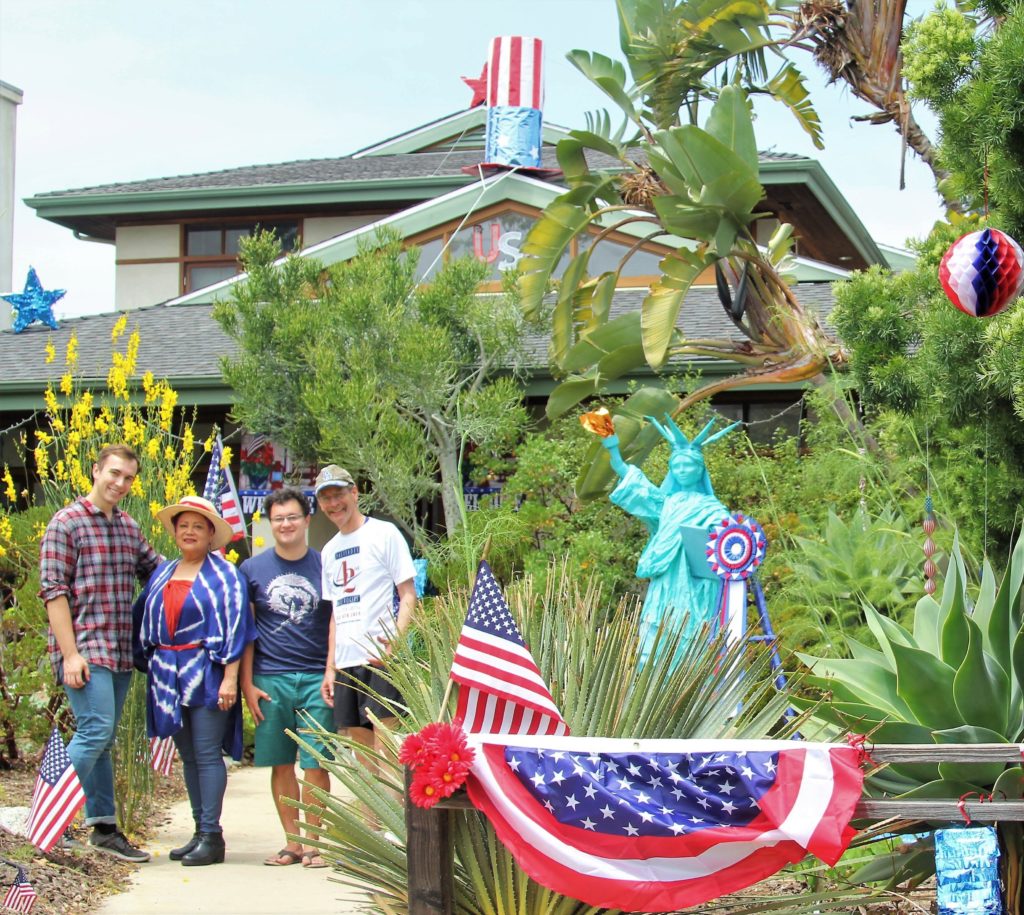
The Farham/Robletto Home on Via de la Paz won the Home Decorating Contest in 2019.

ENTER THE HOME

DECORATING CONTEST:

No matter where you live — Castellammare, the Highlands, El Medio Bluffs, Alphabet Streets, Huntington, the Riviera, Rustic Canyon, a mobile home park, an apartment building, a condominium — everyone in the 90272 zip code area is eligible and encouraged to enter.

This year, awards will be given to the Most Patriotic Home, the Runner-Up Most Patriotic Home, and new this year, will be the Joan Sather Memorial Sponsor’s Award, given to the home that employs the most outstanding use of homemade decorative elements.

Entries must be submitted no later than 5 p.m. on July 2.  Preliminary judging will be conducted upon submitted photos. Final judging will be conducted in person, and awards presented by local celebrities on the afternoon of July 3.


David Trotti and Amy Kate Connolly with their patriotically-decorated home on Haverford in 2018.

Posted in Fourth of July, Holidays | Leave a comment

Drawing Class Will Be Held at the Palisades Library on Saturday

Posted in Arts | Leave a comment

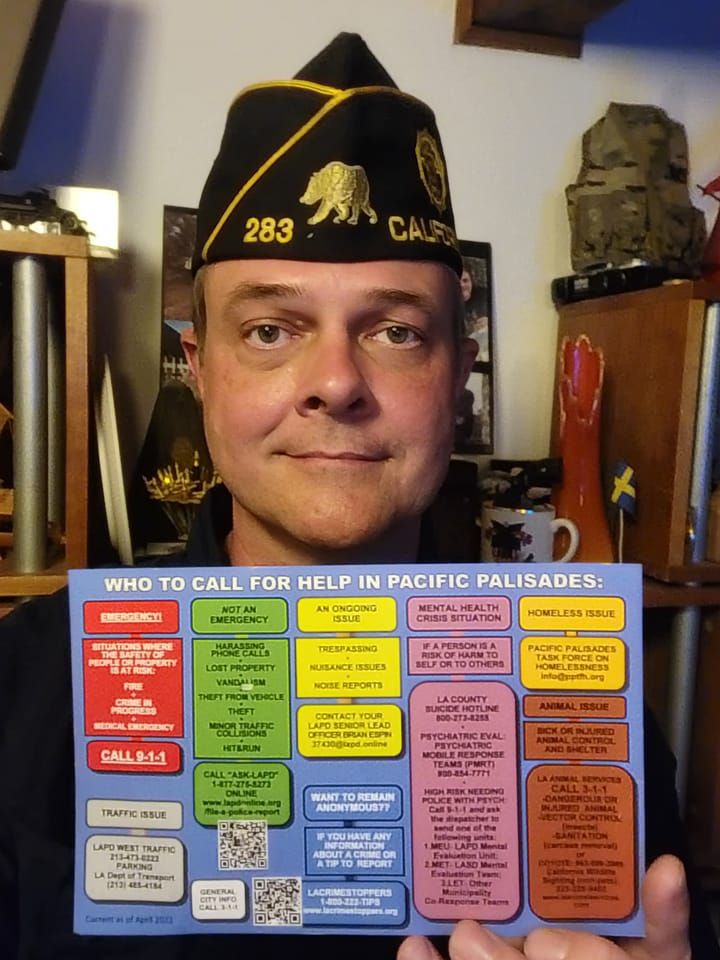
How and When to Report Crimes: Card Explains


American Legion Commander Jim Cragg shows what the “call for help” postcard looks like, which will be delivered to residents.

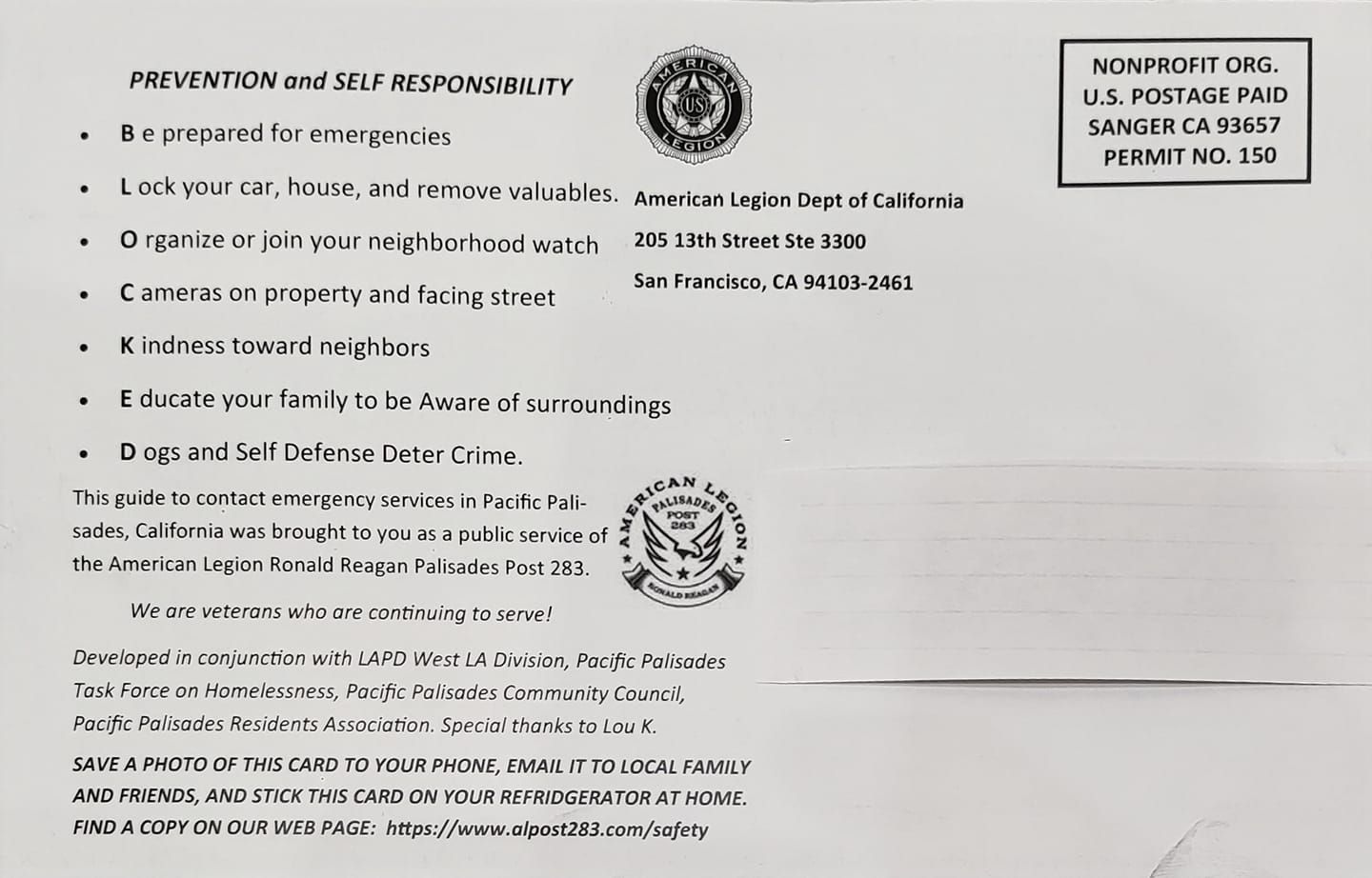
About 10,000 post cards were sent to every home in the Pacific Palisades this week. The cards have valuable information about the correct venues and steps for reporting various crimes.

Ronald Reagan American Legion Post 283 Commander Jim Cragg has spearheaded the project for the past six months.

“Citizens need to know who to call in an emergency and calling the wrong agency can result in lost precious time and clogging EMS dispatch,” Cragg said. “As American Legionnaires, we often have a connection and understanding of law enforcement and EMS (Emergency Medical Services), so I decided to utilize this trusted position in the community to help educate our citizens.”

In addition to listing 911, the card also has contacts for both county and police mental health programs so that families dealing with a relative in crisis know where to turn and who to call.

“We also listed our local homeless task force [Pacific Palisades Task Force on Homelessness] and animal control so people have those options to call respectively rather than wasting calls to 911,” Cragg said, noting that Post 283 paid for printing and mailing costs. “I worked with local community groups, and I spoke with the specific agencies directly.”

Resident Lou Kamer did the initial layout for the postcard, and Cragg thanked residents Krishna Thangavelu and Jessica Rogers for input. He also thanked Legionnaire Janice Bowman for guidance on the mental health resources.

“My hope is that this card will end up on refrigerators or saved on cell phones,” Cragg said. “I also hope this will inspire people to understand that they are an important part of the EMS process. If this brings the community closer to our police, fire crews, social workers, paramedics and animal control, then I will have accomplished something more important.”

Cragg said he would be happy to share the postcard format with other communities. He can be reached at [email protected] or the postcard PDF can be downloaded from https://www.alpost283.com/safety.

This is the backside of the postcard that was mailed to residents this week.

Posted in Accidents/Fires, Crime/Police | 3 Comments

Pros and Cons of Adolescent Cannabis Use

(Editor’s note: The Wall Street Journal ran an opinion piece on June 6 “Cannabis and the Violent Crime Surge” that noted a meta-analysis found the risk of perpetrating violence was more than twice as high for young adults who used marijuana. I asked a writer to research the subject.)

By REECE PASCOE

Marijuana has been in the news the past couple of years, with the legalization of many states and with a push to make it federally legal. Is this the right thing to-do? or should we take a step back and evaluate the pros and cons?

New research and data are just coming to light, and it may shift one’s ideas about cannabis, also called weed, pot or ganja.

 Hashish and marijuana are parts of the cannabis sativa plant. The major difference is that marijuana usually applies to dried pieces of the plant, mainly flower buds, while hash is a paste from resin, or sap of the plant and generally contains a higher concentration of psychoactive chemicals.

Over the centuries one can find examples of weed usage in the world. The earliest is in India in the Atharva Veda the holy book of Hindu, which says to cherish plants including cannabis.

The Arabian culture has references to the use of cannabis as a sleeping agent and to cure ailments. Even then the liberal users of cannabis were called hashish eaters, normally a derogatory name, or what today  someone is called a “stoner.”

Afghanistan’s cannabis growers prosper.
Photo: South China Morning Post

Afghanistan is known for its perfect climate for growing cannabis and poppies. Many things were traded on the Silk Road, the ancient trade route that linked the Roman Empire and China, which included cannabis and opium.

The poppy plant when in its bulb stage can be cut and released a white liquid. The liquid is then collected then heated to get any impurities out and it produces opium and heroin. Could have cannabis been a “gateway drug” to opium?

Over the years cannabis has been growing in potency due to combining different strains or by selecting the better crop. Within the past 20 years one strain went from 4% to 34% THC (tetrahydrocannabinol—the main psychoactive compound). With all the new varieties being created and potency increasing it is safe to say that cannabis is stronger now than it has ever been.

Though weed has been around thousands of years and have been studies for decades, the conclusions are like boat in the water always shifting. It is hard to find an unbiased articles because it seems like everyone has a different opinion.

Looking strictly at studies done by medical professionals, there was one published in the American Journal of Psychiatry in 2018 that looked at substance use and adolescent cognitive development. (Visit:  click here.)

The study was done on seventh through 10th grade students over a four-year period to test cannabis and alcohol use on the adolescent brain.

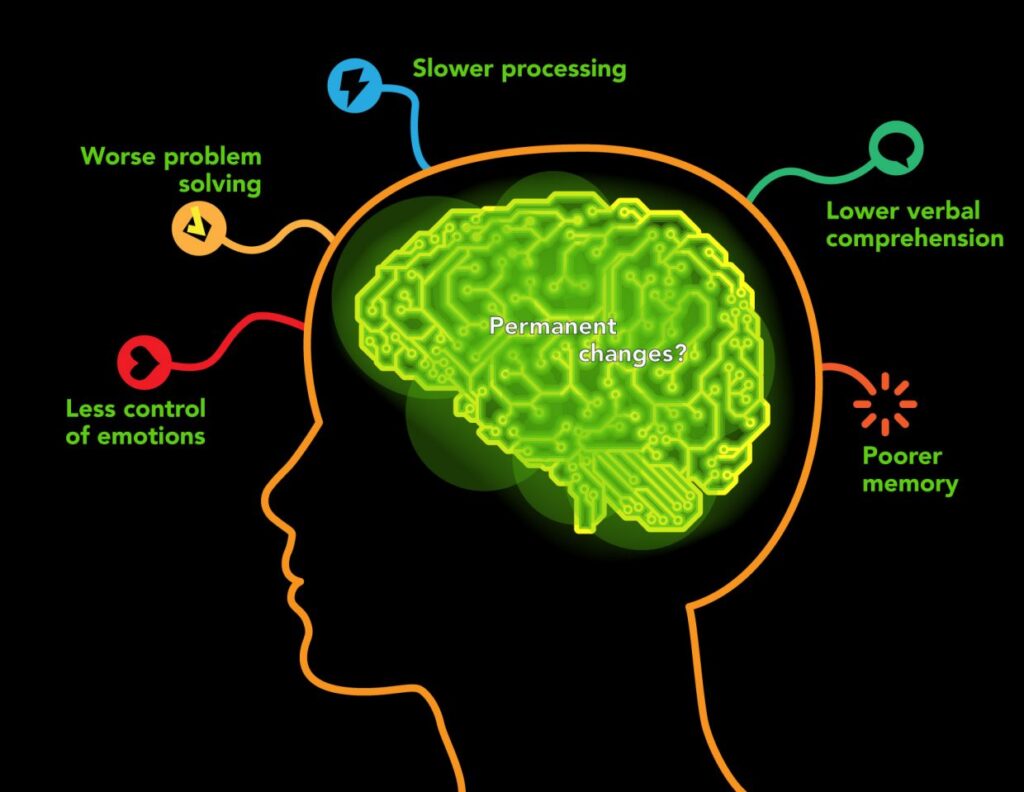
Kids were tested on working memory, perceptual reasoning, delayed recall memory, and inhibitory control. Working memory is one of the best indicators to measure IQ. The findings showed that both alcohol and cannabis had impaired cognition.

“Cannabis use, but not alcohol consumption, showed lagged (neurotoxic) effects on inhibitory control and working memory and concurrent effects on delayed memory recall and perceptual reasoning (with some evidence of developmental sensitivity). Cannabis effects were independent of any alcohol effects.”

Basically, the study said that the use of cannabis will effect ones mental IQ more than the use of alcohol. “The relationships between cannabis and perceptional reasoning were more pronounced at earlier stages of adolescent development, indicating that early-onset users are more impaired on perceptual reasoning and the additional effect of their cannabis use in a given year is particularly harmful to their perceptual reasoning abilities during the early adolescent period.”

A 2018 Meta analysis (JAMA Psychiatry ”Association of Cannabis with Cognitive functioning in Adolescents and Young Adults” click here ) was done to find the effects cannabis has on cognitive function in adolescents and young adults.

The paper concluded there was a definite decline in cognitive function though it was small. They also found that if one abstained from cannabis for 72 hours the effect would be reversed.

The paper also suggested that the side effects in adolescents weren’t as detrimental as previous research would suggest. They ultimately decided that more research would need to be done into the pros and cons relating to cannabis use.

Another study looked at psychiatric syndromes in out-patient adolescents who were cannabis users. More than 600 adolescents were evaluated for five different syndromes: “conduct disorder (74%), ADHA (77%), depression (37.7%), anxiety (28.8%) and traumatic distress (13.8%). About 72% endorsed acute levels of two or more syndromes.”

That study seemed to suggest that there is a strong correlation between mental health and cannabis use, but was unable to distinguish whether patients were using cannabis to self-mediate – or did cannabis exacerbate the mental condition. What came first? Is the underlining factor the brain or is it the pot?

Cannabis should not be overlooked for its health benefits. The main one is for use of severe forms of epilepsy where the FDA has approved cannabis as treatment. Others uses for TCH is during chemo to help with nausea and pain, muscle spasms, seizures, PTSD, Alzheimer’s and Glaucoma.

Cannabis has been around for millenniums, and it seems scientists are still unsure about benefits or possible long-term effects, even with years of data and research. Though the pros and cons are many, it seems we should not outright dismiss it or flat out accept it. One should weigh the cost of his and her own situation and weigh the benefits with his or her doctor.

Posted in Education, Health, Kids/Parenting | 1 Comment

Westchester Neighborhood Council Asks Bonin to Look out for Seniors

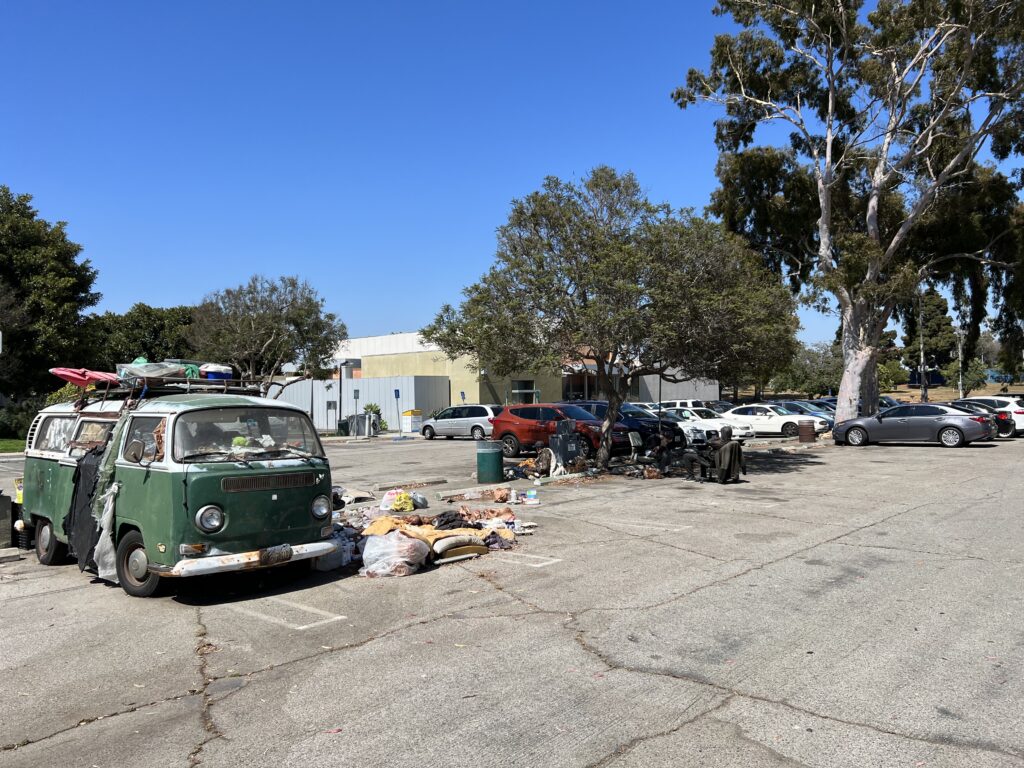
The Westchester Library parking lot is a hazard for library goers and senior citizens. The Neighborhood Council has asked Bonin to clean it up to assist seniors.

The Westchester Neighborhood Council sent a June 20 letter to Councilman Mike Bonin asking him to clear the parking lot by the public library and the senior center.  His office is located in the same area, but Bonin has a private security company to ensure his staffer are safe from some homeless individuals that can be threatening.

NCWP President Paula Gerez wrote, “The senior community has been severely impacted by the pandemic and inflation, and is quickly becoming one of the larger demographics in our homeless population. Many of these people are isolated with very little opportunity to connect with their peers.

“The Westchester Senior Center is an invaluable resource for social connections as well as for obtaining information about the various city and other services available to them through city employees at the center, and their peers,” Gerez said and told Bonin that a May 12 meeting, members of the senior community said they did not feel safe going to the Senior Center because of the vehicle encampments.

“The NCWP therefore requests that (temporary) housing be offered to those living in their vehicles in the parking lot, if it hasn’t already been offered, and have sanitation clean up the parking lot so it is clean and available for parking so that our seniors feel safe going to the Senior Center,” Gerez wrote. “If the vehicle dwellers do not want to accept housing, we ask that you enforce the no overnight parking in the Senior Center parking lot.”

She noted that the moratorium on “no overnight” parking had been lifted and that it was time to ensure seniors had safe access.

That same lot is also used by those going to the Westchester Park and the swimming pool, so Sony Young Jimenez, the Recreation and Parks Superintendent of Venice Beach and the West Region, was also sent a copy of the request.

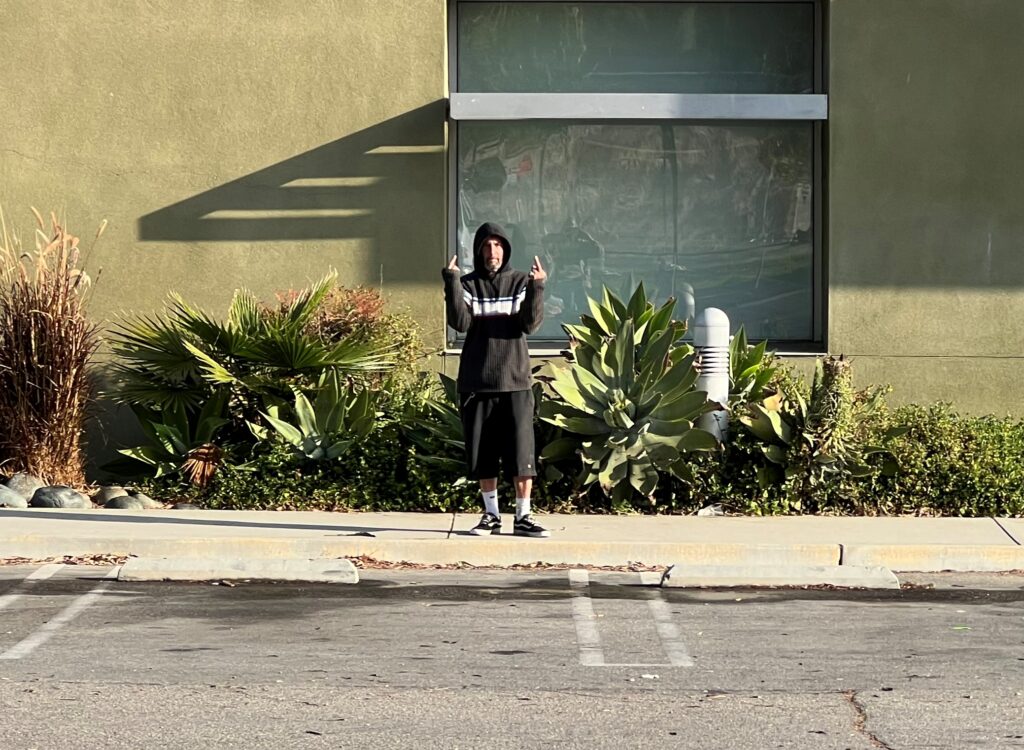
This man standing in front of the Westchester Library shouted profanities at the Circling the News editor, when photos were taken in the Westchester Library/Senior Center parking lot.

Posted in Crime/Police, Homelessness | 1 Comment

“HARVEY” Provides an Enjoyable Evening at Theatre Palisades

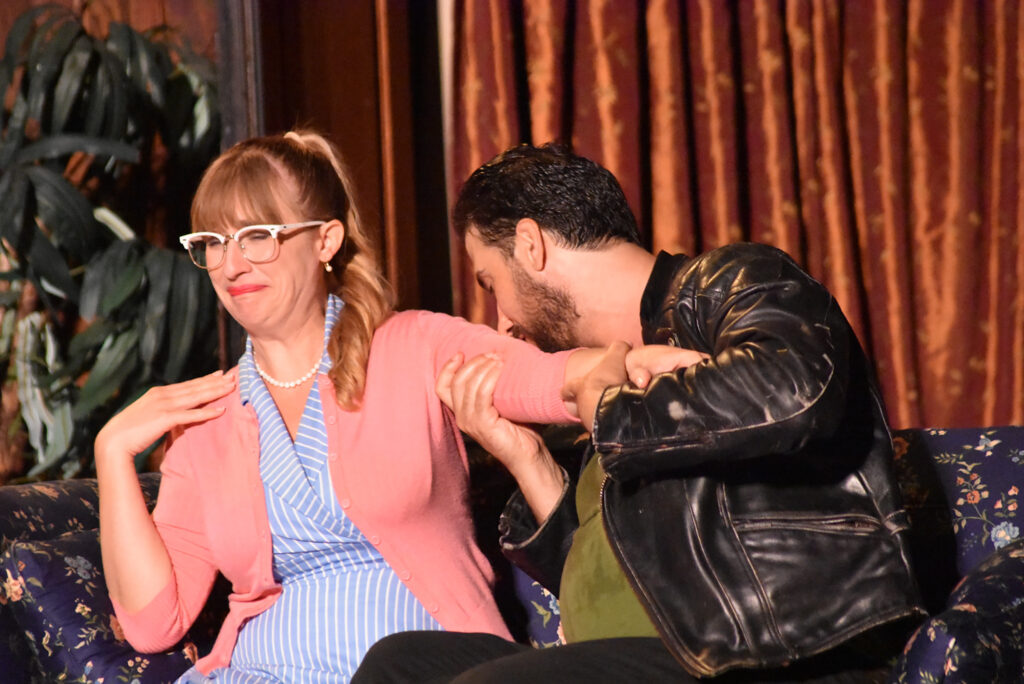
This scene from the sanitorium includes (left to right) Jaxson Brashier, Maria O’Connor, Isabella De Bernardino, Mitch Feinstein, Levente Tarr and Bob Grochau.                                                                                                 Photo: Joy Daunis

Several shoppers at the farmers market Sunday morning asked this editor, “Is there any news I’m missing? Is there any good news?”

Yes.

Even as we’re all being hit with higher gas prices, water rationing and heated political rhetoric, I can report something pleasant.

The Theatre Palisades production of “Harvey” finally opened on Friday night, and it provided a lovely, enjoyable evening.

The play was originally scheduled to open June 3, but was delayed when several of the actors tested positive for Covid. This sweet play will still close on July 10, so don’t wait to get tickets.

American playwright Mary Chase received the Pulitzer Prize for her 1945 drama. Five years later, James Stewart and Josephine Hull starred in the 1950 film.

Although the play is 77 years old, the material seems remarkably fresh, and flows beautifully.

Director Marina Tidwell wrote in the program: “Each character around Elwood P. Dowd is trapped in their fear of how they may be perceived and judged, and they are lonely and isolated. The playwright raises issues about tolerance, acceptance, friendship and love that resonate as much today as they did in 1945.”

The story centers around Elwood P. Dowd (Bob Grochau), who has an unseen friend “Harvey,” a pooka — a 6’3″ rabbit.

The family matriarch died leaving the home to Elwood. His sister Veta (Maria O’Connor) and her daughter Myrtle Mae Simmons (Isabella Di Bernardino) have come to stay on the family’s large estate.

Veta is desperate to have her daughter married, but social gatherings end in disaster because Elwood insists on introducing everyone to the “imaginary” Harvey.

Striving for normalcy, Veta decides to place Elwood in a sanitorium. Unfortunately, when she speaks to the psychiatrist, Dr. Lyman Sanderson (Levente Tarr), he classifies her as the one needing to be institutionalized.

When the mistake is discovered, the head of the sanitorium, Dr. William Chumley (Jaxson Brashier), tries to rectify it.

Playwright Grochau has tapped into Elwood’s character, an amiable, likeably man, perfectly. O’Connor, as the stressed sister who has to make the decision regarding her brother, is an accomplished actress and extremely effective.

This is a well-cast production.

“What’s that you say Harvey? This reviewer forgot something?”

“Yes. Well of course, the rabbit was extremely handsome, too.”

This show is produced by Martha Hunter and Mitchell Feinstein. Sherman Wayne has provided another spectacular set. The costume design by Alta Abbott, including the seamed hose, captures the time period.

Pierson Playhouse is located at 941 Temescal Canyon Road. Visit: theatrepalisades.com or call (310) 454-1970.

Posted in Reviews | Leave a comment

Oom PaPa Band Practices for 4th of July: New Members Welcome

New members are sought to join the Eisenberg family, who is leading the Oom PaPa band this year.

By LAUREL BUSBY

Since 1975, the Oom PaPa band has been providing music and fun for Pacific Palisades.

Aside from 2020, when the pandemic forced the cancellation of the parade and other events, the band has been a regular part of not only the Fourth of July parade, but also Christmas festivities and other local events.

Although the band has local origins and mostly consists of Palisadians, people from across Los Angeles County also join the group each year to make the parade more festive.

Palisadians Gene Romig and Sandy Schaefer started the band, and the name Oom PaPa is not only inspired by peppy marching music featuring brass, woodwind, and percussion instruments, but also by PAPA, the Palisades Americanism Parade Association, which orchestrates the parade.

Five years after its inception, the band’s current leader, Mark Eisenberg, heard about the group from his high school friend, Palisadian Nancy Morrison. He soon joined the band as a trumpeter, and then, in 1986, he took over the role of drum major and music director. This year will mark his 43rd year in the band.

“All of us love it,” said Eisenberg, an attorney who lives in Playa Del Rey. “It’s a great group of people, and we’re all dedicated to having fun on the Fourth of July.”

Eisenberg’s wife, Marla, began managing the band three years ago after longtime managers Margot Morrison and Phyllis Schlessinger retired, and the Eisenbergs’ children, Michael, 16, and Emma, 14, have been joining the parade since they were babies—first in strollers and now as playing members.

Michael, who has played both the drum and trumpet in the parade, “told me two days ago how he can’t wait to play the trumpet this year,” Mark Eisenberg said in early June. Emma, who previously played the clarinet, will take charge of the cowbell this year. “They’re both excited to come back and play again.”

Both Michael and Emma have also invited friends to participate, which means an estimated 10 more young people will join the group, their father said. These newer band members join a stalwart group who return year after year to play together.

Every June, the band begins to gather to practice its repertoire, which includes “76 Trombones” and “Louie, Louie.” Every Saturday morning, on a grassy median on Pampas Ricas Boulevard, the older members help the newer ones get the hang of the tunes, and they’re soon marching up and down the street, entertaining the neighborhood.

“The veterans pick it up where they left off,” Eisenberg said. “It’s just a given. I used to worry that we wouldn’t have a good showing each year, but there’s always this solid core of 20, and every year we expand our ranks to 35 or 40…. For a lot of the people in the band, this is their only opportunity to play. Being part of the community and going out on the Fourth of July to do something bigger is a time-honored tradition.”

As always, the Oom PaPa band welcomes new members. Practices are Saturday mornings at 10:30 a.m. Contact Marla Eisenberg: [email protected].

Posted in Music | Leave a comment

Alan Eisenstock’s Playlist – Monkeying Around

(Editor’s note: Palisadian Alan Eisenstock’s 20th book, “Fierce Love,” came out May 3. He wrote it with Sonya Curry, the mom of NBA Legend Stephen Curry. 
click here

When Eisenstock is not writing, he pursues what he calls “a crazy labor of love side project” that he started in March 2020: sending a weekly Covid-themed playlist of songs to his family and friends. These playlists, which can be downloaded on Spotify click here span rock ‘n’ roll and pop music from the 1950s to 2020, and Eisenstock adds one or two lines of commentary about each song that is clever, amusing and informative.)

Hi, Everyone,

As if Covid’s not enough, here comes fever, headache, and a gross rash. Welcome to monkeypox, another disease to look out for, especially if you’ve had mouth-to-mouth or other direct contact. What to do? Idea. Here are 18 “monkey” songs. Listen up!


  1. “Mickey’s Monkey” Smokey Robinson & The Miracles. Motown mainstays recorded this big hit in 1963, with Smokey singing lead. Holland-Dozier-Holland wrote the tune, which featured The Temptations, Martha & The Vandellas, and The Marvelettes singing backup. Dance party! Apropos of nothing, Smokey, 82, is a vegetarian.
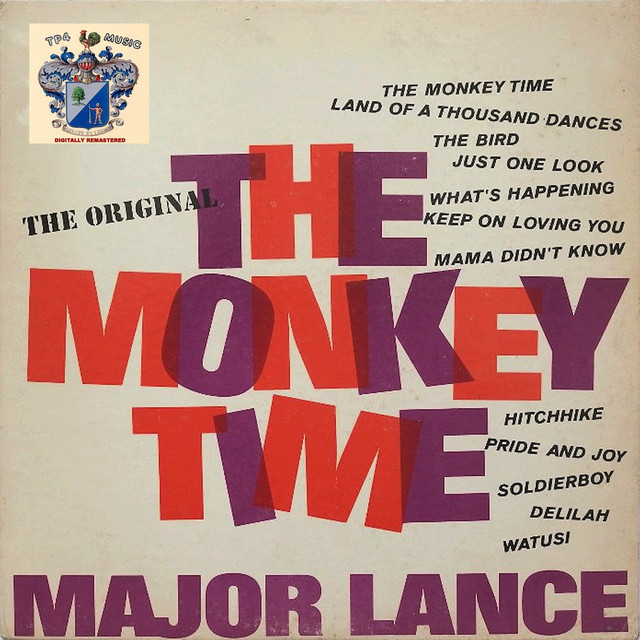
  2. “The Monkey Time” Major Lance. R&B singer born in Mississippi, Major became a major star with this huge hit in 1963 written by Curtis Mayfield. Lance later moved to England and became a star overseas. His daughter, Keisha Lance Bottoms, was the mayor of Atlanta, GA.
  3. “You Can’t Sit Down” The Dovells. Philly doo-wop group formed in Overbrook High School. This song, written by Kal Mann, was a big hit for them in 1963. Bruce Springsteen often plays this tune as an encore during his concerts.
  4. “Everybody’s Got Something to Hide Except For Me And My Monkey” The Beatles. From The Beatles’ White Album. John wrote this song after the band returned from India where they studied transcendental meditation. Paul said that he thought the song referred to heroin.
  5. “Monkey Man” The Rolling Stones. From their album Let It Bleed. Mick Jagger and Keith Richards wrote this 1969 hit inspired by rock singer and filmmaker Mario Schifano. Why they thought of him as the “monkey man” is up for debate.
  6. “Monkey Man” Toots & The Maytals. Reggae superstars from Jamaica led by Frederick “Toots” Hibbert. Toots wrote this 1969 hit which has been covered most famously by The Specials and Amy Winehouse
  7. “Daydream Believer” The Monkees.  A rock/pop band formed to star in a TV sitcom. It worked. They became huge, with several Top Ten hits. This 1967 song was written by John Stewart when he was in The Kingston Trio. Apropos of nothing, Monkee Michael Nesmith’s mom invented Liquid Paper.
  8. “At the Zoo” Simon & Garfunkel. Paul Simon wrote this catchy ditty for The Graduate but the song never made it into the film. It did make it onto their 1967 album Bookends. “The monkeys stand for honesty…”
  9. “Another Postcard” Barenaked Ladies. Canadian band from Scarborough, Ontario, led by Ed Robertson and Steven Page. This 2003 song came after the band took a 2-year hiatus. The lyrics describe a young man receiving postcards with pictures of chimpanzees on them. Really.
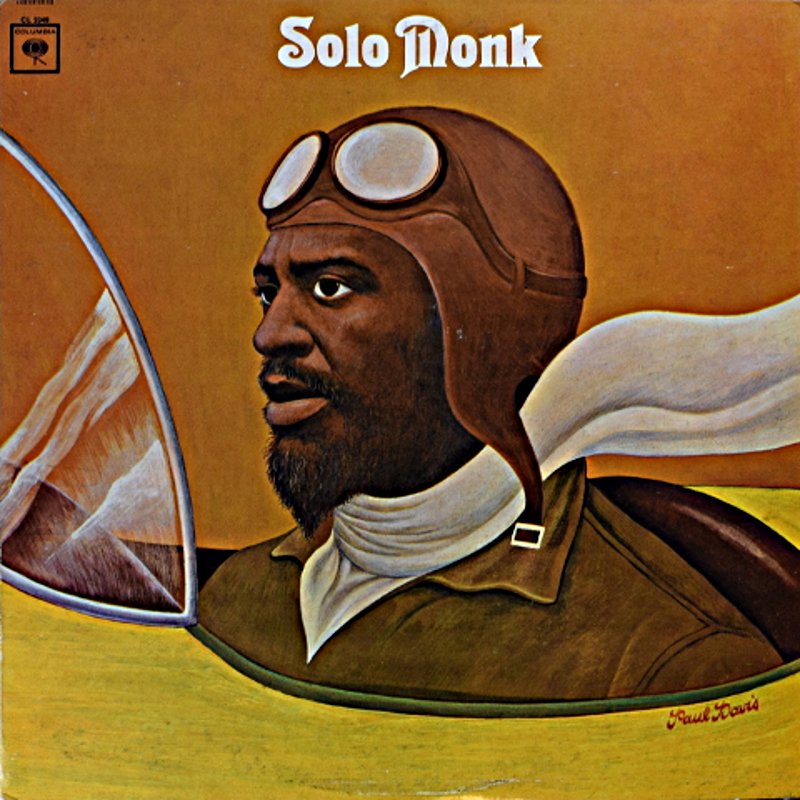
  10. “I’m Confessin’ (That I Love You)” Thelonious Monk. Dapper dresser, master improvisationist, and piano great recorded this jazz standard in 1964, found on his album Solo Monk. Chris Smith wrote the original in 1930, covered later by Peggy Lee, and others. LOVE.

  1. “Do I Wanna Know?” Arctic Monkeys. Indie rock band from England led by Alex Turner. This song, written by Turner in 2013, is the band’s biggest hit. REALLY LIKE.
  2. “Monkey Jump” Jr. Walker & The All Stars. Autry DeWalt Mixon, Jr. cut every word from his name except Jr. and became a famous Motown saxophonist. This song comes from his hit 1964 album Shotgun and sounds a lot like, well, the song “Shotgun.”
  3. “Monkey in Your Soul” Steely Dan. Walter Becker and Donald Fagen led this rock-jazz-funk band and a favorite. This is the last cut on their 1974 album Pretzel Logic.Many L.A. session musicians played on this album, which was recorded at the famous Village Studios in L.A.
  4. “I Wanna Be Like You (The Monkey Song)” Louis Prima, Phil Harris. Prima, “The King of Swing,” sings and plays trumpet on this song from the 1967 Disney film The Jungle Book. Phil Harris provides the voice of Baloo the Bear. Robert and Richard Sherman wrote the song.
  5. “Apeman” The Kinks. Influential sixties British rock band formed by brothers Ray and Dave Davies. Ray wrote this 1970 song, expressing his desire to escape from the hustle and hassles of modern life. In other words, drop out and become basically an apeman.

  6. “Monkey and The Engineer” Grateful Dead. Jerry Garcia and company loved to perform this 1980 song–written by Jesse Fuller–live. Among celebs calling themselves “Deadheads”–Bill Clinton, Al Gore, Bill Walton, Phil Jackson, George R.R. Martin, Steve Jobs, and Stephen King.
  7. “The Monkey Song” The Mountain Goats. John Darnielle is the entire band, well, most of the time. He wrote this 1999 song with the weird lyrics, “There’s a monkey in the basement, where did the monkey come from?”
  8. “Tweeter and The Monkey Man” Traveling Wilburys. The super supergroup consisting of Bob Dylan, George Harrison, Tom Petty, Roy Orbison, and Jeff Lynne. This 1988 song comes from their first album and at five minutes is their longest recorded song. Dylan wrote it, though he shares credit with the group. Tweeter and Monkey Man are drug dealers.


And that’s it… 18 “monkey” songs for your listening pleasure. Some advice:


Don’t Forget to Disinfect and… PLAY IT LOUD!


The link again: click here.

Fact Check

Smokey Robinson is a vegetarian.


Mike Nesmith’s mom did invent Liquid Paper.


Paul McCartney really did think that monkey song was about heroin.

LAST WEEK’S POLL QUESTION:

Bobby Vee’s “Rubber Ball” bounced Floyd Cramer’s “On the Rebound” right off the playlist.

THIS WEEK’S POLL QUESTION:

1963 face-off: Smokey & The Miracles “Mickey’s Monkey” or Major Lance’s “Monkey Time”— Who you got?


Don’t go ape until next week, I’ll be back,


Alan Eisenstock

Thanks,

Alan

alaneisenstock.com


Posted in Music | Leave a comment

Drought, Water Tied to California’s History

During a January rain storm, water was pouring off the steps at Palisades Elementary, along Swarthmore Avenue.

By REECE PASCOE

With the first major rainfall of the year in Southern California, usually in the winter, everyone goes a little crazy.

Car crashes litter the freeways, youth sports games are canceled, and everyone rushes to get home, finally having a legitimate reason to make hot chocolate and watch a movie during a weeknight.

SoCal residents know not to go in the ocean after the first rain. They know to turn off the faucet while brushing teeth; limit the number of baths and the time spent in the shower; plant drought resistant plants; and only water plants/lawns during early mornings or late at night on certain days of the week.

And children since the time they are little, are taught how to limit water usage because it seems were always in a drought – this year, last year, next year, every year, it seems.

Some say current problems are climate change. However, if you look at the annual rainfall in SoCal, the average has been constant since 1877 the first year on record. There is a pattern, almost every 30 years there is a drought 1900,1925,1960,1990 and now.

Increased population, increased high-water crop production, and 100-year-old plan for water distribution complicate the problem.

The first water agreement for the Southwestern States, The Colorado River Compact, was approved in November 1922 by Secretary of Commerce Herbert Hoover, who later became president.

That compact was signed by seven states and separated in into an upper and lower division.

The upper division is Colorado, New Mexico, Utah, and Wyoming, and the lower division is Arizona, California, and Nevada.

The upper division is defined as any area where water enters or leaves the Colorado River above Lees Ferry, which is in Northern Arizona – and located downstream from Lake Powell. The lower basin is below Lees Ferry.

Both the upper and lower basin are allotted to the use of 7,500,000-acre feet of water per annum (AF). This is a very important number because it is the foundation which all other pertinent details are derived.

The upper basin is not allowed to withhold water, and the lower basin shall not require the delivery of water that cannot be readably used.

Then, because the river flows through Mexico, if there is a shortage on the Mexican side, the upper and lower must decrease the amount taken to make sure there is enough water exiting to the Pacific Ocean.

The Boulder Canyon Project Act of 1928 further defined the amount each lower basin state would receive. California is allotted 4,400,000AF, Arizona is 2,800,000AF, and Nevada is 300,000AF.

To determine that amount, there are two metrics: water levels of Lake Mead and Lake Powell, and secondly the average flow of the river.

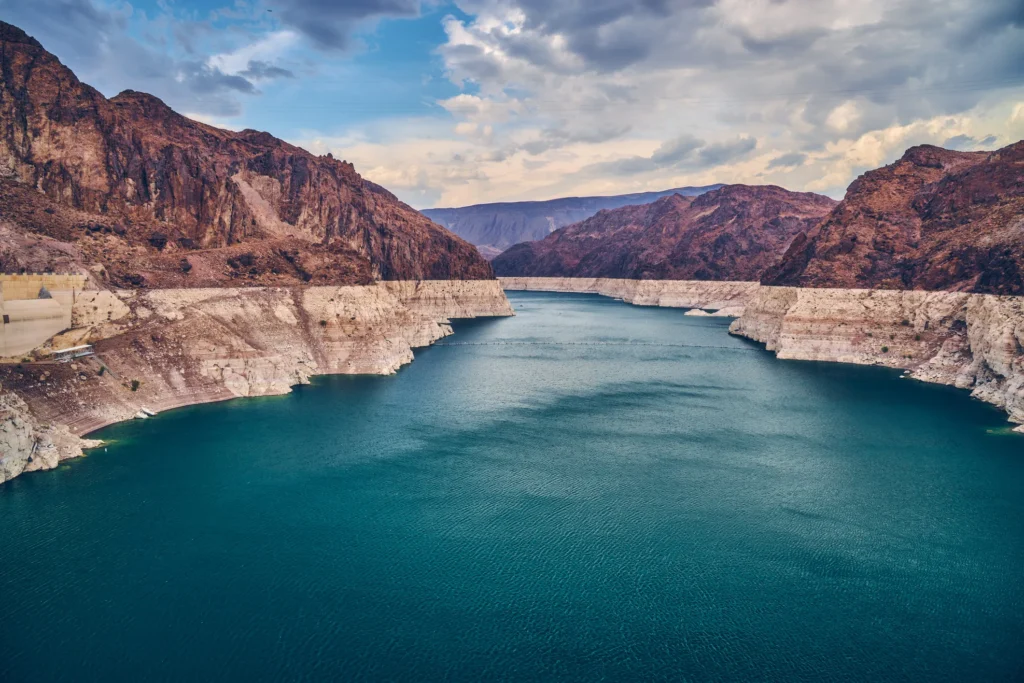
But Lake Mead’s water level is the sole determiner for the lower basin. Lake Mead’s water level as of June 8, 2022, was 1,046 ft. Last June it was 1,071 ft.

According to the agreement, once the water level drops below 1,090 ft, Nevada and Arizona must scale water intake back.

When the water level drops below 1,045 ft. California will have to cut back by 4.5%.

Cutbacks are put into effect on January 1, based on estimated water levels of Lake Mead. This means that starting next year, unless there is a massive inflex of water, Californians will more than likely start to see price hikes.

Lake Mead water levels are low.

The 1944 Water Treaty with Mexico has gone through multiple revisions but the most up to date is MIN 323, which was updated in 2017. Mexico is to receive 1,500,000AF, when the water level of lake Mead is above 1,090ft.

But if the level at Lake Mead continues at its current level, Mexico will have to decrease its amount by 34,000AF. This is the lowest level lake Mead has seen since the construction of the Hoover Dam.

Water usage has also increased in the last 100 years, because Los Angeles population went from 600,000 to 12,500,000. Las Vegas went from less than 3,000 to 650,000 people. Phoenix’s population went from 50,000 to 4,600,000.

A pilot program was launched by the states to voluntarily conserve water in 2014, and in 2017 U.S. Congress passed funding for those measures.

In the 2020 “Review of the Colorado River Interim Guidelines for Lower Basin Shortage and Coordinated Operations for Lake Powell and Lake Mead” it was noted that “During a year when the Secretary of the Interior has determined a Shortage Condition, the Secretary shall deliver Developed Shortage Supply available in a Contractor’s DSS Account at the request of the Contractor.”

That means the Department of the Interior can approve or disapprove a project.

The contractor will have to fill out a DSS basically saying what the water is used for and any pertinent details evolving water usage. This gives the Secretary absolute power over all planned projects involving water.

The Central Valley of California, which is largely agricultural, consumes 80 percent of California’s available water. In the recent years the Valley has been shrinking, in some places more than 11 ft. as ground water is used for irrigation, making outside water even more valuable.

With the recent legalization of marijuana many people may not have realized an unseen consequence: this is a plant that requires a lot of water.

Over the past couple of years, the almonds have been singled out as one of the highest water users of all California’s crops.

California produces about 80% the world’s supply of almonds. It takes about one gallon for one almond or about 25 gallons for an ounce of almonds. Marijuana plants taking about 34 gallons of water to produce an ounce of product.

With Lake Mead at its lowest levels, the shrinking Central valley, persistent drought and growing populations, it may be time to rethink water in California – and its 100 years of dependence on the Colorado River.

It might be time to prioritize less water-dependent crops. Time for California to add a desalinization plant to help offset the water needs, and time to see if water reclamation could be upgraded and improved to fit California’s needs.


Almond trees are being irrigated.
Photo: Crop Science Society of America

(In “East of Eden” John Steinbeck wrote “And it never failed that during the dry years the people forgot about the rich years, and during the wet years they lost all memory of the dry years. It was always that way.”)


Posted in Environmental | 5 Comments

Theatricum’s ‘Merry Wives’ Guarantees a Belly Laugh

Mrs. Ford (Emily Bridges) and Mrs. Page (Willow Greer) plot their revenge.
Photo: Ian Flanders

By LIBBY MOTIKA

Circling The News Contributor

For those of us who are exalting in the return of live theater, Saturday evening at the Theatricum Botanicum filled the order perfectly.

Set in the open-air stage under the live oak canopy and full moon to boot, the opening performance of Shakespeare’s “The Merry Wives of Windsor” answered our post-pandemic hunger for the joyous frivolity provided by the vibrant funny and silly people who wormed their way into our hearts.

Shakespeare’s masterful character, Falstaff, who appears in three of his plays, holds the center of this delicious comedy. This time, the fat, vain and boastful knight who spends most of his time drinking and living on stolen or borrowed money, gets his comeuppance.

His scheme to court two lovely wives in a small town to gain access to their husbands’ wealth invites marvelously inventive and hilarious just desserts.

Falstaff was a favorite of Queen Elizabeth I, who was said to have enjoyed him so much in Henry IV, she commanded that this comedy be written.

The play was completed in 1601, following the plague of 1593 that gripped London for over a year.

The timing parallels our own emergence from Covid and all the suffering and uncertainty of the last two years.

Director Ellen Geer has set the action in the 1950s, in the seemingly good times following World War II. The action is interspersed with “50’s tunes, with selected word substitutions, that include “Sixteen Tons, “At the Hop,” and even a tap dance routine to “Life Could Be a Dream”; you get the picture.

But while the whole town conspires to thwart Falstaff and call out his buffoonery, including the conniving trickery the two wives concoct to humiliate him, there are recognizable threads of patriarchy. The husbands and fathers still set the rules.

It’s easy to commend all the actors, whose versatility—singing, dancing and lots of physical dexterity—is a perfect definition of acting.

The takeaway of this delightful evening is pure joy. Go see it, you’ll leave filled up with delight and hope.

“Merry Wives” plays in repertory, Thursday through Sunday through September. For tickets, call (310) 455-3723 or visit thratricum.com.

Falstaff (Jeff Wiesen) wooing Mrs. Ford (Emily Bridges).
Photo: Ian Flanders

Posted in Reviews | Leave a comment