DSA-Sanctioned Candidates Should be Examined Closely

The Simon Wiesenthal Center, which normally does not protest candidates, has taken a stand against this candidate, who is endorsed by the DSA.

The Westside Current ran an October 26 story (“DSA Endorsements Raise Questions of Anti-Semitism Among Darling, City Candidates”), which pointed out that in order to receive a DSA endorsement, candidates must fill out a questionnaire that asks if they back the BDS (Boycott, Divestment, Sanctions) movement.

That part of the questionnaire, can be found on the DSA LA website and asks candidates “Do you pledge to reject funds from groups that reject Palestinian autonomy, and do you support a boycott of “education trips” to Israel for elected officials? (See below). Erin Darling told the Current he had not filled out the questionnaire.


 

Erin Darling

On the DSA voter recommendation page for Council District 11, the group does recommend Darling. They write “Though Bonin has not been perfect – it took the unrelenting work of organizing community activists for him to oppose police sweeps – he has regularly been one of the furthest left councilmembers, a notable achievement in the otherwise strongly mainstream-liberal Westside.

The DSA opposes Traci Park and concluded “Erin Darling is a civil rights lawyer who has defended the rights of protesters and workers. Darling’s campaign emphasizes permanent supportive housing, a tenant’s right to counsel, and actualizing a Green New Deal for Los Angeles. Erin Darling has received Mike Bonin’s endorsement as well as those of Isaac Bryan, the California Working Families Party, and ILWU – Southern California District Council, and is our best bet at maintaining a left-progressive councilmember in this affluent district.”

According to the Current, Darling’s campaign spokesperson, Josh Androsky, is a DSA-LA officer who also works with Soto-Martinez and was a consultant to Nithya Raman’s 2020 campaign.  Darling has campaigned with Soto-Martinez, and on October 14, the Super Pac “Neighbors and Workers for Erin Darling and Opposing Traci Park” accepted a $50,000 donation from Soto-Martinez’s union, Unite-HERE Local 11.”

Soto-Martinez has been endorsed by the DSA-LA.

Circling the News ran an October 20 story (“Something to Know about the DSA”) “In April, the Simon Wiesenthal Center (SWC) expressed opposition to ‘labor organizer Hugo Soto-Martinez, a candidate backed by the Democratic Socialist Party’s (DSA) Los Angeles chapter, for endorsing anti-Israel measures in his DSA questionnaire.”

According to the story, DSA expects its candidates to endorse BDS (Palestinian-led Boycott, Divestment and Sanctions) and to commit that they will not travel to Israel.”

Soto-Martinez is running against Mitch O’Farrell. The SWC does not endorse candidates, but “But when someone seeking to election to a post where he would be impacting on all citizens of Los Angeles, endorses extremist anti-peace boycotts of the Jewish State, we must protest,” said Rabbi Abraham Cooper, SWC Associate Dean and Director of its Global Social Action.

Kenneth Mejia

Also favored by the DSA is controller candidate Kenneth Mejia. The site said “You should vote for Kenneth Mejia, a CPA who has twice ran unsuccessfully for Congress on an unapologetically leftist platform and emphasizes using the Controller’s office to reveal the ways LA’s government wastes money on sweeps and giveaways to developers when the same money could be used to help working people.  . . . . Meanwhile [opponent Paul] Koretz has spent this race trying to smear Mejia with fear mongering mailers about his old tweets.”

The Current wrote that Mejia tweeted in support of Palestinian protesters blocking traffic in front of the West L.A. Federal Building in May 2021: “Of course, there were tons of law enforcement as usual.

“(Mejia is no fan of law enforcement; he once tweeted that ‘the police exists (sic) to uphold white supremacy.’)  The video attached to the tweet about the Palestinian demonstration was shot by Steven Chun, a paid political consultant of Mejia’s. In March of this year, Chun shut down a candidate forum at Temple Beth Hillel by shouting obscenities at their rabbi. Mejia told the LA Times that Chun (among others on his staff who’ve disrupted public forums) is merely a ‘volunteer’ whom he pays a ‘stipend.’ But Mejia’s campaign data shows he has paid Chun several thousand dollars since July of 2021 for his services as a ‘campaign consultant.’

The Current wrote, “According to those we spoke with, the far left’s singular condemnation of the Jewish state is as concerning as the anti-Semitism coming from the far right.

“As Jonathan Greenblatt, the Director of the Anti-Defamation League, said in an interview with The New Yorker: ‘Anti-Zionism is a new hue of a very old color. Jews have been delegitimized for centuries. For thousands of years. Judaism isn’t a real religion. The Jews aren’t a real people. The Jews don’t really deserve rights. We have heard this throughout time. Today, the subject of derision is the Jewish state, not the Jewish people. But it is an old practice. It’s like old wine in a new bottle.’”

Posted in City/Councilman Mike Bonin, Community | 1 Comment

Halloween versus Fourth of July Decorations

Halloween decorations abound this year,

Circling the News asked readers if they had noticed that there seemed to be more Halloween as opposed to Fourth of July residential decorations. The Palisades Americanism Parade Association helps host the annual Fourth of July decoration contest.

One reader wrote: “I was just talking about this with someone who has a decorating business. This Halloween seems to be off the charts this year. “

The resident pointed out that last Halloween, some schools still had Covid measures – and parents were still juggling the back to school and working from home.

“This year Covid is treated like any viral infection or cold,” the reader said, noting that “Halloween is back in full effect- parties and all. People are decorating in hopes for trick or treaters and parties.”

Why don’t more people decorate for the 4th? The thoughtful reader wrote, “The Fourth of July is my favorite holiday – especially in Pacific Palisades, but even my decorating is super minimal.”

The reader pointed out that no one goes door to door and admires the decorations, which are generally appreciated by those who are trick or treating.

For the Fourth, “it’s for your own pleasure, of if you are having a 4th of July parade- or maybe on the parade route,” the resident said and noted that on the Fourth, many belong to local beach clubs and spend the time there. Many residents are traveling over the summer months. “There is less neighborhood activity unless you live on the 10K route or parade route,” the resident said.

A coven of witches was in the parkway of the Alphabet Streets.

Posted in Holidays | Leave a comment

Letter: Dangers of Fentanyl

The presentation on the prevalence and current and present dangers of fentanyl at the Pacific Palisades American Legion Post this evening was absolutely eye-opening and bone chilling. A true Halloween’s event.

As always, I want to raise the alert level to the danger posed to the public.  This is in red flag territory and much needless suffering can be prevented with a proactive prevention approach.

We will perhaps have to wait until these elections are behind us, but we need to scale and rapidly execute public awareness at the middle and high school level about the lethal nature of fentanyl in all its disguises, being currently easily available to school kids.

Lt. Glenn Walsh of LASD spelled out that these drugs are readily available to school kids in all schools and that teenage experimentation could lead to death at the very first exposure. What looks like “harmless fun” could easily turn out to be anything but that.

My recommendation to Glenn was that LASD work with LAUSD to design a prevention training video that is mandatory viewing for all grade levels that experts deem appropriate.

It used to be such trainings were done in person by cops, in classrooms.  Labor shortages, budget cuts, and the concomitant explosive scale of the problem suggest that a standardized video training with teacher facilitation might be the fastest way to go to prevent needless death and suffering.

Harden the targets. Give kids the information they need to protect themselves. Maybe time to bring back the “Just Say No” campaign. I’m pretty positive that there will be no shortage of celebrity influencers who would be will be willing to support this effort and raise the public relations appeal to such a campaign.

Thanks for inviting us and elevating the issues to community awareness Jim [Cragg, Post 283 Commander]. Thanks for training us and for your service Glenn!

Krishna Thangavelu, Ph.D.

Glen Walsh spoke about the dangers of fentanyl and the problems with education and enforcement.

Posted in Crime/Police, Education, Letters | 2 Comments

Glen Walsh Discusses Dangers of Fentanyl and the National Crisis

Rainbow Fentanyl is manufactured to look like candy.

“One pill can kill,” said Glen Walsh, president of the California Narcotics Officers Association, who spoke at an American Legion Ronald Reagan community-offered presentation on October 20.

The day before, authorities has seized thousands of suspected fentanyl pills hidden in candy boxes at LAX. The pills were hidden in SweetTARTS, Skittles and Whoopers candy boxes. About 12,000 pills were seized by sheriff’s detectives and U.S. Drug Enforcement Administration agents.

Dealers have recently been disguising fentanyl in candy wrappers and manufacturing them in rainbow colors.

“Drug overdoses are the leading cause of death in those under 30,” Walsh said, and noted that overdose deaths increased by 15 percent in 2021, with more than 107,600 dying last year.

How is it happening? “Marijuana is laced with fentanyl. Every drug is laced with fentanyl,” Walsh said. “Common everyday street drugs are laced with fentanyl.”

(The October 24, Wall Street Journal front page story was “Orders for Cocaine, Deaths by Fentanyl.”)

Walsh warns, “If you think you are purchasing certain medication from the internet, you could be playing Russian Roulette.”

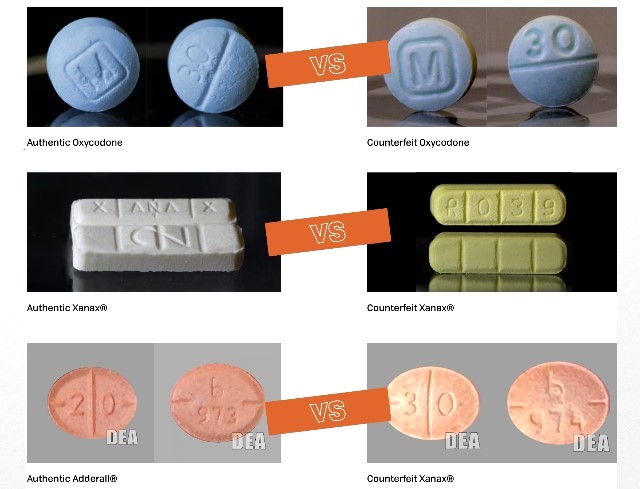
He said the pills one might receive may be counterfeit (and contain fentanyl). “Cartels have copied lots of prescriptions,” Walsh said, and showed photos of fake oxytocin, Xanax, Adderall and Viagra, that had been laced with it.

Cartels make the pills look as authentic as possible. Currently, agents are seizing “rainbow death,” multicolored pills, such as those seized at the airport.

“Where you get your prescriptions is really important,” Walsh said.

REAL OR COUNTERFEIT?

Readers, take the quiz. Which is real, which are counterfeits? Your life could depend on making the right decision.

Is the upper photo real oxycodone or is it the lower? Which is laced  with fentanyl?


Which is the authentic Adderall, which is the counterfeit laced with Fentanyl?

One of the problems with fentanyl is such a tiny amount can produce death. He explained that “Lethal dose for 50, means that 50 percent of those talking the drug will die. He said, “2 mg. can be a lethal dose and 1.3 mg. is the average fentanyl in a pill.”

People taking pills they’ve purchased illegally don’t know how much is in each pill.

“You can go into high schools and buy whatever you want,” Walsh said, and added “Drugs are an equal opportunity destroyer.”

How do you save kids, who might have accidentally ingested fentanyl, thinking they were taking something else?

Walsh said Narcan, which was developed in 1961, can temporarily save the person from dying, but “If you give someone Narcan, then make sure they get immediate medical assistance, because Narcan does not last as long as the opiate.” (American Legion Commander Jim Cragg said he went to CVS and was able to purchase Narcan, with no questions asked, but that the pharmacist has to prescribe it.)

It is not only kids who are faced with possibly taking a counterfeit pill laced with Fentanyl.


How’d we get here?

Fentanyl was developed in 1959 and used, intravenously in a hospital setting. It relieves pain, can produce euphoria and works as a central nervous system depressant. “It was all about pain management,” Walsh said, “and highly addictive.”

In the 1990s George Marquardt, a high school dropout and self-taught chemist, started manufacturing and distributing fentanyl.

Fentanyl, since it is manufactured in a lab, is a much more profitable way of getting people addicted than growing poppies, harvesting them and turning them into heroin.

Heroin users, unsuspectingly, started injecting fentanyl. According to the DEA, “126 East Coast addicts had died from shooting up fentanyl in 1991 and 1992.

“In Baltimore, 28 people overdosed on the drug in 1992. Twenty-three died that year in New York, where fentanyl was sold as ‘Tango and Cash.’ The deaths spread north to Connecticut and Boston, south to New Jersey, Maryland and Virginia, and on to South Carolina.”

Marquardt was becoming rich, because a kilogram of fentanyl sold for “$240,000 to $640,000, depending on purity. A kilo of heroin sells for $100,000 to $200,000; cocaine, for $20,000 to $25,000. Except for a $10,000 rotary evaporator to dilute the drug, making fentanyl does not require enormously expensive equipment or chemicals,” Walsh said.

Eventually, Marquardt was found guilty of manufacturing the drug and sent to jail.

“Officials thought by putting him away, fentanyl would go away,” Marsh said, noting that wasn’t the case. “Now it’s the worst drug outbreak in history.”

China started manufacturing the drug sent to the U.S. According to an April 2019 New York Times Story “China Bans All Types of Fentanyl, Cutting Supply of Deadly Drug to U.S. and Fulfilling Pledge to Trump,” China said it would expand restrictions to all “fentanyl-related substances.”

According to the story, “the ban does not cover all of the precursor chemicals used to make fentanyl and its analogues, according to a spokesman for Mr. Trump’s Office of National Drug Control Policy.

That could be problematic because these chemicals are often sent from China to Mexico, where traffickers use them to make fentanyl that ends up in the United States. China has banned some of them, but not all, which the spokesman said would be nearly impossible.”

It appears that the majority of the fentanyl hitting the streets of the U.S. is now coming from Mexican drug cartels, with aid from chemicals from China.

What needs to change?

Glen Walsh spoke about the dangers of fentanyl and current problems with education and enforcement in California and the nation.

In addition to tightening the borders to stop the flow of drugs, “Prevention, education, enforcement and treatment,” Walsh said.

“We need a sound drug police in California,” he said. “Until we have a sound drug policy, we’ll continue to spiral out of control.

“Drugs ruin everyone,” Walsh said. “If you are addicted, you are enslaved.”

Proposition 47, which passed in 2014, reclassified drug possessions from felonies to misdemeanors.  That took away the power that law enforcement officials had under Prop. 36 (eligible non-violent drug offenders could serve time in a drug treatment program instead of jail or prison).

Now officials do not have the power to “suggest” to those arrested, that a drug treatment program is a better option than a felony.

“No longer are officials teaching about how drugs are bad in classrooms,” he said, and noted that it might be time to get people, including parents, in classrooms to educate about drugs and its effects.

“Drugs are so prevalent,” he said. “And so easy to get.”

After his talk, the American Legion donated $500 to the California Narcotics Officers Association.

(Editor’s note: In the quiz above, the top photo for oxycodone and Adderall are the real drugs. The bottom photos are the counterfeit drugs. Are you still alive? Or did you pick the wrong one?)

It takes very small amount of fentanyl to kill someone. Most people buying drugs on the streets don’t know the amount of fentanyl they will receive in each pill. Many will not even realize fentanyl is in the pills they purchased.

Posted in Crime/Police, Education, Kids/Parenting | 8 Comments

OMG: Bees Are Swarming Outside the House

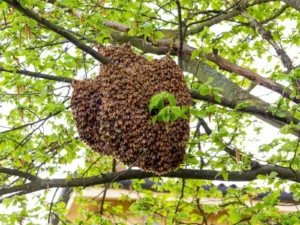
Charlene Potter is a urban beekeeper, who spoke to Rotary Club members.

Many Pacific Palisades residents have reported bees swarming in their yard or in other locations around the area. What’s the right thing to do?

According to Los Angeles County Beekeepers (LACBA) vice president Charlene Potter, leave them. “Swarming means they are healthy and looking for a new home,” Potter said. “They have already scouted their new home.

“When they are swarming, they are most vulnerable,” said Potter, who is urban beekeeper, noting that “If they don’t go away in 24 hours, call a beekeeper and we’ll rehome for you.”

Potter, a member of the LACA, which was founded in 1873, spoke to the Palisades Rotary Club on October 18.

LACA, which will celebrate its 150th anniversary next year, is a nonprofit that gives grants and offers beekeeping classes. The group works at the L.A. County Fair and also at the Spring Fling at the L.A. City Zoo, educating people about the importance of bees.

“There are many kinds of bees, and most are gentle,” Potter said.

The fear that many people feel about swarming bees, can be traced back to when Africanized honeybees, which escaped from Brazil in 1957. A project had been underway to try and breed that species with European honeybees, which are “gentle and docile,” according to Potter.

The African bees escaped and have made their way, over the decades, into the United States, and those bees are more aggressive. Potter said one can’t tell the difference by looking at the bee, but rather observing the behavior of the Africanized bee.

“Beekeeping is a challenge because of the Africanized honeybee spread,” said Potter, who started with two hives and now has 25. “It’s not a cheap hobby.”

In order to be a beekeeper, Potter said that person must be:

  • Fastidious about the management of the hives
  • Perform regular hive inspection
  • Requeen when necessary
  • Treat for diseases and pathogens
  • Work with swarm control
  • Feed bees when necessary
  • Be willing to spend money and time.

By now, the general public is aware of the need for honeybees. According to the U.S. Food and Drug Administration, about one-third of all food eaten by Americans come from crops pollinated by honeybees.

“The commercial production of more than 90 crops relies on bee pollination,” the FDA wrote. “Of the approximately 3,600 bee species that live in the U.S., the European honeybee is the most common pollinator, making it the most important bee to domestic agriculture.”

Bees carry the pollen on their legs.

Potter told Rotarians they could help the bees by allowing the dandelions to grow on the lawn. “It’s the first source of food for bees in the spring,” she said.

“Don’t use pesticides,” Potter said. “Someone within a mile radius of my house used a pesticide and it killed bees in five of my hives.”

She suggested that people get rid of lawns and plant flowering trees and bushes instead. Finally, it’s important for bees to have a water source.

A Rotarian asked about a bee sting. “I’ve been interested in bees since I was stung when I was a child playing in my grandma’s garden,” Potter said, and noted she’s been stung so many times she doesn’t keep count.

“Boy bees don’t sting,” Potter said, acknowledging it is only the female bees. “When a bee stings you, it leaves a barbed stinger in your skin.”

She said, it was important to flick it out as soon as possible because as long as the stinger is still in, it is still pumping venom. The stinger is one tenth of the body of the bee. Once the bee loses its stinger, it dies.

The urban beekeeper says that she “gets a call about once a week to remove bees. The number one place is a compost bin,” she said. “It’s almost the perfect size for bees.” She said that compost does not attract bees, rather it is the sheltered space that is attractive.

“If you need raw honey, healing balms, soaps or if you need bees removed, you can email me [email protected],” Potter said. “No honey is better than the honey you get from your own backyards.”

(Editor’s note: CTN bought spring honey – lighter in color than Potter’s summer honey—and it was delicious.)

Posted in General | Leave a comment

Letters Regarding the Tipu Trees Proposed for the Park

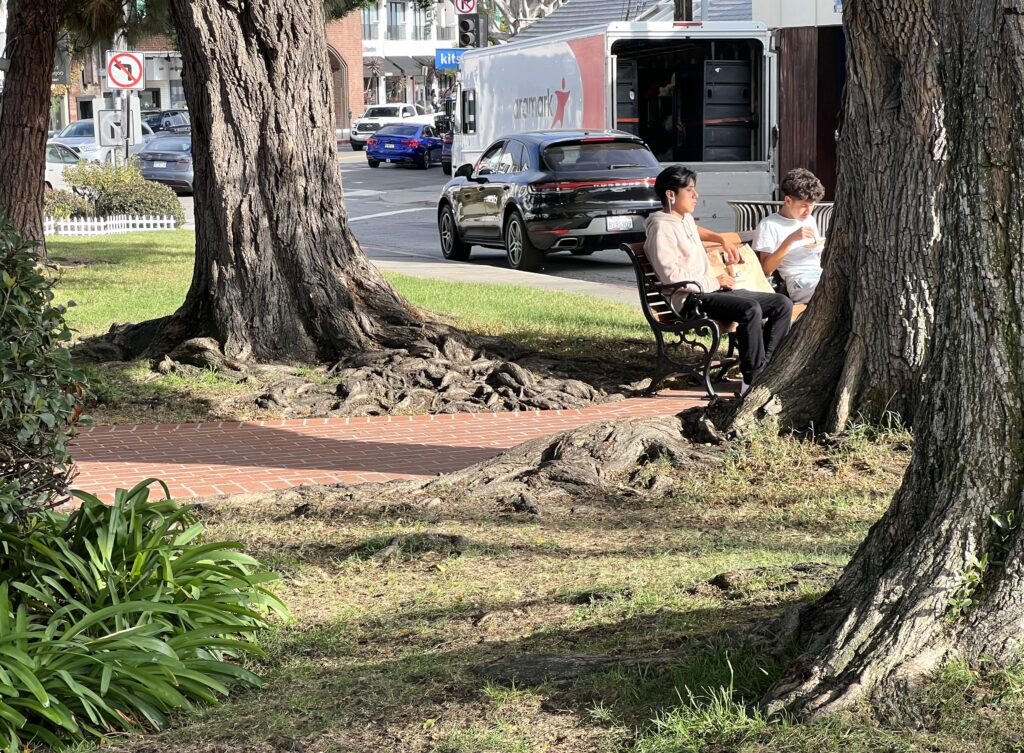
The roots from the tipu trees, resulted in the brick pathways had to be redone. This tree was suggested for Veterans Gardens near the bocce courts.


The Tipu Provides a Good Choice

Wow, Sue! What happened to reporting all sides of the story? I sent you the UFEI/Select Tree information (considered to be the Gold Standard of arboreal information by most arborists for Southern California) comparing the Tipu to the Incense Cedar that was the alternate recommended for consideration in Veterans Garden.

For some reason you fail to mention that the Cedar will be too tall (at 90 feet compared to 50 ft for Tipu), not wide enough for the desired shade in that location (at 10-15 feet compared to 25-50 feet for Tipu), and requires the same root space for planting.

Additionally, the Cedar has potential health risks for Allergies and Irritants (none noted for Tipu), which are not appropriate for a tree in a park with children and seniors. And, the myriad list of pest and disease susceptibility for the Cedar (Phytophthora, Root Rot, Red Ring Rot, Beetle Borers, Juniper Scale, and Western Cedar Bark Beetle) is not mentioned.

The Tipu Psyllid can be treated with a systemic spray (like aphids on a rose) while Root Rot and Beetle Borers may require removal of the tree.

Lastly, the beautiful Tipus in the Village Green have survived for 50 years despite being planted in the wrong place. They are way too close to sidewalks (5 feet versus the required 10; compared to the 20 feet available at Veterans Garden) and watered with lawn sprinklers (versus the deep root water bubblers used for trees at Veterans Garden).

“Maybe” the Tipu is exactly the right tree for the Veterans Garden space since it was recommended by the arborists at Rec and Parks who ultimately are the ones responsible.

Cindy Kirven

Member, Palisades Forestry Committee


A Different Tree than Tipu?

I read with concern the Circling the News’ post regarding the selection of new trees at the Palisades Recreation Center, some of them exotics.

The selection of Tipu trees in particular seems questionable. It appears from my research of these non-native trees that they create a great deal of maintenance, require regular irrigation (despite contrary belief), have extremely invasive roots, and shed profuse quantities of flowers and “honeydew”- type resin. Additionally, they are susceptible to pests (the Tipu Psyllid) for which there are no predators in Southern California (unlike their native South America).

From the Four Seasons Tree Care blog: “As a tree service company, we get year-round complaints about these trees. In early spring they look terrible before the flowers and leaves appear. In early summer they make a huge mess when the abundant flowers fall off. In mid-summer, the Psyllids drop copious amounts of sticky honeydew. By fall they have grown 12-foot-long whip-like branches that hang in the street and sidewalks. Mid-winter they drop most of their leaves. And finally, by the end of winter, people are complaining about hardscape damage from invasive roots.” https://fourseasonstc.com/tipuana-tipu/

The San Diego-based company then notes that they like these trees because “they generate a healthy amount of business for us. We have to clearance prune them once a year. We apply insecticides and growth regulators to keep residents’ complaints to a low murmur. Then, after a few years, we remove them because they were planted in areas too small to support their size.”

As neighbors of the park, we already deal with a great deal of noise from the 4x/weekly blowing of the bocce courts due to shedding from nearby eucalyptus trees. There is additional blowing before each league game, which adds up to hours of loud blowing over the course of the week, during both morning and evening hours. We do not believe the addition of trees with even more maintenance requirements is a good idea for a community park space, particularly one in close proximity to neighboring back yards. What was once a low maintenance area of the park has now turned into the opposite.

Is there not a native, low-maintenance shade tree that would be a better solution for this spot?

Jennifer Massey

Alma Real resident

(Editor’s note: CTN plans to speak to arborist Carl Mellinger this week for his suggestions. Perhaps the shade that is needed adjacent to the bocce courts could be provided by an actual shade structure, which would give immediate relief and, unlike a tree, not take years to grow and maintain.)

Posted in Letters | 3 Comments

Palisades Football Defeats Westchester 40-26: Remains Tied for First

Senior Captains Nathan Spoonamore (76), Christian Baud (74) and Savyour Riley (4), participate in the coin toss at the beginning of the game. Looking on is Joe Spector, who had the press box dedicated to him at the game. He was recognized for being a life experience coach at Pali since 1987.

It was homecoming night at Pacific Palisades High School on October 21, when the Dolphins faced Westchester. Pali was 6-2 on the season and 3-0 in league and needed a win to stay tied for first place with Venice in the Western League.

The final score saw Pali on top 40-26, setting up the championship game at the Stadium by the Sea on October 28.

Comets kicked off and Palisades received the ball on their own 27-yard line. Less than a minute in the game, quarterback Roman La Scala handed off twice to Christopher Washington and completed two passes to Amari Yolas, and the Dolphins scored their first touchdown. Kicker Kellan Ford made the first of four PATS.

Westchester scored its first touchdown four minutes later: Pali blocked the PAT.

The Dolphins received the kickoff on their own 20-yard-line and worked steadily down the field. On the Westchester 28, La Scala went to Washington, who carried it to the 10-yard line. On the next play Washington took it in for a touchdown.

Westchester fumbled on its next possession on the 23-yard line, and defensive end Immanuel Robinson (6’2”, 210 pounds) recovered and ran it in for a touchdown. The Comets blocked the PAT and the score was 20-6.

After the kickoff, the Comets ran the ball back to their own 35, but a bad snap left them scrambling to regain possession, which they did on their own three-yard line. They managed to move it back to the 16, but were forced to punt.

The Dolphins took over on the Westchester 37-yard line. Passes to junior Sean Grier, who had 102 yards for the game, moved the ball to the red zone. A fake from the quarterback to Savyour Riley left the end zone wide open for La Scala to coast in.

Junior Evan Nehrenberg (200 lbs. 6’3”) sacked Comet quarterback, midway in the second quarter forcing Westchester to punt again.

Starting on the Dolphin’s 40, La Scala had two quick handoffs to Washington, who is credited with 18 carries and 91 yards for the game. La Scala passed to Yolas, who scored his second touchdown five minutes into the second quarter.

PaliHi scored its final touchdown of the half, and the game, with a pass from La Scala to Grier.

With five minutes left in the half, Westchester, starting on its 22-yard line, responded with a touchdown, but the extra point attempt was no good.

With under two minutes left in the half, Westchester scored again, but missed a two-point conversion. The score at half was 40 to 18.

It seems that the Palisades team felt they were done after the first half.

Even as the Comets came back fighting, making first downs and moving the ball, Palisades had “checked out.” The Dolphins didn’t have a first down in the third quarter and no points in the second half.

After the game, Head Coach Chris Lyduke told players, “We got a win: it wasn’t pretty. There was a lack of focus, a lack of concentration.”

He told CTN “We just went through the motions the second half.”

With the upcoming game with Venice on October 28 at 7:30 p.m., Lyduke promised, “This will be a good old championship football game.”

Venice beat University 43-8 on Friday. Both teams are 4-0 in league and have 7-2 record overall. This Friday night will also be Senior Night at Pali.

The Dolphins will face one of the toughest quarterbacks in the league with Venice’s Paul Kessler (220 lbs. 6’5”) a senior, who is averaging 195.4 passing yards per game. He is flanked by two seniors, running back Robert Lamar and receiver Rashawn Jackson. Jackson is averaging 84 receiving yards per game, and Lamar, who has 486 total rushing yards, average 8 tackles per game.

Posted in Sports | 2 Comments

Tipus Might Be the Wrong Tree for the Bocce Area

The tipu trees in the Village Green have been called messy” because of flowers and leaves dropping. They are also get Psyllids. The trees do grow rapidly and provide shade.

The Pacific Palisades Forestry Committee (PFC) sought permission to plant eight replacement trees at the Recreation Center during the Park Advisory Board meeting on October 19.

The PFC proposed three tall pine trees near the entrance to the park, three Torrey pines adjacent to the kids’ playground, and two Tipuana tipu trees near the bocce courts.

The Forestry committee, a Community Council subcommittee, has organized the tree-planting project to help replace the numerous trees that have been lost at the park in recent years due to drought, disease and a windstorm.

Several residents who live near the Veterans Gardens/bocce courts had hired arborist Walt Warriner for advice about tipu trees in this particular location. These trees have graced the Village Green for decades.

Warriner, a member of the American Society of Consulting Arborists, provides expert testimony, risk assessments, construction mitigation and community outreach. He told his clients, “I recommend going to the meeting and voicing an objection to the Tipu. I recommend the incense cedar tree. It is native, has the same general appearance of a redwood, is much cleaner of a tree than the tipu and does not develop a wide-ranging surface root system that could be invasive in some areas.”

Warriner sent a photo of this cedar, a tree native to Southern California, growing in Santa Monica.

At the PAB meeting, neighbors were not allowed to offer Warriner’s suggestion, and the board approved the eight trees, including the tipu.

PAB’s recommendation, which is advisory, now has to go before the L.A. Recreation and Parks Board of Commissioners. They have to approve the gift of the eight trees and members of the community would be able to comment during that meeting about the trees.

After the PAB meeting, David Card, chair of the PFC, was asked by email, “Did you ever ask the neighbors’ recommendation for the bocce area? If you asked, was that recommendation on the list of approved trees for L.A.? If you didn’t ask, why not?

Card said that his group had “asked RAP Forestry’s arborist for its recommendation for a shade tree for the Veterans Gardens picnic tables and was given the Tipuana tipu.”

He continued, “As a landscape designer, who 19 years ago graduated from landscape architecture school (UCLA Extension’s four-year Landscape Architecture Program), was the TA for the school’s Plant Materials professor, worked in his landscape architecture firm, and had my own landscape design firm in Pacific Palisades until 2017 (now doing landscape design as a community volunteer), I concurred in that selection, as did the Palisades Forestry Committee and the Palisades Park Advisory Board. RAP’s arborist and maintenance experts said that incense cedars are more susceptible to disease and do not do well in Los Angeles, based on their experience.”

CTN queried several members of the Village Green board about the tipu trees.

One individual responded, “I am very familiar with the tipus since we have three on the VG. They are messy, dropping yellow blossoms at one time of the year and losing their leaves at another time. They get Psyllids which creates another problem. We have to treat for this, so we don’t have a sticky mess on everything. Then the root system has wreaked havoc with our sidewalk and brick area. A number of years ago the Village Green had a very costly repair to replace the sidewalk and bricks.”

The roots from the tipu trees, can be invasive, and resulted in the brick pathways in the Village Green having to be redone.

Card responded to CTN about that information. “It’s not my decision. LA City’s Rec & Parks recommended the tipu for that site. The Vet Gardens people agreed — they manage that area of the park. They will buy and care for the trees, and they’ll have the resources to do so.”

Retired arborist Carl Mellinger, who grew up in Pacific Palisades and is on the Village Green Board, said he was never consulted about the choice of trees. He has agreed to meet with CTN to examine the space and the suitability of tipus.

Regarding maintenance: The Veterans Gardens is under the management of the nonprofit “Your Parks Corporation.” Currently, there is a three-year maintenance agreement for that area that includes the picnic area and bocce courts. It was signed in the fall of 2021.

In consideration for the maintenance costs, Your Parks can issue permits to conduct leagues without any payment to the City.

The two x’s mark where the tipu trees would be planted. One is adjacent to the bocce courts.  It appears that the trees will provide additional shade, but the trees could also cause problems with the courts because tipus have invasive roots.

Posted in Community, Environmental | 2 Comments

Qualia Senior Busby Thompson Qualifies as National Merit Semifinalist


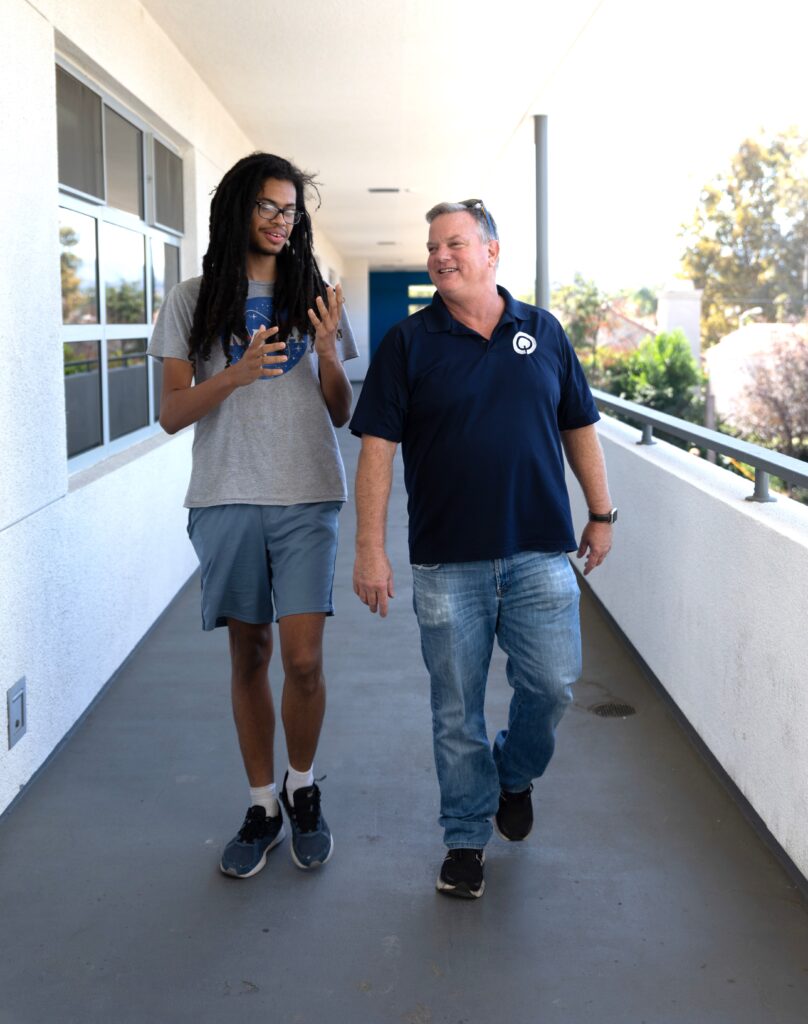
 Terrin Busby Thompson chats with Qualia School Founder Jim Hahn.                                                              Photo: Maggie Storm

Terrin Busby Thompson, a senior at Qualia: The School for Deeper Learning in Calabasas, is among the 1 percent of SAT and PSAT takers to earn recognition as a National Merit Semifinalist this year.

Busby Thompson’s status qualifies him to move on in the national competition and possibly receive one of 7,250 scholarships that together total almost $28 million.

Busby Thompson had suspected that his high-test scores might garner him this initial award in the competition, and he felt both happiness and relief after securing the honor. “I felt like my work paid off,” he said. “It’s a very well recognized award, and I hope that it will be helpful in getting me into colleges…. It definitely made me a lot more confident in knowing that I test well and could handle these high-pressure, speed questions.”

While Qualia, Busby Thompson’s innovative secondary school, emphasizes writing, problem solving and critical thinking over “one and done” testing, students have often attained high SAT or ACT scores, including a handful of perfect scores over the school’s 15-year history, according to Qualia’s co-founder Jim Hahn, who lives in Sunset Mesa.

As a deliberately small school with seminar-sized classes, Qualia provides a personal and passion-driven education that allows students to delve more deeply into standard academic subjects, Hahn said.

In addition, students in all grades take a philosophy course, designed to sharpen critical thinking and develop college-level reading, writing, and analytical skills.

In 2008, Hahn began the first iteration of the school, Areté Preparatory Academy, with five students at a West L.A. house owned by his father, Jim, a former Palisades Rotary Club president.

The school grew and eventually moved to occupy an expansive suite at an office building on Olympic Blvd., but the pandemic made the space no longer tenable in large part due to the shared air conditioning system.

Hahn and longtime friend Jon Cassie, Qualia’s co-founder, discovered an ideal new facility at 4345 Las Virgenes Blvd. in Calabasas, which was previously occupied by director James Cameron’s MUSE School.

The two-acre space offered well-appointed classrooms plus an outdoor space that could be used for classes, athletics and projects. The school moved there last year and changed its name to Qualia.

In addition to regular coursework, students enjoy Qualia’s flexible dual enrollment program. Busby Thompson, 17, has already taken 10 college classes and is enrolled in two more this school year, the post-calculus mathematics course, Discrete Structures, and C++ Programming at Santa Monica and West L.A. colleges respectively.

Busby Thompson says he prefers the style of Qualia classes though, because they allow him to explore topics that fascinate him. For example, he studies two languages, Mandarin and Japanese, and created video games that explore their cultures and mythology as part of his final projects for both classes.

In addition, he takes two music electives, band and music production, and also studies piano and saxophone outside of school, often incorporating music into his class projects.

Qualia students participate in a semi-annual philosophy-based Symposium, allowing them to delve into questions and topics that fascinate them, while learning to research, write and present in the style of an academic conference. Busby Thompson usually employs this time to research topics in astronomy and physics, two other topics that intrigue him, and he aims to find a college that will meet his need for advanced STEM work while also supporting his artistic endeavors.

Hahn, whose wife Mio is both a Japanese teacher and the director of advancement at Qualia, recently celebrated Busby Thompson’s National Merit achievement with the rest of the school with cupcakes and an impromptu party.

“It’s thrilling to see a student with such sincere and deep passions be selected for this honor,” said Hahn, whose son Diego, 17, is also a senior at Qualia, while daughter Amy, 19, a 2020 graduate, is a junior at Pitzer. “The fact that Terrin’s education has been driven by his curiosity and goals, rather than by résumé-building, makes this recognition especially meaningful.”

To garner semifinalist status, California students have to achieve higher scores than students in most other states, because the National Merit Scholarship Corporation provides the awards proportionally by state and California students as a group have higher scores than many other states.

High school juniors generally take the PSAT to earn this initial honor, although students without access to this test may take the more challenging SAT instead. Regardless, students must follow this initial success by also attaining high scores on the SAT or ACT.

About 95 percent of National Merit Semifinalists will advance to the finalist level, and they will receive notification of this designation in February. Several types of scholarships will then be awarded in the spring of 2023, including 2,500 National Merit Scholarships of $2,500 each, and corporate-sponsored scholarships of varying amounts. Students also qualify for 3,800 scholarships provided directly by colleges and universities, including some offering free tuition, room, and board.

Visit: qualiaschool.org

Posted in Kids/Parenting, Schools | Leave a comment

Local Library Offers Two Events: Writing a Novel and Baby Storytime

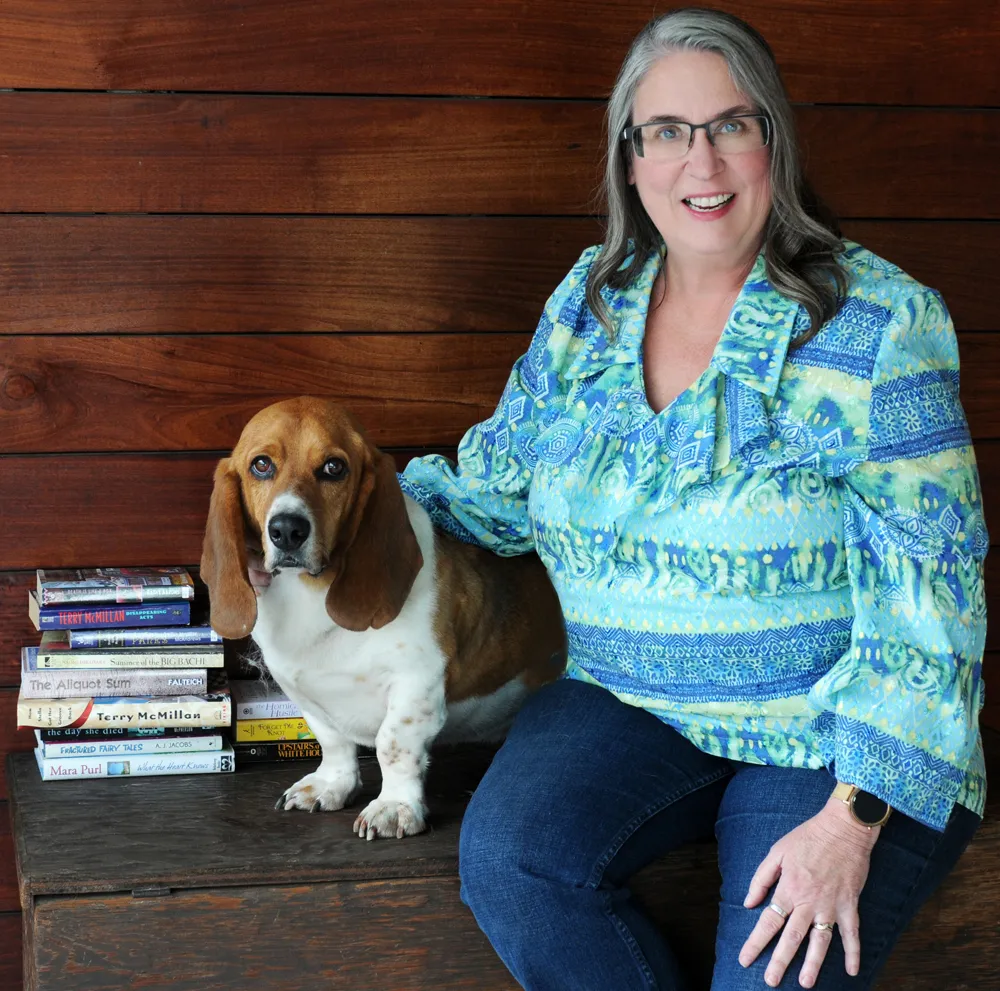
Author Anne Louise Bannon will help beginning writers with “Ideas to Story.”

National Novel Writing Month Celebrated:

The Los Angeles Public Library is sponsoring Novel Writing Month (NaNoWriMo) with a series of programs in October and November.

Funded by the Friends of the Library, every Palisadian who is writing a novel or considering writing a novel is invited for a series of workshops to help with the process.

“Ideas to Story” will be presented at 3 p.m.  on October 29, at the library, 861 Alma Real Drive with writer Anne Louise Bannon.

Bannon, who was a TV critic for more than 15 years, founded the YourFamilyViewer blog, and created the OddBallGrape.com wine education blog with my her husband Michael Holland, has authored numerous books.

She is the co-author of Howdunit: Book of Poisons, with Serita Stevens, as well as author of the Freddie and Kathy mystery series, set in the 1920s,  the Operation Quickline series and the Old Los Angeles series, set in the 1870s.

Bannon, the author of “Death of the Chinese Field Hands,” “Blood Red” and “Rage Issues” will lead participants in the process of turning ideas into a story.

After people have worked on “ideas,” the next library program will be “Outlining” at 3 p.m. on Saturday, November 5.

A write-in will be held at 7 p.m. on Tuesday, November 8 via zoom (email: [email protected] for the link).

On Saturday, November 12 at 3 p.m. an in-person writing event will be held.

Baby and Toddler Storytime:

The next Baby and Toddler Storytime is at 10:15 a.m. Wednesday, November 2. Lap-sit (or not!) storytime is for babies and toddlers and their grown-ups to all share together. One child, one lap, please.

This program is for children ages 36 months and under, accompanied by a grown-up. Due to the structure of this storytime, please show courtesy by being on time.

Posted in Books, Kids/Parenting | Leave a comment