Towering Eucalyptus Is Finally Trimmed at Sunset and Los Leones

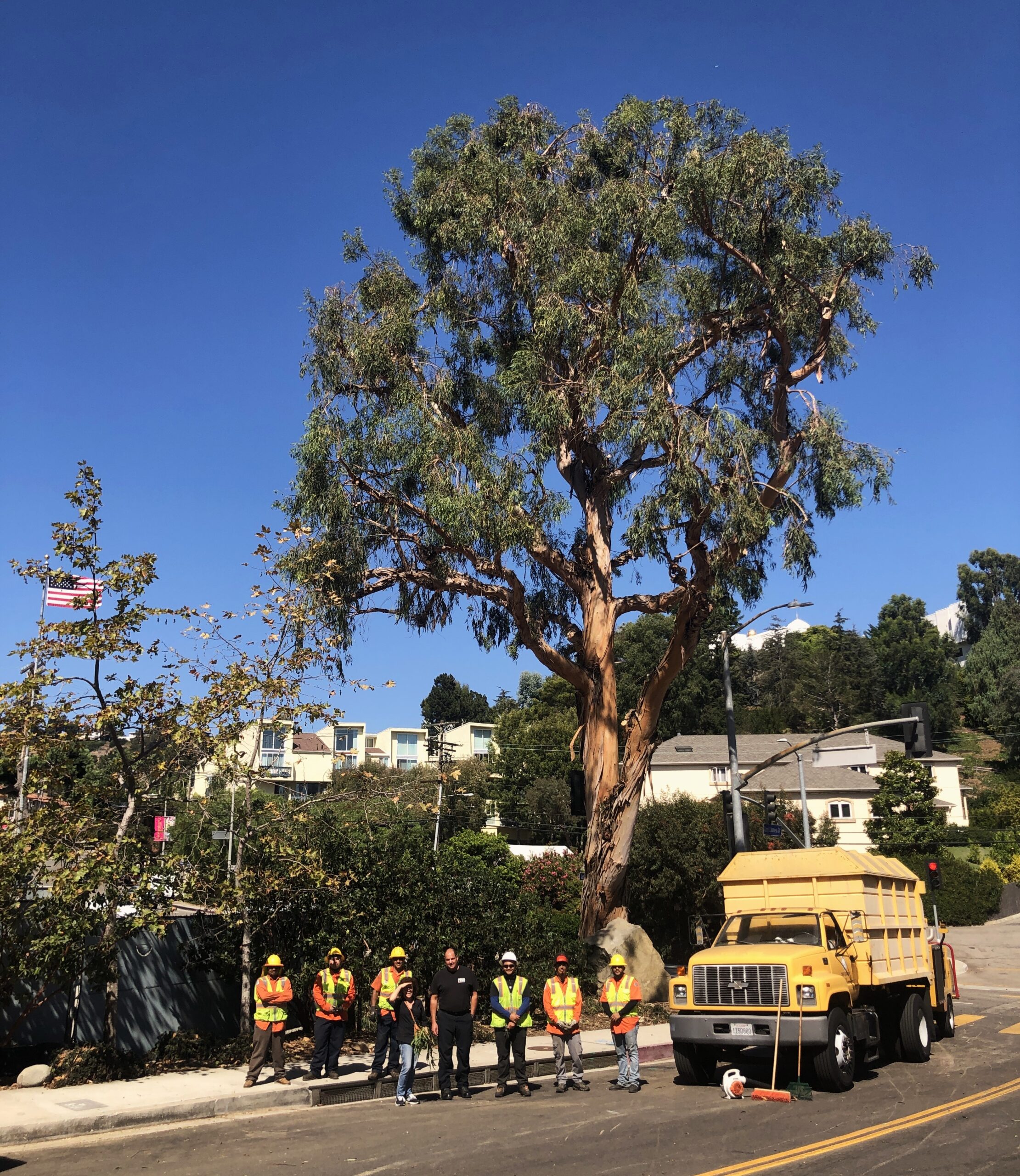
This was the eucalyptus tree at the corner of Sunset and Los Leones before trimming.

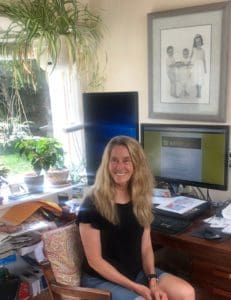
Castellammare resident Kelly Comras, a veteran landscape architect, has long been concerned about the giant eucalyptus on Sunset by Fire Station 23, just north of PCH.

“Over the last decade, the tree had become a serious hazard,” Comras told Circling the News. “Overloaded branches blocked the signal at the corner of Sunset Boulevard and Los Leones, and large branches had begun dropping without warning in the last few months.”

She contacted Noah Fleishman, Council District 11 District Director, and reached out to L.A. Street Tree Superintendent Stephen Du Prey and Tree Surgeon Supervisor Aron Hernandez.

Du Prey and Hernandez agreed with Comras’ assessment that a trimming was needed, and on Saturday, August 27, a crew from the Urban Forestry Division came out.

Six workers trimmed the eucalyptus and cut and cleaned the debris from 7 a.m. to 3 p.m., Comras reported. Five trucks, including a cherry picker and a full-size chipper, were onsite. The tree material filled a flatbed truck.

Resident Marcia Vogler said, “Thank you for getting this done! It is another example of the good that can be accomplished when we collaborate. This work contributes to the safety of so many people, and residents of Castellammare are very appreciative.”

David Card, past Community Council president and chair of the Palisades Forestry Committee said, “Great job to all who worked on this big prune. So much safer – and healthier for the tree, too. Thank you all.”

Comras also thanked members of the Palisades Forestry Committee for their support.

Eight hours later, this was the eucalyptus tree after trimming.
(Front in black) Kelly Comras and David R. Cohen, Captain, Los Angeles Fire Department, FS 23. and Aron Hernandez: Left to right: Alex Alcaraz, Miguel Barajas; Pablo Sanchez; Ernesto Sepulveda; Brian Cazares; Rolando Soto;

Posted in Community, Environmental | Leave a comment

Will He or Won’t He Sign the Bill into Law?

Governor Gavin Newsom has until the end of September to sign or veto bills. On August 31, he asked the state to use flex alerts in the afternoon to conserve energy, during the on heat wave.

The California legislative session is over, and Governor Gavin Newsom has until the end of September to either sign or veto bills. Circling the News invites readers to pick their favorite “possible” new law.

BOOSTING PAID FAMILY LEAVE:

Senate Bill 951 would increase payments to workers from the state’s disability and paid family leave programs. Starting in 2025, workers who earn less than about $27,000 a year would be paid 90% of their regular wages, an increase from the current 70%. The bill would offset some of these costs by removing a cap on workers’ contributions to the program, which currently shields earnings above $145,600.

FAST FOOD WORKER’S SALARIES:

Assembly Bill 257 would create a state-run council to set labor standards across the fast foot sector. The council would be allowed to raise the minimum hourly wage to as high as $22/hour by the end of 2023. The current minimum wage in California is $15/hour for employers with 26 or more employees, and $14/hour for employers with 25 or less.

BUILD HOUSING ON STRIP MALLS:

Assembly Bill 2011 would fast-track housing development along strip malls. It would be allowed to skip CEQA, if apartments are either 100 percent affordable or mixed-use.

Senate Bill 6 would allow housing on commercial real estate provide if developers use at least some union labor on every project. Both bills would take away local control over projects.

KIDS PRIVACY ONLINE:

Assembly Bill 2276 would be a first-in-the-nation law requiring broad privacy protections online for children under 18,  starting in 2024.

INTERIM GOALS FOR 100 PERCENT CLEAN ENERGY:

Senate Bill 1020, authored by state Sen. John Laird, sets interim targets for generating clean energy. The current law already requires 100% of retail electricity to be fueled by renewables such as wind and solar by 2045. This change requires 90% by 2035 and 95% by 2040. In addition, all state agencies must source their energy from 100% renewable sources by 2035, ten years sooner than the current law requires.

COVID DISINFORMATION:

Assembly Bill 2098 would make it easier for the Medical Board of California to punish doctors who deliberately spread false information about COVID-19, vaccines and treatments. The bill, authored by Cupertino Democrat Evan Low, would classify disinformation as “unprofessional conduct,” allowing the board to take action. Discipline could include a public reprimand, probation, suspension, or license revocation.

CLEARING CRIMINAL RECORDS:

Senate Bill 731 would, as of July 1, expand criminal record relief for all felonies, not just jailable felonies, if an individual is no longer serving a probationary sentence, not currently involved in another case, and two years have elapsed. The bill does not exclude violent criminals, and law enforcement and medical groups oppose the bill.

NURSING HOME LICENSING REFORM:

Assembly Bill 1502 would close loopholes that prevent people from purchasing nursing homes before they have a license to run them. Advocates on both sides of the bill have for years called for reform of the licensing system. They want to see better state oversight of who owns and operates nursing homes in the state.

EASIER FARMWORKER UNIONIZATION:

Assembly Bill 2183 would allow farmworker to vote in union elections by mail, rather than the current in-person election system.

STUDENT HOUSING VERSUS CEQA:

Senator Scott Weiner authored Senate bill 886, which would excuse public college and university housing regulations from the California Environmental Quality Act (CEQA).

LIMITING SOLITARY CONFINEMENT:

Assembly Bill 2632 would not allow prisoners to be held in solitary for longer than 15 consecutive days, or 45 days in a 180-day period. The bill would also prohibit the California Department of Corrections and Rehabilitation from putting certain groups in solitary confinement, including inmates younger than 26 or older than 59, pregnant people or those with mental or physical disabilities.  (Editor’s note: the only “people” who can carry a baby are biologically female—but that person can identify however they want and use whatever pronouns they choose.)

FEWER REMEDIAL COURSES AT COMMUNITY COLLEGE:

Assembly Bill 1705 wants more community college students to enroll in classes that transfer to a UC or Cal State campus, doing away with the remedial math and English. Following a 2017 change in the law, most students started taking gateway courses to eventually get into a UC or CSU, but still thousands — about 20 percent of first-time students   — still take remedial courses.

CELL FEE TO FUND 988 CRISIS HOTLINE:

Assembly Bill 988 would raise funds to support call centers and mobile crisis teams associated with 988, the new three-digit federal mental health crisis hotline. In July, the new federal 988 number debuted across the country. The number, billed as an alternative to 911, is intended to make it easier for mental health emergencies. But to build out the system, proponents of the cell phone fee say the state needs ongoing funding.

HUMAN COMPOSTING – ENVIRONMENTALLY FRIENDLY:

And you thought that coffee grounds were the only thing good for the soil? Assembly Bill 351 would legalize natural organic reduction, aka turning bodies into soil after death.

The National Funeral Directors Association estimates that about 67 percent of people were cremated in 2021. Cremating one corpse can release almost 600 pounds of carbon dioxide into the atmosphere. Supporters of the bill say if each Californian opted to be composted after death, the carbon saved would be enough to power 225,000 homes for a year. It would take effect in 2027.


Ten states have a full-time legislature: Alaska, California, Hawaii, Illinois, Massachusetts, Michigan, New York, Ohio, Pennsylvania and Wisconsin. That means that in 40 states, legislators meet part-time and seem to be doing well. Maybe its time for California to go part-time?

But then, how could California residents do without a law about introducing rap lyrics at a trial?

See if Newsom signs Assembly bill 2799. Based on the book “Rap on Trial,” a study showed people were read identical song lyrics, but half were told they were from a country song and half were told they were rap. Participants in the study rated the rap lyrics more offensive—which means according to the bill, jury would be more likely to convict someone if rap lyrics or other artistic expression are relevant to the case.


Posted in Community | 2 Comments

Circling the News Celebrates 1,000 Newsletters

Sue Pascoe (left) being held by Grandmother Cora Larson and her sister Nancy being held by Grandmother Agnes Sazama. CTN Editor had strong “prairie women” role models.

And just like that . . . .Circling the News will post its 1,000th newsletter tonight, September 1.

The first story I wrote in June 2018 was a Viewpoint about the Community Council election (“Community Elections: Same Old, Same Old”). I observed: “The Pacific Palisades Community Council never fails to disappoint. Just when there was an opportunity to make a change and bring in new people, the old guard elected to be ‘stewards of the community’ by reducing, reusing and recycling, during the officer election on June 14 at the Palisades Library.”

Over the next few months, I wrote about Norris Hardware closing, the firing of Editor John Harlow from the Palisadian-Post, a Theatre Palisades review “Write Me a Murder,” and the replacement of both gym floors at the Rec Center with a donation from the L.A. Clippers.

I also wrote (“Out of Work, Again. New Beginnings: New Jobs”) about why I started CTN.

“After working at the Palisades News for about four and a half years (and the Palisadian-Post eight years before that), I have been touched and feel deeply supported by the number of people in the community who have expressed concern about my unemployment. Those people know how much I love writing and how strongly I feel about the organizations in town.

“On so many levels, Pacific Palisades is a community of deeply caring individuals, and I thank you all for your ongoing support.

“There are the  general platitudes to help one through the unexpected, such as ‘When one door closes, another opens’ (but what if the opening door is a closet?) or ‘Success consists of going from failure to failure without loss of enthusiasm’ (glad I’m getting all of these failures out of the way while I can still chew my own food) or ‘Don’t cry because it’s over, smile because it happened’ (leave it to Dr. Seuss to say that) or ‘There are two mistakes one can make along the road to truth. . .not going all the way, and not starting.’ Maybe I shouldn’t use Waze for road advice.”

I concluded: “Let’s live Maya Angelou’s quote – “Laugh as much as possible, always laugh. It’s the sweetest thing one can do for oneself and one’s fellow human beings.”

At Circling the News, I have enormous gratitude for people who have edited my work, such as Bill Bruns and Rosalie Huntington. I am thankful for all the writers who have contributed including Bob Vickrey, Pepper Edmiston, Libby Motika, Laurel Busby, Alan Eisenstock, and my latest contributors Alison Burmeister, Chaz Plager and Reece Pascoe.

I’m happy to have become friends with the editor of the Westside Current, Jamie Paige, as we both continue to draw attention to stories on the Westside that are not covered by the L.A. Times, but matter to the people who live here.

Sue PascoeAnd I’m especially thankful for you, the readers, who not only read, but continue to give me stories to investigate, and also question my viewpoints. I thank everyone who has contributed.
As I start on the next 1,000, with 1,001 set to come out on September 5 (I’m taking Sunday, September 4 off), I give you the words from a commencement address by Steve Jobs in 2005:

“Your time is limited, so don’t waste it living someone else’s life. Don’t be trapped by dogma — which is living with the results of other people’s thinking. Don’t let the noise of others’ opinions drown out your own inner voice. And most important, have the courage to follow your heart and intuition. They somehow already know what you truly want to become.”

Posted in General | 10 Comments

Emergency Cooling Shelters Opened: This One is Empty

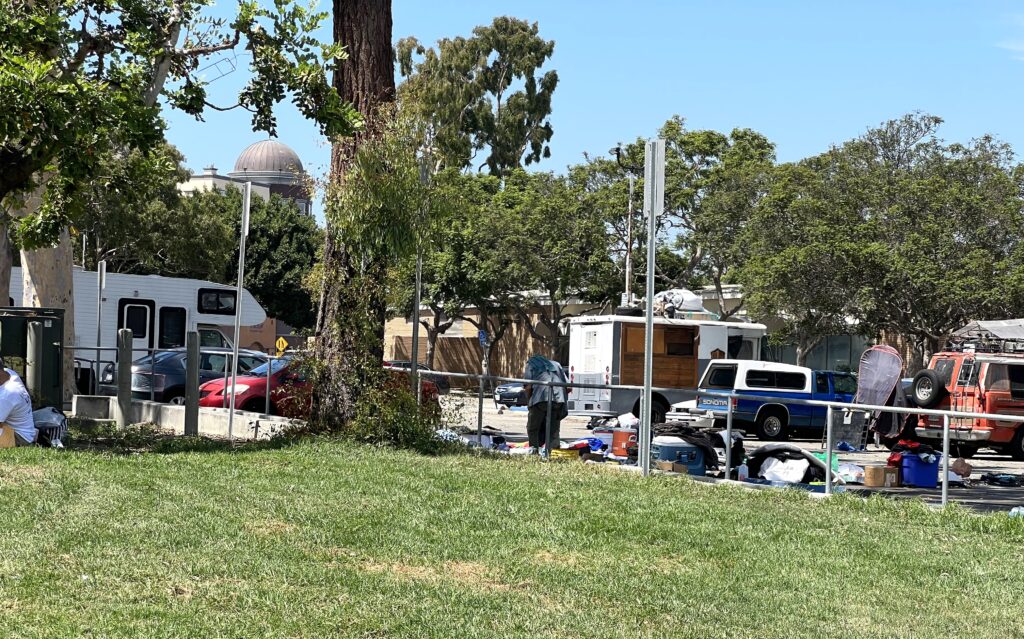
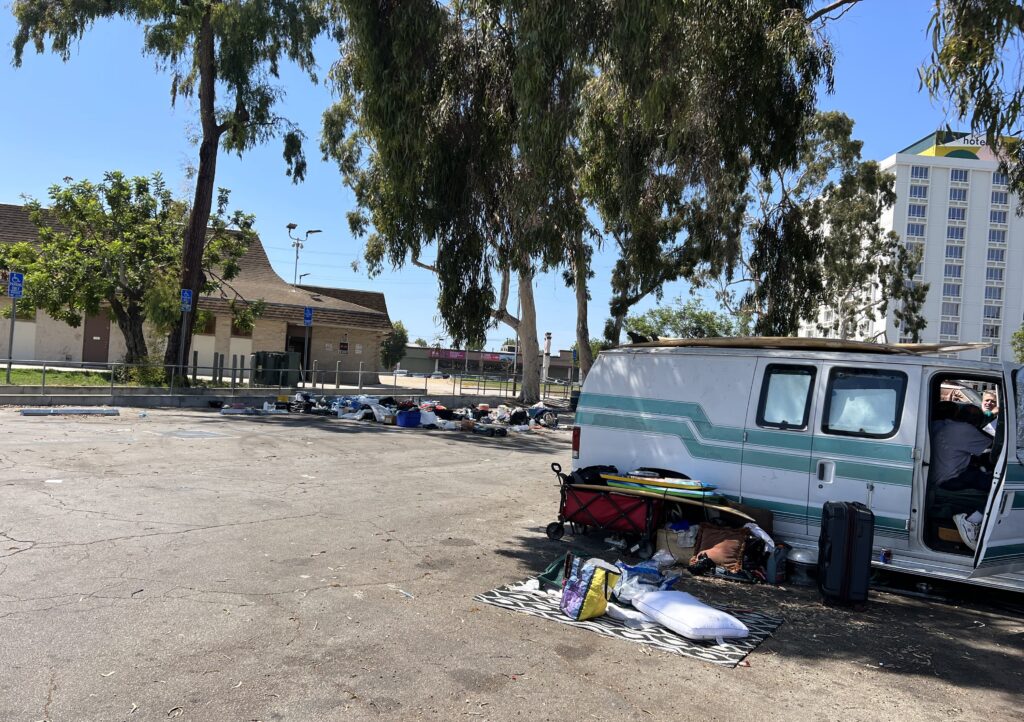
The parking lot by the Westchester Senior Center is filled with garbage. Councilman Mike Bonin’s office is the brick building across the lot in the corner.

The interior of the sole cooling center on the Westside of Los Angeles, the Westchester Senior Center, was clean and cool on September 1 when CTN signed in. This editor’s name was only the second on the list.

Although the temperature outside was nearly 100 degrees, and many who live on the Westside don’t have air conditioning, the room was empty.

Recreation staff thought they might get five people through the weekend, into Monday. That would be five people over four days.

The 100+-degree temperatures are some of the hottest of the year and are expected to last into Monday. Pets are welcome with their owners at the cooling centers, if the dog is on a leash. Why was this cooling center empty?

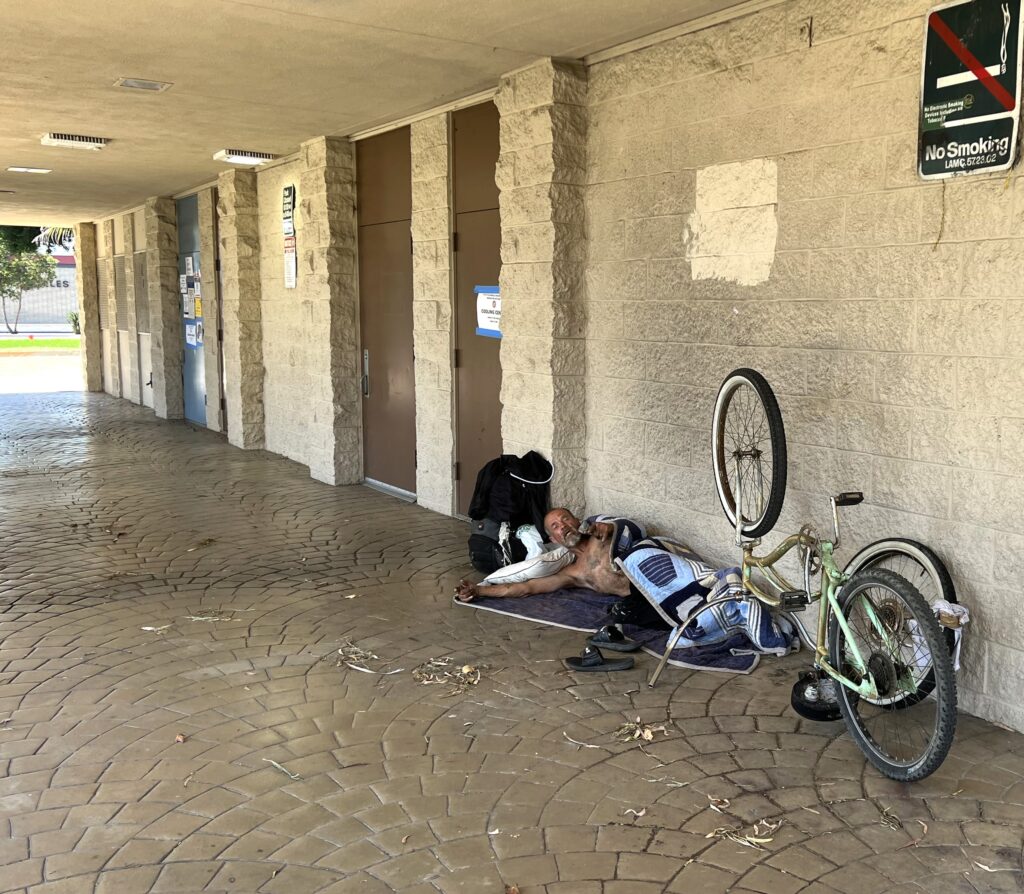
To get to the front door, one had to go around a semi-naked man. This is a man who has been offered help, but refuses.

This man is near the entrance of the cooling center (blue door). He has been offered help, but refuses.

The parking lot was filled with trash and broken-down RVs. There seem to be additional vehicles since CTN visited two weeks ago. No one seems to know where they’re coming from.

A five-year resident, who drove through the parking lot, as she was trying to get to the library, said “I know elderly people who don’t want to come because the parking lot is so dirty. It smells like urine.”

The senior pointed to the piles of trash and the broken-down vans. “My family doesn’t want me to come because they say it’s not safe.

“It’s so sad, it used to be really nice,” she said, and pointed to the handicapped parking spaces in front of the senior center, which were filled with litter. “People with mobility issues don’t have any place to park.”

She pointed to a van and said, “That vehicle dweller is really mean.”

An RV vehicle and its owners two cars took up eight spaces in front of the library – leaving only parking spaces between people living in cars or vans. “Seniors would rather go to Playa Vista than here,” she said.

The resident was asked if she had contacted Councilman Mike Bonin, whose office is on that property in the same parking lot. “I have emailed him, but no response,” she said. “That Bonin will not do anything.”

Another resident said that the County Health Department had been contacted about the rats, cockroaches and jugs of human urine that are found in the parking lot.

To access the cooling center, one needs to walk around a pile of garbage.


Posted in City/Councilman Mike Bonin, Councilman Mike Bonin | Leave a comment

Pets Are Slammed by the Heat: Keep them Safe

Dogs with short noses or snouts, like the boxer or a bulldog, are especially prone to heat stroke.

Pacific Palisades and Southern California are being slammed by unseasonably high temperatures. The heat came in Wednesday afternoon, setting records across Southern California.

According to the American Red Cross, heat stroke is a common problem for pets in warm weather. Dogs with short noses or snouts, like the boxer or bulldog, are especially prone to heat stroke, along with overweight pets, those with extremely thick fur coat or any pet with upper respiratory problems such as laryngeal paralysis or collapsing trachea.

Signs of heat stroke in your pet are:

*Heavy panting and unable to calm down, even when lying down

*Brick red gum color

*Fast pulse rate

*Unable to get up

The American Red Cross offers the following tips for keeping pets safe:

  • Never leave your pet in a hot vehicle, even for a few minutes. The inside temperature of the car can quickly reach 120 degrees even with the windows cracked open.
  • Limit exercise on hot days. Exercise in the early morning or evening hours.
  • Walk your pet in the grass, if possible, to avoid hot surfaces burning their paws.
  • If your pet is outside, make sure they have access to shade and plenty of cool water.
  • Water safety is important for your furry friends. Do not leave pets unsupervised around a pool—they aren’t all good swimmers
  • Watch your pets at a backyard barbecue. Keep them away from the grill and know that some food can be poisonous to them. Avoid raisins, grapes, onions, chocolate and products with artificial sweeteners.

The American Veterinary Medical Association adds that “leave your pets at home if possible when you need to go out and about, and provide different temperature zones within your house for your pet’s comfort.”

Posted in Animals/Pets | Leave a comment

Dome Traps the Heat: California Is Baking

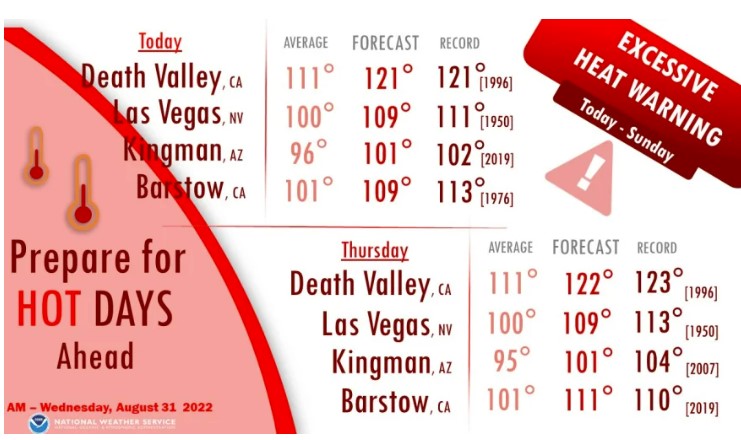
From San Diego to Sacramento, California is under an excessive heat warning that could extend into next week.  The National Weather Service calls it “dangerously hot conditions.”

The manager of the state’s power grid, called for a Flex alert on Wednesday that most likely will continue through the weekend. Consumers are urged to conserve as much electricity as possible from 4 to 9 p.m. and urged not to charge electrical cars during that time and keep thermostats set at 78 degrees or higher.

A high-pressure system over California and Nevada will trap heat, similar to an insulated dome, and will likely result in high-temperature records.  It was predicted that Woodland Hills could reach 105 on Thursday and reach 110 by Sunday.

Pacific Palisades, which has temperatures generally in the 70s in the summer, reached 91 degrees on Wednesday and was a balmy 85 on Thursday at 5 p.m. The hottest days are predicted for Saturday, Sunday and Monday, but the 10-day weather forecast looks like the heat won’t start to dissipate until Thursday, September 8.

UCLA climate scientist Daniel Swain told the L.A. Times that “When you’re inside of a high-pressure system, particularly a strong one, you generally have downward motion in the atmosphere, as opposed to upward motion … and that suppresses clouds,” Swain said. “It results in clear skies, so you get more solar radiation, more warming of the surface.

If you must be outside, reschedule exercise or other strenuous activities to early morning or evening. Be aware that heat exhaustion or even heat stroke is possible. This might be a good time to take a week off.

Additionally, people are warned that excessive alcohol consumption in hot weather, can lead to dehydration. And dehydration can lead to confusion, lethargy and problems with your breathing and heart rate.

Drinking alcohol can increase dehydration during heat spells.

According to the Cleveland Clinic (“The Risks of Mixing Alcohol and Summer Heat”), “To counteract the dehydration risk of alcohol, drink 8 to 12 ounces of water for every alcoholic drink,” dietitian Julia Zumpano said. “It slows your alcohol intake, keeps you hydrated and can mitigate negative hangover effects.”


HEAT EXHAUSTION SYMPTOMS:

  1. Faint or dizzy,
  2. Excessive sweating
  3. Cool, pale, clammy skin
  4. Nausea, vomiting
  5. Rapid, weak pulse
  6. Muscle cramps

What to do:

  1. Moved to a cooler location
  2. Drink water
  3. Take a cool shower or use cold compresses.

HEAT STROKE SYMPTOMS:

  1. Throbbing headache
  2. No sweating
  3. Body temperature above 103
  4. Nausea, vomiting
  5. Rapid, strong pulse
  6. May lose consciousness

How to Treat it:

  1. Get Emergency help
  2. Keep cool until treated


Posted in Environmental, Geology/Dinosaurs/Earth, News | Leave a comment

PaliHi Band Prepares for Competition Season

Palisades High School band instructor Peter Ye (left) works privately with students.

By CHAZ PLAGER

School is back in session, and the unchanging traditions of the fall semester stand firm, such as marching band. Those who live near Palisades Charter High School can often hear the PaliHi band practicing in the evening at the Stadium by the Sea.

However, the fall winds also bring with it new changes for the band. After three years as the leader of the music program, Tyler Farrell has taken an administrative position at the school, and Peter Ye has taken his place.

This doesn’t seem particularly consequential at first glance, but perhaps understanding the depth of the Pali marching band will put that into perspective.

The full marching band and color guard consists of 45-50 members, and as the semester is just beginning, those numbers are subject to change. To participate in competitions, it is roughly $3,000 to transport and feed the team per event.

This year there will be competitions on October 8 (Ayala High School), October 29 (El Camino College), November 12 (Trabuco Hills High School) and November 19 (Chaffey High School).

Annually, the cost of the marching band program reaches over $100,000, which includes costumes, and pays salaries for coaches, including the color guard coach Allison Wyant and percussionist coach Mike Schlatter.

The school does not fund the program, but this year for the first time, a new PaliHi bus policy will ensure that transportation to competitions is partially funded.

The music program still relies on “Fair Share” donations from the band members to make up the difference.

Ye comes into the midst of this program, after a serving last year as a student teacher under Farrell.  He was a music education major at the UCLA Herb Albert School of Music.

Growing up in Oak Park, Ye began playing piano when he was six. He tried oboe in middle school, and then switched to percussion. In high school, he was not only the drum major of the marching band, but also played in the jazz band.

He has worked with renown conductors Robert Ponto (Oregon University) and Anthony Maiello (George Mason University) and studied conducting under Maestro Neil Thomson (Orquestra Filarmônica de Goiás) and Dr. Scott Weiss (University of Southern Carolina) at the LA Conducting Workshop and Competition, where he was a semi-finalist.

More importantly, band members seem to have taken a shine to him. One member said about Ye, “He’s the GOAT, for real, no cap.” Translation: students like him.

The competition show for the marching band this year is titled “Out of Darkness,” and was written by Farrell and Slatter, and the music comes from a variety of genres.

Farrell said the theme of the 2022 show is “leaving the darkness and entering the light”, and choreography and music will reflect that.

When asked what the hardest part is about performing at a high level in marching band Ye said, “It’s that you only have one chance – you just keep practicing for only one shot, and when you get out there you leave it all on the field, and if you didn’t get it right, that’s too bad.”

Ye supported by a star cast of student musicians – and with Ye, Farrell and Slatter involved, it’s safe to say that the Dolphins are in “good fins.”

If a resident would like to support the band or music program at Palihi, visit: https://www.palihighbands.com/

Posted in Kids/Parenting, Music, Schools | Leave a comment

Student Loans Versus Paycheck Protection Program


A reader attacked those who took out PPP (Paycheck Protection Program) loans, saying they were the equivalent of student loans.

Comparing the two loans is like saying baseball and football are the same sport because they both use a ball. Below is a summary, The Wall Street Journal, in an August 31 article (“Biden Attacks PPP Loan Recipients”), explains the difference in more detail.

This was a site common across the country as businesses were told they needed to shut down. 
(AP Photo/Nam Y. Huh)

PAYCHECK PROTECTION PROGRAM:

The Paycheck Protection Program (PPP) was part of the CARES Act of 2020 and ran from April 3 through August 8, providing $525 billion in government-guaranteed, forgivable loans (essentially grants) to businesses with 500 or few employees, which account for 47 percent of private-sector employment.

Recipients were required to spend 60 percent of their loan on payrolls. Many may remember that small businesses across the country were ordered by the government to shut down during the pandemic.

PPP money was for the payroll, keeping people in jobs and off unemployment. Those loans were forgiven provided most of the money went to payrolls.

There were some problems with PPP. The program relied on big banks as preferred lenders—which many small businesses did not have access.

There were high rates of fraud, with an estimated 15 percent of PPP loans going to fraudulent borrowers, which were overwhelmingly service by online financial technology or fintech firms.

Interestingly, according to a May 2022 Americans for Financial Reform [“Report: Lessons Learned from the Paycheck protection Program”] in California, 99 percent of franchised McDonalds locations received PPP funds. In the first 15 months of the pandemic McDonalds’ franchisees in California received at least $246.4 million in PPP Loans.

According to a September 2020 Brookings article [“Has the Paycheck protection Program Succeeded?”] “The program succeeded in its short-run goals, including helping smaller firms withstand sharp revenue declines during the [government] shutdown and keeping workers connected to their employers.”

But added, “Treasury’s muddled management of PPP’s implementation is noteworthy because of its failure to take seriously the advice it was given by a range of private-sector participants and policy experts, leading it to make mistakes that were both forecastable and forecasted.”


STUDENT LOANS:

The college cost of attendance for California’s Claremont McKenna for the 2022-23 year is approximately $82,127. But there is a climbing wall for students to explore.

Student loans means a person took out a loan voluntarily to attend school in exchange to repay it from a future income. According to the Association of Public and Land-Grant Universities, on an annual basis, median earnings for bachelor degree holders are $36,000 or 84 percent higher than those who have a high school degree.

College degree holders are half as likely to be unemployed as those with only a high school degree.

CTN’s editor volunteered in Palisades Charter High School college center for a few years, helping with essays.

One particularly brilliant woman had been accepted to all of the Ivy League Schools, but elected to go to Arizona University, where she had a full scholarship. Simply, her parents couldn’t afford the top tier schools, and she didn’t want the debt when she finished.

Another student was accepted into several top-ranked private universities but elected to go to Santa Monica College for two years. Once again, the student’s choice was a financial consideration.

This editor had no further contact with either student—it would have been interesting to see if they regretted the decision. I remember them specifically because so many other students either had parents who could afford the name college or planned to take out loans.

Biden’s proposed student loan forgiveness plan includes up to $20,000 in federal student loan forgiveness, an extension of the student loan payment pause and a proposal for a new income-driven repayment plan.

One is eligible for money back if you earn less than $125,000 annually (or $250,000 for household).

And if a person’s student loans are currently in default, the person still might qualify.

The August 31, WSJ (“Way More than $10,000 in Debt Forgiveness”) explains that another aspect of the program is allowing borrowers to repay their loans as a percentage of their income over a fixed period.  “The Penn-Wharton model suggests that this feature [income directed repayment] could cost as much as $450 billion over the next decade.”

Many readers may remember that this editor repaid a $5,000 loan that I needed for medical school. When I dropped out, I didn’t have the money necessary to repay the loan, so I waitressed.

In an August 2022 Forbes story [“Student Loan Forgiveness FAQs: The Details, Explained,”] reported that “Am I eligible if I never graduated or am still in school? Yes, if you never finished your degree or are still in school, you can still qualify as long as your loans were disbursed by June 30, 2022.”

Where do I apply?


Posted in businesses/stores | 5 Comments

After Losing ADA Money Last Year, Attendance Policy Is Reinstated at PaliHi

Palisades High School is reinstituting an attendance policy.


If Palisades residents thought they saw a large number of high school kids walking around the Village last year during the school day or hanging out in the park at the Palisades Recreation Center, they were right.

The attendance policy had been suspended at Palisades Charter High School because of the pandemic.

PaliHi Executive Director/Principal Pam Magee said at the Board of Trustees meeting on August 23, “Attendance was a huge problem last year for teachers and students.”

Financial officer Juan Pablo Herrera said, “We lost $1 million last year because of attendance – low attendance rates.”

For the teachers, low attendance made instruction difficult and trying to help students with make-up assignments, meant “I was up to midnight every night trying to grade old assignments.”

One teacher in urging for passage of the policy said, “Twenty-five percent of seniors last year were chronically absent.”

Another teacher said, “I taught seniors last year and it was common to have at least a third gone.”

In addition to a correlation between good school attendance and student achievement, starting in 1998, school districts receive State funding only for students who actually ATTEND school. The state excluded excused absences from ADA for funding purposes.

PaliHi receives $64.85 per day per student. For students who English learners, foster youth or low income, the school receives $77.82 a day (but that’s less than 30 percent of PaliHi’s population).

Prior to Covid, enrollment was at 3,030 and with a 96 percent attendance rate, the ADA was based on 2,907 students.

In 2021-2022, enrollment was at 2,960 and the ADA was 2,779 (93.8 attendance rate).

The projected enrollment for 2022-23 is 3,000 and the ADA is projected for 2,820 (94 percent attendance rate).

Although teachers understood the financial implications, they were more worried about the message that lack of accountability was sending. “Students need boundaries – some are going to college and others will work next year,” a teacher said.

Another added, “It was egregious last year. Students were gone on vacations. We need to put something in place. We need to hold people accountable. Teachers don’t want another free-for-all semester.”

The proposed policy would require a student who is absent to provide a verification note within three days of an absence to the school. If no note is provided, the student will be considered truant.

A student will face further consequences if he/she has is absent three full times in a year with no note or is tardy for more than 30 minutes without a valid excuse. The student on the board thought that seemed harsh, but then was quoted the California Truancy law [Ed Code 48260 (a)] which states “that students are deemed truant following three unexcused absences and/or tardies for more than any 30-minute period during the school day.”

PaliHi students with three or more unexcused absences from any one course during a grading period could be subjected to ineligibility in extracurricular activities, such as prom and graduation.

The student representative, said the policy was too strict, that students should be allowed more than three days to get a note in and asked for seven days and no tardy sweeps.

He said the tardy sweeps were unfair because if someone were a little late, they would just go up to the village skipping the first class. That way they wouldn’t have to spend their lunch hour in detention, which is the standard punishment for being tardy (three tardies = one absence).

A parent on the board agreed that tardy sweeps should not be implemented because before the change of school time (from 7:50 to 8:30 a.m.), “it used to take 25 minutes to drive here. But now with the later start time, it takes 45 minutes,” she said. “Coming into school is a nightmare.”

Another board member commiserated with the parent, but pointed out that traffic is bad in Los Angeles and whenever she has to go someplace, she leaves early.

It was decided that students would have five days to provide a note for an absence. Tardy sweeps would return, and the policy would be reviewed by the Board after 60 days.

The State of California Education Code requires that every person between the ages of 6 and 18 attend school full-time, unless exempted. Therefore, schools are required to have written documentation for student absences and to record such absences as excused or unexcused.

The approved policy can be viewed on the Palisades High School website. https://www.palihigh.org/apps/pages/index.jsp?uREC_ID=411331&type=d&termREC_ID=&pREC_ID=962798

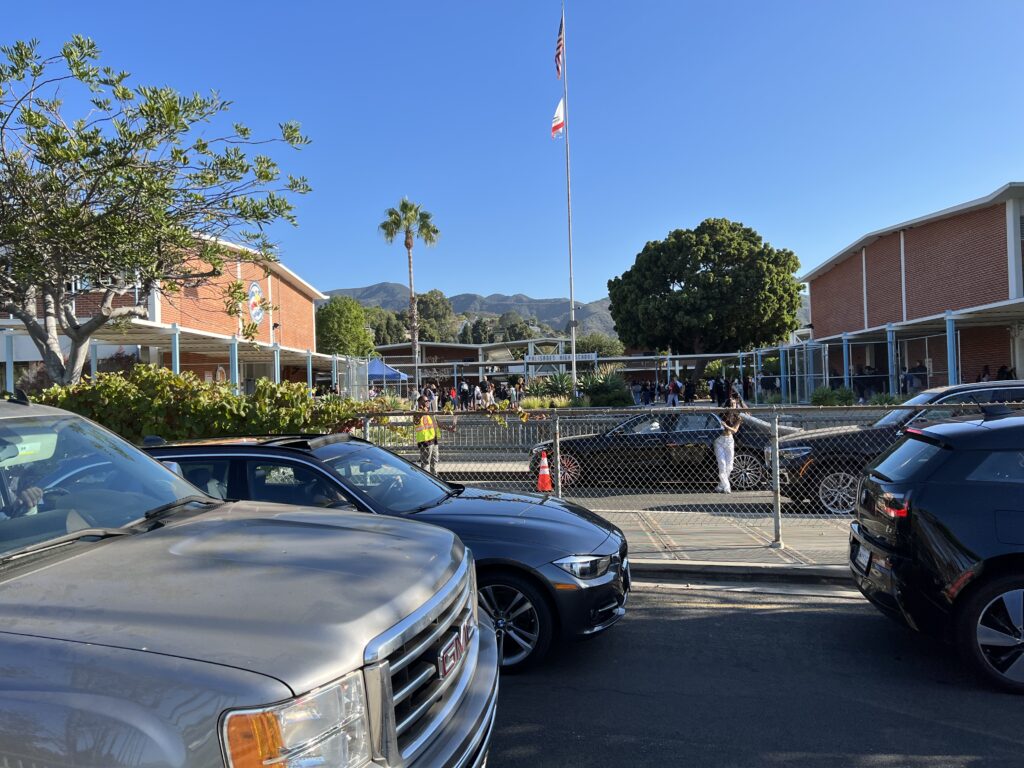
With Temescal Canyon Road as the sole entrance to the Palisades High School, traffic in the morning is always heavy.

Posted in Kids/Parenting, Schools | 1 Comment

August 31 Park Closure Alert for Caroline Byfield’s Memorial

The parking lot at the Palisades Recreation Center, 851 Alma Real, will be closed all day on Wednesday, August 31. The baseball fields will also be closed to the public that day. The playground and tennis courts will be open.

A celebration of life for a beloved teacher/administrator at Village School, Caroline Byfield, will be held.

According to The Village School website, Byfield was wife of Bryan and the mother of two elementary-aged children. She was a champion for the Village School Community.

She received her bachelor’s degree in psychology from Reed College in 1999 and her master’s degree in elementary education from Bank Street College, in New York City in 2003. She immediately jumped into teaching, first at San Diego Cooperative Charter School and then at Rhoades School in San Diego.

She came to Village School in 2010 as a sixth-grade teacher, replacing the retiring Marilyn Frost.

Her enthusiasm and expertise, saw her promoted to curriculum coordinator the following year.

A favorite among teachers and administrators, she seamlessly moved into the role of a principal. She then worked as the assistant head of school under John Evans, until her death at the end of the 2022 school year.

Former head of school Nora Malone, who retired in 2020 said, “She was an incredibly fine educator – brilliant, creative and fully invested in the Village community. We were so fortunate to have her there.”

The website noted that Caroline was a “visionary, innovator, and brimming with humor, and always responded from her caring heart, astonishing intellect, and the wisdom gleaned from many years of experience. She shaped and directed curriculum at Village for more than a decade, introducing signature programs along the way that include the establishment of the Upper Division, the refinement of our approach to STEAM, and the tangible incorporation of social emotional dynamics, TK-6th Grade. Her touch has made a difference in every aspect of the Village experience for students, their families, and our outstanding faculty.

“Caroline believed that outstanding teaching begins with an outstanding faculty – teachers radiating joy when witnessing student success, from the seemingly small achievements to the truly awesome feats. A comfortable, confident, engaged young person is one who is prepared and eager to learn, and Village teachers create a safe and inspirational environment in which to discover and stretch, academically and socially.

“The Caroline Byfield Faculty Professional Development Fund has been established as a living memorial to a wonderful educator and leader, recognizing her commitment to academia and to our students’ futures. With the support of the fund, teachers will continue to stretch their intellects and practices — and continue to bring home Caroline’s love for state-of-the-art teaching and the wellbeing of our students.”


Posted in Obituaries, Schools | 2 Comments