PaliHi Wins Charter Bowl, Defeating Granada Hills

Pali’s offensive line provided Quarterback Jack Thomas (hidden behind Granada’s 84), time to pass.

“Redemption,” said Palisades High School Football Coach Dylen Smith. “We have one redemption. Now we go for another next week.”

PaliHi beat Granada Hills 42 to 28, claiming the Charter Bowl Trophy. The 2024 game was supposed to be held in the San Fernando Valley, but with the heat, the game was moved to the Palisades and the Stadium by the Sea on September 6.

Last year the Dolphins lost to Granada 26-10. The upcoming game Smith referenced is the Sunset Showdown between Brentwood and Pali. Last year, Brentwood won 43-24. One down, one to go for final redemption.

Despite the final score, the Charter Bowl was close through the last quarter.  Granada Hills scored at the beginning of the fourth bringing it to a touchdown difference, with Pali up 35 to 28. Penalties against Pali and then a fumble gave the Highlanders the ball on their own 48 with four minutes left in the game and a chance to tie it.

The Pali defense stepped up and held them. Connor Petoyan made a key tackle, preventing the Highlanders from a first down and the Dolphins took over on the 43-yard line.

Pali tried to run it down the field, but penalties and a personal foul against the Dolphins pulled the ball back to the Highlanders 36. (During the game, the Dolphins lost 125 penalty yards compared to Granada’s 20.)

Quarterback Jack Thomas, who was credited with 309 passing and 61 rushing yards, is a threat. He has a bullet for an arm, can read the field and is good at scrambling. He ran the ball to the Highlanders 18. A personal foul against the Dolphins, left them at third and fifteen. A 20-yard pass to King Demethrius, resulted in Pali’s final touchdown.

Although Pali led during the game, it was back and forth with both teams scoring.

In the first two minutes of the game, a quick TD with a 67-yard touchdown pass from Thomas to Demethrius put Pali on the scoreboard. The two-point conversion was good.

The Highlanders exclusively used a running game.  With three minutes left in the quarter, they scored their first T.D.: the 2-point conversion failed.

At the end of the first quarter, Pali after setback with penalties found itself on the Highlanders 32-yard line in a first- and 20-yard situation. Thomas with two quick passes, first to Max Hejazi and then to Demethris put the Dolphins on the one-yard line. The second quarter started with a TD, when Deveron Kearney ran it in.

Both teams found the endzone before halftime, Thomas passing to Lehenry Solomon and then to Hejazi who caught the TD.

After a kick-off, Granada started on its own four-yard-line. Two plays later they were on the 43 and then a long run by the Highlanders took it to Pali’s one-yard line and then a touchdown. The two-point conversion was good, making the score 22-14.

The Highlanders scored their next touchdown after a 73-yard run with two minutes left in the half. The conversion failed.

Pali’s final TD before half came on a 56-yard touchdown pass to LeHenry Solomon. He would also score a rushing TD in the third quarter.

Leading with tackles for the Dolphins were defensive players Jake Treibtch (16), Rowan Flynn (14) and Nico Townsley (13).

PaliHi and Granada Hills have a long history and first met in 1977, when  the Highlanders edged the Palisades 28-27, under quarterbacks John Elway and Jay Schroeder, two future Super Bowl Champs.

PaliHi and Granada achieved charter status in 2003, the first two high schools in Los Angeles Unified School District to do so.  The Charter Bowl football game was started in 2006, with Granada Hills winning the first one 10-3.

Last year, under former NFL player and scout Bucky Brooks, Granada took the trophy with a 26-10 win. Over 19 years (the game was not played in 2020 because of Covid and in 2022, the game, which was supposed to be held at Granada Hills was cancelled because of the heat), Palisades leads the series 11-5.

“I’m proud of them,” Smith said. “Everyone stepped up when they had to.”

Pali plays Brentwood on September 13, at the Stadium by the Sea. The game starts at 7 p.m.


Posted in Sports | Leave a comment

Viewpoint: The Polio Question: Why Weren’t Gaza Kids Inoculated?

As a mother of three, my kids were inoculated against polio when they were small. I was flummoxed by seeing older children in Gaza being given the vaccination.

I relooked at the guidelines and found children in the United States are typically given the polio vaccine at the following ages:

  • 2 months: The first dose
  • 4 months: The second dose
  • 6–18 months: The third dose
  • 4–6 years: The fourth and final dose

But news photographers snapped shots of older children in Gaza being given the vaccine. According to guidelines, any child over four should already have received the vaccination and that was long before Hamas attacked Israel in October.

Maybe children are not Hamas first priority.

According to NPR, nearly half of Gaza’s population are children.

The estimated number of children under 18 years of age in Gaza Strip is 544,776 males and 523,210 females, with about 15% of the children under the age of five.

Palestinian women average 4.38 births per woman. Statistically, 37% of Palestinian females married when they were under the age of 18, including 5% who married before the age of 15. (And, about 63% of young married women suffer violence at the hands of their husband.)

Maybe the government of Hamas, which has been in power for nearly two decades, did not have enough money to take care of its large population of children?

From 2014-2020, UN agencies spent nearly $4.5 billion in Gaza, including $600 million in 2020 alone.

More than 80% of that funding is channeled through the UN agency for Palestinian refugees, who make up three-fourths of Gaza’s population. Some 280,000 children in Gaza attend schools run by UNRWA (United Nations Relief and Works Agency), which also provides health services and food aid.

Iran is one of Hamas’s biggest benefactors, contributing funds, weapons, and training providing some $100 million annually.

It appears that there is money for the children. If other governments are paying for services, what is the Hamas government paying for?

A 10-month-old boy was diagnosed in Gaza with polio. News organizations were quick to blame Israel for the first case of polio that had been reported in 25 years.

This editor grew up on the Rosebud Reservation. The U.S. government required that shots be given on a routine basis to all school children. We received all the recommended shots; nurses came to the school and gave them. Plus, we were routinely tested for TB and lice.

In Gaza, there was money for ensuring children were vaccinated. But it appears that Hamas views girls/teens simply as baby incubators and males are needed to replenish the fighting ranks.

The BBC reported that about 640,000 children under 10 years old are expected to received oral drops of the polio vaccine amid limited pauses in fighting. It writes that campaigners are saying Israel’s continued destruction of water and waste management infrastructure in Gaza is aiding the spread of the highly contagious disease.

The blame doesn’t belong with Israel. It belongs to Hamas for not taking care of its children – and for attacking Israel and taking hostages – and for killing innocent victims. . . . while screaming to the world, “they [Israel] don’t care about the children.”

Posted in Viewpoint | 2 Comments

Library Events to Mark on the September Calendar


SAVED BY A STORY:

Senior Writing Group meets the second and fourth Mondays at 1 p.m. Next meeting is September 9, in the Palisades Community Room at the library 861 Alma Real.

RSVP is recommended but not required ([email protected]). Once a person has RSVP’s , they will be sent a welcome packet, guidelines, and a reminder the day before the meeting.

Kathy Katims, founder of Saved by a Story, leads an ongoing writing group for seniors. New members are welcome to all or any sessions. Write to prompts, share (if you would like to), connect with fellow seniors in the neighborhood, hone your writing skills, and find your story.

BEGINNER’S BRIDGE:

This group is for beginners, people who want to improve, social bridge players and even non-partner duplicate bridge. There are tables for people of all abilities and the group meets in the Palisades Community Room, the first and third Friday of each month, from 12:30 to 3:30 p.m. Please RSVP to Sherry at (310) 454-7538 or [email protected]. Space is limited.

DUPLICATE BRIDGE:

This group of bridge players meets the second and fourth Friday of each month from 12:30 to 3:30 p.m. in the library community room, 861 Alma Real. The next meeting is Friday,  September 13. Space is limited and you must be on the organizer’s email list [email protected], so you can be notified about how to RSVP for the game and reserve a spot.

MYSTERIOUS BOOK CLUB:

The Mysterious Book Club meets monthly to discuss a mystery book in the library community room, 861 Alma Real. The next meeting will be at 1:30 p.m. Tuesday, September 17, to discuss Rupert Holmes’ Murder Your Employer. Even if you haven’t read the book consider coming to enjoy the discussion – and then you’ll know the selection for the following month.  This book is about the McMasters Conservatory for the Applied Arts. To gain admission, a student must have an ethical reason for erasing someone who deeply deserves a fate no worse (no better) than death.

PALI KNITTING (& CROCHET) GROUP:

The Pali Knitting (&Crochet) Group meets the second and fourth Wednesdays of every month at 2 p.m. in the library community room, 861 Alma Real. The next meeting will be September 11. There is no fee, and the group is open to anyone who already knits or crochets. This is a chance to share work and chat. This is not a class for people who do not know how to knit.

TEEN COUNCIL:

The Palisades Teen Council meets at 4 p.m. on Wednesdays at the Palisades Branch Library in the teen area, 861 Alma Real. New members are welcome as teens help lead projects that they feel are important for the library and the community.

Posted in General | 1 Comment

Debunking a Palisades Urban Legend: Nazi Utopia

People can still hike on the steps in upper Rustic Canyon that were built to maintain nut, citrus and fruit trees on a ranch that was designed for the Stevens’ family.
Photo: Stewart Slavin

By STEWART SLAVIN

What’s the real story behind Murphy Ranch?

The long-abandoned survivalist sanctuary tucked into the hills of Pacific Palisades has spawned one of L.A.s wackiest urban legends — that of Nazis building a utopia there during the 1930s that Adolph Hitler planned to use as his “Western White House” after victory in World War II. Even historians bought into it.

In an effort to separate myth from reality, I had the help of the grandson of owners of the ranch during that time period to piece together what really happened there.

The actual story is stranger than fiction, featuring one of America’s richest families and a Rasputin-like faith healer from Norway who most probably triggered the Nazi myth.

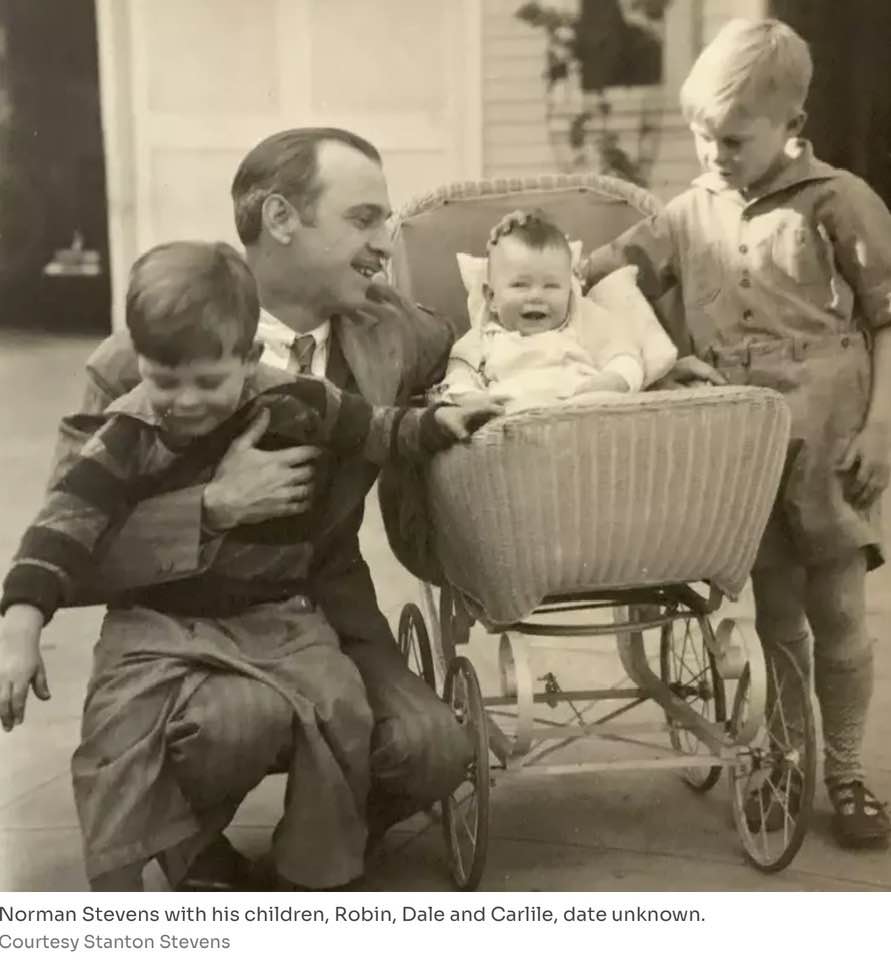
Our journey begins in 1918 when Winona Bassett, a beautiful, Stanford-educated Pasadena socialite, attended a dance for military personnel. Also present was Norman Stevens, a handsome instructor in the Army’s Service Balloon Corps. The pair met and sparks flew. They began courting under the watchful eye of Winona’s protective mother, Theophila Bassett.

Two weeks before their wedding, Winona sprung the news on Norman that her family was one of the wealthiest in the country, making their fortune in the thumb tack and nail business in Chicago, and she had inherited $20 million with more on the way. That’s an amount worth well over $1 billion in spending power today. (To Norman, $1,000 was a lot of money.)

Despite her vast wealth, the couple started out living in a comfortable, though modest, home Norman had bought with money from designing a refinery for a local oil company. Stevens was a talented engineer who had built and flown his own biplane and glider before attending MIT though he later dropped out to join the Army.

Not satisfied with their living arrangement, Winona’s mother built one of Pasadena’s finest homes across the street for the couple. Norman swallowed his pride and he and Winona moved in.

We jump to 1931 when the couple’s 4-year-old son, Robin, was stricken with the skin infection impetigo, which at the time could prove deadly, and he had to be isolated because the condition was extremely contagious. For a year, Winona followed the treatment prescribed by Christian Science, which was Theophila’s religion, and involved a lot of praying but no doctors. When the praying failed to improve the condition of the boy who was then near death, Norman took over and brought in a Norwegian healer he heard could do wonders.

The healer, Conrad J. Anderson, bent over Robin’s bed and touched his sores. Within two weeks, nearly all the sores were healed, and Robin was cured. Winona promptly gave up Christian Science and adopted Anderson as the spiritual guide for the Stevens family. In her eyes, Anderson could do no wrong.

The Stevens may have had second thoughts had they known that a year earlier Anderson was sentenced to 90 days in jail and fined $500 for practicing medicine without a license. The sensational case drew headlines because Anderson had been accused of treating a woman for a serious illness with cosmic rays emanating from his fingertips. He had charged the woman and her husband $1,200 but she died a short time later.

After gaining the Stevens’ confidence, Anderson told them another global war was coming but that he could help protect them from it if they followed his plan. He urged the couple to build a self-sufficient sanctuary in hills north of Los Angeles.

Winona heeded the call, and in 1933 or 1934 purchased 41 acres from Jessie M. Murphy in the upper reaches of Rustic Canyon next to the properties of Will Rogers and Anatol Josepho, the inventor of the Photo Booth who would donate his land for a Boy Scouts camp in 1941.
At the time, Norman Stevens was in Canada looking after mining interests. Winona wanted to keep a low profile, so she worked out a deal with Jessie Murphy for her to keep the property under her name until the early 1940s when Winona’s name appeared as owner of record. Under the agreement, Norman was listed as chief engineer of the ranch, and his name even appeared in correspondence with neighbor Will Rogers when the cowboy humorist raised concerns about the diversion of water from a creek that went through both properties.

The local newspaper, the Palisadian, reported on May 25, 1934, that “at present there is a force of 50 men or more busy leveling and terracing the canyon sides and building a cement flume the entire length of the canyon to care for flood waters. Reservoirs for water, of which the estate has its own supply, and for crude oil, have been built. A high wire fence surrounds the entire tract. Architects Plummer, Warden and Beckett are now working on plans for the building proper, which is to be in the Spanish Mission style. Engineer N.F. Stephens is supervising the work.” (The commission was reportedly the first for Welton Beckett, who later designed the Capitol Records building and Los Angeles Music Center.)

Nine concrete staircases, the longest 512 steps, were built into the side of the canyon to maintain some 3,000 trees — nut, citrus and fruit. The concrete water tank, supplied from wells, held 395,000 gallons and a steel fuel tank 20,000 gallons. A power station with double generators was large enough to supply a small community. Paved roads were built along with an elaborate greenhouse and huge food locker dug into the bank of a stream providing natural refrigeration.
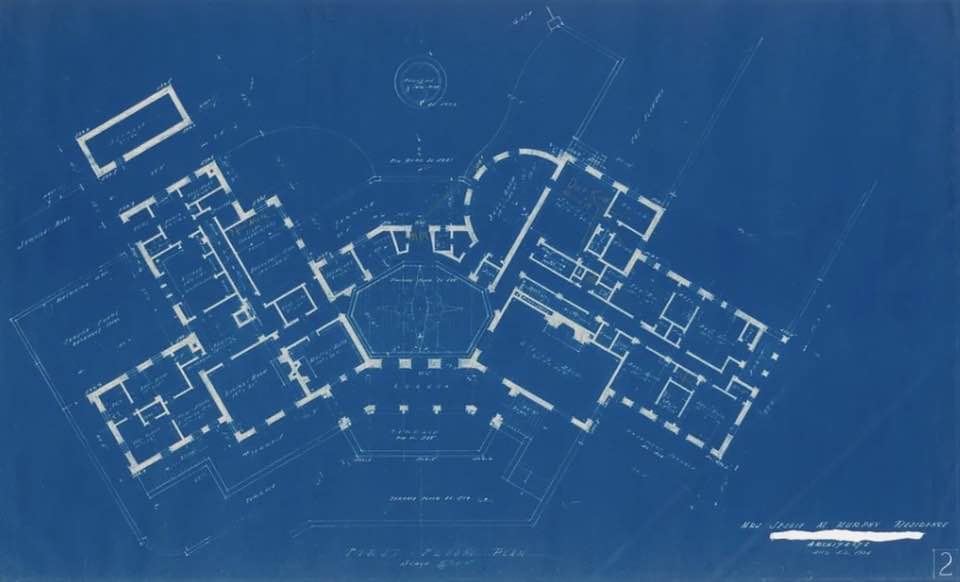
These were the blueprints for the four-story home, that was never built.

Over the years, various architects made blueprints for a palatial, four-story mansion, culminating in a 1939 plan by black architect Paul Williams. The neoclassical design included 22 bedrooms, detached servants’ quarters, multiple libraries and reading rooms, a children’s dining room, and in the basement a swimming pool, gym and workshops. A two-story barn would include a dairy, butchering facility and commodious pigeon loft. All of it was planned for the Stevens and their four children.

Construction of the facilities and other infrastructure took eight years to complete, but the mansion was never built. Cost of the entire project, including purchase of the 41 acres, was approximately $900,000 according to Norman Stevens. During the building work, he traveled back and forth to the ranch from the Stevens’ homes in Pasadena and later Hermosa Beach, with the whole family moving to the spread on Thanksgiving Day, 1942.
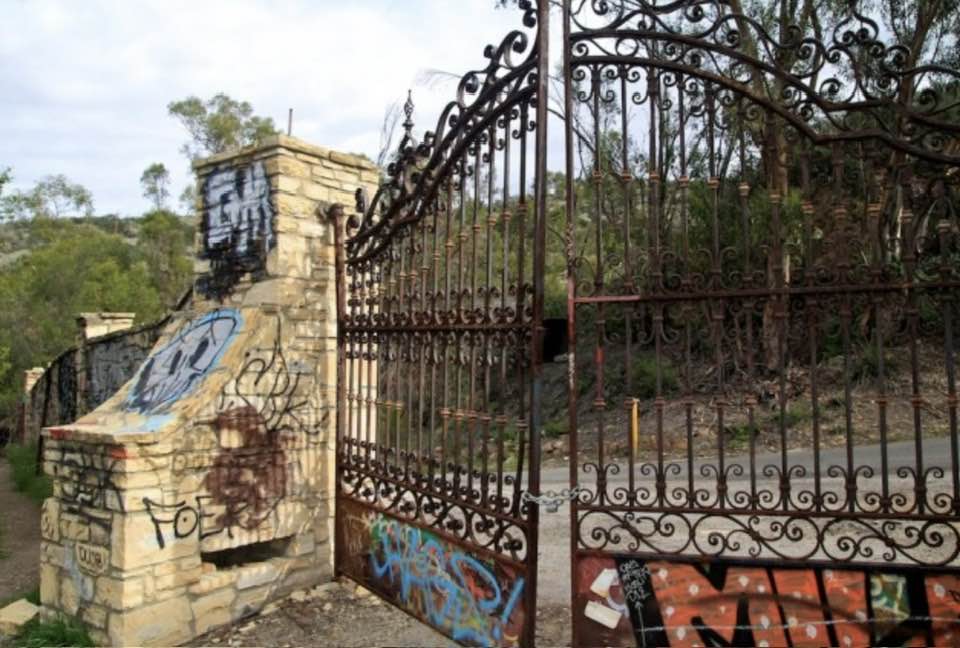
The wrought-iron gate to the entrance of Murphy ranch survived nearly 80 years before it was torn down by the city in 2016.                                                                                                                                              Photo: Stewart Slavin

Faith healer Anderson, meanwhile, took up residence there a couple of years earlier, bringing with him two wealthy women followers, and later a third, who were tasked with milking the cows, collecting eggs and other farm chores involved with running the ranch.

Two of the Stevens children, Robin and Carlile, recalled that Anderson was a womanizer and abuser who cruelly exploited the family and instilled fear in them. At the same time, they described him as a charismatic party host often surrounded by women followers who did his bidding.

But he was also a “powerful and evil” man, according to the Stevens grandson, who nearly succeeded in getting Norman and Winona to sign over to him the ranch and all their assets should Anderson outlive them.

At one point, he instructed a woman follower to poison Norman’s food with arsenic on a daily basis. The plan ultimately failed when Norman didn’t die. Despite his attempts to control the family, Winona still trusted the mysterious Norwegian with his supposed magical healing powers.

Anderson himself miraculously survived a steep fall down the canyon in his car shortly after his arrival at the ranch in December 1938. According to a news report, Anderson’s “heavily built automobile” failed to negotiate a sharp turn near the ranch and plunged nearly 500 feet to the canyon bottom.

“The car must have turned over many times before it reached bottom,” the report said. For two hours the fire department labored to lower more than 1,000 feet of rope and managed to bring Anderson to the top with a specially constructed stretcher. He was dazed but escaped major injury.

Now it’s time to take on the urban legend claiming that Nazis ran Murphy Ranch and how it began.

There is evidence the source of the misinformation began with a one-page affidavit written by UCLA music professor John Vincent that had been requested by historian Betty Lou Young for her 1975 book, “Rustic Canyon and the Story of the Uplifters.”

She had been leery of his claims of Nazi involvement and asked for the documentation. Vincent, a composer and head of the UCLA Music Department, also was a director of the Huntington Hartford Foundation and negotiated the $100,000 purchase of Murphy Ranch from the Stevens in 1949 for use as an artists’ colony.
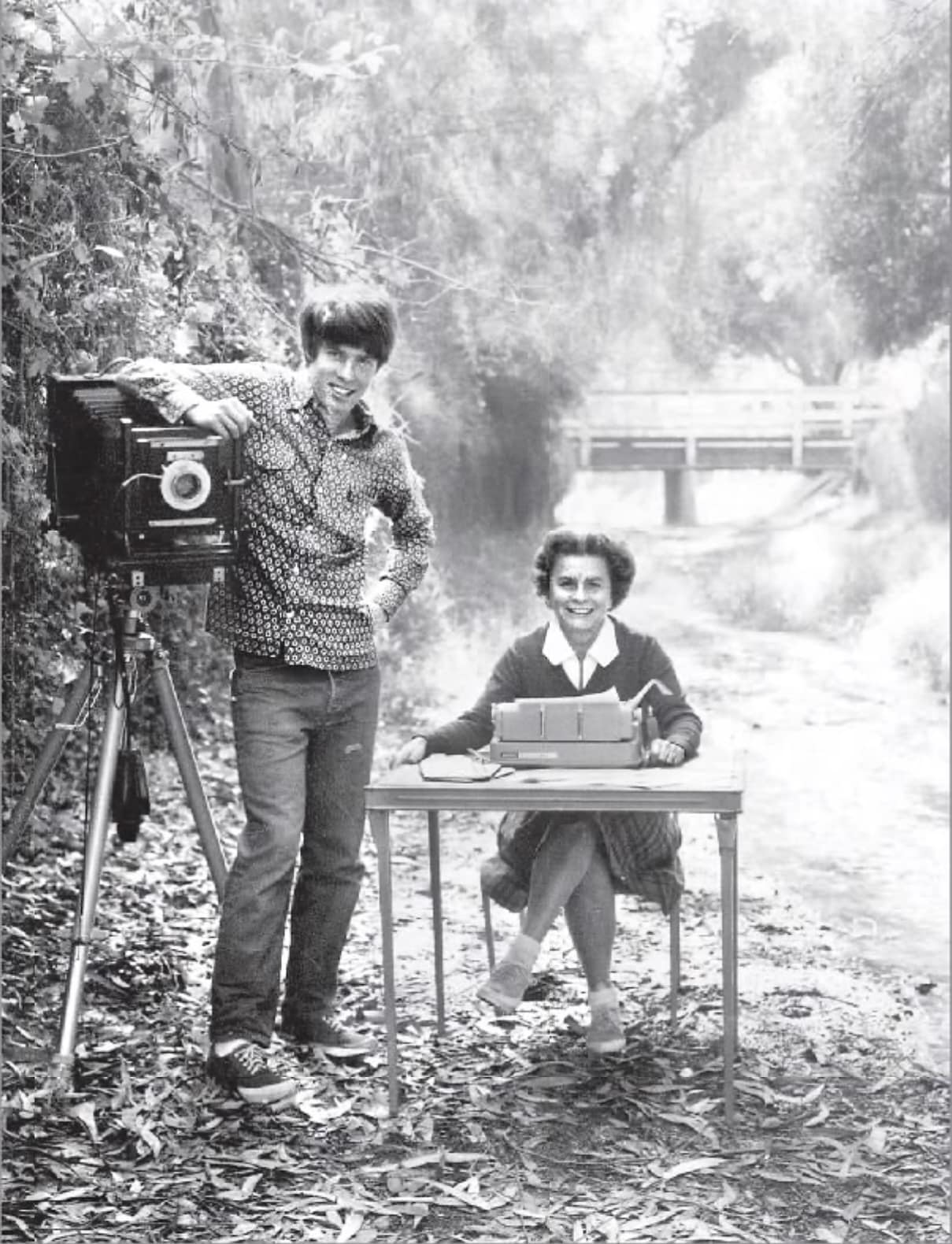
Betty Lou Young, with son Randy, was leery of the claims of Nazi involvement at Murphy Ranch.

The affidavit was suspect from the outset.

In it, Vincent claimed to have met the Stevens while they were living in a steel garage at the ranch in 1948. But that is disputed by the couple’s grandson, Stanton Stevens, who said they had moved to a property in Ramona in 1945. Also, Vincent incorrectly referred to the couple as Winona and Norman Stephens, which is repeated in the book and later versions of the urban legend.

Betty Lou Young wrote that rumors were starting to swirl in lower Rustic Canyon that something strange was going on at Murphy Ranch in the 1930s. “A workman told tales to his neighbors of a self-sufficient farm in diligent operation, Nazi-style paramilitary exercises and drills, and the presence of an overbearing German named Schmidt.”

Based on Vincent’s affidavit, Young said the ranch was envisioned as “a sort of National Socialist Utopia, financed by Winona and Norman Stephens — he an engineer with silver mining interests (actually, he had no such interests), and she the daughter of a wealthy industrialist.”

“Mrs. Stephens was intrigued by metaphysical phenomena and fell under the influence of a very persuasive gentleman who convinced her that he had supernatural powers,” the book said. “He also convinced her that the end of the world was at hand, that as a result of the imminent struggle between the United States and Germany,

California would be devastated, and that the United States would inevitably be destroyed by the might of Germany.”

“The only salvation, Schmidt told her, was to establish a completely self-sustaining community where a group of chosen could survive the bombings, defend themselves, and remain for at least a year until it would be safe to emerge and form a nucleus to repopulate the United States.”

The book said an estimated $4 million had been invested in the ranch, while the actual figure, according to Stanton, was $900,000.
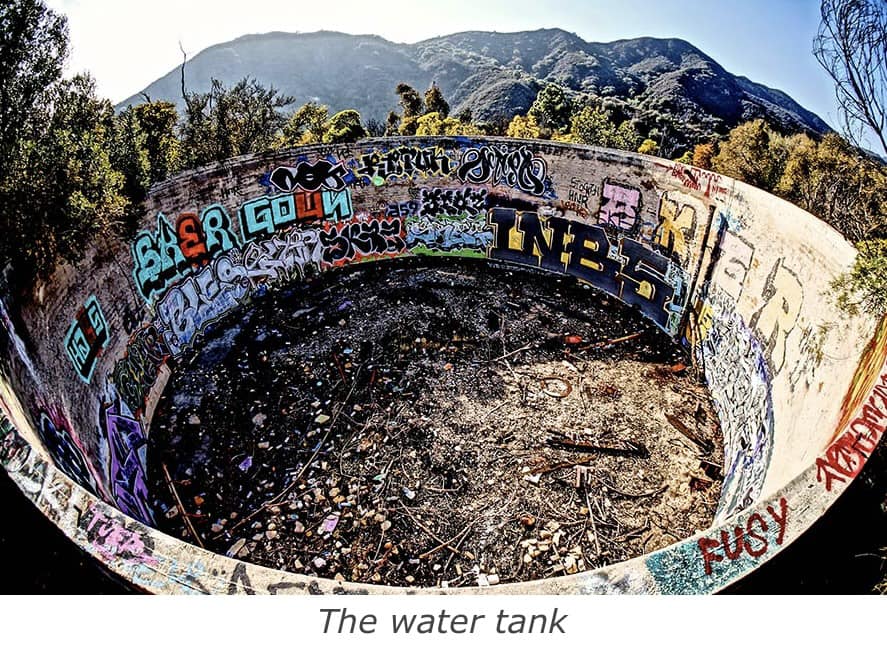
This structure was a water tank for Murphy Ranch. It was torn down in 2016.

The Nazi plan fell apart, Young said, after the Japanese attack on Pearl Harbor on Dec. 7, 1941.

“The canyon Svengali was promptly apprehended and identified as Herr Schmidt, a Nazi spy who had hidden powerful shortwave radio equipment on the ranch property and was sending clandestine messages to Germany. With no public furor, he was put in prison where he died before coming to trial,” Young wrote. As many as 50 of Schmidt’s followers were arrested with him, some unsubstantiated reports claimed.

Betty Lou Young wrote that “no living soul ever seems to have encountered a flesh and blood Jessie Murphy.” Randy Young expanded on the claim years later by speculating that “Murphy” was actually a front for Nazi groups that footed part or all of the bill for the ranch.

But Jessie M. Murphy was no figment of the imagination. According to Winona’s daughter, Theanne, her mother had become good friends with Murphy and she and her mother visited the previous ranch owner in her apartment in Santa Monica when she became ill. Theanne was attending Canyon Elementary School at the time with her brother Carlile.

Randy Young also estimated that up to 40 local Nazis may have lived on the secretive property from 1933 to 1945. “It was a Silver Shirt operation of the American Bund movement,” said Young, who was the photographer for the book and followed his mother as president of the Pacific Palisades Historical Society. Randy admitted, however, he had scant evidence for the claims he said were based mostly on what was passed down orally.

Norman and Winona Stevens were also alleged to be Nazi sympathizers and members of the American Socialist Party, all derived from the writings of the Youngs or John Vincent.

The Stevens grandson vehemently denied the claim, pointing out that Norman worked on fighter planes at Douglas Aircraft as a quality control engineer which would have required security clearance. Two of the couple’s boys, Dale and Robin, went off to war in Europe and the Pacific to fight the Nazis and Japanese, respectively. The oldest boy, Dale, was awarded a Purple Heart and was a driver for Gen. George Patton.

Stanton Stevens, in interviews with family members who lived on the ranch, said no one remembers Anderson having allegiance to Hitler, or mentioning Nazis. At one point, the Scandinavian healer told the family he could use his black magic to stop any Japanese invasion into the canyon. “I will use my powers to turn their rice into rat droppings,” Anderson reportedly said.

And there was no Herr Schmidt or goose-stepping Silver Shirts on the property carrying out marches and drills, Stanton said. Norman Stevens would have noticed any suspicious activity on the ranch during his frequent visits during the 1930s.

How the Nazi rumor first got started is unclear, but it’s not too far-fetched to conclude that the over-bearing Anderson with his mystical beliefs may have conjured up a Herr Schmidt in the minds of suspicious and fearful neighbors in a Los Angeles faced with a proliferation of local Nazi groups during the Depression years.

The legend grew like Pinocchio’s nose to a point that Hitler himself was said to be planning to make Murphy Ranch his Americas vacation home when the Nazis achieved victory. “When the Nazis were thinking grandly about Hitler’s inevitable takeover of the United States — once he had finished with Europe — the Murphy Ranch was going to be like San Clemente for Richard Nixon or Mar-a-Lago for Trump, only better sited for international routes,” USC historian Steven J. Ross told the Palisadian-Post in 2018.

In 2014, the Stevens’ two surviving children who lived on the ranch with Anderson had a meeting with Randy Young, who had been telling the tale of Murphy Ranch being a Nazi enclave in newspaper interviews, on television and in lectures for nearly 40 years.
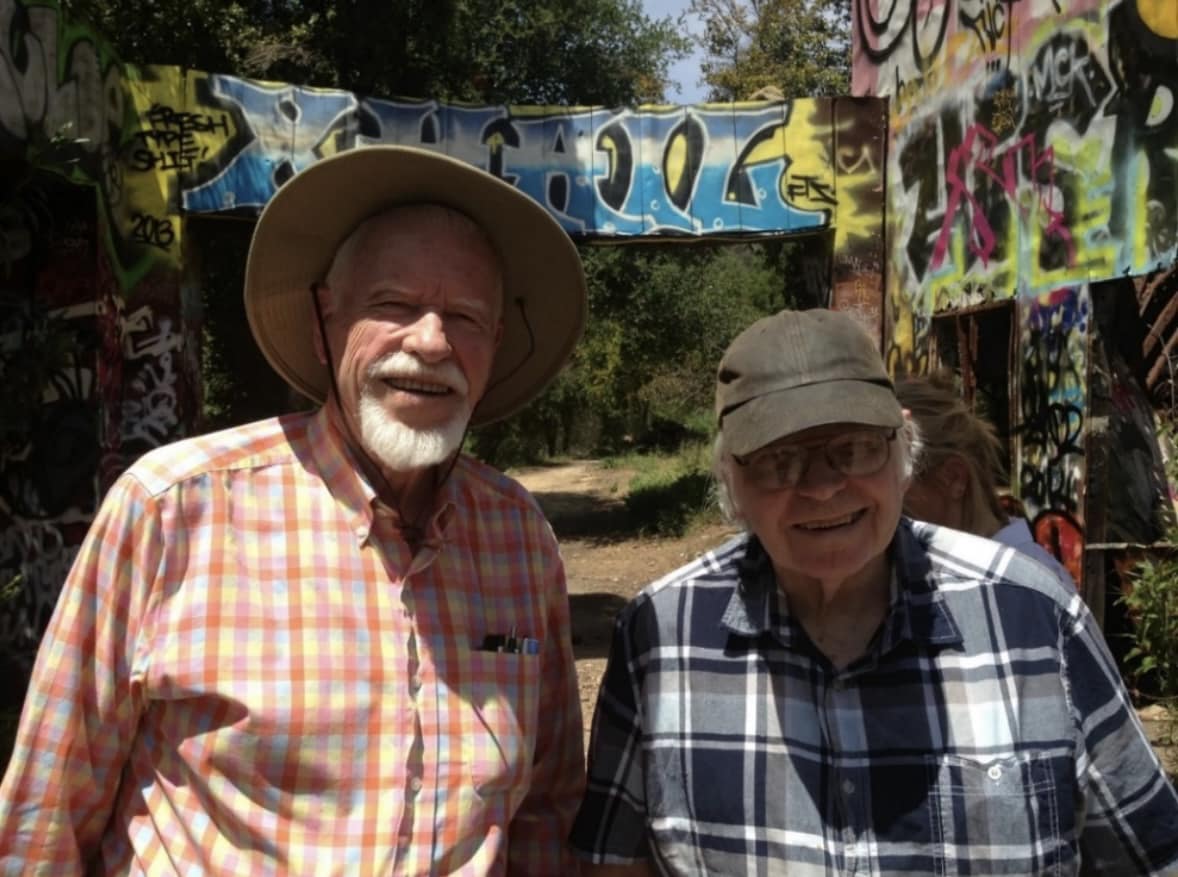
Carlile, (left), and Robin Stevens met with local historian Randy Young, to debunk the myth that Murphy Ranch was intended for Nazis.                                                                                                                        Photo: Stewart Slavin

After listening to the stories and memories of Stanton’s father and Robin, then 86, Young believed them, Stanton said. “He (Randy) said the hairs on the back of his neck were standing up” after hearing the real history of the ranch, Stanton added.

“My uncle begged him in tears to stop calling our family Nazis and Young agreed to stop repeating the story,” Stanton said. “He is serious about being accurate as a historian. He is as dismayed as we are at the exaggerations added to the story as the yeas have gone by.”

Today, there are few reminders of the ranch whose grand plans were never realized. Anderson died on the ranch in 1943. By the time of Winona’s passing in 1954, nearly all of the family’s fortune was gone.

The 1978 Mandeville fire destroyed most of the structures on Murphy Ranch, now accessible only by a 3.85-mile hike and concrete staircase of 512 steps. The big water tank, gate and remains of the steel building were torn down in 2016 for safety reasons by the city of Los Angeles, which now owns the land. The concrete powerhouse, which Carlile once tended, is the only structure left standing on the ranch property, which is continually painted over with graffiti.

This building was the  source of the power used on Murphy Ranch. It is the lone building still standing on land, now owned by the City of Los Angeles.

Stanton Stevens is author of The True Story of Murphy Ranch, Nazi Nonsense in Los Angeles.

Stewart Slavin, who attended Palisades School (class of 1964), graduated from UCLA. He spent his life globe-hopping, covering news for the UPI in the far reaches of the world. After retiring, he relocated to North Carolina. His second book Memory-Go-Round — Ride of a Lifetime, was released in June.

Posted in Community, History | 6 Comments

Hovde’s Quilt Wins a Blue Ribbon at the Fair

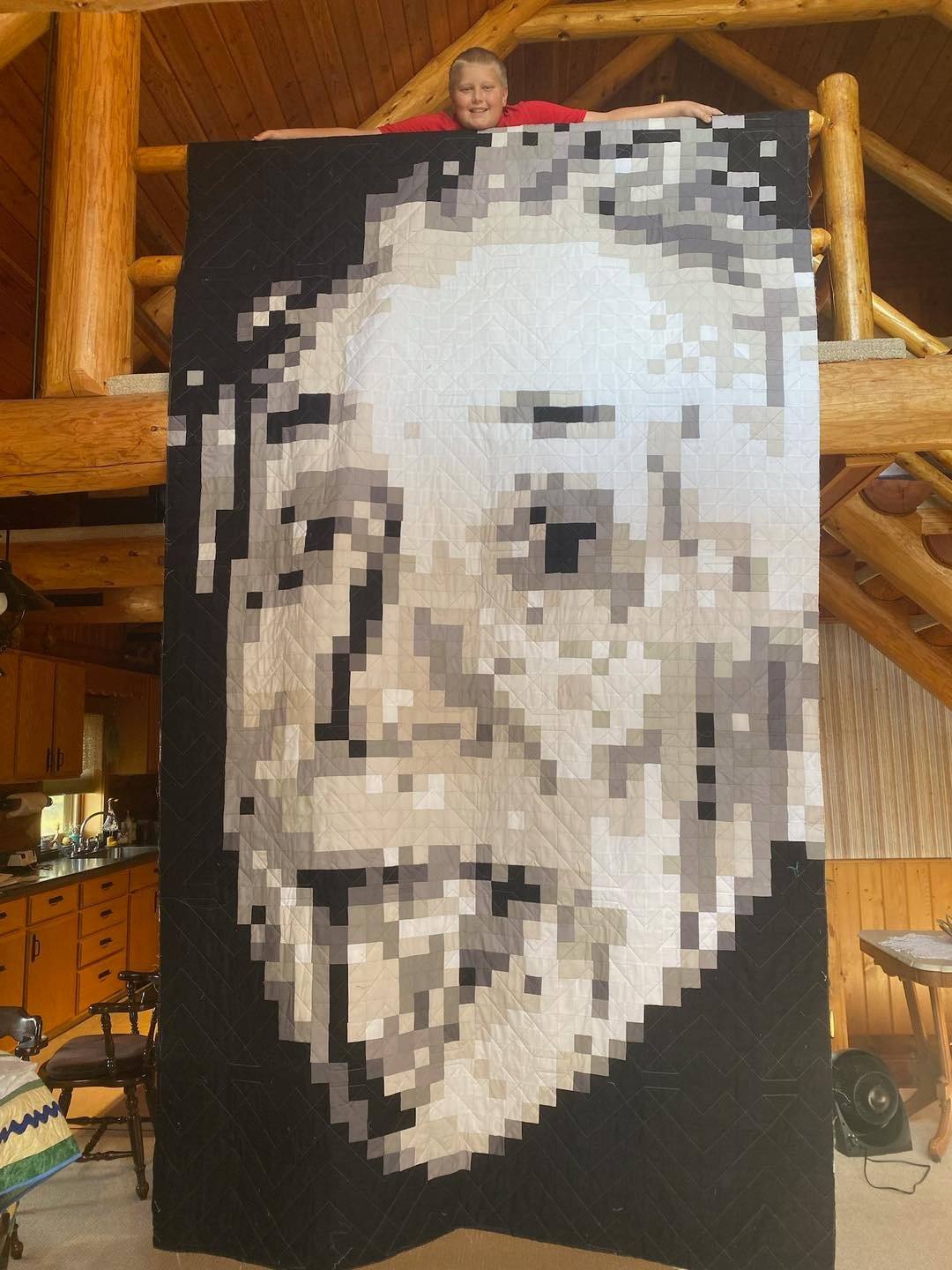
Hovde’s quilt of Einstein took a first place at the Central States Fair.

It was a blue ribbon at the fair for seventh grader Reuben Hovde’s Einstein Quilt.

One of the biggest county fairs in South Dakota is the Central States Fair click here, which includes a carnival, a stock show, a rodeo, and agriculture and handicraft exhibits. With so many participants, it is not easy to win a blue ribbon. Hovde, who has two older brothers, said he was surprised by taking first place.

Hovde’s quilt is 80 x140 inches, with 2-inch finished squares. A standard California king-sized bed is 84 x 72, but the youth did not want to cut it down because it would have meant losing some of Einstein’s face.

He was asked how he got the idea for the quilt. “I saw a bunch of Rubik’s cubes that were put together to form Einstein’s face and thought I could make a quilt like that.”

He told his mom, a graphic designer, about his idea for an Einstein quilt. She made a pattern on graph paper for him to follow. The quilt is made up of black, white and six shades of gray material.

His quilt has now been entered in the Hill City Quilt and Fiber Show on September 7, which is held annually with more than 300 quilts shown. To view the 2023 award winners, click here.

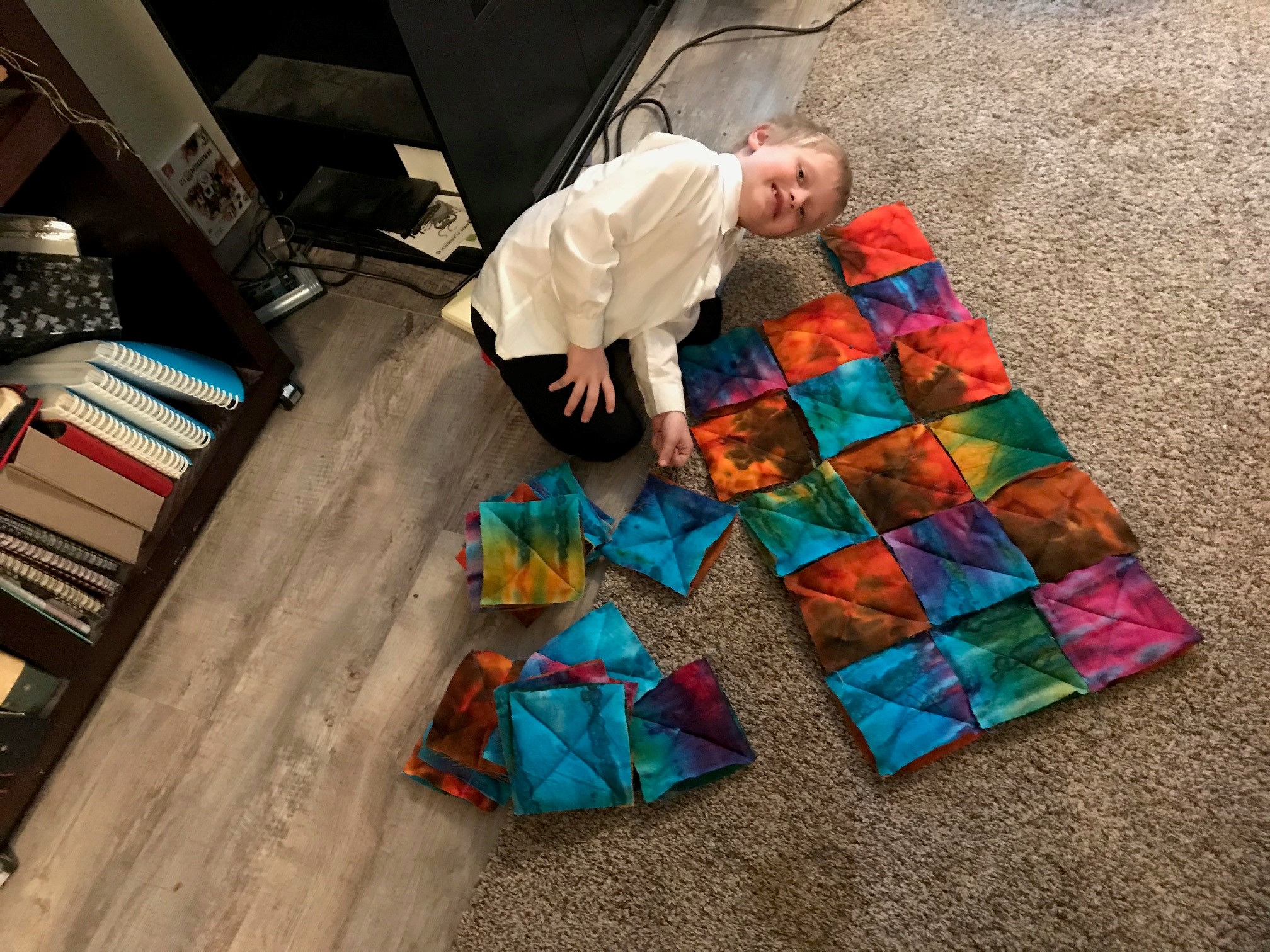
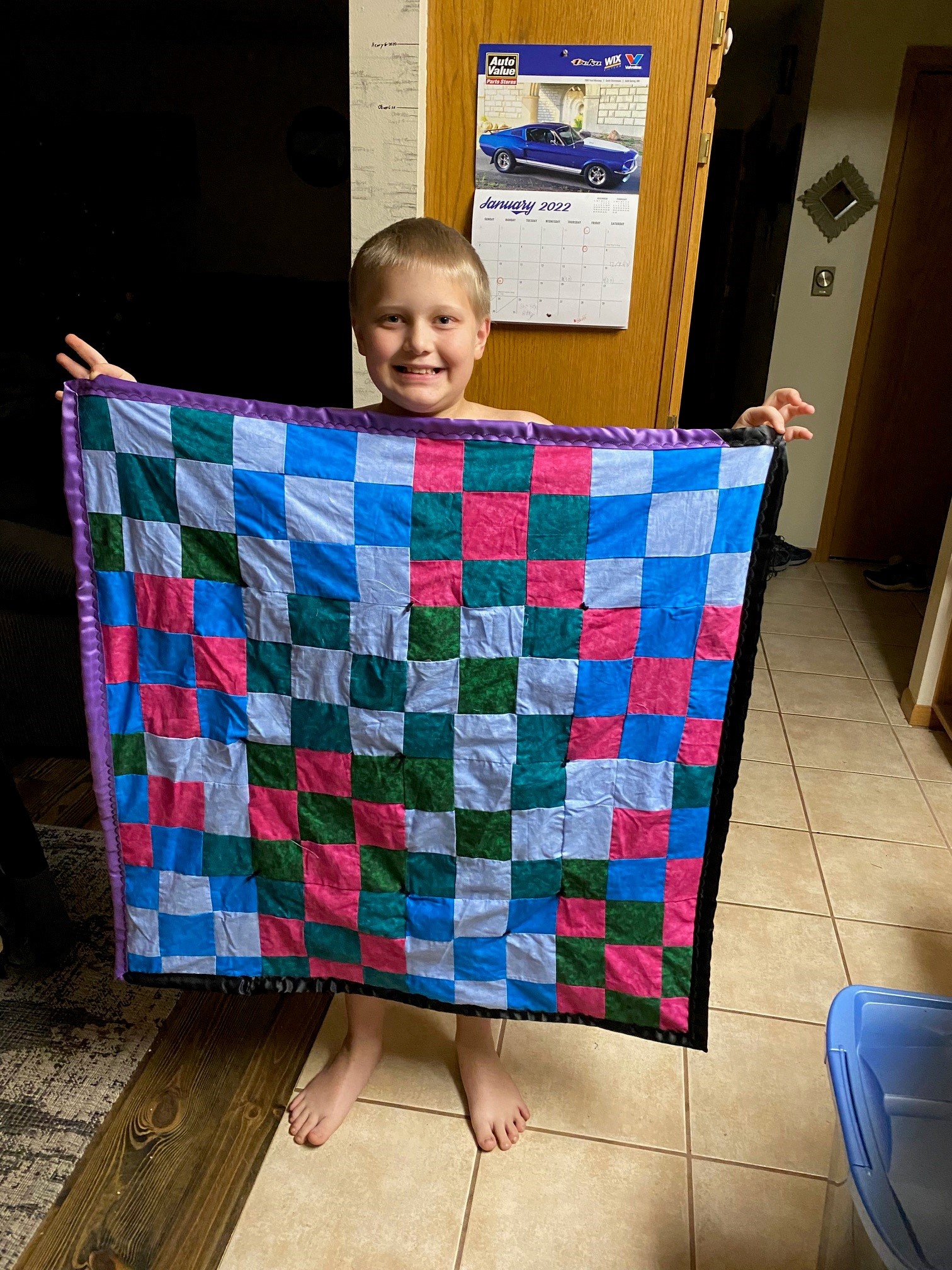
Hovde, who plays tuba in his middle school band, made his first quilt, a rag quilt, with his mother Melissa’s help.  His next quilt, an independent project, was a simple 9-patch quilt with scraps.

Hovde helped his mother put together this quilt, which started him quilting.

This was the first quilt that Hovde sewed independently.

“I like doing it, because I like the end results,” Hovde said.

After his mom said she was entering the Hoffman Challenge, an annual national contest hosted by Hoffman Fabrics that encourages participants to create artwork using their fabrics. Hovde also decided to enter.

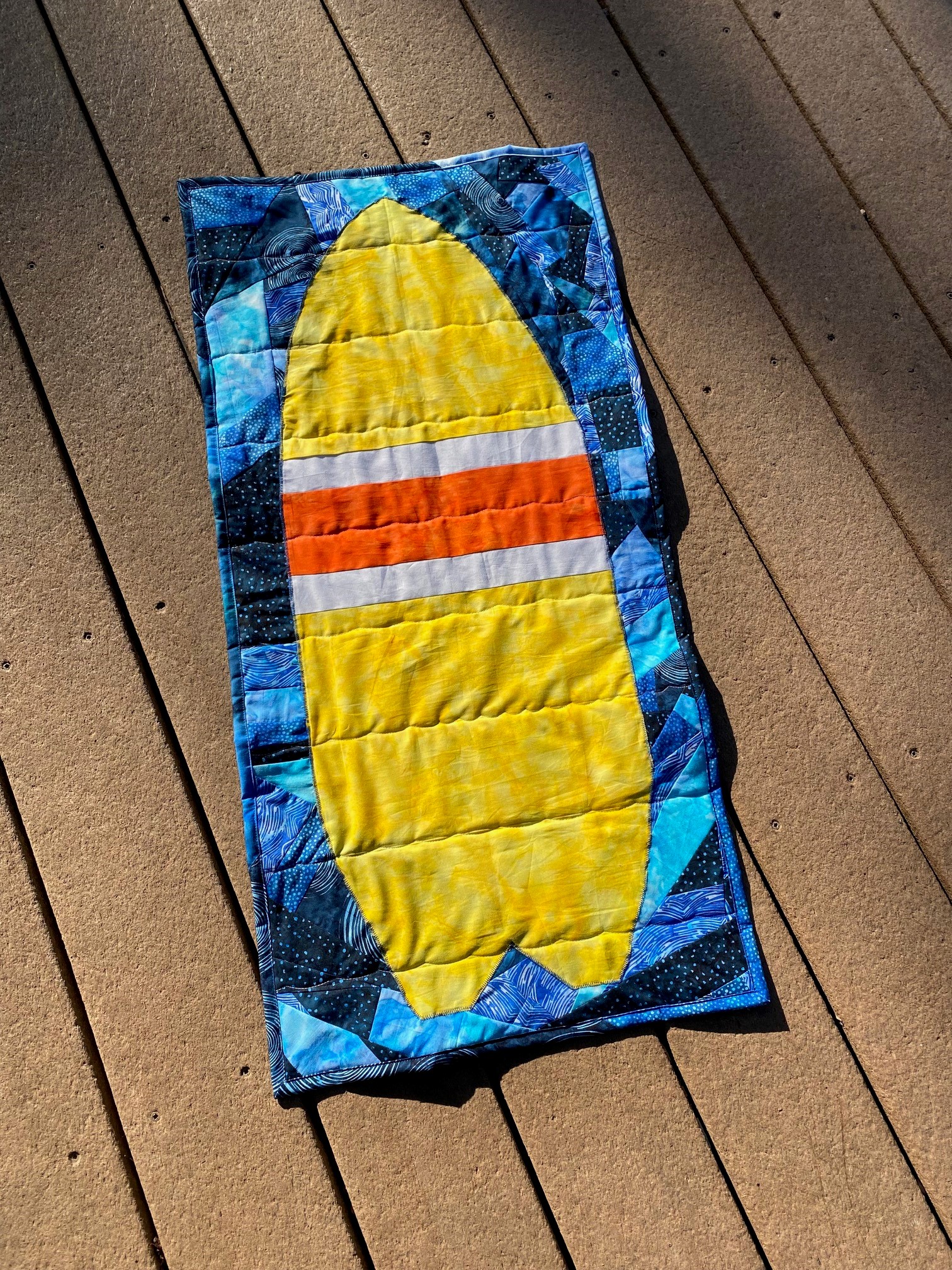
More than 350 quilts had been entered and mom, Melissa’s quilt Waiting for a Wave (31 X31 inches), was  selected as a finalist to go on tour. Her son’s quilt, Surfing on Scraps (17 X 35 inches), was also a finalist in the youth category and is currently on tour in the U.S. with other quilts.

Hovde’s favorite subject in school is P.E. and he was on the wrestling team for two years, but mom and dad, Erik, nixed it this year, “After two broken arms, two separate times, he is not doing it this year,” mom said.

Would Hovde sell his Einstein quilt? Before he could enter it in the Hill City show, he was required to put a price tag on it. “Let’s say $1,000,” he said. “If someone give me a thousand for it, I’ll make another one.”

Reuben Hovde entered this quilt in the Hoffman challenge and it is now part of collection that is touring the country.

(Editor’s note: Readers if you want to purchase an Einstein Quilt, let this editor know and I’ll put you in touch with the mom, who is also entering numerous quilts in the show.)

Posted in Arts, Kids/Parenting | Leave a comment

New Play at Theatricum Pops the Myth of the Latino Vote

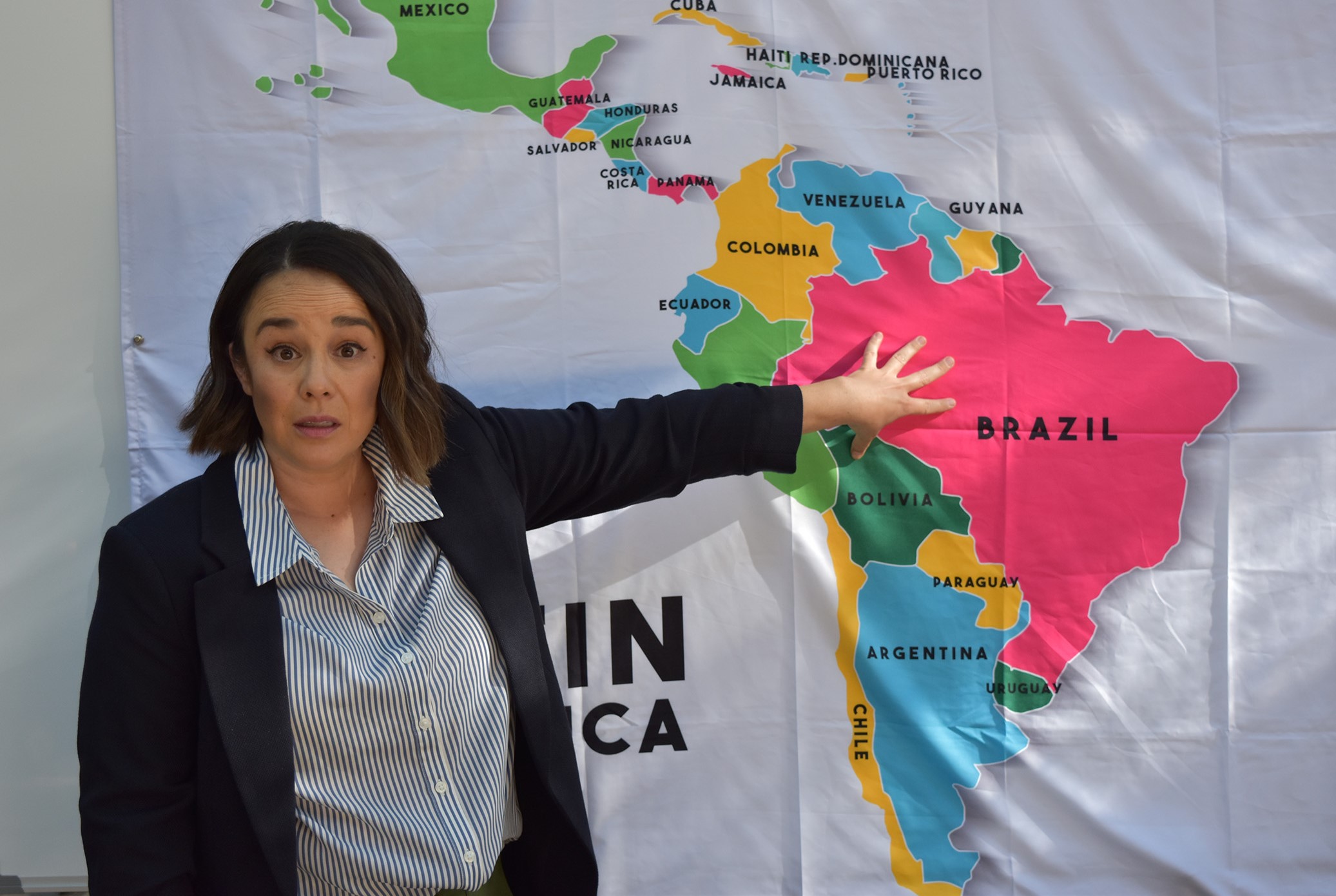
Xochitl Romero questions the audience on its knowledge of South American countries.
Photo: Ian Flanders

By LIBBY MOTIKA

Circling the News Contributor

It’s not often when you see a play about an election that doesn’t involve backroom drama, a candidate’s demons, or the breathless election-night count.

No, Bernard Cubria is interested in the so-called myth of the mono “Latino” vote— somehow more than 60 million people vote in lock step.

That it’s absurd to expect that every single Latino or Hispanic person from Tijuana to Buenos Aires would think and vote the exact same way.

So instead of railing against the wild misconception, he wrote a comedic play, “The Hispanic/Latino/Latina, Latinx/Latine Vote,” now on stage at the Will Geer Theatricum Botanicum. He addresses the topic with wit and his belief that life is absurd and ridiculous.

A group of political strategists for THE political party are looking for an “expert” to help them understand the Latino vote. The job carries a handsome paycheck. Researcher and professor Paola Aguilar (Xochiti Romero), who has undergone years of fertility treatments and the debt that ensues, hesitantly takes on the job.  After all, she’s pragmatic–money is money.

Unfortunately, the job is nearly hopeless as she tries to get the pundits to understand all the nuances of her community.

The play was conceived a year and a half ago, originally commissioned by Florida’s Studio Theatre in collaboration with the Milagro Theatre in Portland, Oregon.

To get a sampling of authentic Latino voters, Cubria interviewed over 500 voters in Florida and Oregon. This is reflected in both the pundits who, in conducting the interviews, try to understand how Latinos vote, and the sampling of interviewees, portrayed with brilliance by Roland Ruiz’s quick-silver transformation from an explosive, cynical man who sneers at the value of his vote, to a florid Florida woman, who just “loved Hillary.”

Cubria, who directs with Willow Geer, involves the audience, which the night I attended became more and more invested in the proceedings.

Romero is stuck deciding what her sperm donor should be and turns to the audience for our opinion in filling out the application. We help her decide and find the right vibe. How tall should he be. She turns to a couple in the audience. “How tall is your kid?” she asks. “Thirty-five inches,” the mom replies. The audience laughs. Aguilar ponders, “That’s small.”

In combining the Latino vote with the IVF journey, Cubria, a proud Mexican American, says he  joined “the most two-dimensional thing in my life with the most three-dimensional thing in my life.”

The play is funny, which Cubria with a background in comedy, finds useful in pursing the nuances in life. “In a day, you’ll have a funny incident and another you’ll have a very serious moment,” he says.

“The Hispanic/Latino/Latina/Latinx/Latiné Vote” will have eight productions over the next year, aligning with the election. This is the first production. The show will change in each city depending on the audience.

“I’m really interested how to make theater specifically for local audiences and for it to feel like it was written on the day you watch it, especially because it’s about this election,” Cubria says. “We keep changing lines every night based on the headlines that are happening.”

The play continues through October 20 at the Theatricum, 1419 N. Topanga Canyon Blvd. Contact theatricum.com/the-vote for specific dates and times.


Posted in Reviews | Leave a comment

New Physics Theory: Einstein’s Eternal Energy

Pacific Palisades resident Chuck McGlothlin discusses Einstein’s theories. Photo: RICH WILKEN

During Covid, some people hunkered down never leaving their homes, watching nonstop news and bemoaning the end of civilization. Palisades resident Chuck McGlothlin took a different approach.

The Purdue graduate, who received his bachelor’s degree in aerospace engineering, and then his master’s degree in the same subject from USC, continued reading books on Physicist Albert Einstein and his theory of relativity E=mc2. It was an interest that had started when McGlothlin retired in 2002.

“I was intrigued by his discovery of Special Relativity and his famous 1905 equation E=mc2,” McGlothlin said, noting he was also intrigued by Einstein’s 1915 theory of General Relativity. (General Relativity is a physical theory about space and time. According to general relativity, spacetime is a 4-dimensional object that has to obey an equation, called the Einstein equation, which explains how matter curves the spacetime.)

For his contributions, “Time Magazine selected Einstein as the most important Person in the 20th Century,” McLothlin said.

A former Palisades Citizen of the Year, McGlothlin came to some conclusions calling it “Einstein’s Eternal Energy” which he shared with CTN.

The 1905 theory states that space and time are relative, and all motion must be relative to the frame of reference. On the most basic level, the equation says that energy and mass are interchangeable, that they are different forms of the same thing.

McGlothlin wrote: E=mc2 is Einstein’s Equation was presented in 1905, where E is energy, m is mass and c2 is the speed of light squared.

He suggests the following conjecture could be applied to Einstein’s famous equation.

“Assume all the mass of every person on Earth is eventually converted to energy, and this energy remains in our solar system and galaxy forever.

“The total would be a tremendously large number because c2 is 34.8 x1024 miles/years (light years squared) or a trillion, trillion miles/years.

McGlothlin concluded that “We would call this Einstein’s Eternal Energy, and this energy could contribute to Dark Energy, which has been estimated at 90 percent of all the matter in the Universe.”

Physicists, is McGlothin onto something?

McGlothin, who went to Central High School in Flint, Michigan and attended Purdue, worked for eight years in Aerospace with Lockheed Aircraft and Hughes Aircraft.

After the Aerospace industry, he worked for 30 years as a Commercial Real Estate Mortgage Banker with GMAC Mortgage and GE Mortgage.

He moved to the Palisades in 1974 with his wife Susan, and became active in the community, including as a member of Sons of the American Legion.

McGlothlin also led the effort to revitalize Swarthmore in the mid-90s. Before Caruso, Swarthmore’s sidewalks, buildings and landscaping were unsightly. With Hal Maninger, the two men were able to raise money to upgrade that street, putting in new trees, sidewalks, benches and lampposts.

Their efforts turned the street around and made it a centerpiece of the town. He and Maninger were named Citizens of the Year 1996 for the accomplishment.

Donations to revitalize Swarthmore were made through Palisades PRIDE, of which McGlothlin was the first president.

McGlothlin, who has been a member of the Palisades Optimist Club since 1980, and club president in 1989, annually helps with the 5/10K Will Rogers Run, which helps the race foundation with its contributions to local nonprofits. Last year, he was named President of the Palisades Optimist Foundation, which donates funds to youth activities in the Palisades and Los Angeles.

Albert Einstein


Posted in Community, General | Leave a comment

Both Sides Rest in the Kupfer Murder Case

Los Angeles Deputy District Attorney holds up a replica of the murder weapon that killed of UCLA college student Brianna Kupfer. The events leading up to the murder had been recorded and was played in court. The victim could be heard pleading for her life during the audio. 
Frederick M. Brown for DailyMail.com

In a surprise move, the prosecution and defense rested before noon on September 4, in the murderer of Brianna Kupfer.

Kupfer, a 5’3” 123-pound UCLA graduate student was working alone on January 13, 2020, when she was murdered.

She was found dead on the floor at Croft House, a Hancock Park boutique furniture store on La Brea Avenue by a customer. About a week later Shawn Laval Smith was arrested for her violent murder.

The trial started on August 29 at the Clara Shortridge Foltz Criminal Justice Center, in a downtown court room.

After three and a half days of calling witnesses, the people rested shortly before noon on September 4. The defense, which had not made an opening statement, nor called any witnesses, also rested.

Judge Mildred Escobedo was told by defense attorney Robert Haberer that defendant Shawn Laval Smith would not testify.

Shawn Laval Smith listens to testimony in Los Angeles Superior Court from a witness during the murder trial for the killing of UCLA college student Brianna Kupfer.                                                 Frederick M. Brown for DailyMail.com

The judge queried him, “You’re waiving your right to testify?”

“Yes, ma’am,” he said.

“You’re freely and voluntarily waiving this right?” she asked.

“Yes,” he said.

“Are you waiving this right because it is your choice,” she asked.

“Yes,” he said.

Earlier, the day’s trial had started with LAPD Homicide Detective Dave Vinton on the witness stand.

Vinton was asked if he recognized Smith, who had been seen going into at least five stores in that vicinity of the Croft House on the day of the murder: Artspace Warehouse, Twentieth, Landon Cole (furniture), Friedman Law firm, and Chiropractic Center L.A.

Vinton also testified that there were three additional pieces of surveillance footage showing Smith that was obtained from a local temple Shaarei Torah, a 7/11 store and the Wonderbrett (pot shot).

An audio recorder was placed on the counter of the Croft House by Smith (his DNA was confirmed) and it was left on during his encounter with Kupfer and her eventual murder.

The entire tape was down loaded by police, and jurors heard a clip of a December recording by Smith . . .”That’s all that’s on my mind killing all F**ken niggers.. . .cause I f**ked mine up. I’m destroying everything and I mean everything. I do not like bitches, girl.”

Vinton was asked if he recognized the voice and he said it was Smith, that he had listened to about 30 hours of Smith, through the tapes, the arrest and police cams and was sure of the voice.

Then, jurors heard the recording from the Croft House.

Kupfer, professional, is sweet and polite to Smith. At one point, when he asks for her Facebook info, she tell him no. He says he needs her information  – she points to business cards on the desk.

He asks which card is hers and she tells him Kari (that is her supervisor). From her voice, you can tell she is uncomfortable.

“I am not going to hurt you, right, I’m not going to hurt you. Chill the f**k out,” he says on the recording.”

“Okay,” she responds.

Then there’s the subtle sound of him pulling the sheath off the knife.

“I can’t have you in here,” Kupfer said. “I’ve called the cops.”

“Wait no,” Kupfer said.

“Get down on the floor,” Smith said.

“I want to help you. I can help you,” Kupfer said, then “wait, get off me.”

“It’s over, it’s over, it’s over,” Smith said.

“Oh my god, okay, okay,” Kupfer said.

“It’s over. It’s over. It’s over b*tch. It’s over. It’s over. It’s over b*tch,” Smith said.

Jurors listen as the tape continues recording; the music from the store is in the background and then a phone rings and rings again.

Briana Kupfer was killed January 13, 2020.

The district attorney asks Vinton if he recognizes the male’s voice. “That was Mr. Smith, no doubt,” Vinton said.

A replica of the seven-inch knife that was used in the murder was brought into the court room and Vinton was asked by the defense about the flimsiness of a filet knife.

“I’ve seen different knives used in homicides,” the detective said.

On redirect, he was asked if this blade could penetrate the skin, liver, lung.

“Yes,” he said.

Kupfer had been stabbed 46 times, 26 were stab wounds, 20 were incisive wounds. Her lungs, liver, stomach and aorta were punctured. There were also defensive wounds that occurred when Kupfer tried to protect herself.

The knife blade used in Kupfer’s slaying was bent. In prior testimony, the DNA on the blade was Kupfer’s the DNA on the sheath was Kupfer’s and Smith’s, the DNA on the knife handle was Smith (83 percent), Kupfer 17 percent) and an unknown person (one percent).

Haberer to Vinton “You testified you heard about 30 hours of Mr. Smith speaking.”

“Yes,” Vinton said.

“You were listening for something, audio tape, calls that would be helpful to the prosecution?” Haberer asked.

“Yes,” Vinton said.

Balian then asked to bring in the jail calls.

Haberer objected to the jail calls, being brought into evidence.

“Judge, he opened the door with calls,” Balian said.

After a brief conference, Balian was allowed to ask Vinton a directed question.

It was explained to the jury that jail calls are listened to and monitored. When someone is speaking, a recording comes on every two minutes reminding the inmate that everything they say is being recorded.

Regarding jail calls, “Did you find anything that would make him culpable for murder?” Balian asked.

“I did,” Vinton said.

The trial was concluded without further explanation of Smith’s jail calls.

In addition to the murder charge, Smith faces two special circumstances allegations: lying in wait and use of a knife. Haberer asked the court to drop the special circumstances.

The judge felt there was enough evidence and “the court denies the dismissal of special charges,” she said.

Closing statements for both sides will be Monday morning at 9:30. The judge reminded the jury that they are still under her admonishment not to listen to any news or to speak to anyone about the trial.


Posted in Crime/Police | 2 Comments

Sonic Visions Exhibition Featured at Lurie Gallery

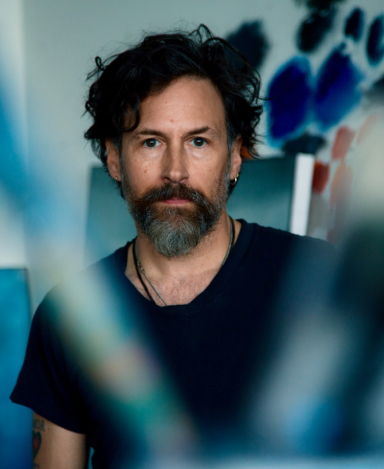
Mark Acetelli will be one of the artists featured at the Bruce Lurie Gallery.

The Bruce Lurie Gallery at 873 Via de la Paz will host Sonic Visions, an exhibition featuring the lasts paintings by Mark Acetlli and George Mead from September 7 through October 2.

An opening reception will be held from 6 to 9 p.m. on Saturday, September 7.

Mark Acetelli is a self-taught artist that was born in Detroit. His recent series, Gathering Light, engages in a visual dialogue about overcoming obstacles and challenges, being resilient in the face of our vulnerabilities, and finding light in the darkness. This series embodies the spark of hope that refuses to burn out, reminding viewers that in the darkest of nights, the stars shine the brightest.

George Mead grew up in the South, and studied in the East, North, and West —at places like The Museum School of Fine Arts in Boston and at The California College of Arts and Crafts in Oakland. He spent years in the entertainment industry, painting large-scale backdrops and other heroic representations of communal dreams, using the same techniques he employed later to augment and honor low-income communities and buildings on the West Coast and elsewhere with massive murals of everything from plants to musicians to humpback whales.

With his Art of the LP Series, George is back to one of his original passions: contemporary music, the visual expression that completes it, and the history that surrounds it.

George Mead’s “art of the LP” series will be at the Lurie Gallery.

Additionally, the Lurie Gallery is holding a summer vault sale. The artwork information including retail prices are listed on the site click here. Potential buyers are also asked to inquire about discounted prices. There is a wide variety of artists and styles featured.


Posted in Arts | Leave a comment

Idea for Kids Who May Not Want Organized Sports

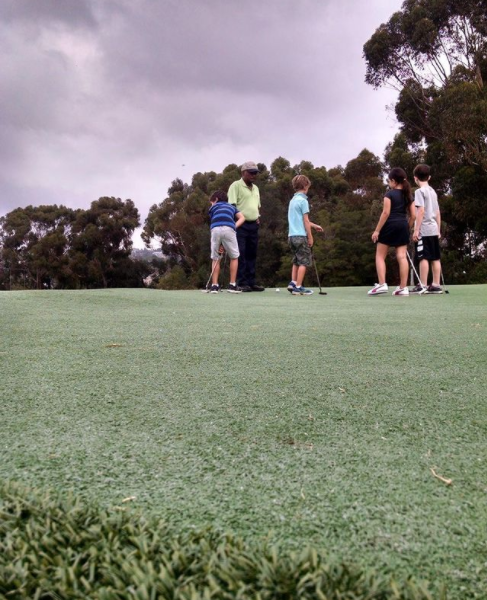
Golf Pro Carlos Rodriquez with students on the course.

If you have a youth between the ages of nine and 14 and they told you they are done with organized sports, such as soccer and basketball, have they tried golf? This is a life-long sport and a great way to get your kid away from screens and outside.

Many adult business deals are done on the golf course, and better your kid learns to play when they’re young, rather than picking it up when they’re in the twenties.

Now, there is a fall golf development program for juniors from 3:30 to 5 p.m. that will run from September 5 to November 21.

The program is taught by PGA Pro Carlos R. Rodriguez at Heroes Golf Course at the West L.A. Veterans Campus. All aspects of the game, driving, chipping, putting and etiquette are covered while playing the nine-hole, three-par course.

The cost is $110 per day, plus the $20 green fee. Youth may attend on a daily basis. To register, email [email protected] or call/text 310-230-2052. Visit: www.LAGolfAcademy.com

Posted in General, Schools, Sports | 1 Comment