
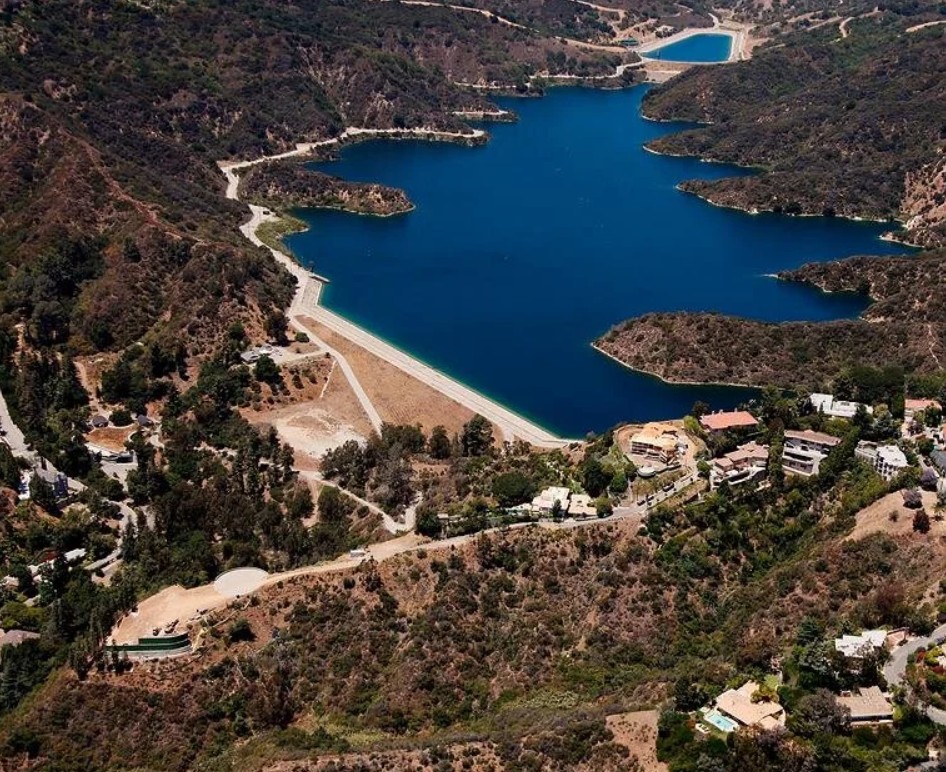
Water comes to Pacific Palisades via a 36′ pipe from the Stone Canyon Reservoir in BelAir.
There should have been water to fight the Palisades Fire on January 7, the system was initially built for it after the 1961 BelAir Fire. Worse, there was water to fight the fire on January 8, when almost another 1,000 structures were destroyed, but firefighters were told no water was available.
The Los Angeles Department of Water and Power had enough water to supply the community with drinking water on January 7, but when extra demands were made on the system, there was not enough pressure in the Westgate Trunk Line to provide water for a large-scale firefight.
Pacific Palisades receives its water from Stone Canyon Reservoir via a 36-inch pipe, the Westgate Trunk Line, which runs along Sunset Boulevard towards the ocean. (CTN asked DWP for a map, it they respond the story will be updated.)
Homes/businesses south of this trunk line/Sunset Boulevard access water from the Westgate Line through gravity. The areas north of Sunset are at a higher elevation, so water is pumped up to three holding tanks: Marquez, Santa Ynez, and Trailer, which each hold a million gallons. Water from those tanks flow via gravity to surrounding neighborhoods.
When the fire started north of Sunset Boulevard, the Westgate Trunk Line was tapped to supply the hydrants, fill the three holding tanks and supply customers north and south of Sunset with water.
At some point, the Westgate Trunk Line pressure dropped below a given value because of demand. The feed pumps to the holding tanks stopped because there was not enough water to pump to the tanks. The three tanks simply ran out of water, they were drained.
On January 7, the Marquez Knolls tank ran dry at 4:45 p.m. At 8:30 p.m., the trailer tank in Palisades Highlands ran dry and by 3 a.m.on January 8, the Temescal tank was empty.
That meant there was no water pressure for fire hydrants or to the water tanks or to homes north of Sunset. Likely low water in the Westgate Truck line meant that people below Sunset started to be impacted by lack of water, too.
At one time, aerial firefighting equipment were able to dip into the Santa Ynez Reservoir, which was built after the BelAir 1961, specifically for firefighting and to provide a quick turnaround for helicopters.
Once a cover was in place, helicopters were still able to fill up from the hydrant next to the reservoir.
Riana Basuel with the LADWP Media Relations Team was asked where the hydrant at the Santa Ynez Reservoir Complex (which was used by LAFD and LACoFD, received water. She responded, “It is supplied by a distribution pipeline with water pumped from the Westgate Trunk Line via the Santa Ynez Pump Station.”
CTN asked when the Santa Ynez Reservoir is full, how is that water circulated. Does it go into the hydrant?
Basuel said, “To maintain proper water quality, Santa Ynez Reservoir is normally operated in an inflow/outflow cycle. In this cyclic operation, you can think of the Reservoir roughly as a ‘turnaround’ point at the end of the Westgate Trunk Line. When the Reservoir is operating normally, water flows in from the Trunk Line over the course of several days until the Reservoir is filled.
“Once filled, the flow is reversed, with water from the Reservoir flowing back into the Trunk Line to supply the area,” she said. “Consequently, the Reservoir serves as a limited alternative supply from one end of the Trunk Line, while the line is otherwise fed from the opposite end by a supply that is effectively unlimited.”
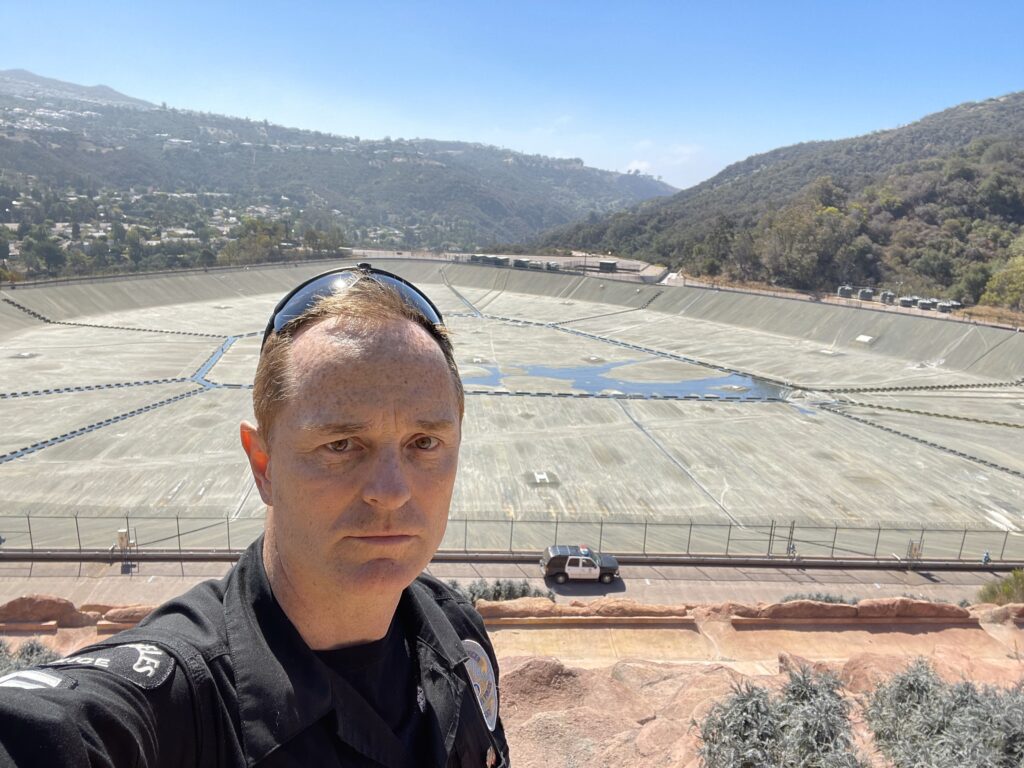
Former LAPD Beach Patrol Officer Rusty Redican routinely patrolled areas in the hills, such as by the Santa Ynez Reservoir. This photo was taken on July 5, 2021.
(Editor’s note: and as one person pointed out and the reservoirs were not filled with drinking water, but water that could be used for drinking and that “drinking water” is used to fill hydrants and flush toilets.)
In a July 2009 Palisadian-Post story, written by this editor, it was reported that DWP has also constructed a new cistern at Pacific Palisades aka Chautauqua Reservoir (on upper Chautauqua) for the L.A. Fire Department’s large helicopters to use for fighting brush fires.
‘Once the floating cover is in place, these helicopters will no longer be able to dip their snorkels into the Santa Ynez Reservoir but will instead have to use the cistern at Pacific Palisades Reservoir,’ said DWP Project Manager Paul Rugar. ‘However, the smaller choppers will still be able to land at Santa Ynez Reservoir and use the fire hydrants to fill their tanks.’
Both reservoirs were empty, neither were available for aerial firefighting. Water-dropping helicopters had to fly outside the fire zone to refill their water tanks, losing a total of 6 hours and 25 minutes of time during the critical initial attack of the fire.
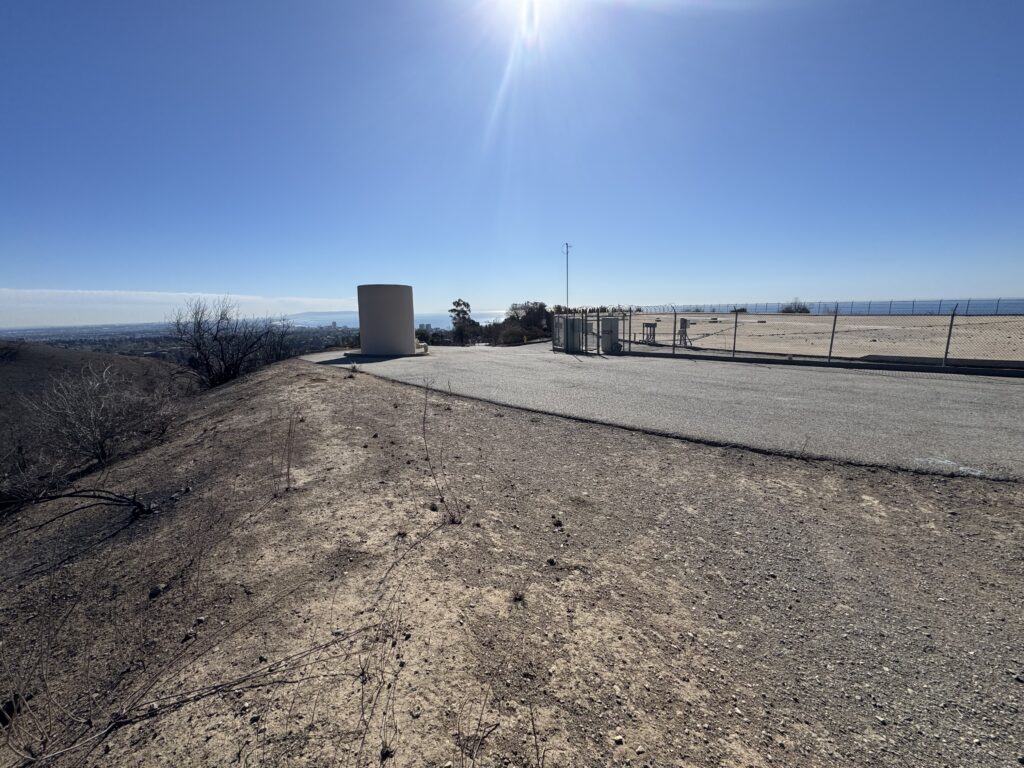
This is the reservoir that is at the top of Chautauqua, off the hiking trail that leads to Will Rogers Park. It was emptied this last summer.
Residents were told that firefighters stopped fighting the Palisades Fire because there was no water, the hydrants weren’t working and the wind gusts were excessive. That explanation might be plausible on January 7, but by some estimates, nearly a third of the buildings lost in the Palisades Fire, burned on January 8.
Eyewitnesses, residents, who walked into town early a.m. on January 8, took photos of buildings, such as the Methodist Church, condominiums on Haverford, the Chase Building and residences that were still standing (Only official vehicles were allowed in on January 8, but residents walked in via paths and stairs, that were unknown to officials.) .
There was no wind on the morning of January 8, so why was an aerial attack not underway, putting out building fires? The second fire on January 8 burned basically unchecked. But there was water.
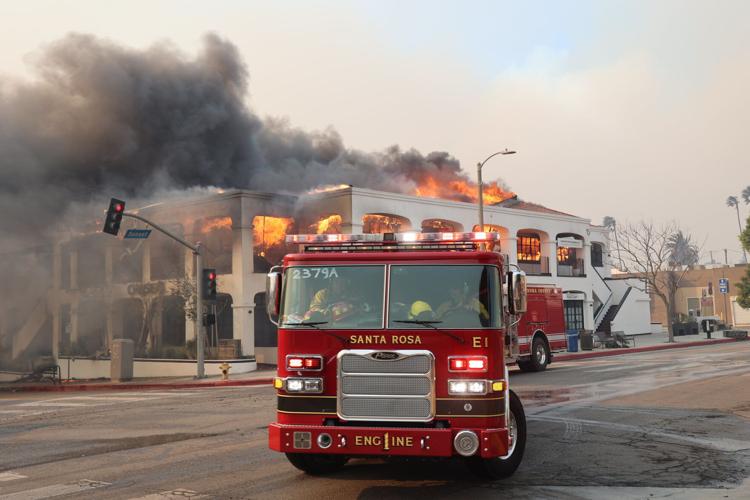
The Chase Bank building burned January 8. People who gained entry to town that day, said it started as a small spot fire on the roof. It was not extinguished and the building burned.
A resident wrote: “Once the pressure came back, I bet the pumps restarted filling the tanks. By January 8, the tanks would have new water to fight the fire as LAFD wasn’t taking water from the hydrants. The pumps possibly restarted filling the tanks which then fed the ‘above the main’ customers. It isn’t like the water stopped and never started again. The water pressure dropped, the system responded, recovered, and water started to flow.”
That scenario would explain why there was water for some residents to fight spot fires on January 8 on both sides of Sunset Boulevard.(CTN asked DWP for pump maintenance records for the three tanks. When they respond, the story will be updated.)
In the BelAir Fire, the hydrants that failed were at higher elevations, initially the Highlands and high elevations is where the system failed in the Palisades Fire.
In the BelAir Fire, loss of water came from destroyed structures, many houses and 1 ½” conduits that ruptured. Although it was reported that Palisades residents turned on sprinklers to prevent homes from burning, there has been no evidence to collaborate it, and more likely it was broken water pipes, such as those reported in the BelAir Fire.
This 1961 BelAir Fire report predicted the 2025 Palisades Fire water failure. The LAFD knew 64 years ago that:
-
- The ungridded distribution system was vulnerable.
- Higher elevations would lose pressure when lower elevations drew heavily.
- Four-hour maximum capacity was insufficient for widespread conflagration.
- Storage was adequate, but distribution couldn’t sustain prolonged overload.
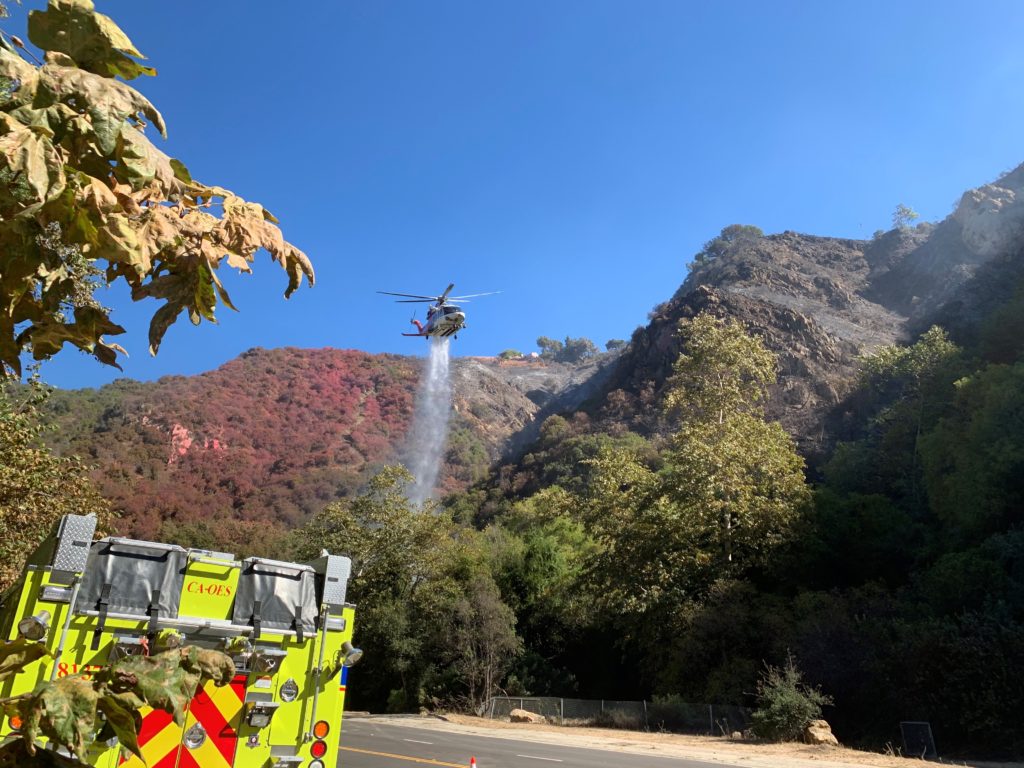
In the 2019 Highlands Fire, residents reported seeing helicopters filling by Santa Ynez Reservoir.
BELAIR FIRE
The 1961 Los Angeles Brush Area Conflagration report noted that: “Brush fires occur in this city every year with almost predictable regularity. As long as masses of highly susceptible vegetation cover the landscape and the climatic cycles produce dry, windy periods, firemen will be called upon to suppress watershed fires. Whether these will again affect populated sections so devastatingly depends primarily on the actions which are now taken to remove conflagration-breeding hazards. . . .A potential fire condition, neither wholly watershed nor structural in scope, but with the worst features of both, lies in wait to sally forth to cut a flaming swath through brush and homes.
“Little corrective legislation has been promulgated to deal with the growth of this singular and dangerous condition. . . .The people living in these regions will receive a maximum degree of security from fire only when reasonable and enforceable laws are produced to effectively regulate and control unsafe structural practices, brush clearance around buildings, water distribution, and accessibility within the mountain areas. Once a conflagration has begun, the best-trained fire fighters, most modern apparatus, and best tactical procedures can only struggle to restrict losses.”
Recommendations from that report are still valid more than 60 years later.
- Improvement of existing roadways that are of inadequate width, or do not have adequate hydrant distribution, whether they be dedicated streets, subdivisions, private streets, or metes and bounds.
- Installation of all power lines underground, within the Mountain District.
- The provision of more and wider fire breaks–either by sterilization, fire retardant planting, or bulldozer clearance.
- That engineering studies be made and that there be provided at least two streets or roads, running parallel to Mulholland and Sunset Boulevards, between Laurel Canyon and Topanga Canyon Boulevards. And further, that north and south through streets or roads be generally provided on each ridge and in each canyon, between Sunset and Ventura Boulevards, in the area bounded by Laurel Canyon, Topanga Canyon, Sunset, and Ventura Boulevards.
- That the water supply in the mountainous area be vastly strengthened. (Editor’s note: It had been until the two reservoirs were not available for firefighting.
What an awesome report. Please preserve this writing.
Wow. Good work, Sue. This is an excellent report.
I live on Tramonto drive in Castlemarre, I had 5 hoses running around at different houses around me , I had pressure all day and night, and the next day.
Fire department didn’t even bother trying to connect to the hydrant in front of my house, even though I don’t asked them to
CRIMINAL BEHAVIOR
The January 7th fire was predictable and preventable.
We, the taxpaying residents of Los Angeles, DEMAND public hearings with the City and County of LA , LAFD and LADWP departments.
We also demand a public hearing with the State of CA, Department of forestry regarding
Brush clearance. (Lack of). The ENTIRE Los Angeles basin is UNSAFE if the residents do not get answers as to what happened on January 7th. Santa Ana winds down not stop at the 405 Fwy, they run from the highest mountain to the sea , blowing over ALL of the Los Angeles Basin. Honestly, NO ONE living in Los Angeles is safe until we get answers to the CITY-WIDE system failures that occurred on January 7th.
In my opinion, this was a complete City, County and State, governmental failure across the board.
It still both infuriates and saddens me, what was allowed to happen to you all! I know how LAPD failures led to a destruction of the posture of daily proactive, high visibility patrolling of the hillsides. Which completely erodes the fabric of safety and security that we all built.
God Bless You all!🙏🏻🙏🏻🙏🏻🇺🇸
Absolutely right. Lots was learned in 1961 but little implemented.
In November 2024 there was a small brush fire in the Highlands.
It was put out by Helicopters in minutes with water from the Santa Ynez reservoir. I have pictures. I showed my UK relatives how effective our fire service was!
I still believe that more action on the morning of Jan 7th could have suppressed the fire in the Highlands. I watched it from my office in Santa Monica and saw very little action.
Biden was blamed. But it was a failure of the City and LAFD to respond. Then LAPD was completely unprepared and ineffective to deal with the traffic mess pouring out of the Palisades. Jan 8th is now turning out to be another debacle of poor City management.
Excellent reporting, as usual.
Judging from their indefensible widespread failures, and their current posture, the guilty political incumbents will be responding ONLY to large lawsuits. The rest of us can save our breath (and vacate the increasingly hopeless region).
The voters are responsible for this tragedy! You vote for people who won’t respond to dangerous situations.
There is a cure for this problem. Vote republican, you don’t have to like them but it will give democrats religion. Democrats have to know that your serious, toss them out and give them a reality check. No one is coming to save you, don’t fall for “we’ll get around to it”.
Or don’t, and wait for more destruction.