The heavy rains that fell February 15-16, totaled 1.91” according to RainDrop click here. Prior to the rain storm, the City and County sent flash flood alerts and warning of possible debris and mud, but no one could have predicted a concrete slab “flow” alert.
Santa Monica Canyon resident Sharon Kilbride reported that “folk in the lower Canyon were alarmed to hear a loud rumbling in the creek near Channel Lane” on February 16.
As residents gathered on the narrow one lane street to peer over the bridge, they were treated to a roar of water that appeared close to breaching the side walls of neighboring homes.
As the rain subsided, so did the water and people could see huge slabs of concrete piled in the canal. With more rain predicted for tonight, January 17, and a danger that additional water could breach the sides of the flood control banks, Kilbride, a member of the Canyon Alliance and a representative on the Pacific Palisades Community Council contacted L.A. City councilmember Traci Park and L.A. County Public Works.
Parks office responded immediately. “Preliminary reports from LA County Public Works field engineers for the Santa Monica Channel say the concrete overlay that was installed in the 1970s has peeled off and this is the material in the channel.
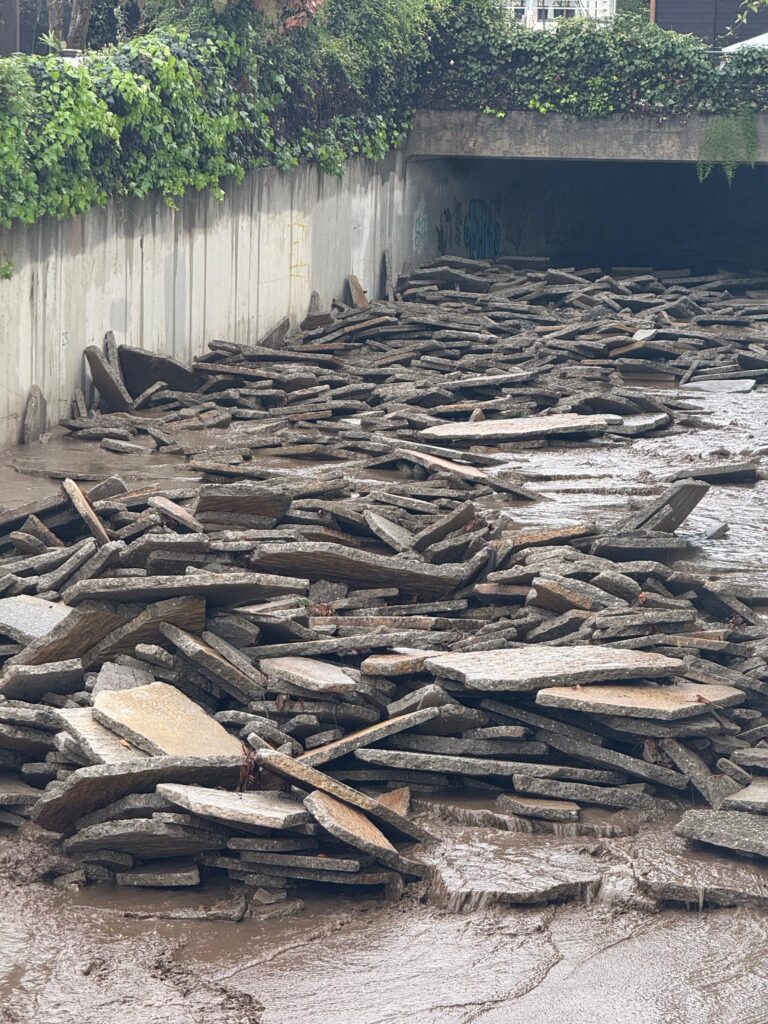
After the water subsided in the channel, concrete slabs were seen.
Photo: SHARON KILBRIDE
According to those engineers, “the channel capacity has been reduced by about 15% near the confluence of Rustic Canyon and Santa Monica Channel and should handle expected flows.”
Residents were told that crews will not be able to remove the concrete until after the storms but that officials are continuing to monitor the channel.
The channel is County responsibility, but if water flows out of the channel into the streets, it is a City issue. Arus Grigoryan, field deputy for Traci Park’s office added, “We will continue to work with City departments to keep them aware of the issue if we have more water that spills over during the next few rain events.”
The National Weather Service is predicting a half and three quarters of an inch tonight and on Wednesday another tenth of an inch is predicted.
There were historic floods in Santa Monica Canyon between February 27 and March 3, 1938, when two storms swept across Los Angeles. As local historian Betty Lou Young (now deceased) wrote “A crisis developed in Santa Monica Canyon when the storm drain under West Channel Road became blocked by debris, sending a crest of water four feet high rushing down the canyon. Huge chunks of Pacific Coast Highway were washed out to sea.”
And the local town paper The Palisadian reported, “two days of heavy rains forced the water from Rustic, Sullivan and Mandeville Canyon to overflow and converge to form a mighty, roaring torrent 100 feet wide. . . homes were flooded along Channel Road, Rustic Road and Entrada Drive, and all the stores and service stations in the canyon were flooded to a depth of several feet.”
After the 1938 flood, Rustic Canyon and Santa Monica Channel were lined with concrete, to ensure the water stayed in the channel. By the early 1960s most of the channels in L.A. were lined. They are credited with saving property in 1969, when record rainfall of 13 ½ inches fell in L.A. in nine days (more than what fell in 1938). And again in 1980, the channels held back water when there was another major L.A. rain event.
In the 1990s, visions of restoring and improving the L.A. River back to a more natural form has slowly gained favor.
But, now, once the concrete is removed, an assessment will need to be done to see if concrete will be replaced or if other work needs to be done.
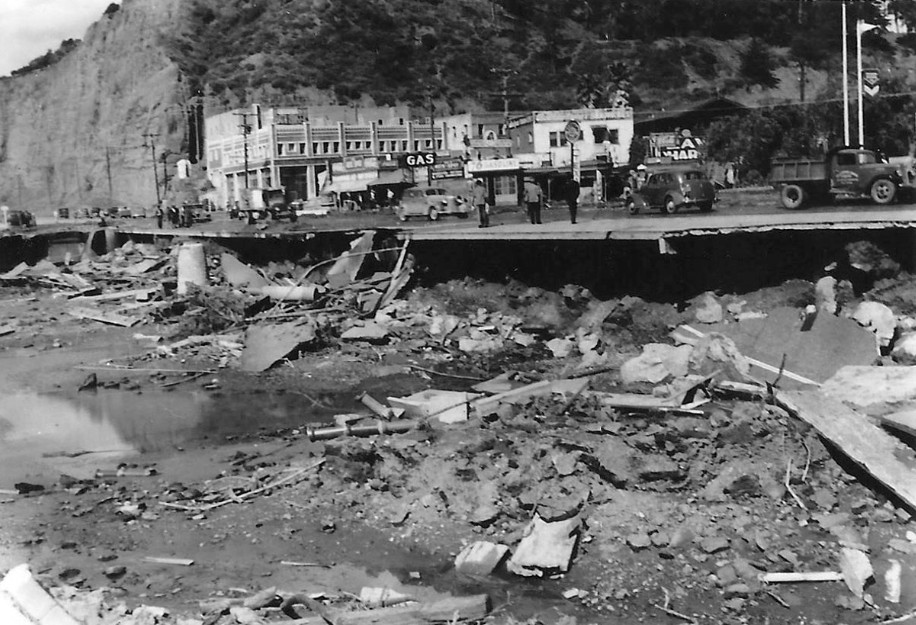
The corner of PCH and Chautauqua after the 1938 flood.
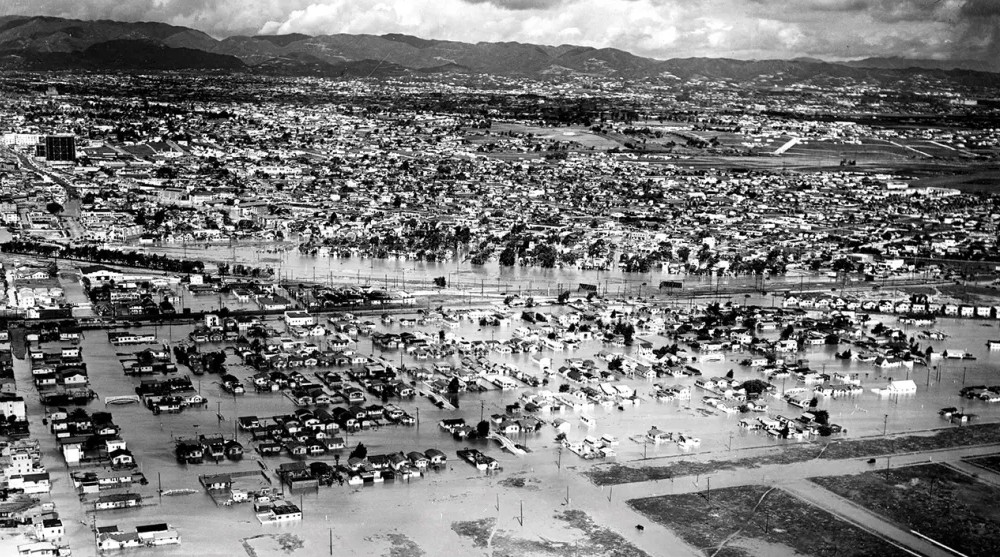
The 1938 Flood also covered Hollywood.