
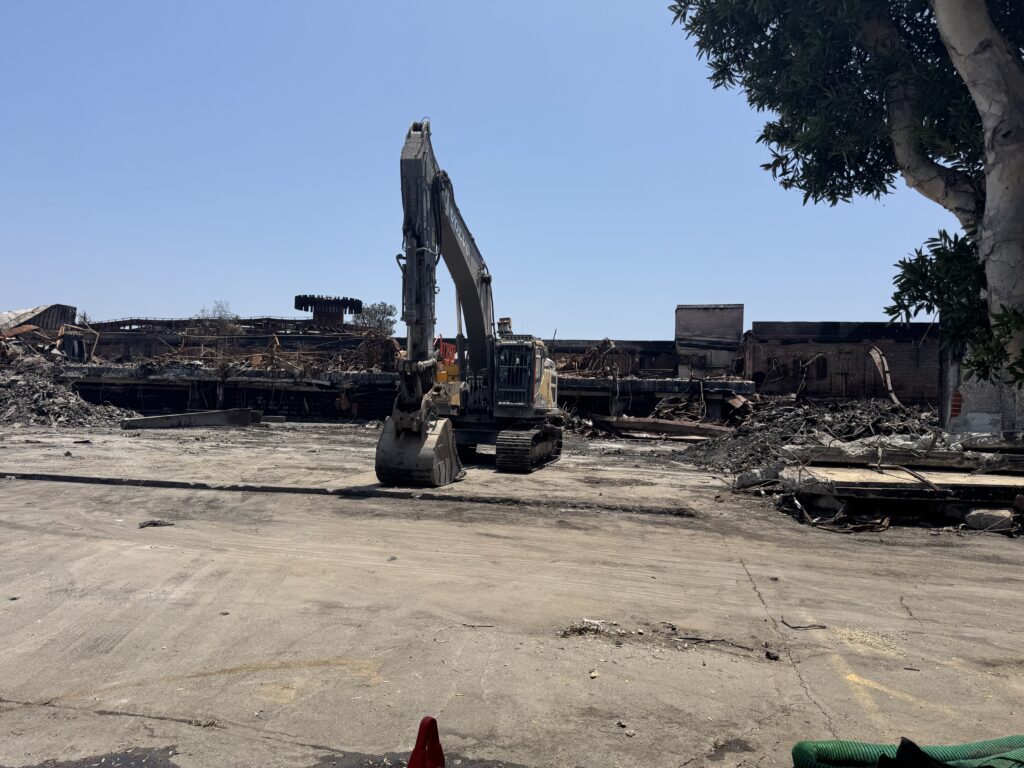
The heavy equipment used to remove debris after the fire destroyed Pacific Palisades streets that were already rated poor by the City of Los Angeles.
Residents of Pacific Palisades spoke to L.A. Street Services at the street fair held by the PaliBu Chamber of Commerce on November 23. They specifically asked about Albright and Charm Acres. After the January 7 Palisades Fire, that street like so many have been destroyed, with large potholes, breaking pavement and on some streets, now dirt.
Officials told the couple that there would be no repairs until the majority of the work is completed in the Palisades, maybe two or three years.
It has been an year since the fire, and progress is slow. Two to three years might be an optimistic assessment of when work will be done in the Palisades.
After the fire, heavy equipment went up and down city streets removing the almost 7,000 buildings that were destroyed. There were graders, haulers and bulldozers that worked nonstop to remove house foundations, fallen trees and poles and the remains of fire debris.
Anyone familiar with Pacific Palisades knows there are few major roads in town, (hence problems with evacuation) but that meant debris hauling had a major impact on streets.
Street repair, in general, is a problem in Los Angeles.
In a December 29, L.A. Times Viewpoint, Oren Hadar and Michael Schneider write “It might be hard to believe but L.A. hasn’t repaved a single street since early summer. The city’s dashboard Metrics – Fiscal Year 2025 to 2026 | Bureau of Street Services says crews have resurfaced zero miles since July 1, the beginning of the city’s fiscal budget . . . in its draft budget, the city is proposing to repave zero miles next year, too.”
Hadar and Schneider point out that instead of repaving the city has shifted the budget to “large asphalt repair,” which means that holes are patched, but the entire street goes unattended, which is more expensive than full repaving.
They write, “streets that are in decline but still in decent shape can get slurry sealed, which is a common maintenance treatment that costs only $30,000 a mile. Streets in worse condition need to be resurfaced at about $200,000 a mile. If a street gets so degraded that it must be completely reconstructed, that can cost up to $1 million a mile.”
According to a May 2013 L.A. Times Story (“Grading Los Angeles Streets”–visit: click here.), 23 percent of the streets in Pacific Palisades (175 out of 769) received a grade of F. That was before the fire.
According to Street Services, streets are rated using the Pavement Condition Index (PCI), which rates the physical condition of the street by considering the pavement’s structural and surface operational condition and is based on a 0 to 100 scale. An F grade means the street condition is poor, with the following characteristics:
- Type of Maintenance Required: resurfacing and/or reconstruction (6 to 12 inches of asphalt concrete.).
- Physical Condition: major or unsafe cracking, 36% to more than 50% of base failure.
- PCI Range: 0 to 40
The Street Services website reported that overall in the City, as of July 1, 2017, 55 percent of the roads are in good repair, 20 percent in fair condition and 25 percent in poor condition.
In 2019, this editor reported that Sunset Boulevard, a major thoroughfare, was rated poor for much of its length. The L.A. Times gave the road an F. Other major streets in Pacific Palisades received F’s – and that was before the fire.
That map does not list the 39 vacated Palisades streets, which are not rated nor given a grade.
In 1935, California passed a law allowing cities to pull “municipally owned” property out of public use. The City of L.A. started withdrawing streets in 1936 because a city engineer told lawmakers it would prevent claims against damages arising from defective streets.
According to the original ordinance, those vacated streets were supposed to be outfitted with barricades and warning signs, but many of them are still being used today.
A May L.A.Times 2018 story (“Some L.A. Streets Aren’t Being Repaved Because of a Law Dating from the Depression”), said the state code had been repealed. “And in the decades since, city attorneys have advised that L.A. still bears legal responsibility for such damages on withdrawn streets, according to city records, including a 1988 engineering report and a 2014 motion made by a city councilman.”
Residents living on one of the vacated streets below may not be able to find their street graded because, according to the City, it “doesn’t exist.”
Palisades streets withdrawn in 1937 included Giardino Way to Tramonto; W. Livorno Drive (Ida Street to Salerno Dr., Salerno Dr. to Marquez Ave. and Marquez to Bollinger Dr.); Marquette St. (Bienveneda to 400 feet east of Las Casas); Alta Mura Road (San Onofre Dr. to Alta Mura);San Onofre Drive (Alta Mura Rd. to Terminus); Bellino Drive (Tranquillo Road to Sabbiadora Way and Quadro Vecchio Drive to Tramonto); Tranquillo Road (Sabbiadora Way to Tranquillo);Monte Grigio (Sabbiadora Way); Monte Grigio (Tramonto Dr.); Notteargenta Road (Sabbiadora Way to Tramonto); Coperto Drive ( Tramonto Dr.); Via Nicolas (Paseo Miramar); and Fermo Drive (Romany Road to Rustic Canyon Road).
In 1948, 11 streets off Paseo Miramar were “vacated” (Vista Pacifica to Alondra Dr.), (Alondra to Resolano Drive), (Resolano–2), (Resolano to Catalonia Avenue), (Catalonia to Lucero Avenue), (Lucero Avenue via Nicolas), (Via Nicholas to Florence), (Via Florence to Sunset Blvd.), Via Maria (Via Florence) and (Florence via Maria to Paseo Miramar).
In 1957, Via las Olas (which transverses the bluffs over PCH) was vacated from Mt. Holyoke to Friends Street.
In 1958, two more roads that feed into Posetano Road (Stretto Way and Revello Drive–both directions) were vacated.
The last street vacations in the Palisades came in 1963 when streets that fed into Tramonto Drive were “let go,” including Revello to Coperto and Coperto to Quadro Vecchio. Also, on that list were Casale Road to Capri, Castellammare Drive to Stretto and Stretto Way to Breve Way.

Revello Road was lost during a slide and after a law suit, the City rebuilt it. Portions of Revello have been vacated. In some areas of Pacific Palisades, these are the streets that fire trucks need to navigate.
Palisades had many streets that needed repaired by the City before the Palisades Fire. After the fire, almost every street needs to be replaced. One also wonders if fire trucks are able to access vacated streets.
(Editor’s note: If the state receives FEMA money to rebuild infrastructure destroyed by the fire, such as streets, one would like to see oversight to make sure the money actually goes to Palisades street repair and not into the City’s Black Hole.)
The City of L.A. and the State of California are broke and mismanaged. We pay very high taxes on our gas (which makes our gas about twice the average for the country) that is suppose to go toward repaving roads. The City and State need an AUDIT from a third party that isn’t connected to them.
No money for repaving roads but plenty of money for well connected non-profits and government officials salaries. @TCM is exactly right.
We will need off road vehicles to get to our lots/building sites!