
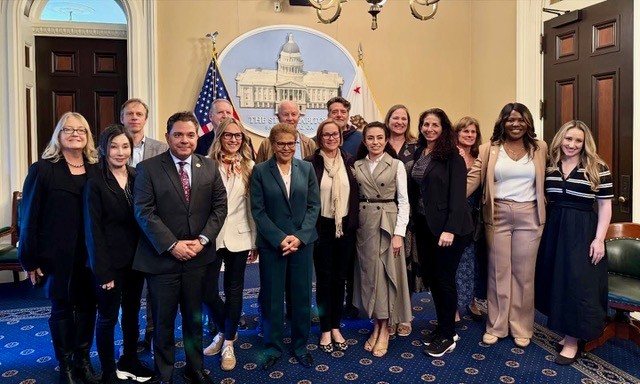
A delegation of Palisades residents traveled with Mayor Karen Bass and Traci Park to Sacramento to speak about insurance. Photo: ROSEANNE LANDAY
A delegation of 11 Palisades residents traveled with L.A. Mayor Karen Bass and Councilmember Traci Park to Sacramento on February 9 to advocate for Palisades Fire Survivors.
The delegation represented 1) single-family homeowners who lost their homes, 2) underinsured households, 3) condominium and townhome owners, 4) HOA board members, 5) mobile home residents, 6) apartment building residents, and 7) families whose properties suffered fire and smoke damage.
Residents covered their own transportation expenses and participated on a volunteer basis. Individuals attended in their personal capacities as community members and wildfire survivors
During the visit, the delegation met with legislative leadership, insurance committee chairs and staff, senior representatives from Governor Gavin Newsom’s office and California Department of Insurance officials.
Key legislative proposals discussed included:
- SB 876 (Padilla) – Wildfire Catastrophe Claims Reform Act
- SB 877 (Perez) – Fair Claims Practices and Transparency Act
- SB 878 (Perez) – Insurance Payment Accountability Act
- AB 1680 (Calderon) – Make it FAIR Act
- AB 1642 (Harabedian) – Wildfire Environmental Safety and Testing Act
- SB 894 (Allen) – California Wildfire Resilience Program
Delegates advocated on three issues:
1)Wildfire insurance claims reform, including enforcement and transparency improvement, 2) Long-term insurability as communities rebuild, particularly in high fire-risk zones, and 3) Mortgage forbearance and rebuild financing gaps, including credit reporting and repayment concerns.
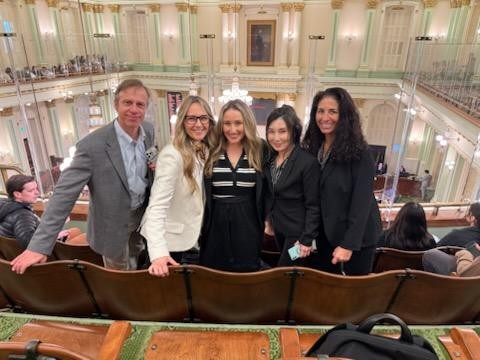
Residents spoke to individual legislators about insurance issues.
Photo: ROSEANNE LANDAY
Legislators were told that multi-unit housing, such as condominium and townhome HOAs, apartment buildings, and mobile home parks, are often classified as commercial properties and can fall outside certain residential insurance protections and government programs.
Residents also described delayed claims processing, shifting adjusters, disputed valuations, contamination testing challenges, underinsurance gaps, insufficient ALE/LOU, and the additional financial exposure faced by underinsured multi-unit housing, all of which complicate and may stall rebuilding timelines.
Several delegates also raised concerns about wildfire-related contaminants — including substances classified as neurotoxins and carcinogens — and emphasized the need for rigorous, standardized testing protocols prior to scope-of-loss determinations and remediation.
Another concern presented to legislators was about mortgage forbearance under existing law and the need for relief protections aligned with extended rebuild timelines. Governor Gavin Newsom recently announced an agreement with lending institutions to extend mortgage relief for wildfire survivors, subject to federal approval. Participants emphasized the importance of ensuring those protections are durable, enforceable, and inclusive of all Palisades communities.
Legislators were told that residents are willing to rebuild to higher fire-hardening standards and invest in defensible space and other mitigation measures. However, there is currently no standardized mechanism to ensure those investments translate into durable, long-term access to insurance coverage.
In addition to multiple survivor testimonies, the delegation presented findings from the Ground Truth Initiative, a resident-initiated rapid-response survey of single-family homeowners that gathered nearly 500 responses within 72 hours. (The survey was independently organized and funded through Palisades Rising.)
The homeowner survey data reiterated delegates’ experience with ongoing claims, inconsistent smoke and contamination coverage, significant underinsurance gaps, uncertainty around long-term insurability, and construction funding shortfalls tied to both insurance and mortgage constraints.
Residents described the meetings in Sacramento as constructive and implementation-focused.
The City’s delegation emphasized that Pacific Palisades and Eaton can serve as learning environments for how California coordinates recovery, insurance reform, environmental testing standards, mitigation investment, and mortgage protections going forward.
Participants stated that the goal is not only to improve outcomes after a loss, but to ensure all housing types can rebuild safely and efficiently, stabilize, and remain insurable over time.
The City of Los Angeles and residents plan to continue engagement with legislative offices, the Governor’s administration, and the California Department of Insurance as wildfire-related legislation advances and recovery efforts evolve.
Participants and their focus:
- Elissa Ashwood – Standing homes; multigenerational families
- Rita Ciolek – Tahitian Terrace Residents Association
- Steve Cron – Senior citizen financial recovery and underinsurance challenges
- Martin Hak – Insurance claim recovery friction points; future insurability; rebuild funding gaps; senior resident financial recovery challenges
- Allison Holdorff-Polhill –: Insurability; total-loss rebuild challenges (among the first homes rebuilt post-fire)
- Rachel Jonas – (State and federal mortgage relief)
- Grace Kono-Wells – (Mobile homes and mobile home parks; immediate no- and low-cost rebuild funding; insurance inclusion)
- Roseanne Landay – (Condos, townhomes, apartment buildings, affordable housing, seniors, and essential workers; access to low-cost capital for rebuilding multi-unit housing)
- Tim Schneider – (Standing homes; insurance claims practices; future insurance affordability and availability)
- Marianne Wisner (Rigorous toxin testing prior to scope-of-loss determination and remediation; regulation of remediators)
- Felix Werner (HOAs; Palisades resident news coverage)