
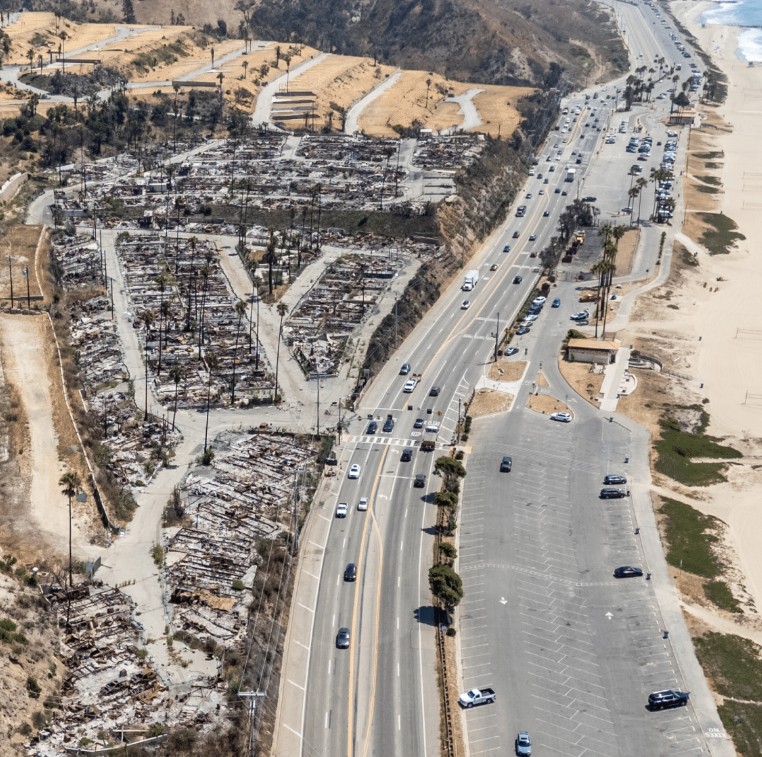
The Paliades Bowl Mobile Home Park is located across from the Pacific Ocean. The property has been listed for sale.
The real estate brochure shows gorgeous photos of the Palisades Bowl at 16321 Pacific Coast Highway. The square footage is listed as 861,181-square-feet on a lot size of about 19.77 acres.
The brochure notes that the Bowl is “Situated along one of Southern California’s most iconic corridors . . . offers investors and developers the chance to acquire a prime asset in a highly coveted, supply-constrained market.
“Formerly home to 173 mobile residences, the Property was impacted by the Palisades Fire, creating a blank canvas for redevelopment. With favorable RE40 zoning and exceptional visibility along Pacific Coast Highway, the site is ideally positioned for a transformative residential or mixed-use project. . . .and offers direct access to beaches, hiking trails and scenic vistas.”
There was no asking price.
There were also are a few caveats not mentioned in the brochure.
Prior to the Palisades January 7 Fire, the Bowl provided affordable housing for a large number of seniors and people with families, many of whom are on rent control. Residents owned the mobile homes that were on the lots, but paid rent to the Biggs family who owned the land. The residents have leases and anyone purchasing the land would have to honor those documents.
Bowl resident Jon Brown, who has advocated for the displaced residents and his neighbors, said that for a buyer close the park, an impact report would have to be filed, and whoever bought the property would be responsible for removing more than 100 senior citizens, most on fixed incomes.
The person would also have to file a change of use for a property that is zoned RE-40.
Chief Executive Officer of Crest Steven Somers said that RE40 Zoning means “properties are typically utilized for single-family homes,” and noted that “this property in particular has a unique entitlement history allowing the previous multifamily use, which could be maintained under the various fire rebuild executive orders as long as the building footprints are not increased by more than 10% and the unit count is not increased.”
Somers said that if a future owner wanted to redevelop with more units, “a coastal development permit and additional discretionary entitlements would be required.”
Senator Ben Allen was asked about the status of the Palisades Mobile Home Parks. “We recently introduced SB 1092 to provide residents or their designated representative (a qualified nonprofit or local entity, perhaps) with an opportunity to compete to purchase the park if the owner receives an offer,” Allen said and noted that if a sale would go through before the bill would take effect on January 1, 2027, there are existing local protections in place.
Those protections mean if a new owner wants to close the park or apply for a change of use of the land, “The City will require impact reports and relocation assistance for the residents,” Allen said. “By the time that is done, our SB 1093 will be in effect (if passed and signed) to provide additional protections and clarifications in the event of a proposed closure or change of use.”
There had been talk about the displaced residents trying to buy the property. They have formed a nonprofit Palisades Bowl Community Group.
Also not mentioned in the brochure is the active landslide behind the Palisades Bowl. Asilomar Avenue, between El Medio and Almar Avenues, is built on a hillside that has two landslides. One starts 90 feet below the surface, extends into the Pacific Ocean, and is considered inactive. The other, 35 feet down, is continually moving.
The hill is owned by the City, and owners of the Palisades Bowl and Tahitian Terrace. In 2023, the City spent money to stabilize its portion – the top of the hill, but neither mobile home park owner has addressed the slide. Sommers was asked if that would have to be disclosed.
“Sellers of real estate are required to disclose any material facts that they are aware of regarding their property,” Sommer said. “This would typically include any known information regarding geotechnical instability.”
Brown said that if the infrastructure, electric, water and sewer could be installed, most residents could return because the homes could be built quickly and cheaply.
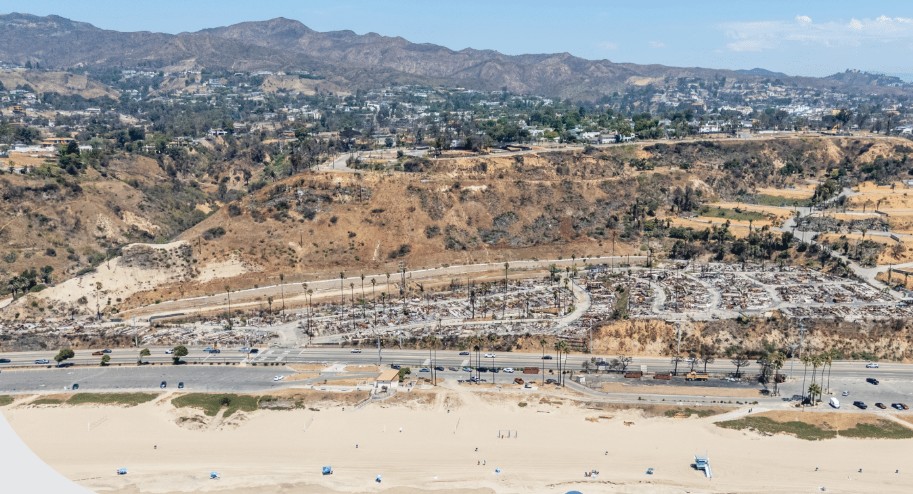
The hill behind the Palisades Bowl has two landslides, one is inactive, the other active.
As was noted, the active landslide is just one of many limiting factors that the seller is not disclosing. I believe the Milla Roos Act (which requires every community provide affordable housing) would be a challenge for any developer as the Biggs family tried numerous times to change the use to high end residential or mixed use and were refused by the governmental agencies.
It would be great if the city of LA would assist the owners in purchasing the park, and repopulating it with mobile homes and former families.
As a resident of the Palisades Bowl I’m not really surprised to read about the sale here first. The owners were never communicative to the residents.