Viewpoint–St. Matthew’s Teacher’s Letter Promotes Reverse Racism

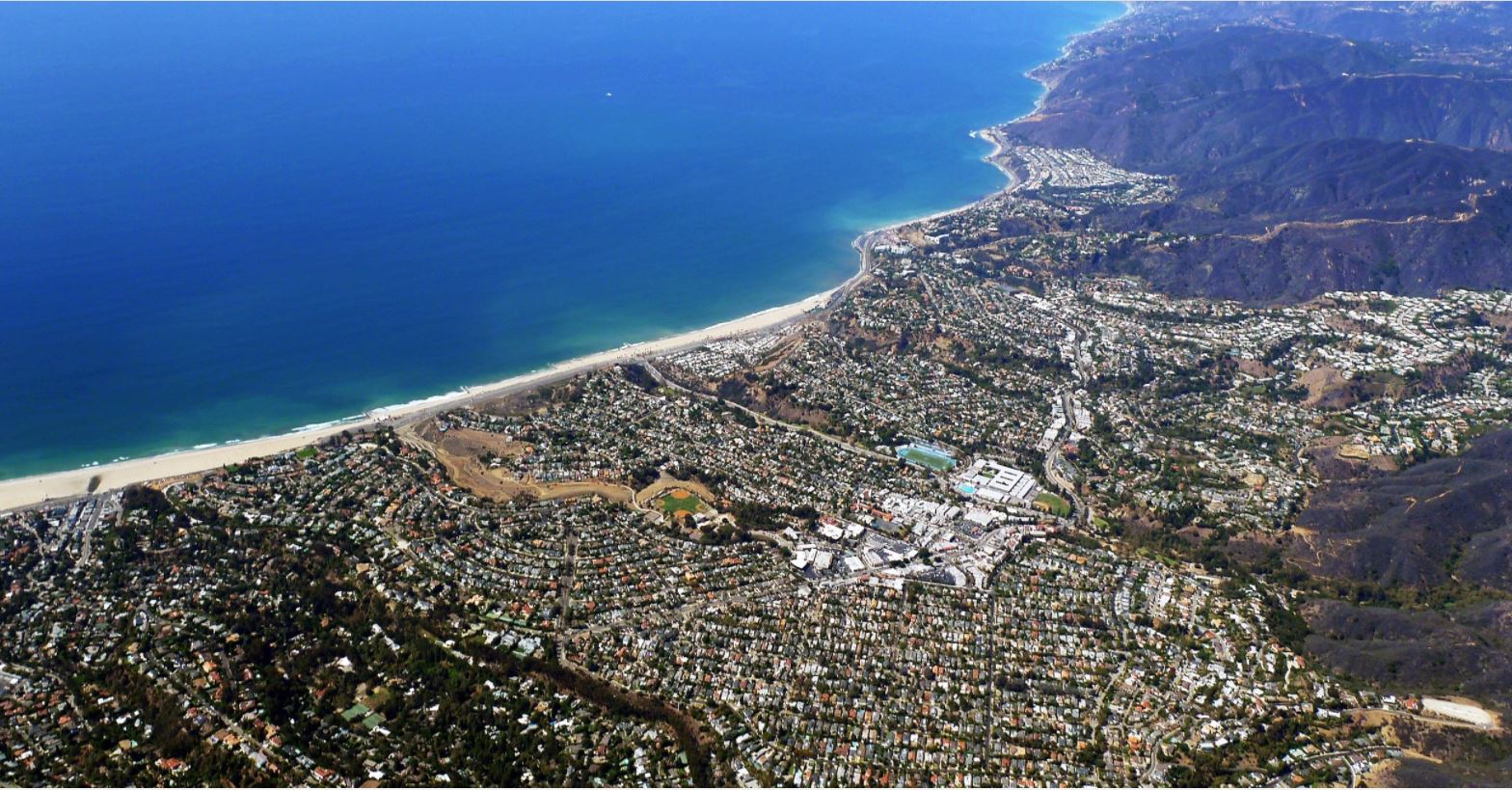
St. Matthew’s School in Pacific Palisades is locate on a beautiful site of land.

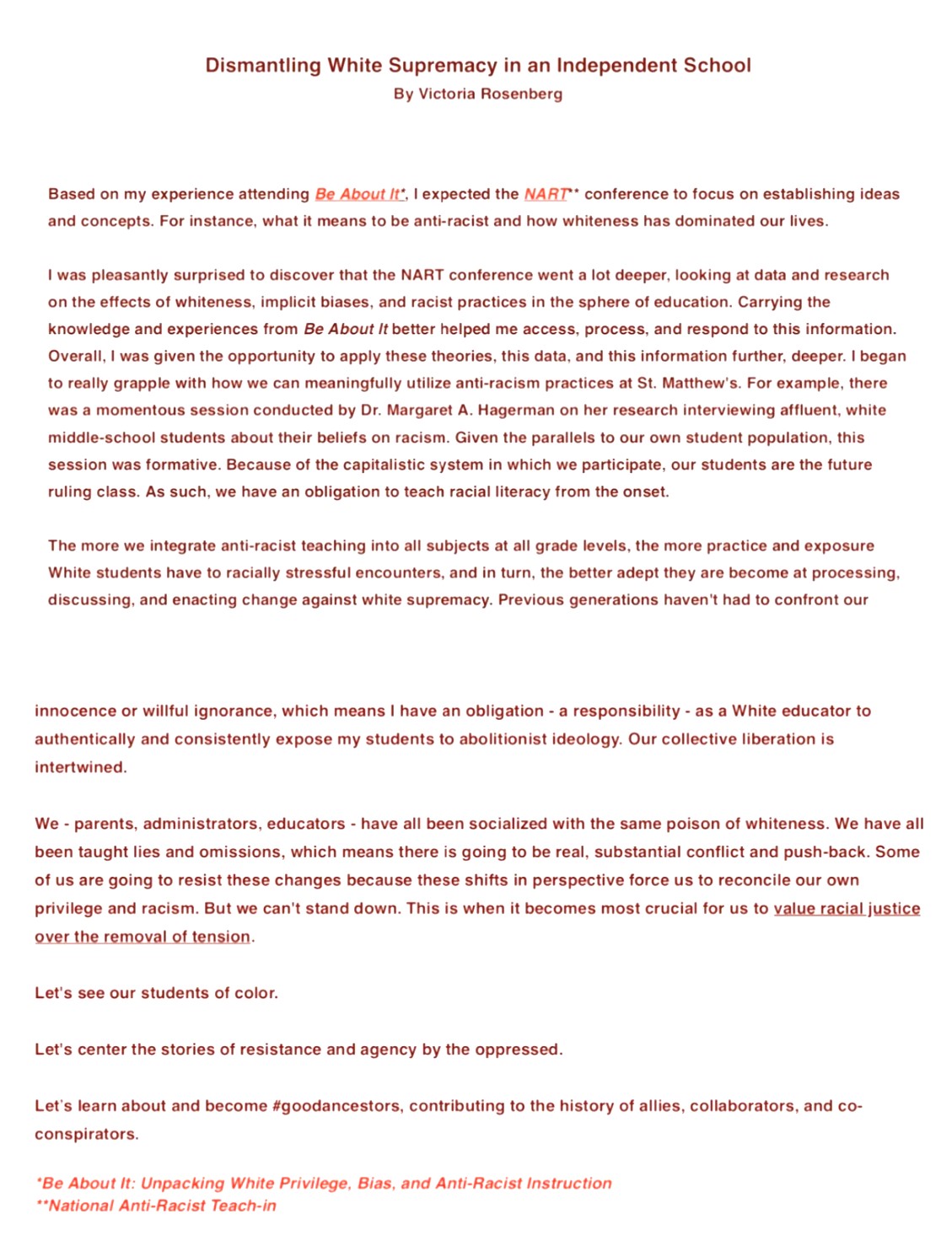
St. Matthew middle school teacher Victoria Rosenberg sent a letter (below) to parents, which was shared with CTN, and also sent to Breitbart News.

Rosenberg attended a NART (National Anti-Racist Teach-in) conference that hosted prominent critical race theorists including author of the 1619 Project, Nikole Hannah-Jones.

NART professes one of the core beliefs of Critical Race Theory, that “Racism and white supremacy exist today, and all members of this society are active participants in it. No exceptions.”

Rosenberg wrote to parents and teachers that “all have been socialized with the same poison of whiteness.” She advocated for the integration of “anti-racist teaching into all subjects at all grade levels” on the basis that it will give white students more “exposure” to “racially stressful encounters.”

She specifically argued that these encounters will prepare white students to act as woke activists who can become better at “processing, discussing, and enacting change against white supremacy.”

Reverse racism. Anytime someone discriminates against another person based entirely on the color of their skin, they are a racist. Being a racist is not a white phenomenon, and when skin color is chosen to define a person, it is a disservice to all people.

People are afraid to say that in today’s political climate, because then, they are called racist and labeled not smart enough to know they are racist.

This editor acknowledges there has been injustice and inequality in the past, not only in the United States, but in countries around the world.

The United States has had a black president and vice president. CTN believes that both were chosen for their leadership abilities and not because of skin color. There is opportunity in this country for anyone who wants to strive for it.

Growing up on reservation in South Dakota, people have intermarried for generations, and one might be surprised to find the blue-eyed, red-headed woman was actually enrolled in the tribe. Or the man with more melatonin in his skin, who looks darker, might not have enough “Indian” to be part of the tribe and qualify for benefits.

For the most part, people have no control over their physical being, so to hate them because of the color of the skin, the color of the hair, height, large/small nose, pointy ears, is inane.

CTN feels sorry for Rosenberg – and her students. She tells parents that she has “a responsibility” to “consistently expose my students to abolitionist ideology” for the sake of “collective liberation.”

The teacher concludes her letter by noting her own intention of fostering “collaborators” and “co-conspirators.”

It is important to acknowledge history, but also important not to live in the past, to see and take advantage of the opportunities that exist today.

St. Matthew’s Parish School is an elite private school, with tuition costing nearly $40,000 for seventh and eighth graders. CTN reached out to St. Matthew’s for comment but did not receive a reply.


Posted in Kids/Parenting, Schools | 8 Comments

Author William Kent Krueger Speaks on Writing

(Editor’s note: Brookings, South Dakota, held a book festival at South Dakota State University at the Oscar Larson Performing Arts Center on September 24-26. The event was free and open to the public. In addition to numerous workshops, such as journal and poetry writing, and how to complete and have books published, there were several well-known authors in attendance, such as William Kent Krueger. Krueger, published by Simon & Schuster, is an American novelist and crime writer best known for the novels that feature Cork O’Connor. In 2005 and 2006, he received the Anthony Award for best novel. His stand-alone book “Ordinary Grace” won the Edgar Award for Best Novel of 2013.)

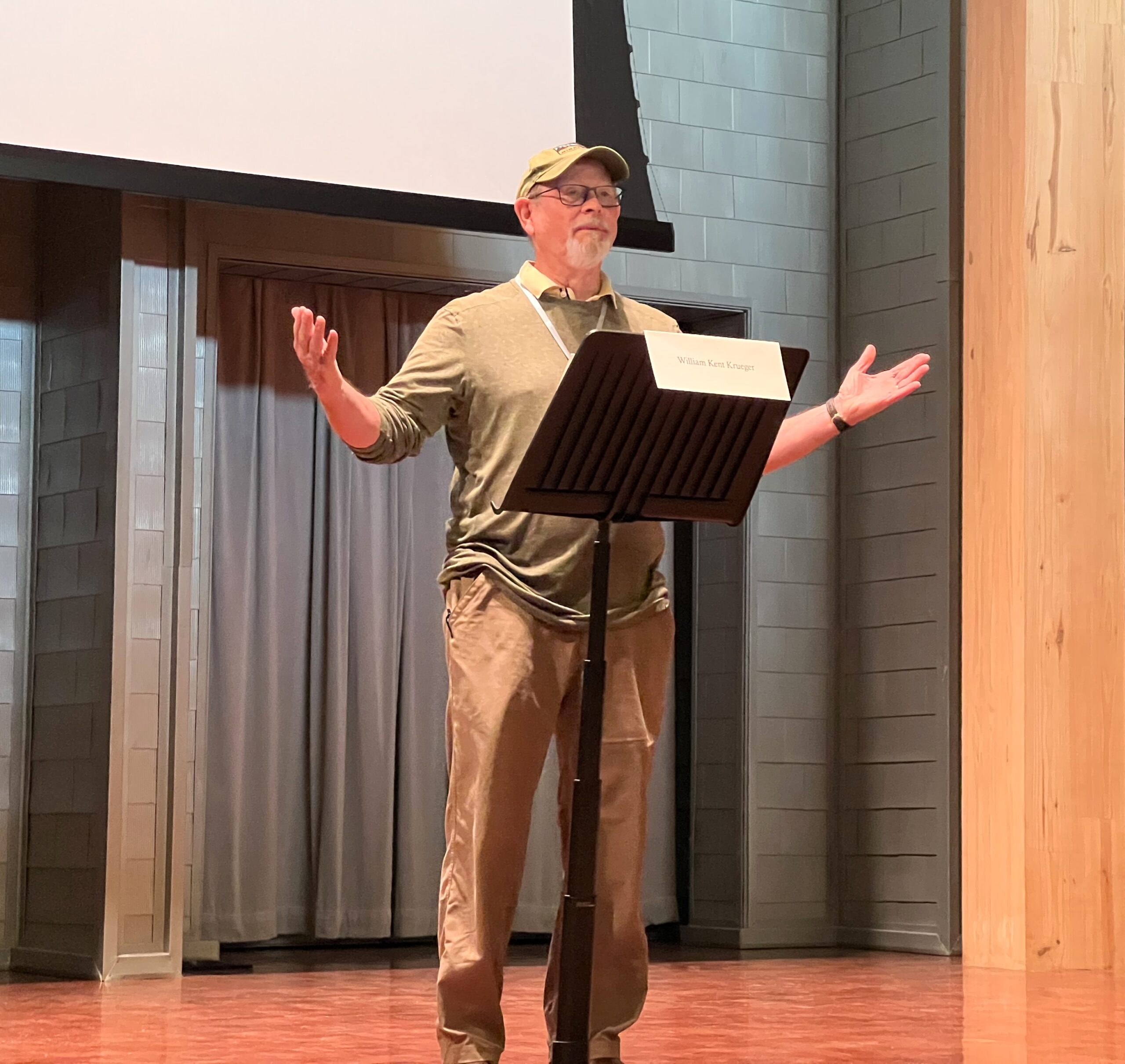
Author William Kent Krueger spoke about the art of writing.

“To be a writer is to live in hope,” William Kent Krueger told the about 100 people who had gathered Founder’s Recital Hall at 9 a.m. on a Saturday morning.

He told the audience, he uses his full name on his books, but “I’ve always gone by Kent.”

He is the author of 19 Cork O’ Connor books, the first being Iron Lake, and two stand-alone novels. He started with an opening line from Moby Dick because it was a journey of a young person and a vision of what is possible.

Krueger said we all go through life with the vision of “what’s possible,” but that some of us find it later in life and then explained how he became a published writer in his 40s.

His father was a high school English teacher, who walked around the house saying, “doesn’t anyone use a dictionary?”

Krueger’s first attempt at a storytelling was in third grade, when he wrote about a dictionary that had legs and could walk. He said he received high praise from the teacher and his father for the story. “In third grade, I knew I wanted to be a writer.”

His father had him read Ernest Hemmingway, and “At 18, I wanted to be Hemmingway.”

In an interview for Shots magazine, Krueger said about Hemmingway, “His prose is clean, his word choice is perfect, his cadence is precise and powerful. He wastes nothing. What’s not said is often the whole point of a story. I like that idea, leaving the heart off the page, so that the words, the prose itself, is the first thing to pierce you. Then the meaning comes.”

He attended Stanford in the 1970s, but during student protests got into an argument with the administration and did not complete his degree.

He kept writing, while digging ditches, logging timber and in construction.

“When I hit 40, I hit a mid-life crisis,” he said, and noted that he decided to write a book. He did research and discovered that everyone loved mysteries and “I decided to write a mystery.”

His father had not encouraged mysteries, because they were not considered great literature, so “I never even read even any Nancy Drew as a child.”

He started his mystery education by reading Tony Hillerman, who is known for his strong characters and tribal policeman who solve crime on the Navaho reservation.

“He created profound characters with a strong sense of background,” said Krueger, who explained that conflict is essential in any novel.

Krueger, who lived in Minnesota, was aware of the conflicts there that center around weather, the landscape and cultural differences.

He decided to make his main character half Anishinaabe (Ojibwe). “I started by reading everything I could get my hands on about the culture,” he said, noting that he also gives his novels, after they are finished, to Ojibwe friends, to make sure the traditions are correct.

His main character Cork O’Connor is half Ojibwe, half Irish American.  Krueger said he chose the name Cork, because he wanted a character who, no matter what happened in life, was resilient, would always come back.

Krueger said that authors of series make a choice for protagonists to either make them static or dynamic.

An example of a static main character would be Sherlock Holmes, but this author elected to make Cork dynamic. Those that are fans of the series have followed Cork as he’s aged and watched his children become young adults.

The author said that the first dictum of writing is to “write what we know,” and he created a family man and the “saga of the Cork O’Connor clan.”

He finished his 500-page first novel Iron Lake and sent it to 30 publishers in New York. “I only got six xeroxed negative replies and some were not even centered on the paper,” he said.

It was when friends told him he should try a Chicago agent Jane Jordan Brown, that his hope of becoming published shifted.

“I crafted a letter and sent it to her,” he said, “And she agreed to read the book.”

After reading it, she told Krueger if he could cut it by about 100 pages, she would reread it.

“I took a year and trimmed about 120 pages, and sent it back to her,” he said.

Brown sent his book to six publishers in New York and when Krueger received an offer from St. Martin’s Press for a first novel, he was ecstatic and asked, “Where do I sign?”

She didn’t let him because she was convinced there would be a counteroffer from Simon & Schuster, which she received. Once again, Krueger asked, “Where do I sign?”

Brown didn’t let him sign until she had counter offers from both and he ended up with a lucrative two-book deal from his current publisher.

He was asked which was his favorite novel. “Iron Lake, because it was my first. I like Thunder Bay because of the theme about the sacrifices we’re willing to make in the name of love,” Krueger said. Lightening Strike because it is about Cork as an adolescent and now my new book Fox Creek.

Friday and Saturday saw numerous writing events at several venues.

Posted in Books | Leave a comment

LAHSA’s Homeless Numbers Questioned by Several Sources

This homeless encampment was a block from bridge housing in Venice (white building in the background). It has been cleared, but tents have moved a block over on Third St.

(Editor’s note: In February, the Westside Current published an article about a discrepancy in the LAHSA 2020 homeless count. The article, Venice Group’s Data Indicates LAHSA’S Homeless Count May Be Wildly Inaccurate, highlighted a difference between a Venice group’s homeless numbers and those from LAHSA’s 2020 count. After that story, a report released by the RAND Corporation supported the numbers of the Venice group.  Angela McGregor picks up the story from there. This story is reprinted in cooperation with the Current.)

BY ANGELA MCGREGOR

A newly released Los Angeles Homeless Services Authority (LAHSA) point in time count of L.A.’s homeless population is under scrutiny, again.

In early September, LAHSA released the results of the 2022 Point In Time count of L.A.’s unhoused population, the first it had conducted since 2020.  Countywide, the count showed a 4.1% increase.  Within the City, the number was up just 1.7% from 2020.  LAHSA’s acting co-director, Kristina Dixon, characterized these numbers as evidence of a “flattening of the curve”, compared to the 32% citywide increase between 2019-2020.

On the westside of Los Angeles, however, the curve appeared to have gone over a cliff.   LAHSA’S data showed an overall 39% decrease in unhoused persons in CD11.

In Venice Beach, there was a decline from 1685 persons in 2020 to 981 persons two years later.

Within minutes of the release of those numbers, Mike Bonin weighed in with a long Twitter thread commencing with the contention that the massive drop in his district “shows housing and services — not enforcement and criminalization — end homelessness.”

The candidate Bonin endorsed to succeed him, Erin Darling, tweeted a similar summation:  “2022 LAHSA homeless count shows LA’s largest decrease in homelessness occurred in District 11. Take a look at this tool to see for yourself. We know what works: prevention and services. Solutions not scapegoating!”  He then linked to LAHSA’s data dashboard.

But within hours of its release, others in CD11 had had a chance to analyze the numbers and were less enthused by — or even convinced of the accuracy of — LAHSA’s count.

On September 10, Christopher LeGras, a Venice volunteer for the count (and staff member of CD11 candidate Traci Park’s campaign) wrote on his blog, The All Aspect Report:  “We observed 85 individuals (61 adults and 24 youths age 18-24) as well as 30 cars, 29 vans, 16 campers/RVs, 54 tents, and 67 makeshift shelters. LAHSA counts each car, van, tent, and makeshift shelter as one person, while campers and RVs are counted as two. Thus, our total count for our census tract was 297 people.

When LAHSA released the final tally yesterday, it showed our tract as having 77 homeless people.”

The data LAHSA features on their dashboard for that particular stretch along Ocean Front Walk did not include any numbers for how many were living in tents, cars or RVs, or for how many were sheltered or unsheltered — a particularly glaring omission given that the Cadillac Hotel, being used for Project Roomkey, is located along that stretch.

LeGras felt the discrepancy could be because of the new counting app volunteers used this year, called Akido Connect.

“Each time I attempted to submit our data the app simply froze, until it locked up my iPhone completely… For seven months I’ve wondered whether our count ever made it into the system. Yesterday’s results prove they did not.”

LaGras had noted these problems with the app in a previous blog post “I participated in L.A.’s annual homeless count this week. It was a mess.”

LaGras wasn’t the only participant to note problems with the new app.  In May, Cal State L.A.’s student publication noted, “As of last week, the app had a two-star rating [out of five] on the app store.

Many volunteers shared their difficulty using it.”  They quoted one review and included a screenshot:  “I will add mine to the chorus of voices having trouble with the app…Before long, your screen flashes. I’m supposed to use it for the Long Beach count tomorrow, and I don’t know how much use I’ll be.”

Another review called the app “basically unusable on the night of the count.” Akido has since removed the app from both Google Play and the Apple App store.

Akido Labs was created six years ago out of the USC Digital Health Lab and has, over that time, created a number of apps successfully used by social service agencies which integrate various sources of data (in particular, healthcare) in order to provide a more thorough picture of unhoused populations.

Venice Count

Shawn Stern, who is part of the group that was profiled by the Current in February who are still conducting weekly counts of the unhoused in Venice, told us, “While I agree with Mr. LeGras that LAHSA’s methodology and the large discrepancies in the counts are extremely problematic, I have to say that his count… doesn’t comport with our counts of the same area done on a weekly basis for months during this same period. ”

In fact, Stern told us the new LAHSA numbers for Venice were much closer to his group’s than in previous years.

“The 2020 count had 1,901 unsheltered homeless people in Venice…which is a 57% increase over the 2019 count while this 2022 count has 722 unsheltered homeless people in Venice, which is a 50% decrease over the 2020 count. And we all saw the increase in the encampments in our neighborhood in 2020-2021.

“I have always felt that 2020 was a grossly inflated count in Venice, which is why I suggested we go out and talk and COUNT the homeless,” Stern said. “I would argue that the numbers are very likely inflated all over. Is this due to poor methodology, negligence, incompetence or corruption? I don’t know, but from everything we have all seen in our neighborhood these past few years with so many millions spent and so little achieved it certainly seems to be a broken/failed plan.”

Between September 2021 and January 2022, the RAND Corporation conducted its own count of unhoused persons in Venice and tallied 523, a number consistent with that of Stern’s group.

Stern wondered if the massive decrease in Venice’s numbers might be “due to someone at LAHSA looking at the Rand report and finding out that our count corroborated the numbers so LAHSA was forced to lower the inflated numbers their flawed methodology produced? I don’t know.”

The St. Joseph Center, which conducts most of the homeless outreach in Venice, told the Current, “Census tract data from the 2022 Count indicates that a significant proportion (43%) of the reported decline in Venice’s total homeless population is attributable to the area around Ocean Front Walk (which was down 70%). This is where St. Joseph Center led a major Encampment to Homes effort in summer 2021, and where we have continued to coordinate consistent outreach efforts for more than a year.

While homelessness has not been eliminated on Ocean Front Walk, the number of people St. Joseph Center staff have observed living in that area overnight prior to the intervention compared to the year since it occurred is consistent with a notable reduction. ”

Data St. Joseph provided show 213 persons moved off Ocean Front Walk between June 2021 and September 2022, roughly 20% of the overall decrease of 1179 Venice homeless between 2020 and 2022.

The city of Santa Monica conducted its own homelessness count in January and released the results in May 2022. They found 807 people experiencing homelessness, roughly in line with LAHSA’s count of 827, and just 11 percent fewer than their count of 907 in 2020 (LAHSA’s Santa Monica count was 811 for 2020).

There were 26 RVs and 39 cars parked illegally next to the Ballona Wetlands on February 7. That number did not include tents and other structures.

Ballona Wetlands

The RV-lined corridor between Lincoln Blvd. and Culver Blvd., adjacent to the Ballona Wetlands, has long been a source of grief and anger for nearby residents.

In January 2022, one month before the count was conducted, Spectrum News interviewed Jim Burton, the CEO of Ecokai Environmental Inc., who told them the damage done to the wetlands by the scores of RVs there parked there could result in “years of ecological work…being reversed.”  In March 2022, a fire that began at one of the encampments resulted in five acres being burned.

According to LAHSA’s count, 64 persons are living on that stretch of Jefferson (that number was zero in 2020).

But on its data page, LAHSA has no figures on how many are living in RVs, tents, cars or vans.  Pie charts alongside the data indicate zero for every category (and running a mouse over those figures reveals weirdly incongruous numbers that appear to have nothing to do with what is being reported).

LAHSA’s data conversion page explains that “The number of people sleeping inside these dwelling types was estimated by surveying the unsheltered population from December 2021 through February 2022” and an average of 1.69 adults live in each RV in SPA 5, the Service Provider Area which includes Playa Vista.

Did LAHSA count 38 RVs along that stretch?  Or did their numbers include tents and cars as well?  That data is not provided.

The current reached out to LAHSA for clarification, and they have not responded.  On Friday, September 23rd, they released a statement to the L.A. Times: “During the Count, we received several reports of user and technological errors resulting from a lack of training and poor internet connectivity.  Despite these errors, we are confident in the accuracy of this year’s homeless Count because LAHSA and its partners took several steps to account for what was happening in the field.”

The day after the count was released, Traci Park tweeted a drone video of the Ballona Encampments with the caption:  “This video speaks for itself. While Bonin and Darling are taking a “victory” lap, this footage shows the RVs at the tract encompassing Jefferson Blvd & Ballona Wetlands. Sorry, we believe our own eyes. This is not an unsolvable problem; it is a matter of resolve and leadership.”

Third Party Audit

The count’s unreliability has also attracted the attention of the City Council.  On September 16, Council President Nury Martinez introduced a motion calling for an evaluation of the effectiveness of LAHSA’s count and a report with options on conducting a third-party point-in-time count.

“While the data is useful in gaining a general understanding of the homeless trends across years, it is unclear whether the current approach is most effective and accurate,” the motion stated.

Councilmember Curren Price said that his office, along with a few other council members’ offices, had trouble accessing data breaking down the sheltered versus unsheltered populations.

“If the city is going to be tasked with solving these problems without serious investment from our neighbors, our neighboring jurisdictions, and the county, then I think we need to start having more control over placements (of unhoused people),” Price said.  “I think we have to have that control.  And we need an agency that can provide us with the basic data so that we can make those decisions.”

Posted in Homelessness | Leave a comment

Hovde, 10, Wins Top Prize for Quilt

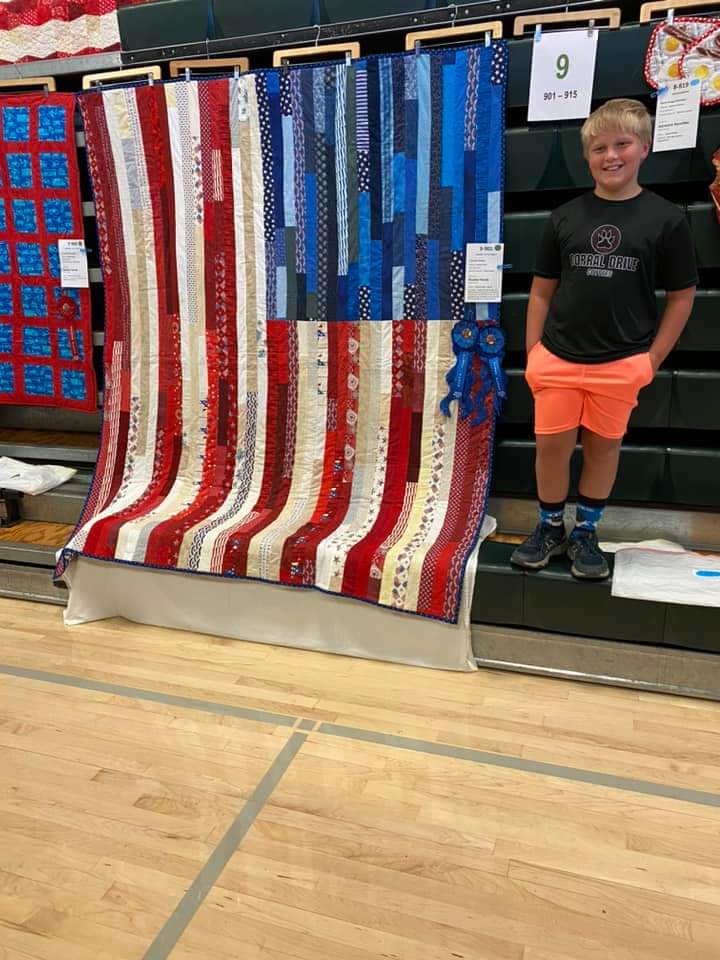
Reuben Hovde took first place for the quilt he sewed.

While many 10-year-olds are busy on the computer, Reuben Hovde is winning prizes for his handmade quilts.

The Rapid City fifth grader entered his quilt in the Central States Fair, where he received the top prize of a purple ribbon.

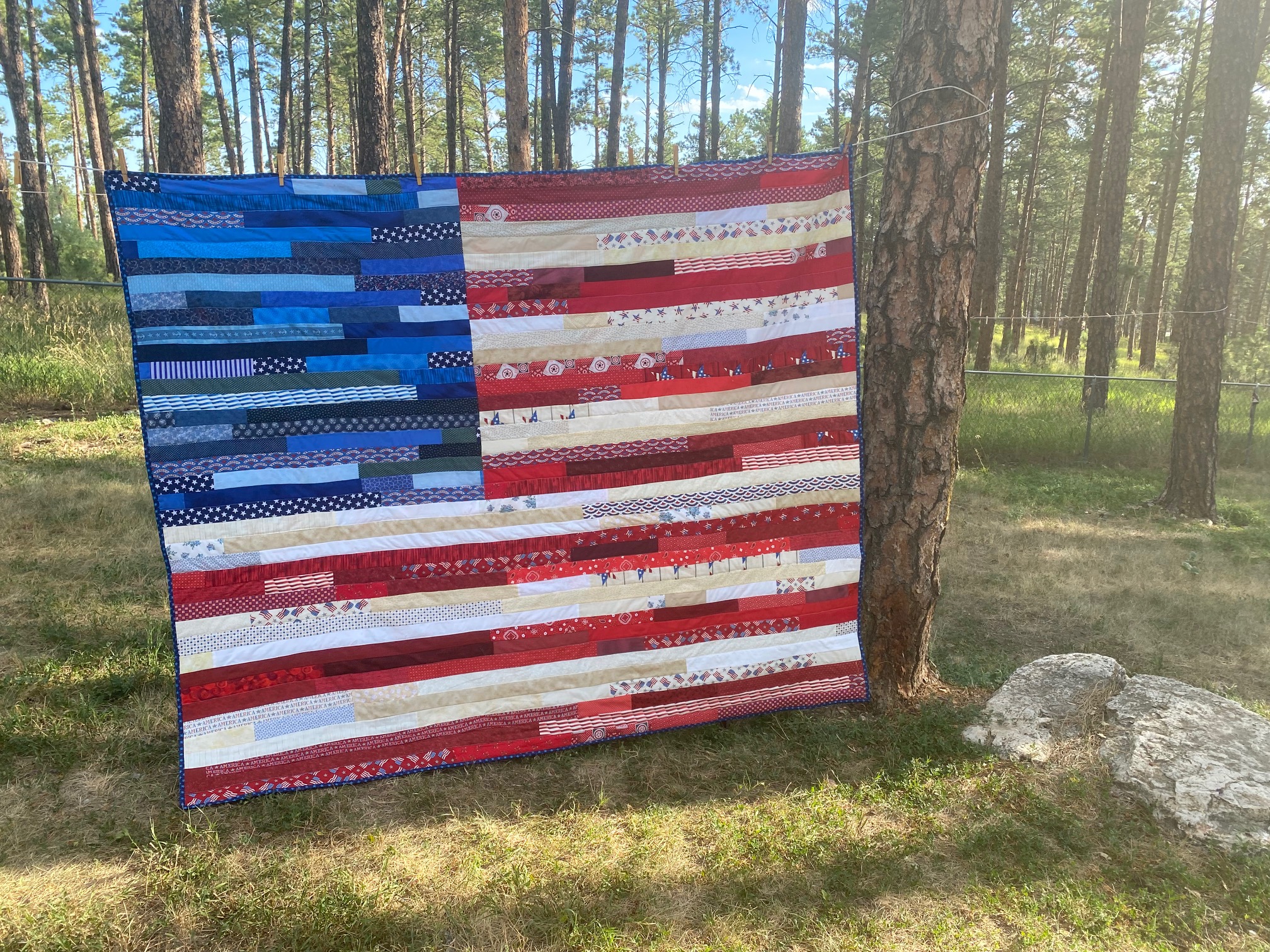
He then next put his red, white and blue quilt in the Hill City Quilt Show and his quilt was selected first through the People’s Choice award.

Mom, Melissa Hovde loves quilting and taught her son to sew. He made is first quilt in the spring from fabric squares he had found at a garage sale.

He started his second quilt, a red and blue transportation quilt next, and spent all summer crafting it.

Then exactly a week before it had to be entered in the Fair, he told his mom, “I think I can get another quilt done before the fair, so I can enter another one.” His mom was entering 12 at the fair.

“I told him, I was not cutting any [strips of material] for him,” mom said. “And he knows he doesn’t get to use my rotary cutter.” [Quilters use a cutter with a sharp blade that can cut up to six to eight layers of cotton fabric at once.]

While his mom was working, Rueben went to her drawer of jelly rolls (precut material strips 2.5 inches wide) and selected what he needed.

Originally, he started pulling out bright colored strips, but then he started grabbing every red, white and blue strip he could find.

Exactly one week later the quilt was competed. Reuben said the hardest thing was “sewing the really long strips together and keeping everything straight.” His mom says that he uses clips instead of pins to hold the fabric together while he sews.

Reuben has a busy schedule. Last year his season on wrestling team was cut short after he broke his humerus, but he plans to try out again this year.

This year he’s added band, starting with the trombone, but the band instructor asked him to try the tuba. “He did so well that she is now having him play the tuba,” mom said.

He also likes collecting Hot Wheels and making model kits of trucks with plastic and glue.
When he has a break from school and his extracurricular activities, Reuben already has another quilt planned, “This one will be more colorful,” he said, and he urges other students to try quilting because “Kids should try all sorts of things.”


Posted in General | 2 Comments

Long Discussion: Two Hours Later a Vote Taken

Pacific Palisades Community Council has been meeting on Zoom.

The Pacific Palisades Community Council conducted its September 22 meeting after members of the community listened to Council District 11 candidates Traci Park and Erin Darling answer questions for 45 minutes.

About two hours was mostly devoted to four bylaw changes. The first bylaw was to simply state that officers were elected for one year and that Zoom meetings could be held if necessary.

The second bylaw was to add a parliamentarian. The third bylaw would add a corresponding secretary. There would be two secretaries, a recording secretary that would be allowed to vote and then the corresponding secretary, who would not.

The fourth bylaw would move Resilient Palisades, an environmental organization, from the Civic category to the environmental category. The American Legion would be moved from the service category to the Civic category.

Temescal Canyon Association’s Shirley Haggstrom asked to delay the vote so she could take these bylaw changes to her board. According to the bylaws, an organization can delay a vote for that reason.

But as President Maryam Zar pointed out the bylaws had been presented more than a month ago and the PPCC were told TCA was going to have a meeting on September 19.

Zar commented that the first three bylaw changes were not controversial and asked Haggstrom if she would reconsider her motion.

PPCC’s legal advisor Rob Webber was consulted, and he said that if the President felt there was a time issue, a straw poll could be taken and the matter moved forward to the executive board.

Since a new board would be seated with the first meeting in October, the bylaw amendment process would have to start over.

Then comment after comment started following from board members and included Reza Akef, who said he had gone to TCA’s website and that according to its bylaws its supposed to have 15 members and only 11 are listed. That there were no meetings listed and no notification of board meetings, He asked, “is the organization compliant with its bylaws”

Zar said that according to the PPCC they were compliant.

Randy Young, PPCC Treasurer, said that he had offered to go to the TCA board meeting to speak to them about the proposed bylaws, but was not invited.

Another person he had heard from a TCA source that “they spoke about this at their meeting.”

Haggstrom said, “I wasn’t able to open the link to share it at the meeting.”

Past chair David Card pointed out that the information/changes had been posted on the website and were available to everyone

Another person pointed out that “the postponement is a tactical move to delay the vote.”

Educational representative Cliff Roberts said that this was like a filibuster, “when everyone knew what was on the agenda.”

Resident Chris Spitz said, “I don’t think its our place to question. This is an automatic postponement. I think this is disrespectful to Shirley.”

Eventually Haggstrom agreed to allowing a vote on the first three bylaws, which passed, but only after Spitz argued several legal issues that she felt should have been included in the bylaw changes, particularly regarding the corresponding/recording secretary.

Card said he felt the changes were clear and a vote was taken.

An earlier PPCC had put Resilient Palisades into the Civic Category because the emphasis on getting solar panels was a technology issue and promoting vegan was a business/restaurant issue. Members of this Council felt that RP best fit into the environmental category.

At 9:45 p.m. after Haggstrom read a long statement about TCA’s accomplishment and the new president of TCA James Alexakis spoke. Then, Haggstrom agreed to allow a vote on the final bylaw change, which would allow Resilient Palisades to share the environmental category.

David Card summed up the marathon meeting “This is a good lesson on democracy.”

Maryam Zar

Zar said, “I look forward to continuing to strengthen a board that has demonstrated they can work together toward a sensible goal, with fairness and in the end, with unity and a spirit of collaboration.

“TCA took the time to tell us about their work and their challenges through Covid, and their plans to regroup and expand,” Zar said. “We were all pleased to learn more. Resilient Palisades has been a force for good on the environment and we congratulate them for all their strides. I look forward to seeing these two organizations strengthen the environment category and be stewards of our natural environment, each in their own unique and important way.


“I commend the PPCC board for a long but productive night that began with a successful CD11 candidate forum, and ended with near unanimous votes taken after thoughtful debate and community-minded collaboration,” Zar said.


Posted in Pacific Palisades Community Council | Leave a comment

Permission Needed to Post Signs on Village Green

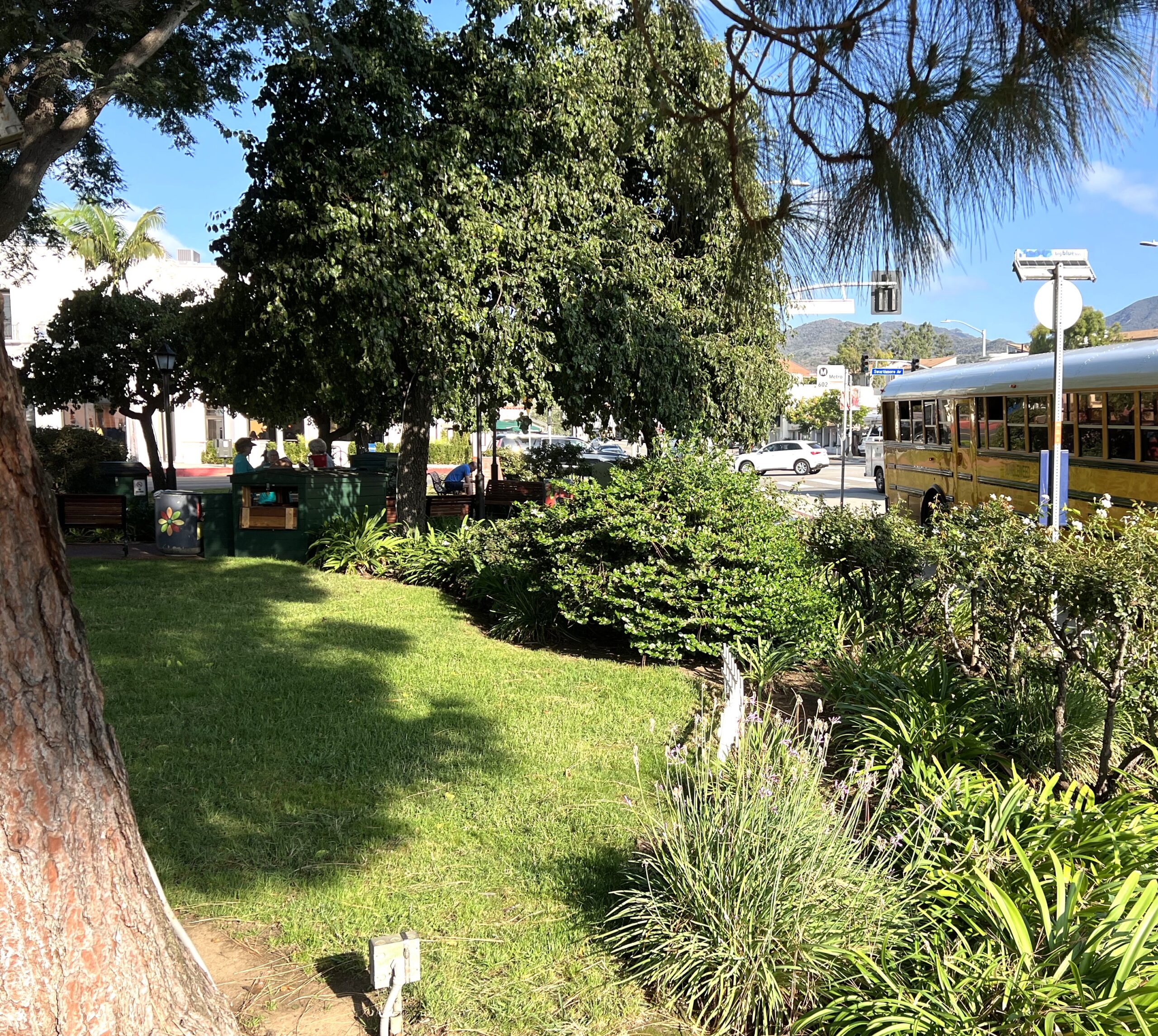
Little white fences were put up around some landscaping to remind people not to cut through the vegetation and trample on the plants in the Village Green.

The Village Green is not a city park, it is a private park, run by a nonprofit for the community’s use.

Volunteers meet at the park on Fridays to pick up trash and do minor cleanup. On one Friday, a volunteer was putting up a little white fence because someone using the bus stop walked through the plantings. When one volunteer asked if she could walk around, she said, “There’s no fence.”

Another day when CTN walked by the little triangular park, the outgoing president Marge Gold was picking up broken glass and condoms that had been left at the park.

When board members of the Business Improvement District wanted to know more about that vandalism, Rick Lemmo, who represents Caruso’s Palisades Village, said they didn’t need to discuss it because the Green was not part of the BID.

He is correct, the Green is not a business, but a nonprofit and being able to pay the assessment annually would be prohibitive. Norm Kulla, who used to be Councilmember Bill Rosendahl’s District Deputy, helped remove the Park from the BID because of the costs.

But, the park is the heart of the town and all residents need to be stewards of the little park.

Circling the News received the following reminder from the board to share “we had to remove a political sign yesterday and then today remove about six flyers taped to our benches, sheds and garbage cans advertising the Climate Change event that is being held in front of Starbucks.  Could you please remind people that nothing can be posted without our consent.  Political signs are never allowed, and we would never have given permission for the flyers that were removed today.”

Lemonade stands, advertising for pet services and any tables set up on the green must be approved by the board. That information is listed on the website (Visit: palisadesvillagegreen.org).

Initially, there was a gas station in the space.

In 1972, Standard Oil decided not to renew its lease. The newly organized Pacific Palisades Community Council established a five-member Village Green Committee and signed a lease giving the committee an option to buy the land — if it could raise the necessary funds.

Starting in October that year, nearly $70,000 was raised. About $46,000 was used to purchase the land and the rest of the money went to park development.

The Palisades Village Green was certified as a California nonprofit and formally dedicated on August 17, 1973.

All residents are invited to join the board, which annually must raise nearly $30,000 to pay DWP, the gardeners, fountain upkeep, rodent removal, landscaping (and tree trimming) and trash pickup.


Posted in Parks | 1 Comment

Environmental Protest Rally Held on Swarthmore

Students, demonstrating on Swarthmore, raised awareness of climate change.

By CHAZ PLAGER

As part of the Global Climate Strike Protest on September 23, Pacific Palisades teens joined the rest of the world in protest against environmental damage.

Originally created by Swedish teen Greta Thunberg, who was nominated for the Nobel Peace Prize, these peaceful, worldwide rallies by people of all ages are held to focus attention on the need for action to combat climate change.

The Human Rights Watch Student Task Force at Palisades Charter High School and Resilient Palisades organized the rally in front of Starbucks in the center of the Village.

The Student Task Force is one of 15 chapters at high schools in Southern California area that focus on issues of human rights that are especially important to teenagers, such as the fate of the environment. The group secured the permits to close the street and set up an information booth with Resilient Palisades.

One resident reported, “There were about 50 students, who carried signs, played music (my favorite was Joni Mitchell’s ‘Big Yellow Taxi’—‘They paved paradise and put up a parking lot….’) and roused the crowd with chants and posters demanding action to address the climate crisis.

“Their efforts were greeted with waves, car and truck honks, and yells of support from passersby,” the resident said. “The students clearly succeeded in bringing awareness of the need to address the climate and environmental crisis directly into the heart of our community.”

PaliHi teacher Steve Engelmann, who has already been incorporating climate change education into his AP Environmental Science classes, spoke at the protest.

“We want to make our voices heard, as elections are coming up for mayor of Los Angeles and we’d like the candidates to know climate change is an important issue to their constituents.”

Similarly, Resilient Palisades is a community-led organization trying to reduce the town’s carbon footprint through various initiatives such as the Pali Microgrid Project, which seeks to install a solar grid on most of the houses in the Palisades.

Resilient Co-founder Ingrid Steinberg, who helped organize the protest alongside Englemann and the Student Task Force, said she hopes that Palisadians will consider joining Resilient projects.

Students were, of course, the main attendees. Junior Carter Yen described his reason for joining the rally. “I mean, most adults are pretending the problem doesn’t exist because they’ll be dead before it gets really bad. We’re the new generation, and we’re actually going to have to deal with this. So we want to make our voices heard.”

The mood over the strike was a general sense of optimism. Smiles and cheering could be seen and heard all around.

However, not all were so optimistic. A student who wished to remain anonymous had a gloomier view of the situation. “I just don’t think it’s ethical to have kids anymore,” they stated. “I mean, the world’s already super screwed up and we’re way too late to fix anything. Making kids watch the world crumble further to bits would just be cruel. And besides, who has the money to raise a kid these days anyways?”

When asked why they still attended the rally if they felt the environment was beyond repair, they replied with a shrug, “I don’t know.”

The world is currently on pace to have the average global temperature rise by three degrees Fahrenheit by 2050. There may be a time that children born today only understand what the polar ice caps were through photos and textbooks.

Should this disturb you, checking candidates’ stances on climate change and writing to them to let them know that it is an issue their constituents care about is a good way to have your voice heard. (Visit: https://www.hrwstf.org/wordpress/vote-for-the-planet/ ). Joining Resilient Palisades in their microgrid project would also be a way to take direct action. (Visit: https://resilientpalisades.org/).

The HRW Student Task Force website is: https://www.hrwstf.org/wordpress/


Posted in Environmental, Schools | 3 Comments

Rihanna Selected to Perform at Next Super Bowl


By BERNICE FOX


Former Palisadian Rihanna will be the halftime headliner at the next Super Bowl.

The multi-Grammy winning pop and R&B singer will take the stage at Super Bowl LVII, on Sunday, February 12, 2023, in Glendale, Arizona.

This announcement only adds to a tremendous year for Rihanna, who gave birth to a son with boyfriend A$AP Rocky in the spring.

It was her single, Umbrella, off her third album, that made Rihanna a star in 2007.

Along with her music, the Barbados-born singer has a lingerie line and a beauty products line. Both use her last name, Fenty.

Rihanna’s time in Pacific Palisades was not carefree. She lived in Rivas Canyon off Sunset Boulevard, moving into a distinctive home in 2012. She left in 2014, moving out after stalkers trespassed onto the property. The home sold in 2016. She has been hounded by stalkers at at least one other Los Angeles home as well.

Posted in Film/Television, Music, Pacific Palisades Community Council | Leave a comment

Second Annual 5K Run Will Donate to Local Charities

The Palisades Lutheran 2nd Annual 5K Charity Run and Walk will be held on Saturday, October 15, from 9 a.m. to noon.  The goal is to raise $20,000 for homeless and community charities. The student fee is $20 and $35 for others.  The race starts and finishes at the church on Sunset and goes through local residential streets.

There are two ways for a charity to win. The three charities with the most runners/walker listing them as the “Charity of Choice” will receive a share of the Oktoberfest proceeds:

First place will receive 20 percent of the proceeds; second place will receive 15 percent and third place will receive 10 percent.

Additionally, all runners, who enter a “Charity of Choice” recipient on his/her registration form will participate in a random drawing will receive five percent of the proceeds.

Local streets will be closed between 9 to 10:30 a.m. and the run includes a scenic turn on Almar Avenue, overlooking the Pacific Ocean.

Later in the day, the community is invited to the annual Oktoberfest in the Lutheran Church courtyard from 4 to 7 p.m. There will be live music, German food, a beer garden, dancing and games. For more information, visit: PLC. Org or call (310) 459-2358.

Posted in Community, Sports | Leave a comment

Council Candidates, Darling and Park, Speak at Community Council Meeting

Council District 11 candidates Erin Darling and Traci Park spoke at the Pacific Palisades Community Council September 22 meeting. About 100 people listened as the candidates addressed homelessness, the Ballona Wetlands and discretionary funding.

PPCC President Maryam Zar had sent a list of 10 questions to both candidates and after Darling and Park introduced themselves, they spent 45 minutes answering the questions.

The first question centered around 41.18, a City law which prohibits homeless encampments near schools. Additionally, if a councilmember asks for enforcement to allow access to public spaces, such as libraries and parks, homeless encampments can be removed from those spaces. Zar asked how both candidates would address that law.

Erin Darling

Darling said that since it’s a law, he would enforce no encampments by schools, but as far as the other locations, “Government has to create beds for the unhoused. We have to create a pipeline. We don’t want to shuffle people from one space to another. We have to house people, but not warehouse them.”

Park said, “I have never waivered from my position that schools, libraries and parks are not places to house people.” She said that outreach was necessary, but public places did not serve either the unhoused nor the general public.

The candidates were asked about their plans for dealing with RVs illegally parked on streets.

Park noted that there are already city laws regarding RVs and parking and “we need to get those rules back in place,” she said. “It’s unreasonable to have large RVs not held accountable.” In addition to working with parking enforcement, she said that LAPD has a unit that works with mental health issues and those in RVs could be helped.

Darling said he would institute a five-member staff that would work with those living in RVs. “They need safe hookups and we need to stop shuffling people around.” He suggested that Safe Parking has to be a safe alternative and his team would respond to helping those in RVs.

Traci Park

Regarding the Ballona Wetlands, an environmentally sensitive area, Park said, “there is a half mile encampment there. I’ve spent time down there and I’ve seen the environmental degradation. I would have all the RV’s removed. This is a precious coastal area that should be protected and preserved. We need to restore access to the public.”

Darling said, “if we just push people from the Ballona, we’re pushing pollution to another place. Affordable housing is necessary. If we’re just clearing people off the street, we aren’t solving anything.”

Both candidates were asked about discretionary funding. This funding is money that comes to each Councilmember and that person is allowed to spend it at his/her whim. There is no accounting nor oversight on that money.

Both candidates promised community involvement in the process of awarding money. The current Councilmember, Mike Bonin, has spent all CD 11 discretionary funding (millions) on homeless services.

Next the candidates addressed police funding. Park would like to see staffing levels resumed to at least the bare minimum of 10,000 officers. “Work didn’t go away when funding was cut from the police department,” she said. “Now the City is going to have a high overtime bill. We also need to stop the contentiousness (regarding LAPD).”

Darling would handle it differently by hiring mental health teams and outreach people to go out on some of the calls to the police. “We need to get officers from behind the desk and back on the street,” he said. “We need to reduce response time and balance the different kinds of calls.”

To listen to the entire 45-minute Q & A, visit pacpalicc.org.

Posted in General | 1 Comment