Prop ULA will not help those living on the streets.
The way to get the homeless of the streets is to tax the rich, according to Los Angles Proposition ULA, which voters approved on November 8.
Many did not read the proposition closely and instead voted for the sentiment.
People were convinced by the advocacy coalition, United to House LA, that the only reason there are still more than 60,000 people on the street is because there isn’t enough housing. And the only way to get more money to provide affordable housing is to tax the rich.
The December 2 tally by the L.A. County Register, saw ULA described as “funding for affordable housing and tenant assistant programs,” passed 58 % to 42%.
This proposition does not address the lack of winter shelters for the homeless. This proposition does not provide group shelters. It does not help those with addiction problems. It does not aid those with mental illness living on the streets.
City Controller Ron Galperin in February assessed Prop. HHH, which was passed in 2016. There has been $1.2 billion collected in bonds, was supposed to end homelessness. Less than 1,200 housing units were completed. He wrote in his report “Our previous reviews of Proposition HHH concluded that project costs were high and estimated development timelines did not reflect the needs of unhoused residents living in dangerous conditions.” https://lacontroller.org/audits-and-reports/problems-and-progress-of-prop-hhh/
The money collected from Prop. ULA will be used solely to fund the development of affordable housing to serve acutely low, very low, and low-income households, which in theory will stop people from becoming homeless.
The Los Angeles Housing Department (LAHD) would have authority to approve funding of up to $50 million per project. No City Council review or approval will be required.
Instead, a 15-diverse Citizen’s Citizens Oversight Committee, comprised of 13 voting members and two advisory youth members, will be appointed by the Mayor.
This proposition is also a way to bypass restrictions on tax increases. Special taxes generally require two-thirds majority, but taxes brought forth by citizens, such a Prop. ULA just need a simple majority.
Who are the rich that will be taxed? A 4% tax on properties sold or transferred for more than $5 million and a 5.5% tax on properties sold or transferred for more than $10 million. These sales include not only the large homes in many areas of the City but also includes the sale of apartment buildings.
One Palisades resident wrote, “most voters say ‘Yes, tax the first $10M, where do I vote yes?”
“That’s the problem,” the resident said. “Most voters who don’t have wealth could care less and that was reflected in the votes. It’s about a backlash to disparity once you put it on a ballot. Saying all my investments are now worthless, or we have to pay too much tax on our windfall is meaningless to voters who have no windfall.”
The resident pointed out that this proposition leaves owners of any property $5m+ with a 8-10% total transaction fee on the sale of their property in addition to other relevant taxes… whether a loss, a gain. “If you buy a property for $11 million, and sell it for $10 million in a year, you will still be required to pay a $550,000 tax on a $1 million loss.”
The resident added, “if you think the $1 to 4 million dollar properties are exempt, they are not. In fact, they could be next. What’s to stop the next tax on sub-$5m? What’s to stop the 5.5% tax from being 25%?”
Barron’s PENTA November 28 story (“Greenlit by More than 500,000 Voters, Measure ULA is Unpopular with the City’s Real Estate”) “Jon Grauman, of the Grauman Rosenfeld Group at The Agency, said in an email. ‘While we are all sympathetic to the dire homeless problem that exists in L.A., taxing the wealthiest residents in a city that is arguably already over-taxed—thereby causing many individuals to leave the state—is not the solution,’ he said.”
The story noted that Los Angeles already ranks as one of the top metropolitan areas that local residents are looking to leave, bested only by San Francisco, according to October migration data from property portal Redfin.
Bloomberg’s November 10 story (“Can LA’s Mansion Tax Unlock Affordable Housing Across Callifornia?”) points out that much of the revenue comes from sales of apartment buildings as opposed to mansions. “A real estate executive named Moses Kagan outlined one plausible scenario in a tweet: If a developer builds an apartment complex for $7 million and sells it for $10 million, making a profit of about $2.3 million after costs, then a 5.5% transfer tax would work out to $550,000 (my math, not his). That’s about 24% of the profit. Since a typical split on a deal runs to 80% for investors and 20% for developers, that tax ought to kill the deal.
As Jeremy Padawer wrote on Nextdoor: “I believe this is happening not because of homelessness…but because of hopelessness. Our children no longer believe that they can work hard and have better lives than their parents. As a result, wealth is less aspirational… more despised.
“I grew up in Mississippi and Tennessee and found my way to the Palisades with a good heart, idealistic nature and belief that we all can reach our potential with hard work,” he said. “This sort of tax is contrary to anything remotely close to those ideals. . . We have a $100 billion surplus in California … and then we do this.
“I would have gladly paid a percentage of gain to solve crime, homelessness and educations for my fellow citizens in LA… even with the $100 billion surplus,” Padawer said. “This tax is wrong. It’s not well thought out. And worst of all, it’s not well intended.”

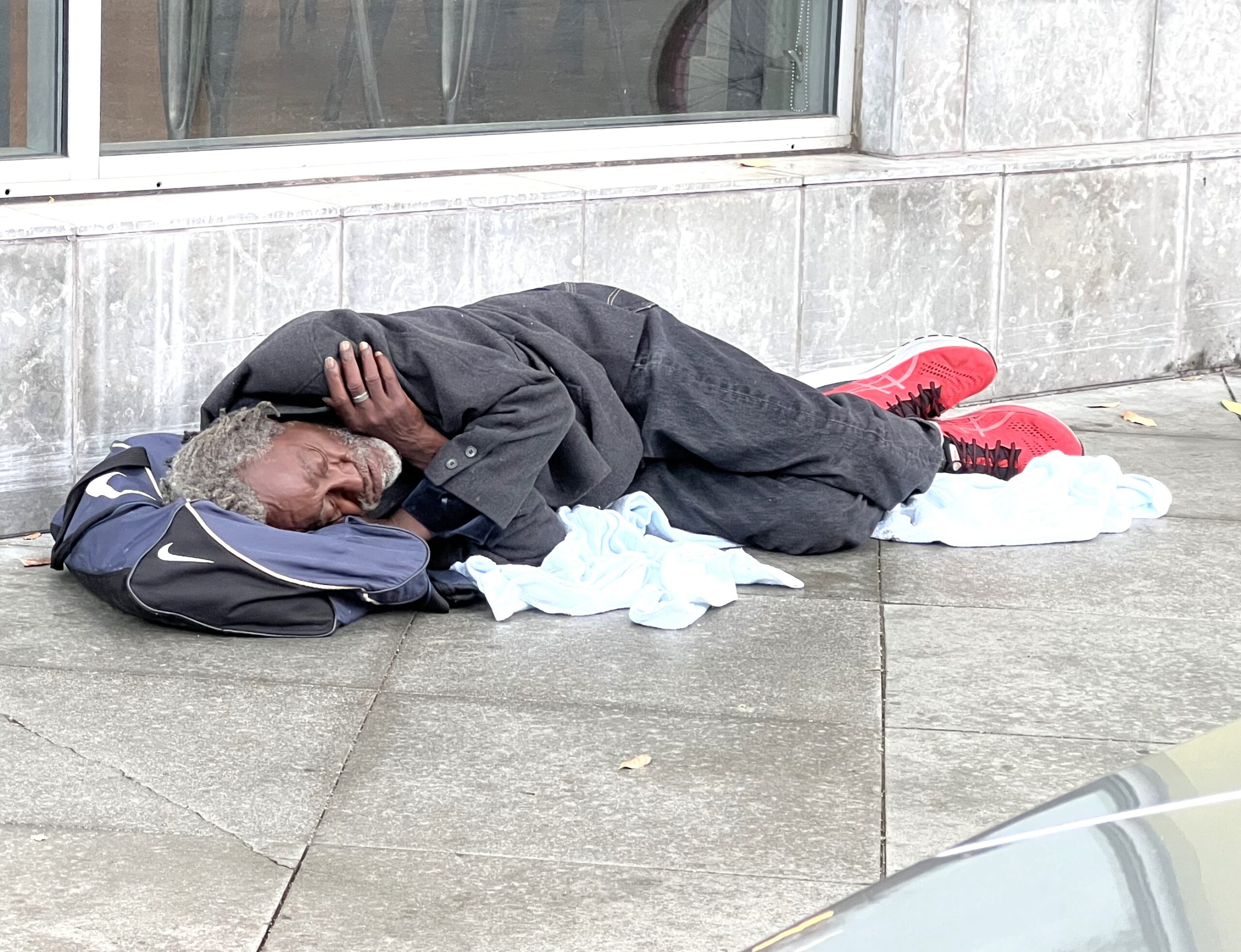
A homeless encampment is below the underpass at 405 and Venice Boulevard.
(Editor’s note: United House LA is composed of many groups, including ActLA-Alliance for Community Transit, IBEW Local 11-electrical construction industry, KIWI -Koreatown Immigrant Workers Alliance, LA Family Housing, American Federation of Labor-representing 48 local unions, LA Can – Los Angeles Community Action Network—helping fight back against oppression, L.A. County Federation of Labor, AFL-CIO, MoveLA – transit, SEIU Local 2015—long term caregivers, SCANPH – Southern California Association of nonprofit housing, SAJE – strategic actions for a just economy, T.R.U.S.T. South LA – community organization and Unite Here! Local 11 – workers in hotel, restaurant, sports arenas and convention centers.)















 Reload document
  Open in new tab