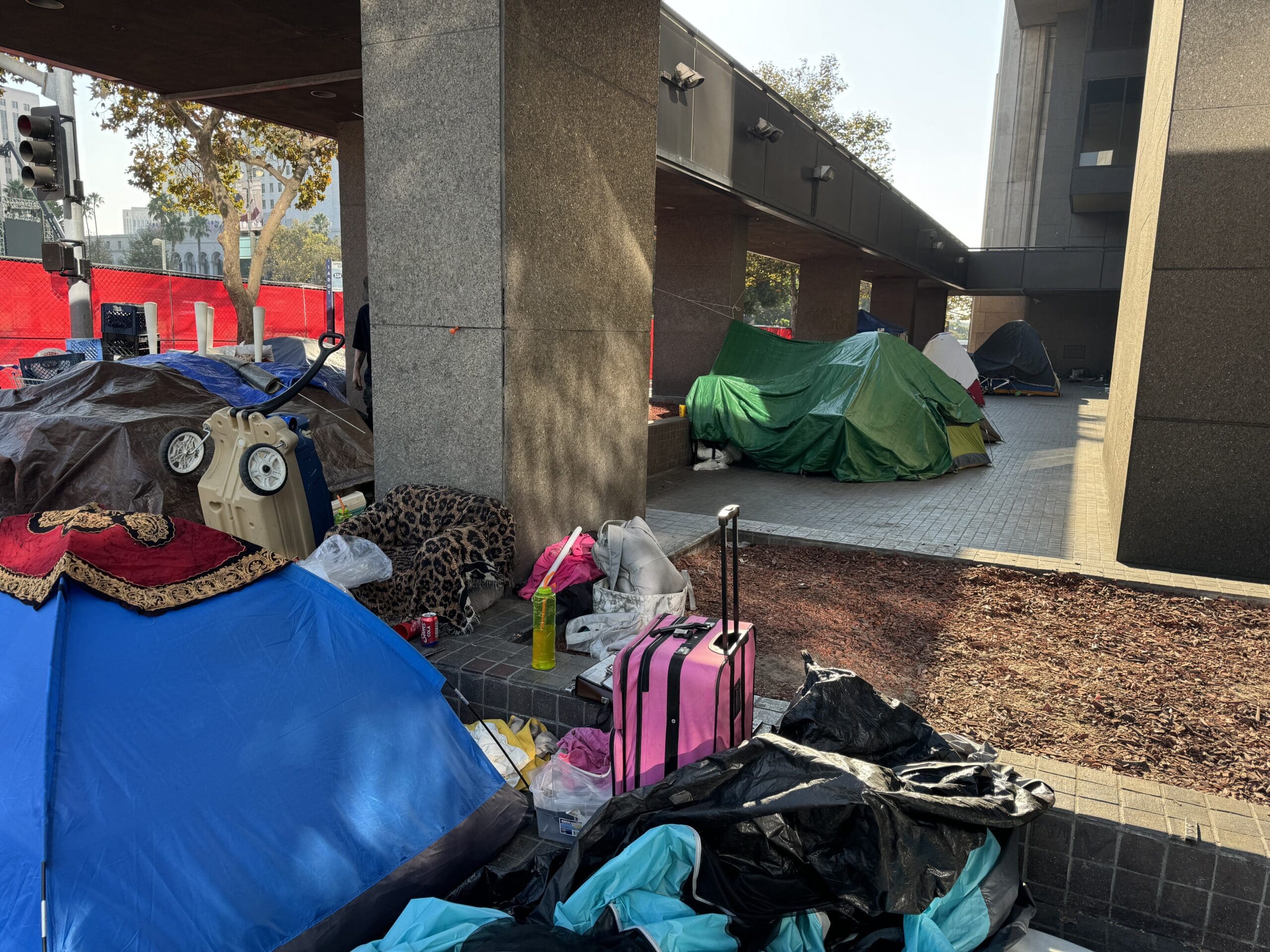
Measure A: Tax Hike Proposed. Officials Say Its Needed to Fund Homeless Programs

Homeless nonprofits want more money for the homeless through a sales tax increase.

(Editor’s note: This first appeared in the Westside Current on September 19 and is reprinted with permission.)

By TIM CAMPBELL

Scanning recent headlines about local nonprofit organizations would challenge even the most optimistic among us. The news stories include:

The State of California Is Suing Santa Monica-Based Step Up on Second Street for $114 Million for Misappropriating Project Homekey Funds

State Attorney General’s Office is accusing Step Up and its for-profit partner Shangri-La of fraud and breach of contract for projects funded by state grants.  The suit alleges the two organizations colluded to steer funds to improve their leaders’ standard of living rather than developing motels into homeless and low-income housing.

RICO Lawsuit Filed Against Urban Alchemy For Violence and Drug Trafficking At Sausalito Encampment.

Urban Alchemy, a City of Los Angeles contractor for its CIRCLE team services, has been sued by numerous people and entities. One case stems from a shelter Urban Alchemy (UA) runs in Sausalito, where a former resident alleged he was beaten for speaking to local media about conditions in the shelter, including drug dealing and human trafficking by UA employees.

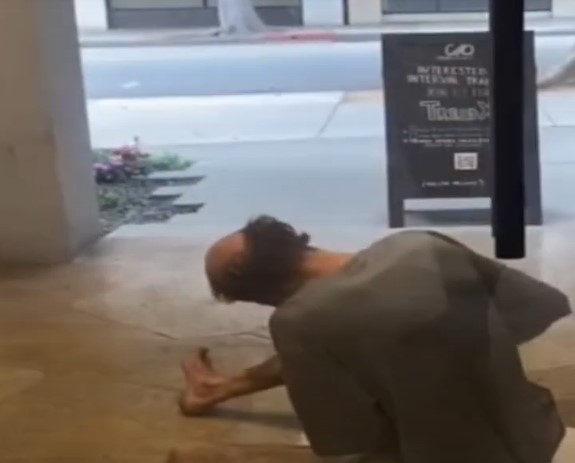
Locally, the City Controller is investigating UA because one of its employees was caught on video using a power washer to force an unhoused person to move off the sidewalk. Even though the investigation was announced in January 2024, the City Council continued to approve sole source contract amendments to Urban Alchemy through June 2024.

Orange County Supervisors: Tracking Taxpayer Money

An Orange County nonprofit received more than $13 million from the County to provide meals to senior citizens and other vulnerable people. In August, the County sued Viet America Society (VAS) to recover the funds after the nonprofit failed to produce evidence it provided any meals. When VAS received the contracts, its nominal head was the 23-year-old law student daughter of Andrew Do, one of the County Supervisors who approved the contracts; he failed to disclose his personal relationship when he voted for the funding.

AIDS Healthcare Foundation Settles with Tenants over Conditions in Skid Row Apartment Building

The Aids Healthcare Foundation, (AHF), one of the largest landlords in Skid Row and DTLA, recently settled a lawsuit with tenants of one of its apartment buildings, promising to correct serious issues like inoperable elevators and vermin infestations. This was not an isolated incident.  An LA Times investigative article found squalid living conditions at several AHF-owned facilities. You could define AHF as one the most notorious slumlords.

An LA Nonprofit Helped House Hundreds Of Homeless People. Then Many Were Forced Out. What Went Wrong?

HOPICS, an LA nonprofit active in several aspects of homelessness services, received $140 million to help at-risk and formerly homeless people pay the rent for their apartments.  HOPICS and its various subcontractors botched the job so badly, hundreds of people are at risk of being evited for non-payment. Despite reports of problems in late December 2023, like Urban Alchemy, the City continues to contract with HOPICS.

These are just some of the cases we know about. One of the first things a professional auditor learns about fraud is that it is one of the most under-reported crimes in America.  For-profit organizations rarely report fraud because it undermines investors’ faith in their companies and hurts their bottom lines.

Public agencies try not to divulge fraud claims because they damage the public’s trust in government. There could be many more cases of questionable financial behavior we know nothing about.

These five stories share some interesting traits.  One of the most obvious is that neither the City nor the County have taken any corrective action.

Unlike the State Attorney General, the County of Orange, or AHF’s tenants, local government has done virtually nothing to hold providers accountable for the millions they spend on homelessness programs.  The City continues to contract with Urban Alchemy and HOPICS is one of LAHSA’s favorite contractors.  Councilmember Yaroslavsky pushed L.A. Family Housing to run a controversial shelter in Venice, despite LAFH’s history of mismanaging a North Hollywood shelter.  She also failed to disclose her deputy for homelessness had recently left a management position at LAFH.

One of the most important tools for preventing waste, fraud, or abuse is setting the proper tone at the top. A review of LA’s leaders’ statements and some of its policies show that local government not only leaves itself open to abuse but invites it.

Consider this statement by Lourdes Castro-Ramirez, Mayor Bass’ Chief of Homelessness. She said the only way to house people is through “relentless outreach.”

If you were a CEO of one of large corporate nonprofits performing outreach, that statement is an open invitation to charge as much as you possibly can for outreach services, regardless of actual results. After the Supreme Court’s Grants Pass decision, while other local leaders were planning new ways to encourage people to move into shelters, Mayor Bass was stridently denouncing the decision, declaring the city would continue the failed policy of No Barrier Housing First.

Again, the message to nonprofits is “we will continue paying you for services that are untethered to performance measures as long as you keep doing what you’re doing now”.  Indeed, the status quo is official city policy.  A recently revealed plan for ending homelessness in 10 years has no provision for adding new programs, changing existing ones, or eliminating failed ones. It merely calls for doubling the budget for programs that have yet to show any effect on homelessness.

The City is not exempt from its own version of waste. As superbly documented by Jamie Paige and Christopher LeGras, Los Angeles spent more than $800 million acquiring hotel properties for Project Homekey housing, only to leave 1,200 units vacant, representing at least $340 million in taxpayer money in unused assets.

Much to the frustration of federal Judge David Carter, neither the City, County, nor LAHSA can produce performance measures and financial documents required by the firm performing the independent audit he ordered a few months ago.

Indeed, it appears the only ones benefiting from this lax environment are large nonprofits and their well-paid executives.

As detailed by Angela McGregor in the Westside Current, some of these organizations have become major developers, as their budgets have exploded over the past few years as they consume more public funding. They have become so deeply enmeshed in the development sphere, they have formed their own lobby, just like many other building industry companies. Little wonder Sue Pascoe from Circling the News terms the era of government largesse, a “Gold Rush” for nonprofits.

Overlaying all of these problems and waste is the infamous April 2024 report from California’s State Auditor, stating the state has nothing to show for $24 billion in homelessness program expenditures over five years.  Program mismanagement is systemic, tricking down from the state to counties and cities.

The lack of performance measurement, oversight, and accountability has resulted in an environment ripe for abuse and fraud, what I call institutional corruption. It should come as no surprise, then, that we see almost weekly news about some new scandal engulfing a nonprofit.

Into this freewheeling environment, inject Measure A, a proposal to double the current quarter-cent sales tax imposed by Measure H.

Proponents say the increased funding is necessary to fund services to eliminate homelessness. If that sounds familiar, it’s because similar language was used to pass Measure H, Measure HHH, and Measure ULA. Each proposition promised to make “game changing” improvements to homelessness programs. The real result has been unfettered enrichment of a few select nonprofit organizations with the political connections and power to pass policies that benefit their bottom lines.

The current use of Measure H funding, especially by the county, does not support the need for more revenue. A 2023 report from the L.A. Alliance for Human Rights shows the county has not used available funding to its full extent.

To quote the Alliance report: “Overall, the County spent 89 percent of its Measure H-D7 (rent subsidies and social support services), funding. However, there is significant variation among each departments’ use of funds. Department of Health Services funding accounts for 88 percent of the D7 budget and 95 percent of the actual D7 expenses. DHS uses most of its funding to provide housing, rather than support services or treatment.

Per its strategy statement, the Department of Public Health provides rent subsidies and tenant services. Most of the funding for the Measure H strategy intended to serve the most vulnerable is predominantly dedicated to providing housing, not treatment and services.

Therefore, the burden of providing supportive services and treatment falls to the Department of Mental Health, which was budgeted 10 percent of D7 funding and accounted for only four percent of actual expenditures. [my emphasis added] The department with the smallest allocated budget is responsible for critical health and behavioral treatments. However, because of the County’s priority of addressing homelessness department appears to prioritize the provision of housing as a major strategy to accomplish public health objectives, and all of its requisite needs with housing, treatment and health services are shortchanged.”  The Alliance report also shows that the County has historically underspent its entire Measure H allocation, usually by about 22 percent in any given year between FY 2018-19 and 2022-23. Unspent funds averaged $109.8 million per year.

Providing mental health services is one of the “core homelessness services” that would be funded by Measure A.  Also included in core homelessness services is affordable housing.  Given the County’s emphasis on housing over other programs, past practice suggests those priorities will not change, and mental health services may again be subordinated to housing.

Sales tax increases are also regressive, disproportionally affecting those on limited or low incomes more than higher income levels. Los Angeles already has one of the highest sales tax rates in the state. Adding a quarter-cent may not seem like much, but given the aggregate effect, it is more likely local residents will make major purchases in neighboring counties. Just like the overly-optimistic estimates for Measure ULA, Measure A’s revenue projections are probably unrealistic.

One element of Measure A often mentioned by supporters is the emphasis on program performance and oversight.  Addressing oversight first, the proposed measure assigns responsibility to the County, in the form of an existing Executive Committee and a new organization called the Los Angeles County Affordable Housing Solutions Agency called the (LACAHSA), a rather nebulous agency within County government, whose Board primarily consists of leaders who have overseen the disastrous response to homelessness we are currently enduring. These two entities would issue periodic public reports on how various programs are meeting stated goals.  Those programs not meeting their goals could face reduced funding, with the money being reallocated to other more effective programs.

Unfortunately, the County and LAHSA have a history of problematic performance reporting. LAHSA is being sued by the publication Calmatters because it refuses to release statistics on deaths and injuries in shelters.  Fundamental structural change is needed to track program activity and measure performance.

Although Measure A provides goals such as reducing the number of homeless people with substance abuse or mental illness problems, that goal would have to be achieved within the framework of No Barrier Housing First, which does not require treatment or behavioral modification for program participation.

A key provision in the measure is that underperforming programs will face reduced funding in favor of more effective programs.  That brings up the question of why such a policy is not in place now, and why a new measure is required to implement it. Measure A’s language also makes no reference to assessing the need for the tax to continue indefinitely. What happens if no program meets expectations? How would the County justify continuing imposition of the tax if it did not have the desired effects?

Reviewing the organizations sponsoring Measure A is helpful in understanding the effort to increase revenues.  Although there are some reputable agencies like the United Way involved, others are more questionable.  Although funding first goes to the County and City, most of it will be passed to a network of nonprofit organizations.  Almost all of LAHSA’s $800 million budget goes to NPO providers. Often, there are multiple layers of these organizations being used to provide a single service. For example, one of the measure’s sponsors is HOPICS.  HOPICS subcontracts with a number of providers to manage the rental subsidy program mentioned earlier. Because of its emphasis on housing, Measure A represents a significant source of new income for HOPICS.

Other sponsors include construction companies, labor unions, and housing developers who would benefit from a perpetual source of revenue. Many of these organizations are deeply entrenched in the current system, where they exert tremendous influence over government decision-makers.

In fact, Measure A is little more than a desperate effort to indefinitely continue and expand the revenues from Measure H.  Measure H is set to sunset in 2027, and unless something replaces it, agencies will lose hundreds of millions of dollars in funding.  Rather than showing how they have used Measure H to reduce homelessness, special interests are trying to make a preemptive strike by replacing it with Measure A, a perpetual increase in the sales tax, a fact it conveniently omits from its public relations materials. There would be nothing better for large nonprofits and developers to enact a tax that will never expire, and that will require them to make no changes to their lucrative business model.

Before approving more money to a failed system, voters should demand to see the results of current expenditures. 2024’s highly improbable and insignificant decrease in homelessness cannot be justified by the huge increases in funding needed to achieve it. Pumping more money into the current system won’t get any more people off the street or save any more lives; it will merely provide a more efficient way for some organizations to fleece Los Angeles’ taxpayers.

Posted in General | 2 Comments

Celebrating 95 Years in South Dakota

Baby Noma, being held by her dad John, with her three siblings Neal, Joyce and Corrine.

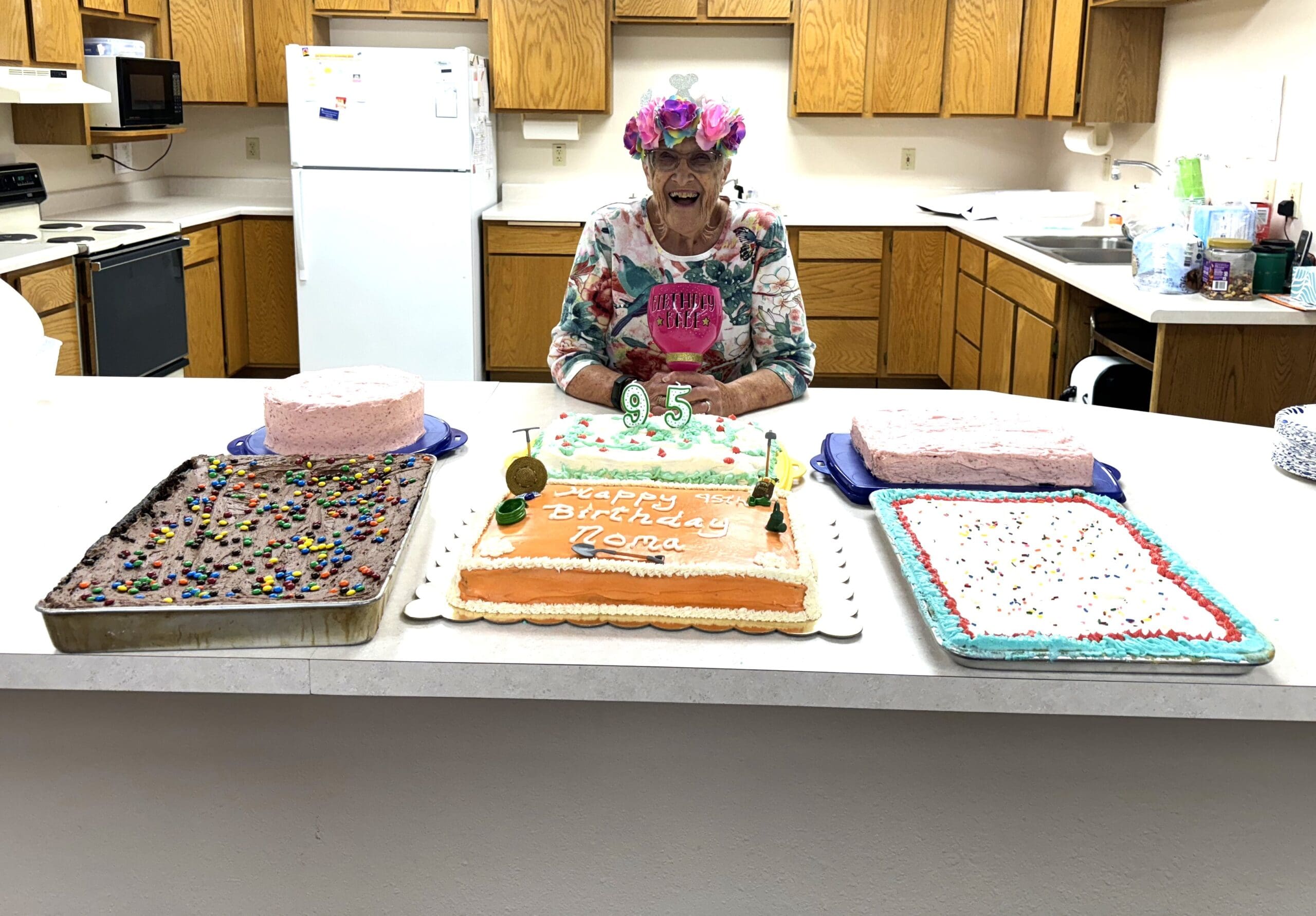
Noma Sazama, nee Larson, celebrated her 95th birthday on September 21. Growing up on the Rosebud Reservation near Mission, South Dakota, she moved to Martin, S.D. when she was in her 80s to be closer to one of her six children.

“Staying busy,” was her answer to a long life. This editor would also add, that her faith, family and friends play an important role.

Her birthday celebration was held at the Lutheran Church. She has been a member of that faith, since a little girl. One daughter put an ad in the local paper that all were invited to cake and ice cream at the Saturday, 1-3 p.m. celebration. Cards were requested in lieu of gifts. It was a lovely afternoon as people sat and visited.

Noma, who grew up during the “dirty 30s,” was raised on a farm with her three siblings. The grasshoppers were everywhere and ate the paint off the buildings. As  a young girl she remembered waving a dishtowel at them in the garden to try and save the vegetables.

She suffered a terrible loss when her dad, John Larson was killed on July 4, 1950, 1when a town fireworks show, caused a fireworks to misfire in his face.

Noma married George B. Sazama in 1952, they would have six children. She went back to college to get her bachelor’s degree and her teaching certificate. The couple took their children with them to summer school, often living in four-room apartments, over several summers.

When she found out she needed a physical education credit to graduate, she took up golf, which she not only played for several years, but taught her children to play. Two played on the high school golf teams.

Noma, just like her mom Cora, loved plants and gardening. All of her children were raised in the garden. She still gardens, eating the fresh vegetables and canning and freezing the rest. Her salsa won best of show in the Bennet County Fair this past August.

She taught 33 years, the last were working with middle school math. Her husband died in 1989.

When her mom, came to live with her in 1992, she retired from teaching to become a caregiver.

On Monday, she went with her walking group, they walk in the high school gym two days a week (safer – no broken sidewalks and the temperature is controlled). She and a friend were trying to figure out what day they could play bridge – because their schedules were so busy.

Noma also plays Sharp-13 (cards), with another group of women, she belongs to the American Legion auxiliary and is active in her church. She spends every day doing card games, Wordle and other computer games. She’s kept up with technology – and embraced it.

So, yes, she does keep busy.

But . . .I think it’s her faith that helps keep stress low. When I ask her what she thinks about a national issue or national candidates, she responds, “God will take care of it. He’s in control.” (That a small sip of Fireball Cinnamon Whiskey, when she has a scratch in her throat.)

Noma Sazama, wearing the birthday “crown” with her six homemade cakes. Two were baked by her niece and four by her daughters.


Posted in General | 5 Comments

70 Percent of Project Homekey Homeless Rooms Remain Vacant

The County bought 2,157 units, of which 1,538 are empty, at a cost of $550 million.

(Editor’s note: This is Part 3 of an ongoing Westside Current investigation into the challenges and failures of Project Homekey. It is reprinted with permission.)

By JAMIE PAIGE and CHRIS LEGRAS

A retired veteran in a wheelchair, missing a leg and suffering from multiple medical issues, arrived in Los Angeles from Missouri with hopes of “getting away from himself” and making a new start. Instead, he found himself waiting outside a vacant, abandoned hotel in Norwalk, hoping for help. It never came.

On a particularly hot August day, during the worst heat wave in recent memory, he sat alone on the sidewalk. He shared that he had come to L.A. because he’d heard about the city’s homeless housing and services. However, upon arrival, he discovered nothing but an empty building and no direction on where to go next. When asked if he had been offered any help by the county or nonprofits, he simply said, “no.”

He’s one of countless thousands in similar situations.

Tony, from Pacoima, is a local who got injured on the job. After his mother lost their family home, Terry found himself living in a park with nowhere to turn.

“I’ve paid into the system my whole life, and it feels like there’s no help for people like me,” he explained. At night, he sleeps in a friend’s car, saying the park isn’t safe and that he has to protect himself however he can. Like the veteran in Norwalk, Terry represents the growing number of homeless people in Los Angeles who’ve been left waiting for help that seems ever farther out of reach.

L.A. County’s homelessness crisis is the source of much debate and rancor. However, one area on which there is increasing agreement is that the status quo, which focuses on providing every homeless person with “permanent supportive housing” (PSH), has failed.

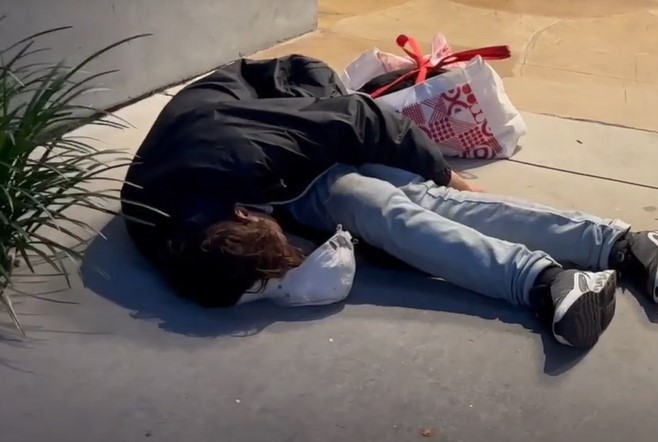
Housing takes years to construct and make available, if it ever materializes at all. Meanwhile, at least six homeless people die every day in the County. According to County Health Department records , in 2022, the last year for which numbers are available, 2,201 homeless people died. Those are the official statistics. Like the annual point in time count of the County’s homeless population the actual number of deaths is several times higher.

Project Homekey, California’s COVID era emergency housing program, was supposed to change all of that. Governor Gavin Newsom directed $3.5 billion in emergency federal COVID relief funds to help cities and counties purchase motels, hotels, and apartment buildings rapidly and make them available for homeless housing.

The state distributed three rounds of Homekey funds in 2021, 2022, and 2023-24. L.A. County received a total of $550 million and used the funds to help purchase 32 buildings. Earlier this year, Newsom lauded the program as “a national model for rapidly creating affordable housing for Californians in need.”

A hotel in Compton sits empty. There were no construction workers or equipment at the site. This photo was taken midday on a weekday.
Photo: JAMIE PAIGE

RELATED: More Than 1,200 City-Owned Homeless Housing Units Remain Vacant Two Years After $800 Million Buying Spree

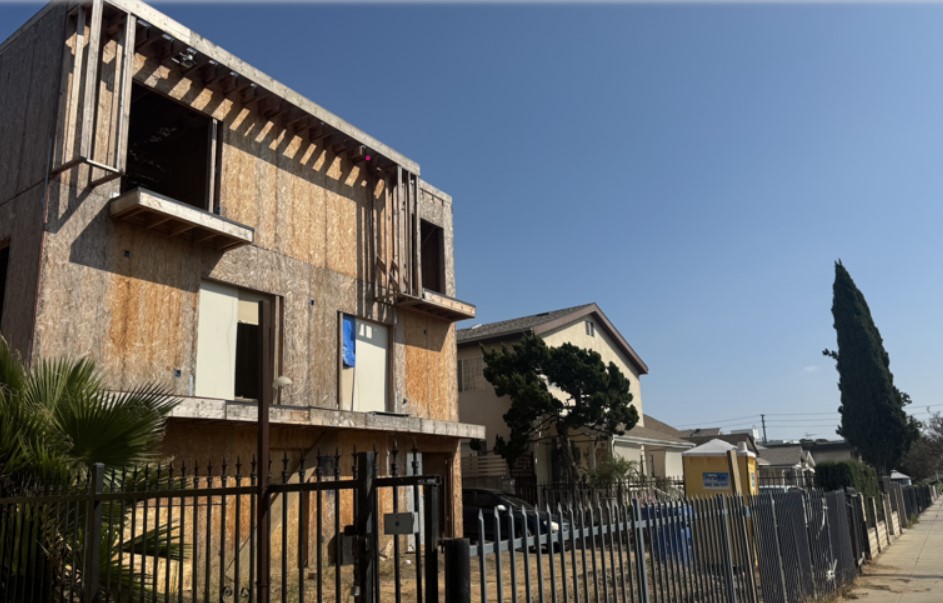
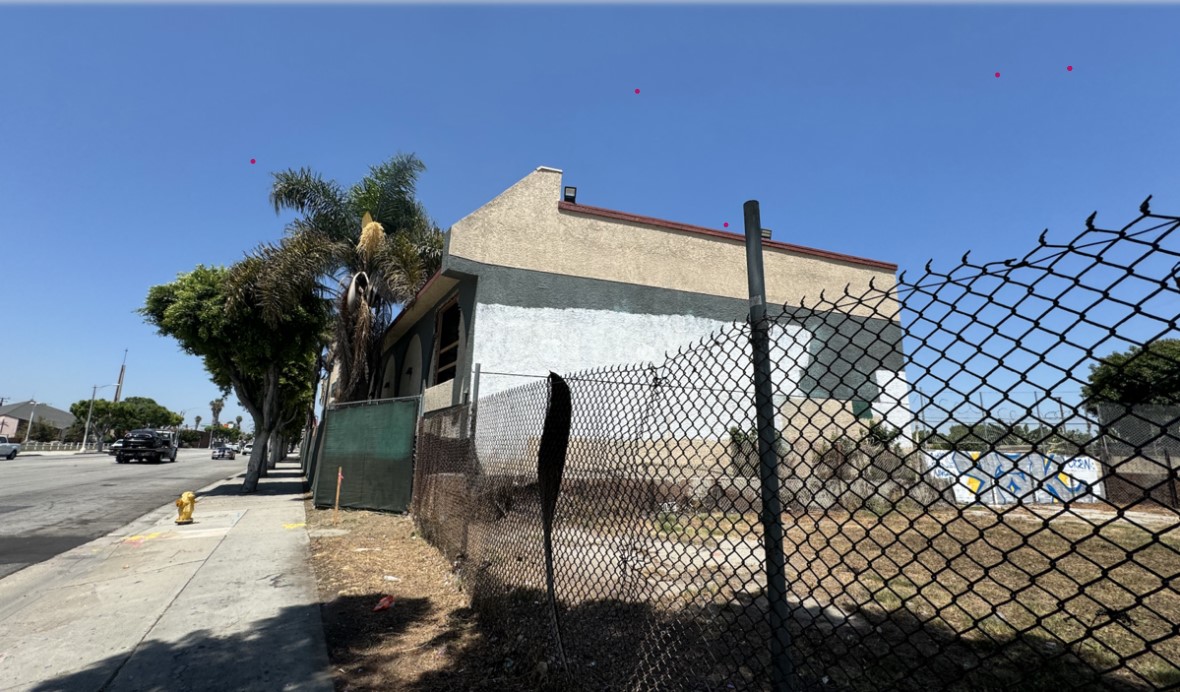
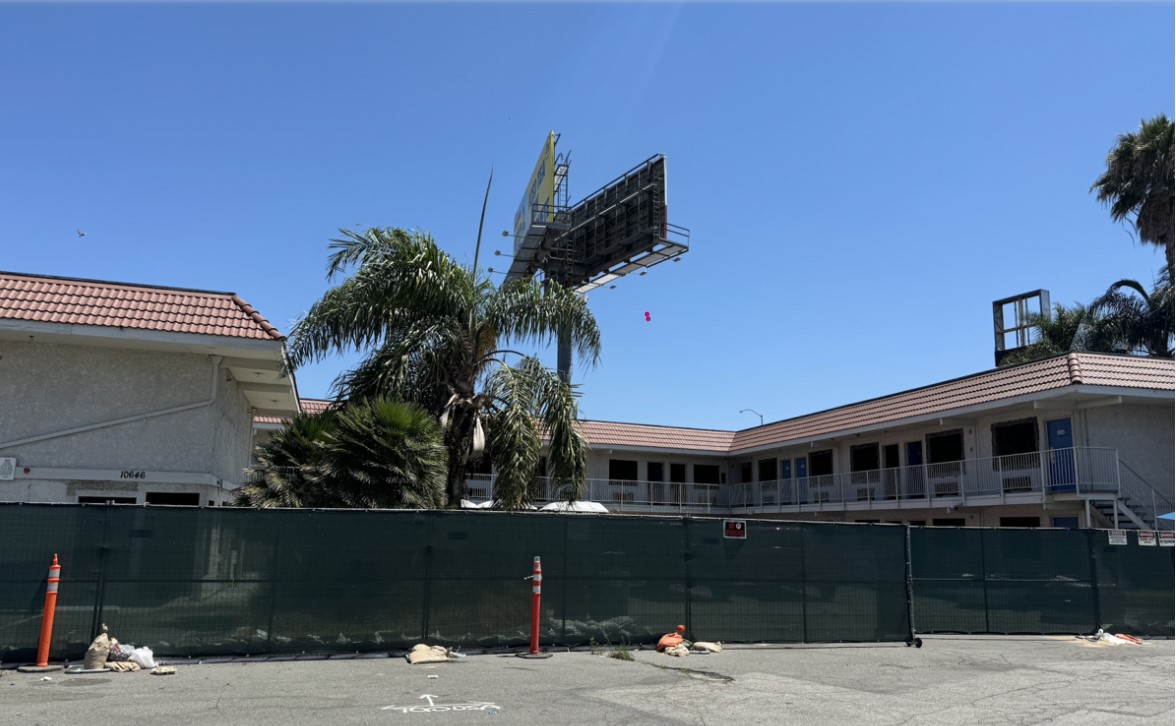
However, according to an exclusive, months-long investigation by the Westside Current, as an estimated 139,151 homeless people, both locals and newcomers, occupy streets, sidewalks, beaches, parks, playgrounds, and other public spaces throughout the County, at least 1,538 of  the total 2,157 Homekey rooms are vacant. This number accounts for more than 71% of all Homekey rooms. These revelations come on the heels of our previous reporting that discovered more than 1,200 vacant Homekey units owned by the City of Los Angeles.

Our investigation included visits to 31 of the 32 properties, often more than one, as well as interviews with unhoused residents, security guards, neighbors, and on-site managers at Homekey sites, extensive online research, and correspondence with representatives from Governor Gavin Newsom’s office, the California Department of Housing and Community Development, the County of Los Angeles Homeless Initiative, and individual property developers. We also reached out via email to all five County Supervisors. None responded to our inquiries.

Project Homekey

There have been two phases to Project Homekey. During the pandemic, properties served as emergency short term (also called “interim”) housing. Unlike the City, the County appears to have done a good job initially filling its rooms. Thousands of homeless people received shelter. In the second phase, the County has begun hiring contractors to perform necessary repairs and upgrades for the interim units to qualify as permanent supportive housing.

This is where the challenges began. Our site visits revealed that construction has not started at many properties.

Other buildings require such extensive renovations that occupancy is months if not years away. Among the vacant properties include a 57-room former Motel 6 in Harbor City ($7.9 million purchase price), a 107-room former Extended Stay in Carson ($41.8 million purchase price), and a 109-room former Grand Park Inn in Baldwin Park ($42.8 million purchase price). When we visited this month, there were no significant signs of construction activity at any of them.

One county project, a new 25-unit co-living building in Exposition Park called The Nest at Exposition, officially broke ground on February 29, 2024. The $13.5-million project, which is across the street from the Lucas Museum of Narrative Art, is owned by an L.A.-based nonprofit Wellnest.

When completed, the building will house homeless and at-risk transitional youths ages 15-26.

On hand for the groundbreaking ceremony were Los Angeles County Supervisor Holly J. Mitchell, Los Angeles Mayor Karen Bass’s Chief Housing and Homelessness Solutions Lourdes Castro Ramirez, and California Department of Housing and Community Development Chair Gustavo Velasquez. A  post on Supervisor Mitchell’s X/Twitter account includes a picture of officials holding shovels in what appears to be a pile of sand dumped onto the pavement.

However, when we visited the site more than six months later, on September 15, construction had not started. It remains an empty parking lot.

In response to emailed questions, Wellnest VP Communications and Public Affairs Rebecca Haussling attributed the delay to “Approval of all construction permits by [the] City of Los Angeles.” She said the project will break ground this month and has an estimated completion date of November 2025.

Another example of the county’s struggles is the 104-room former Willow Tree Inn in Compton, which the County purchased for $16.8 million in December 2020.

A County Board of Supervisors motion dated December 20, 2022, allocated an additional $19 million for renovations, bringing the total cost of acquisition and construction to $35.8 million.

The motel’s on-site service provider, The People Concern (TPC), reports on their website that, “Conversions Begin at Willow Tree.” There is no date on the announcement.  According to the county’s “American Rescue Plan Public Portal,” the building will complete construction by April 30, 2025.

A December 20, 2022 Board of Supervisors motion granted TPC a 36-month gratis lease on the Willow Tree, with a subsequent option on the nonprofit’s behalf to accept transfer of title for free. This arrangement – free rent and an option to obtain title to the properties free of charge – is not uncommon.

An October 28, 2022 Board of Supervisors motion identified eight other Homekey properties for identical deals.

Delays upon delays:

Federal and state regulations, as well as settlements in two federal civil rights cases in 2018 and 2024, impose numerous requirements for units to qualify as permanent supportive housing (PSH).

The results are often extensive retrofits, including plumbing, electrical, and HVAC upgrades or repairs, the addition of kitchens, and installation of features required by the Americans With Disabilities Act (ADA). Additionally, our investigation revealed that several of the properties are in such poor condition that they effectively need to be rebuilt.

For example, a former Best Inn motel on West Adams has been taken down to the studs. These properties likely are years away from occupancy.

In response to emailed questions, HCD Deputy Director of Communications Pablo Espinoza told us that Homekey properties “began operations as Interim Housing…and are required to convert to Permanent Housing (meaning tenants have a lease and no length limit to stay in their unit) any time before the interim affordability period expires, a term of 10 years.”

In the context of a declared homelessness emergency, a decade is a long time to bring badly needed new housing units online, especially considering that they are in existing buildings.

In response to emailed questions regarding the lack of construction activity at so many Homekey sites, L.A. County Homeless Initiative spokesperson Christina Villacorte said, “The same impacts that are affecting the construction sector are also affecting Homekey projects, including inflation, the cost of supplies, and labor, which can impact the timeline of project completion.”

Villacorte said that the County has hired a “concierge” service to assist people being moved out of Homekey properties. However, we spoke to numerous residents, none of whom were able to say where or if they were being relocated. Neither HCD nor County officials could tell us how many people have been relocated successfully, or how many may have fallen back into homelessness.

For example, in May we visited a former Extended Stay property on Sepulveda Boulevard near the 405 freeway for which the Housing Authority of the City of Los Angeles paid $55.3 million in 2022.

We spoke with one of the few remaining residents, a woman in her early 60s. She confirmed that she was being relocated. However, she did not know where her new shelter would be, or if she would be sheltered at all. Our conversation was disrupted by a security guard for the contractor the city is paying to manage the property. He admonished us to leave the “private property.” The woman, appearing unnerved, quickly walked away.

Los Angeles County has company with other properties in California.

Well-documented operational shortcomings and lack of oversight make it difficult if not impossible to determine just how many of the 15,000 total Homekey units in California are vacant.

An April 2024 report from the State Auditor’s office concluded that the “lack of coordination among the State’s homelessness programs…hampered the effectiveness of the state’s efforts to end homelessness.”

Consistent with the Current’s investigation,  reporting by other outlets has revealed hundreds more vacant Homekey units around the state. It has also been reported that some properties acquired through Homekey resulted in evictions of existing residents, effectively making people homeless in order to house the homeless.

The Westside Current will continue to monitor these developments, reporting on the progress—or lack thereof—as the county and city attempt to navigate the complex challenges of Project Homekey. For now, the empty rooms stand as a testament to the difficulties in translating bold initiatives into tangible solutions.

Meanwhile, six people a day die on our streets—that we know of.

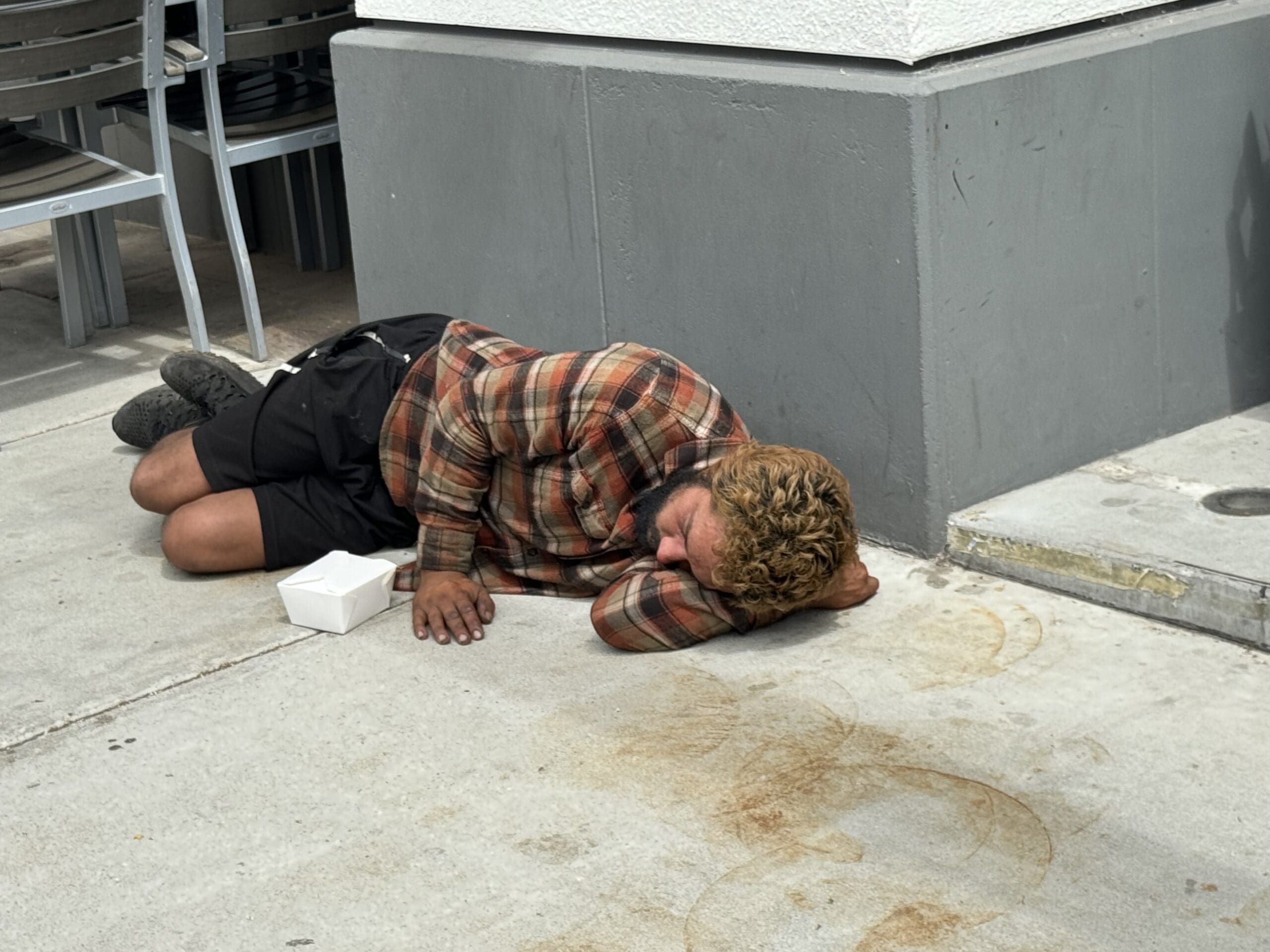
Mentally Ill and the addicted are dying in the streets.
Photo: JOHN ALLE/SM COALITION

Posted in Homelessness | 5 Comments

“Friday Night Lights” at PaliHi Reunion

Former PaliHi Football players Carl Hill and Carter Harrington reminisce at the Class of ’64 Reunion that was held at the Quad. All classes were welcomed to come share memories.

By STEWART SLAVIN

Palisades High School football team traveled to Harvard Westlake on September 20, defeating them soundly 33-13.

The next day, football was again the topic when the Class of 1964 celebrated their 60th reunion at a picnic at the Palisades High School Quad. The class invited all alums to come share the celebration and memories.

Carl Hill, Pali Class of ‘76, chatted with Carter Harrington, Class of ‘64.

In 1974, Hill was at Pali when the varsity football team played for the city championship at the Memorial Coliseum with Dick North and Merritt Stanfield as coaches. A year later, Hill was a Western League first team linebacker.

Before 12,747 fans at the Coliseum on December 14, 1974, San Fernando High squeezed out a tense, exciting 12-10 victory over Palisades High to capture the city football title. The outcome was in doubt until the final gun.

“I went to the game,” said Carter, a star fullback and defensive end of the ‘62 and ‘63 Pali varsity teams. “I was so proud of Palisades High School and our class that dug the holes to plant the seeds of Friday Night Lights.” The Class of ‘64 took part in Pali’s very first football season in the fall of 1961.

Of the reunion picnic on the Pali quad, Carter, a former Top Gun Navy fighter pilot, said: “We all had a more quiet time, one-on-one sharing thoughts, memories and appreciation of each other. Connecting our Dots … and for me I got to know people that I didn’t know growing up together. It’s what our world needs now. Coming together. Connecting our Dots. And realizing we are the same.”


Posted in General, Sports | Leave a comment

Reporter Starts Next Phase of His Life

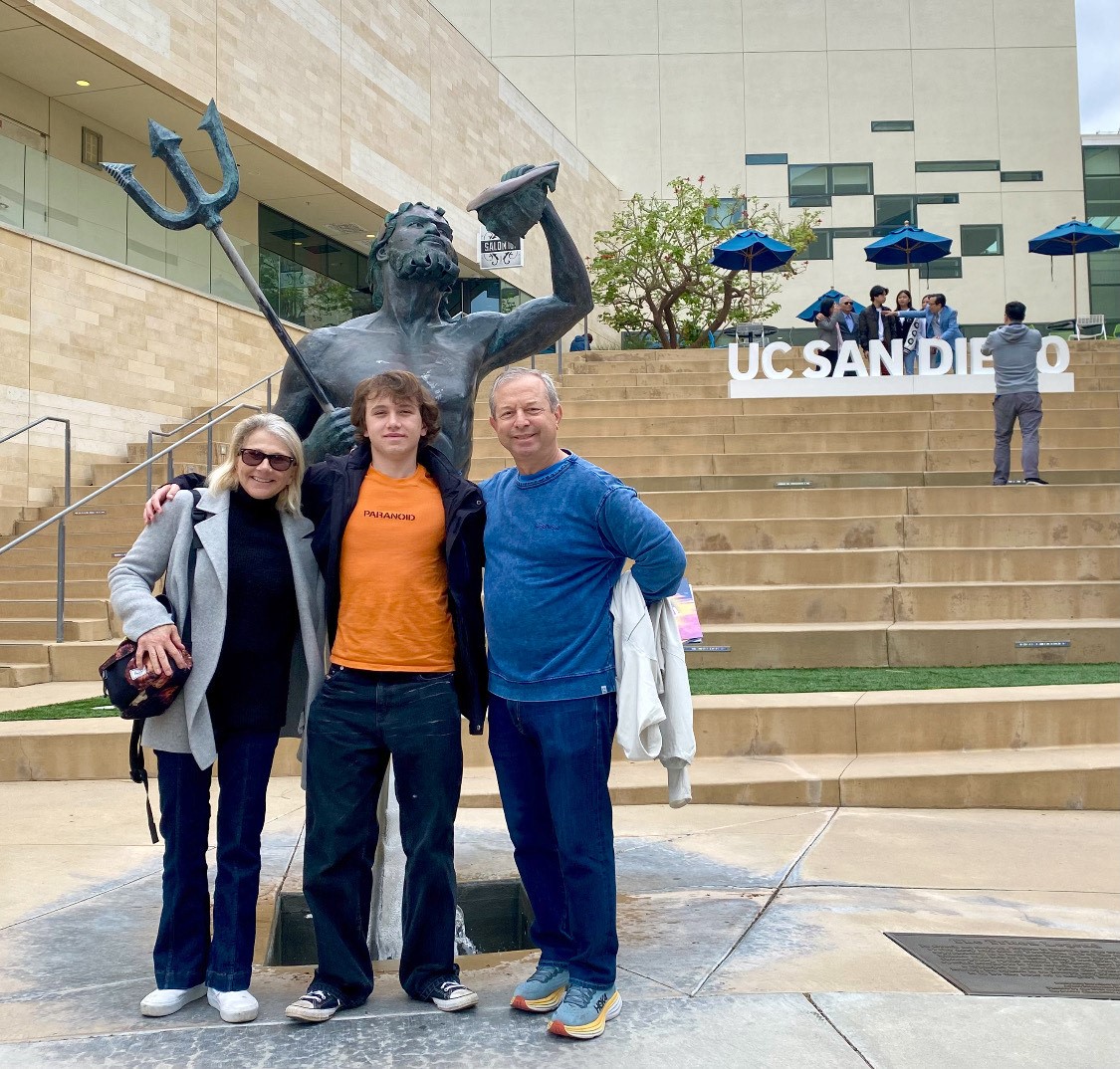
Chaz Plager with his parents as he starts college.

I never pictured myself saying this, but three years of articles later, this will likely be my last in official capacity as Junior Reporter for Circling the News. It has been an honor to work with the wonderful Sue Pascoe all this time, and I find it very difficult to put into writing how grateful I am for this incredible opportunity she’s granted me. Still, I suppose I’ll try.

When I wrote my first article for Circling the News, I had next to no confidence in myself or any of my skills. The Pali High color guard, which I was a member of at the time, was highly lacking in funding, and I reached out to Sue with the hopes of writing a piece on the issue. I found it very hard to believe that what I wrote would be any good or have any of the impact I hoped it would. And yet I still wrote it. Perhaps I had a lot more wishful thinking, rather than confidence.

In response to my article, the American Legion donated $1500 to the color guard, ensuring it would last the year. To have my efforts be rewarded was an incredible, but altogether unfamiliar experience. In hopes of experiencing it once again, I proposed to Sue that I continue to write. That marked the beginning of my journey with Circling the News, and it has been truly remarkable in every respect. I have met with several notable people, seen parts of California I’ve never seen before, gotten thrown out of a public park on Easter Sunday, eaten excellent food, and given back to my community in ways I didn’t expect I would ever be able to.

If there is one lesson I would like all who have graciously read my articles to take with them, it is that it is always possible to pursue your passions. If there is something you wish you could do, it is not a matter of “if”, but “when” and “how”. Years ago I spent my time wallowing in self-pity: never again, I swore to myself.

I would also like to extend my thanks to Rich Schmitt, who provides the wonderful photos you see next to most of my articles. They wouldn’t be the same without his amazing work. And finally, I thank each and every person who has read and responded to my articles over the last few years.  You’re all truly wonderful.

I will be continuing to hone my skills at UC San Diego, where I plan to keep up my journalistic efforts. Many famous individuals have taken up residence in the Palisades, and I hope to join their ranks. In the meantime, in case I don’t see you— good morning, good afternoon, good evening, and good night!

(Editor’s note: I first met Chaz Plager when he was an eighth grader at Revere Middle School. He was on the school newspaper and wrote an incredibly “smart” and “well-disguised” quip that went undetected until the paper came out. It was exceptionally clever and I mentioned to his dad, who was in a spinning class with me that if Chaz ever wanted to write for Circling the News to let me know. He penned his first piece in 2020 and wrote about how it was for kids isolated in their homes dealing with Covid.

He is smart, writes pieces that require little editing, and no matter what topic I threw at him, he took on the story, everything from the Nike Missile Site, to interviewing local musician Matty Gottsman, to HO!HO!HO! to reports from Japan, to Palisades High School stories from graduation to music, to food reviews. He also suggested topics, that I wasn’t aware of, such as Anime. Over the three years he wrote more than 80 stories, while taking a full class load at PaliHi, including APs.

Chaz was a pleasure to work with and took suggestions and editing and incorporated it into his writing. Dr. Seuss wrote “Oh the Place You Will Go. . .” and I will eagerly wait and watch to see Chaz’s path as he starts the next phase of his life – and the places he goes.)

Posted in News | 11 Comments

Addressing the Mentally Ill Who Are Homeless

The mentally ill and the addicted are dying in the streets.
Photo: JOHN ALLE/SM COALITION


(EDITOR’S NOTE: A reader, tired of hearing about how homelessness programs were ineffective, challenged people to offer solutions, rather than just criticize existing programs. This editor took the challenge and has said there are three components. There are homeless that are addicted or drug problems. This piece speaks about the mentally ill.  The number of addicted and those with mentally illness is sometimes given as nearly three-fourth of those on the streets. To read about addiction/homelessness https://www.circlingthenews.com/how-to-fix-the-h…s-in-los-angeles.)


Part II: Treating the Mentally Ill on the Streets

Anyone who lives in Los Angeles has seen these people. They talk to themselves; they walk out in traffic; they throw things at passing cars; they attack pedestrians with no warning, and some commit violent crimes.

While at Oxford University, Elyn Saks suffered mental illness, and was put in a mental hospital. With medication and therapy, she was able to finish her degree and then attend Yale Law School, where once again schizophrenia momentarily took over her life.

Saks, who is now an associate dean at the USC Gould School of Law convinced her doctor, Kaplan [a pseudonym], to lower her dosage of Zyprexa. She writes in her book that he agreed with the caveat that “If, in his judgment, I was in trouble and he decided that I needed to go back on my dosages, I’d do it immediately – no bargaining, no equivocation.”

Saks writes, “As I dropped my levels over the next few weeks, I faintly sensed the fog drifting in, the early signs of disorganization beginning. I gritted my teeth and concentrated on work. I can adjust to it, I thought. I’ll get better. Just wait. I flew east for my tenth law school reunion . . .and for most of the evening’s program at Yale, I sat next to Steve [her best friend] and struggled with the urge to jump out of my chair and scream at the terrifying creatures hovering in the air around me.”

Kaplan insisted that she go back on the dosage, which she does, but then attends a conference in San Francisco. “But the delusions and the disorganization accelerated; I was coming apart at the seams. I called Kaplan.”

Her doctor suggested that she return to Los Angeles, but she decided against his advice. “At which point my sickness took a new, horrific turn. For some reason, I decided that Kaplan and Steve were imposters. They looked the same, they sounded the same, they were identical in every way to the originals – but they’d been replaced by someone or something. Was it the work of alien beings? I had no way of knowing, but I was terrified.”

Her journey of coping with schizophrenia, is documented in The Center Cannot Hold.

If a woman with resources, friends, and doctors, has trouble battling this disease, what about the people on the street?

Suffering psychosis and schizophrenia they sleep on the street and scavenge for food while battling the voices they hear. They do not recognize people they know or even understand they need help. Housing first will not help these people – and will not help addicts. Stabilizing them has to come first.

With all the money that is given for housing first and “Inside Safe” – a majority of those dollars need to go for drug rehabilitation and mental help. It is not.

Rosemary Kennedy

People still like to blame Ronald Reagan forty-three years later, but that is wrongly placed. President John F. Kennedy’s sister Rosemary had intellectual challenges and was given a lobotomy, which left her institutionalized for  her adult life. Trying to help his sister and others like her, he appointed a Mental Health Commission.

That commission in 1961 said state mental health hospitals should be replaced by “community mental health centers” and that the federal government would take over management of mental health care from states.

In 1963, that Act closed the hospitals, with no plans for discharged patients. By 1964, the country had gone from need to care for mental illness to refusing to do so, unless there was a risk of “harm to self or others.”

People read the book One Flew over the Cuckoo’s Nest and saw the movie and determined that people had incorrectly been placed in institutions, although there were no statistics to support that conclusion.

Under President Lyndon Johnson, Medicare and Medicaid were created.  Medicaid rules stipulated that funds could not be used for people in mental institutions.  This became the Institutions for Mental Disease (IMD) exclusion.  Somehow, the government arrived at the threshold of 16 beds constituting an institution. Federal dollars will not go to institutions with more than 16 beds.

The mentally ill are left on the streets.
Photo: JOHN ALLE/SM Coalition

Dr. Drew Pinsky writes that most of those mentally ill on the street have Anosognosia, which means those people are unaware of a disability and don’t feel they need treatment.

With stroke, dementia and other diseases, doctors will go to great lengths to save a patient, but with mental illness, because of civil rights, the disease is privileged by the law. Patients don’t get the help they need.

Pinsky in a talk, said, “Currently, we can intervene in the case of dementia where there is no hope of changing the progression of the disease.  In the case of schizophrenia, if we intervene early, we can change the course of the disease. Yet anosognosia, mental illness, is “privileged” by the law.”

In the book Tomorrow was Yesterday: Explosive First-Person indictments of the U.S. Mental Health System – Mothers Across the Nation Tell It Like It Is – 64 mothers talk about trying to save their children. Readers will learn about terrible group homes, suicides, adult children killed by police, incarcerations, solitary confinement, lack of beds, family chaos, substance abuse, ineffective medications, heart-breaking HIPAA restrictions, hallucinations, homelessness, sorrow, hurt and anger. The author Dede Ranahan wants the public to know these families’ stories.

Right, now if one’s young adult child is going through a mental episode, there is little a parent can do. The CARE Act, SB 1338 was passed that can allow a parent to file to have their child assessed. The program is voluntary, and the child, who may be in the midst of mental illness has to agree to treatment.

Bottom line, the mentally ill need to come off the street. Too often they commit some crime, whether to survive or in the throes of schizophrenia, and end up in jail.

Or they just end up dead in the streets.

Finding a way to treat the mentally ill and those with drug addictions could reduce those on the streets by nearly two-thirds.

Some say not treating the mentally ill is a right’s issue.
Photo: JOHN ALLE/SM Coalition

Posted in Viewpoint | 4 Comments

What is it #39?

I found this on a crowded shelf at our local Salvation Army store. It looked old and interesting, so I took a chance for $8.50.

After doing some research, I learned it’s an antique copper pitcher that was used in bars and taverns in the 1800’s.

It can hold one half gallon of wine or brandy or apple cider. A sturdy bar maid could carry two or three in each hand gripping the handles as she delivered them to the tables.

This rough handling accounts for the many dents. These pitchers were made in England or the United States in tinsmith shops or factories using copper sheeting from patterns. The pieces were then welded together.

Because of the lead solder, I wouldn’t use it for beverages – besides they often leak at the welds.


(Editor’s note: Palisades resident Howard Yonet has an interesting collection of curios from around the world and with his permission, Circling the News is publishing one a week. About the collector: Dr. Howard Yonet was born in Brooklyn in 1934 and attended Brooklyn College. He went to Baylor Medical School and then returned to do an internship at Bellevue Hospital. Yonet completed his residency at the Manhattan V.A. and the Montefiore Hospital. During this time he went skiing in Vermont and the Catskills, and while traveling found barns filled with early American pieces. This led to his interest in American Antiques.

In 1965, he married Daniele, who was originally from Nancy, France. During the Vietnam War, Yonet was drafted as a medical officer and stationed in Landstuhl, Germany (1966-1969). This was close to the French border, which meant he and Daniele and could visit her family.

While abroad, the Yonets took weekend trips through France and Italy, purchasing many interesting pieces at flea markets.

The family settled in Pacific Palisades in 1970 and Yonet practiced general radiology until 2006. He continued to acquire antiques and collectables at estate and garage sales and the Salvation Army Store. He also enjoyed looking for collectibles while traveling in Montana, Idaho, Colorado and Massachusetts. Daniele’s family helped add to his collection.)


Posted in What is it? | 2 Comments

Revere School Traffic Needs to Be Fixed

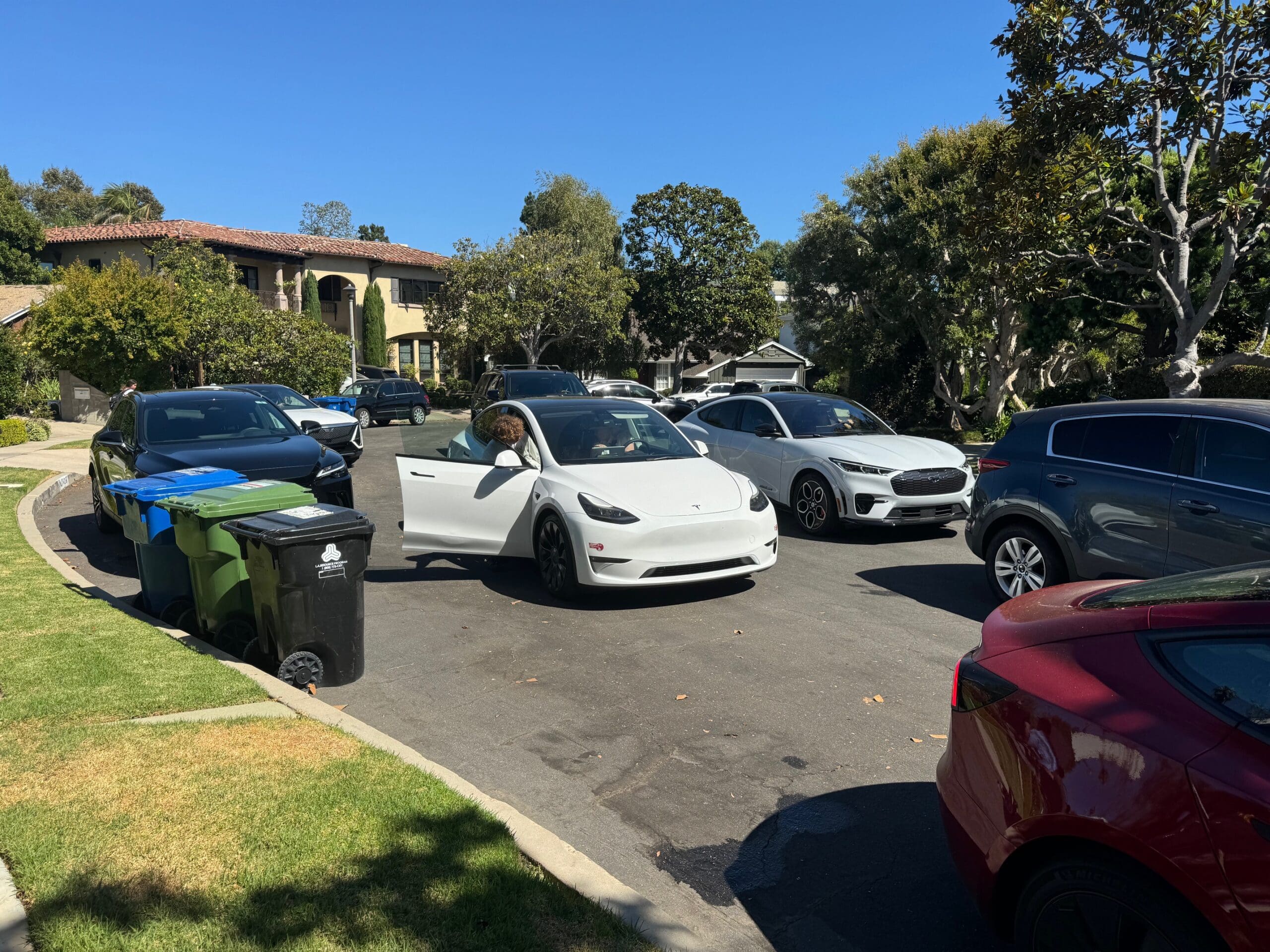
Cars double park on both sides on the streets that radiate from Allenford, not allowing residents to leave the area when Revere middle school lets out.

The traffic at drop-off and pic- up times at Paul Revere Middle School needs to be fixed. There is only one road, Allenford, that goes by the school entrance. That street accommodates cars and buses that drop off and pick up the 1,700 students who attend sixth through eighth grade.

Sunset Boulevard runs along the north perimeter of the school, but there is no place to park or pick up students on that major four-lane thoroughfare. There are residences to the east and south with no roadway access to the school.

About 400 students come to the school on LAUSD buses, an additional 450 kids ride buses paid for by parents and there are 250 students on public buses (Metro and Big Blue Bus). That means about 600 students arrive or leave by car.

Those private vehicles descend on the three streets that radiate off Allenford. Residents living there are trapped in their homes twice a day. The only way in and out of those streets, Longworth, Brinkley and Pontoon, is Allenford. The Riviera Golf Course prevents exiting to the west.

Even though the school has no jurisdiction over the L.A. City streets, Revere school officials have asked parents to be considerate of neighbors and not block driveways.

This editor accompanied Pacific Palisades Community Council Area 8 representative Andrew Wolfberg to watch dismissal. That day a traffic officer was on site, and moved at least 50 different cars, which were illegally parking on Allenford.

Wolfberg said that if they could have an officer more frequently, it would stop some of the illegal parking.

The “west gate” of the campus, used to allow parents to line up on the inner driveway parallel to school, which took some traffic off the street. But following the nationwide school shootings, that practice had been stopped and the gates are locked, only allowing school buses.

Wolfberg said he had reached out to LAUSD Board Member Nick Melvoin’s office to inquire whether the District would consider opening the gate at the west driveway earlier to allow parents/guardians to pick up students, thereby reducing neighborhood traffic.

He also asked if someone from LAUSD’s Office of Environmental Health and Safety (OEHS) visit Paul Revere to observe the afternoon dismissal and report back with recommendations for improving safety and curbing inappropriate behavior by parents/guardians.

CTN reached out to Allison Polhill last week to see if LAUSD had looked at the situation. Neither Polhill nor OEHS has responded.

CTN asked if the neighbors had any suggestions to help ease the gridlock that occurs there at least twice a day. (Note: After observing the traffic, this editor, who had parked near the golf course, and then joined the traffic, taking a full half an hour to go less than a mile. Environmentally, the exhaust cannot be good.)

Below are suggestions from the most realistic to the least realistic.

1.    Increased parking enforcement.

2.    Traffic control officers at Allenford and Sunset.

3.    Traffic control officers at 26th and San Vicente.

4.    Opening the west driveway to accommodate vehicle queuing.

5.    Implementing LAUSD shuttles to the E-Line light rail stop at 26th and Olympic and major bus lines (Wilshire/Santa Monica/Venice).

6.    Increasing the number of LAUSD school buses for students.

7.    Implementing LAUSD shuttles for off-site pick-up after school.

8.    Staggering dismissal times for students.

9.    Taking and publishing photos and videos of parents/guardians who create dangerous conditions or disrespect the neighbors.

10.   Opening access to Paul Revere via Sunset between Allenford and Mandeville.

11.   Securing financial contributions from private businesses and local groups to offer reduced price options for the private yellow buses. (School buses from Palisades and other areas are available, but residents are required to pay a hefty fee for riding to a public school.)

12.   Paving the path next to the County Flood Control channel to create an additional lane for queuing.

13.   Constructing a multi-level parking lot on the west side of campus.

When neighbors moved to the “polo field” region of Pacific Palisades, they were aware of the traffic generated, but they are asking LAUSD and the City need to take stronger action to address these traffic issues and the associated misconduct because they create dangerous conditions for both students and residents.

The traffic congestion extends beyond the immediate vicinity, impacting a large part of the Palisades and Brentwood community. It can delay emergency vehicles responding to crises and transporting patients to hospitals, putting lives at risk.

The traffic issue is raised every year, but it is conveniently ignored by the City and LAUSD, both saying “there’s nothing we can do.”

Cars line up on either side of Allenford at pick up time, ignoring signs.

Posted in Community, Schools | 4 Comments

Pot Shots #26

What are Pot-Shots?

Ashleigh Brilliant writes:

WHAT EXACTLY IS A “POT-SHOT” OR “BRILLIANT THOUGHT?”

Pot-Shots are epigrams, composed according to the following very strict rules.

The length must never exceed 17 English words. Note that this is a maximum. Some Pot-Shots are much shorter. Hyphenated words count as a single word.

Pot-Shots must be easy to translate into other languages. Therefore there can be no use of rhyme or rhythm, idioms, puns, or other word-play.

Pot-Shots should be capable of being appreciated in all times and cultures. Topical and cultural references must be avoided.

Every Pot-Shot should be as different as possible from every other one.

Every Pot-Shot must be totally original, and unlike anything else the author, or anyone else, has ever said before.

The words of a Pot-Shot must be able to stand on their own, and not require any illustration in order to be understood or appreciated.

Whatever is being said should be worth saying and said in the best possible way.

NOTE: These are ideal standards, and I myself have failed to meet some of them occasionally — but in general I have adhered to them quite scrupulously.

Posted in Pot-Shot | Leave a comment

Mansion Tax Fallout: LA Sees Sharp Drop in Housing Production

(Editor’s note: This story appeared on September 12, in the Westside Current and is reprinted with permission.)

Single family “mansions” priced above $5 million have seen sales drop by 50 percent since ULA passed in November 2022.

By ANGELA MCGREGOR

The November, 2022 passage of ULA (aka, “United to House L.A.” or the “Mansion Tax”) is perhaps the best evidence of non-profit housing developers’ recently acquired political muscle.  SCANPH – the Southern California Association of Nonprofit Housing – a membership organization that represents non-profit developers – lobbied hard for the measure.

They promised that ULA would increase the stock of low income housing, and reduce homelessness. It passed with 58% of the vote and went into effect in January of 2023.  Roughly 70% of the funds garnered by the transfer tax are earmarked for low income housing; the remainder are mandated to support renter assistance and other homelessness prevention measures.

The only exemption to this new tax is, according to L.A. Housing Department guidelines,  “reserved for low income housing developers that are 501c3 non-profits, community land trusts, limited partnerships and limited liability companies having a non-profit or community land trust general partner or managing member with a history of experience in affordable housing development or management.”  In other words, private developers of multi-unit housing – even projects with a significant low income component – pay the same 5% tax as billionaires selling multi-million-dollar mansions.

And as of April, 2024 the tax has brought in just $215 million over 16 months -– less than a third of the $900 million per year its backers had predicted.

But the actual result of the measure, according to multiple sources, is that ULA has put a damper on all real estate development, resulting in less development of both market-rate and affordable projects.  And as of April, 2024 the tax has brought in just $215 million over 16 months -– less than a third of the $900 million per year its backers had predicted.

According to a February, 2023 article 3 in the Real Deal, ULA has dried up multifamily financing in L.A because “The transfer tax makes it difficult to estimate what a property’s value will look like over the next three, five or 10 years — typical hold periods for a multifamily developer and owner. And for construction loans specifically, lenders may not want to convert the loan into a traditional commercial loan when construction is finished, given the uncertainty around how much the asset will be able to sell for once it’s finished.”

The Nonprofits’ Role in L.A.’s Housing Crisis

Part One:  The Growth of Affordable Developers

An April, 2024 study from Hilgard Zenith Economics examining residential building permits shows a 19% year over year decrease in residential housing starts between 2023 and 2024.  The difference in production between 2022 and 2024 is even more pronounced; two years ago, the city issued three times as many housing permits.  The only overall increase in building permits was for so-called  ED1 projects – defined as 100% affordable.  But these developments only constitute 11% of total output.

“The continued fall in citywide permitting is somewhat unexpected as interest rates have leveled off, local employment numbers have continued to climb and it was theorized that developers might adjust to Measure ULA by now,” Joshua Baum of Hilgard Analytics and Samuel Maury-Holmes of Zenith Economics wrote.

According to the L.A. Business Journal, “Sales are down across all asset types. In quarters two and three of this year, multifamily properties priced above $5 million sold for a total of $320 million. That’s far below the combined $2 billion sold in those same quarters last year.”

“[ULA] sounds good in theory, but in reality it’ll further increase the threshold at which it makes more financial sense to hold onto a property and rent it out rather than sell it.”

As for single family properties over $5 million – the so-called “mansions” that were supposed to have been impacted the most — sales have declined by over 50%.  As one property owner told USC’s Selina Kauser, “[ULA] sounds good in theory, but in reality it’ll further increase the threshold at which it makes more financial sense to hold onto a property and rent it out rather than sell it. Who’s going to want to sell off a property they are required by law to sell for at least 10% lower than its market value? L.A. is going to turn into a city of people who hold onto their property forever and pass it on to their heirs.”

Making matters worse, properties are only reappraised for property tax purposes when they change hands, meaning this extreme loss of liquidity, should it persist, may lead to less property tax revenue for the entire state for decades to come.

The local budgetary impacts of ULA’s revenue shortfall might also be dire.  The L.A. City budget for fiscal year 2024-2025, apparently drafted before the actual numbers were in, “allocates over $400 million in funding anticipated to be generated by Measure ULA to the formula categories in the measure and enables the city to spend receipts collected by the measure.”  It’s worth noting that this city’s latest budget already has a potential $400 million deficit.

Nevertheless, in May of this year, Councilmembers Raman, Hernandez and Harris-Dawson introduced a motion calling upon the L.A. Housing Department, in consultation with ACT-LA, a social justice coalition,  to identify ways to use ULA funds to implement a social housing program for Los Angeles, similar to that in Vienna, Austria (known as a so-called “renter’s paradise”).

According to their motion, “Through the social housing developed under Measure ULA, there is an opportunity to explore these alternative forms of ownership, generational stability, and wealth-building for more Angelenos.”  According to the online publication Dwell, which interviewed Hernandez about the motion, “It’s a great chance to use quite a bit of suddenly available money”.

An Occidental College study, primarily authored by faculty at UCLA’s Luskin Center (home of the Lewis Center, which had authored the pre-election study of the measure deeming its effects on housing production “minimal”)  titled “L.A.’s Mansion Tax:  An Evaluation of Measure ULA’s First Year” takes a glowing view of the measure’s impacts.

By their estimation, the $192 million raised by ULA in its first 10 months is laudable because it exceeds annual affordable housing revenue from the Federal government, and Proposition HHH’s annual revenue.

Nowhere does the study mention the previously promised $900 million, nor ULA’s impact on housing production and high-end real estate sales.  “Measure ULA will capture a small fraction of the immense amount of new wealth created by the area’s booming real estate market and put it to productive use,” according to the study.

Efforts to overturn ULA have thus far failed.  A measure scheduled for the November, 2024 ballot that would have required a two-thirds majority vote in order to pass taxes like ULA (and would have, therefore, repealed it) was struck down by the California Supreme Court.

The Court stated that the sweeping changes the Taxpayer Protection And Government Accountability Act would enact require an amendment to the state’s Constitution.  In April, lawsuits brought against the city by the Howard Jarvis Taxpayer Association and Newcastle Courtyards (representing a family trust) were both dismissed.

According to the Loss Angeles Business Journal, leaders in the business, real estate, labor and housing advocacy communities are currently working to come up with a “fix ULA” proposal to amend the tax so that it doesn’t continue to chill the production of housing.  In the meantime, developers of all types of real estate are going so far as to stop developing housing within Los Angeles, citing business conditions that are, in their view, impossible.


Posted in City, Real Estate | 1 Comment