Addams Family Comes to PaliHi in a Terrific Production

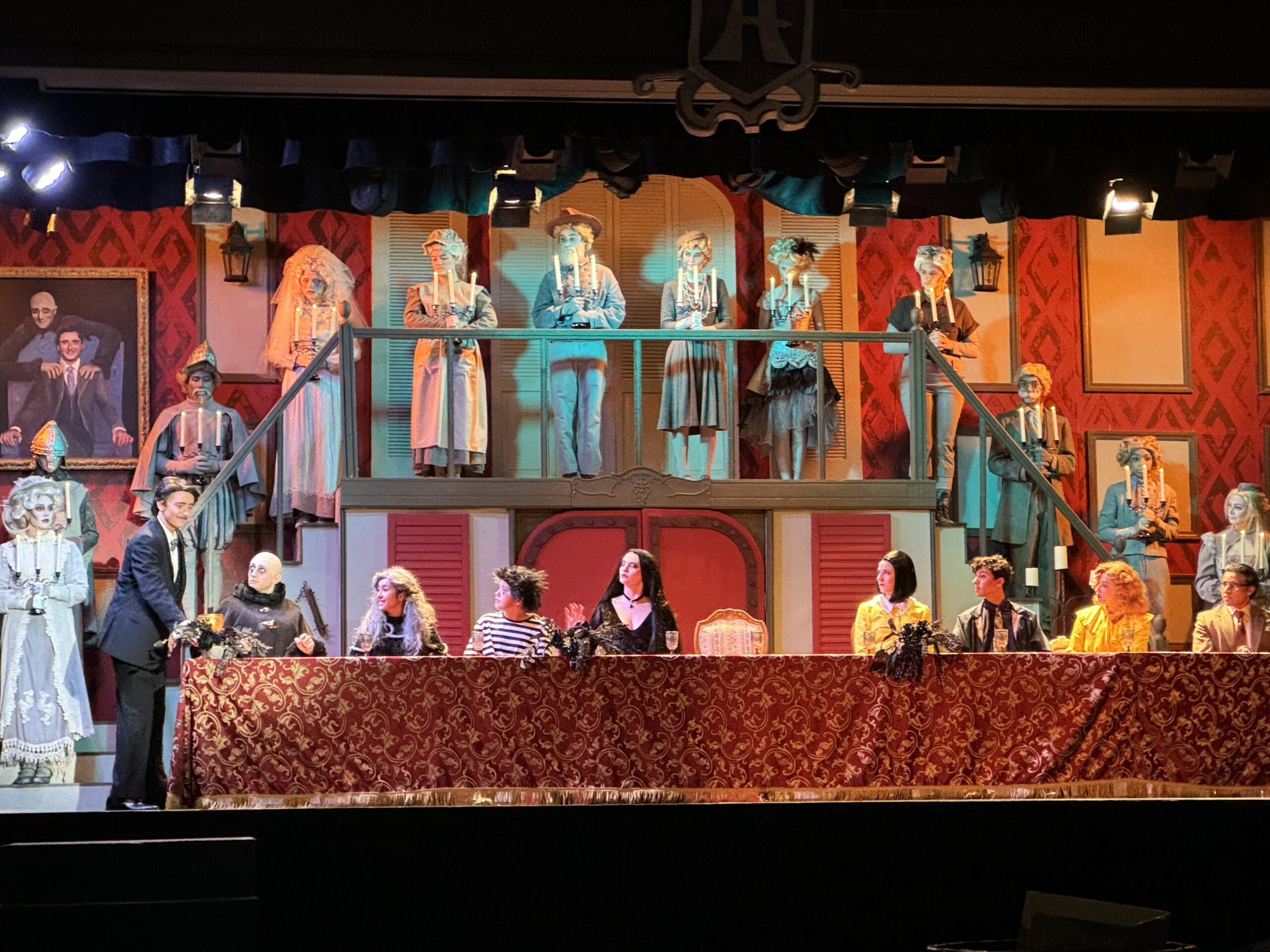
The ancestors look on at the Addams/Beineke Family dinner.

Just in time for Halloween, director Nancy Fracchiolla brings the delightful Addams Family Musical to the Palisades High School stage.

At a preview performance, someone was laughing loud in the mostly empty audience, and then I realized it was me.

When this show opened on Broadway, one New York Times reviewer wrote that it is “ A tepid goulash of vaudeville song-and-dance routines, Borscht Belt jokes, stingless sitcom zingers and homey romantic plotlines.”

True, true and true, but the reviewer failed to mention it was fun, spoke about marriages and left one happy after the show was over.

Although most critics hated the show on Broadway, it consistently played to 100% capacity and grossed third only to Wicked and The Lion King after it opened.

The PaliHi show is splendid, put down your television remote and plan to see a live show, with a pit orchestra, and some truly talented individuals, such as Annika Johansson (Morticia), who last year won as the Best Supporting Actress at the Jerry Herman High School Musical Theater Award Show.

Or Aurora Finetti (Alice Beineke), a senior this year who has never appeared in a school musical before because of prior commitments. She deserved a standing ovation for her performance as a “normal” mom at a family dinner in the song “Full Disclosure.”

The story is simple. Wednesday Addams (Ella White) and Lucas Beineke (Kian Mizban) have fallen in love and plan to marry.

What can go wrong when a normal family, the Beinekes meet the Addams family? Just about everything, especially when Pugsley Addams (Sabrina Hall), steals a potion from Grandma Addams (Eva Hefner) and Alice Beineke drinks it. Her poor husband Lucas (Kian Mizban) doesn’t know what to do.

Not often do high school productions get a call out for costuming, but Natalie Alpert and Henry Sims, have done a spectacular job. I would urge everyone to go to view the “ancestors” and the dancing (choreographer Hazel Clarke) and dance captain (Logan Christopher) is outstanding.

Conor Kowalski (Gomez), Uncle Fester (Jack Lochkheart) and Ivan Munn (Lurch) are also outstanding.

The only thing missing on the preview evening was an audience to share an enjoyable time in Mercer Hall with a terrific cast and production.

The show is at 7 p.m. on September 26, 27 and 28, and October 3, 4 and 5, at Mercer Hall, 15777 Bowdoin Street.

General admission is $18.85, and students are $11. Tickets can be purchased online at https://gofan.co/event/1707139

Uncle Fester sings to his “true” love, the moon.

Posted in General | Leave a comment

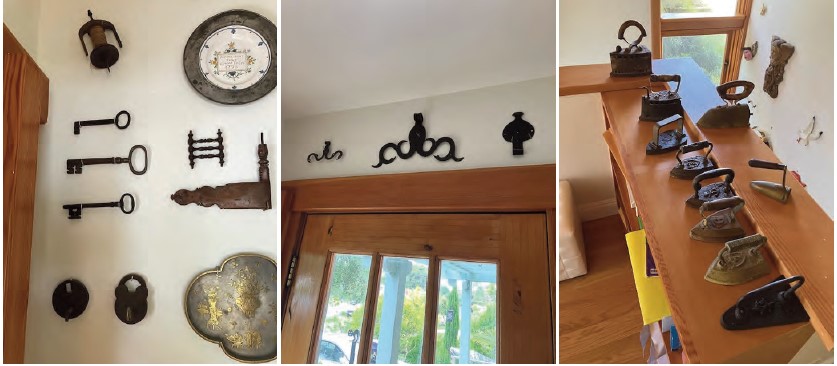
What is it #40?

In 1968, I was on a short vacation from the Army hospital, where I was working. My parents and my wife Danielle had joined me. We  were in our old Volvo, as we drove by the outskirts of Vienna.

I spotted a huge pile of scrap iron in the center of a yard. I made a sharp U turn, entered the yard and climbed on to the 15-foot mound and started pulling these pieces from the pile.

The pieces included laundry irons and many ancient door hinges and ancient locks. As payment, I gave a carton of cigarettes to the grateful proprietor.

Austria was in the process of post-war modernization, and no one had need of laundry irons that required putting coals inside to heat them.

(Editor’s note: Palisades resident Howard Yonet has an interesting collection of curios from around the world and with his permission, Circling the News is publishing one a week. About the collector: Dr. Howard Yonet was born in Brooklyn in 1934 and attended Brooklyn College. He went to Baylor Medical School and then returned to do an internship at Bellevue Hospital. Yonet completed his residency at the Manhattan V.A. and the Montefiore Hospital. During this time he went skiing in Vermont and the Catskills, and while traveling found barns filled with early American pieces. This led to his interest in American Antiques.

In 1965, he married Daniele, who was originally from Nancy, France. During the Vietnam War, Yonet was drafted as a medical officer and stationed in Landstuhl, Germany (1966-1969). This was close to the French border, which meant he and Daniele and could visit her family.

While abroad, the Yonets took weekend trips through France and Italy, purchasing many interesting pieces at flea markets.

The family settled in Pacific Palisades in 1970 and Yonet practiced general radiology until 2006. He continued to acquire antiques and collectables at estate and garage sales and the Salvation Army Store. He also enjoyed looking for collectibles while traveling in Montana, Idaho, Colorado and Massachusetts. Daniele’s family helped add to his collection.)


Posted in What is it? | 1 Comment

Former LAPD Beach Detail Head Rusty Redican Honored

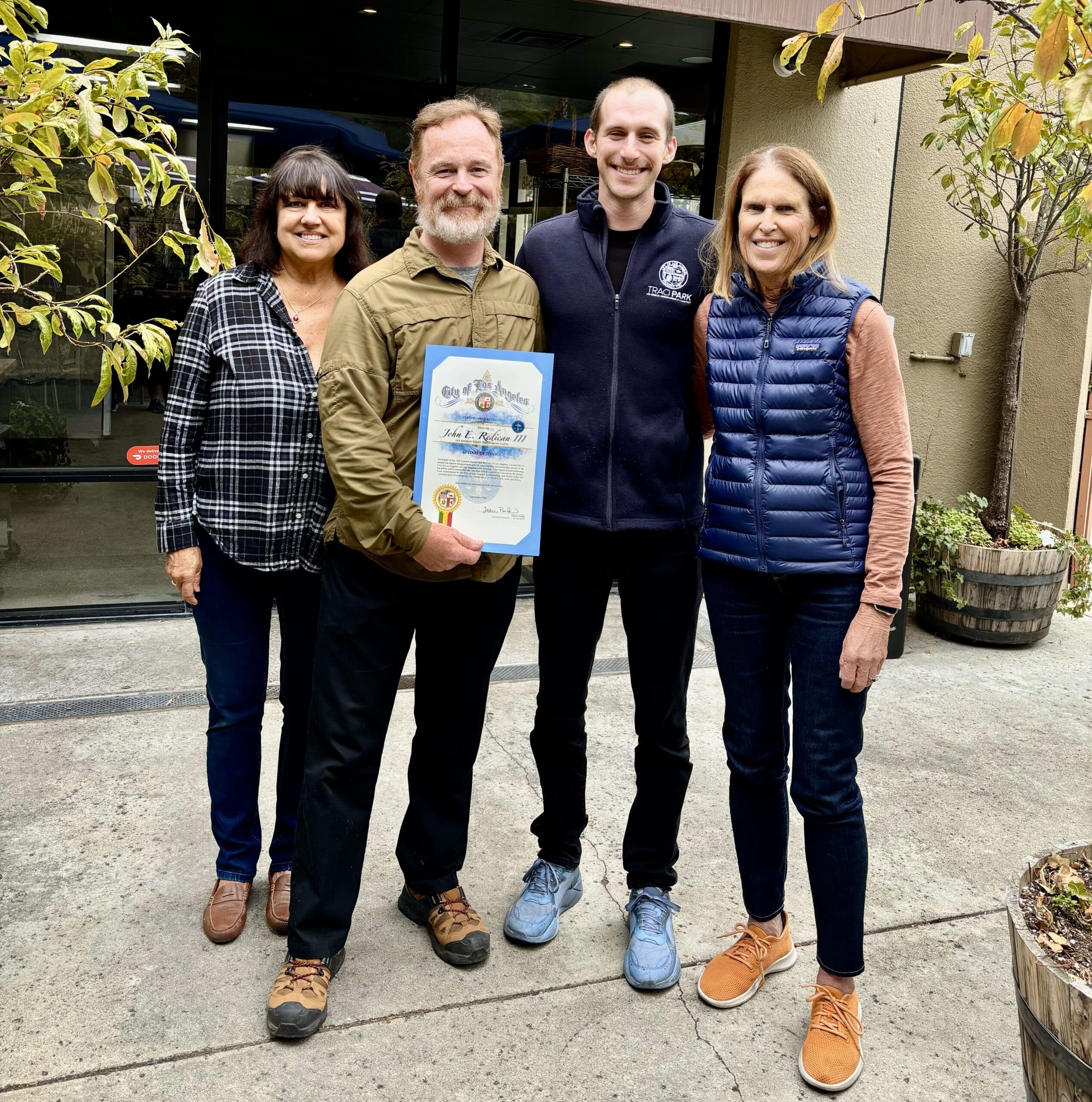
A certificate of appreciation was given to Rusty Redican. (Left to right) Sharon Kilbride, Redican, Michael Amster and Sue Kohl.

A special celebration luncheon was held at Kay’s on September 25, to laud former beach detail Head Officer John E. Redican III, “Rusty.”

He officially retired from the Los Angeles Police Department (LAPD) on September 19, after 22 years of service. Before he left for his now permanent residence in North Carolina, many community members wanted to commend him for his dedication to Pacific Palisades.

Councilmember Traci Park’s field deputy Michael Amster presented Rusty with a certificate from the City in appreciation for what he had done for the community.

Former Pacific Palisades Task Force on Homeless President Sharon Kilbride worked closely with Rusty for six years. “Thank you, Rusty, for your service in the Palisades protecting our community,” Kilbride said. “Thank you for your compassionate demeanor, working alongside the PPTFH and our unhoused population.”

Office Adam Margin, who now heads the detail said, “Thank you for choosing me to come on all those years ago, you didn’t have to pick me, but you took a chance.”

Margin added, “I try to emulate everything you’re shown me. I will try to do the best so that your hard work doesn’t go unnoticed.”

President of the Pacific Palisades Community Council Sue Kohl said, “I’m not sure our PPTFH would be as successful as it is today if it weren’t for the Herculean efforts of Officer Rusty Redican.

“Rusty put his entire heart and soul into it every day and worked both ‘on’ and ‘off’ hours, engaging constantly with the Community Council,” Kohl said. “He showed incredible compassion and empathy toward the unhoused individuals whom he encountered and tried to communicate to them that while there were rules that dictated where they were allowed to be, there was a huge Palisades community who cared about them and wanted the best for them.

“Rusty gave his cell phone number to many concerned residents and always answered their calls,” Kohl said. “He is truly one in a million, and we will continue to miss his efforts and his handsome, smiling face.”

At the lunch, Redican recounted how the beach detail began.  Then, West L.A. Captain Tina Nieto, after several fires in this area, asked him to do a quick reconnaissance of this area and report back to her about the steps that could be taken.

“In 2016, I was with Maryam Zar, and saw a fire on the hill and called it in,” Redican said, noting it helped him work out what needed to be done.

“When I reported back to Nieto, I told her that 12 officers were needed to solidify resources with the Pacific Palisades Task Force on Homelessness.”

The Captain told him, “I’ll give you a partner and I’ll try it out.” That was the start of a successful operation between volunteers and LAPD.

Redican explained at the event on Wednesday that because of a family situation and working with his daughter, he had a better understanding of what was needed with the homeless and those suffering addiction.

“These are human beings were dealing with,” he said. “I always looked at each situation as if I was dealing with someone’s daughter, someone’s son, a mom or dad.”

He explained that empathy was needed so that the homeless knew he, an officer, was there to help, not arrest.

“It started to reap benefits,” he said, because “the homelessness knew he was talking with them and not at them.”

Another factor that made a difference, Redican said was “Being available was what led to the success from my contribution.”

He also praised Palisades residents. “The people saw a problem that was not getting attention from the City and they put their money and their efforts where their mouths are – they put together a taskforce.

“It is one of the most gratifying teams to be part of,” Redican said. “We did it together. We did some great things.”

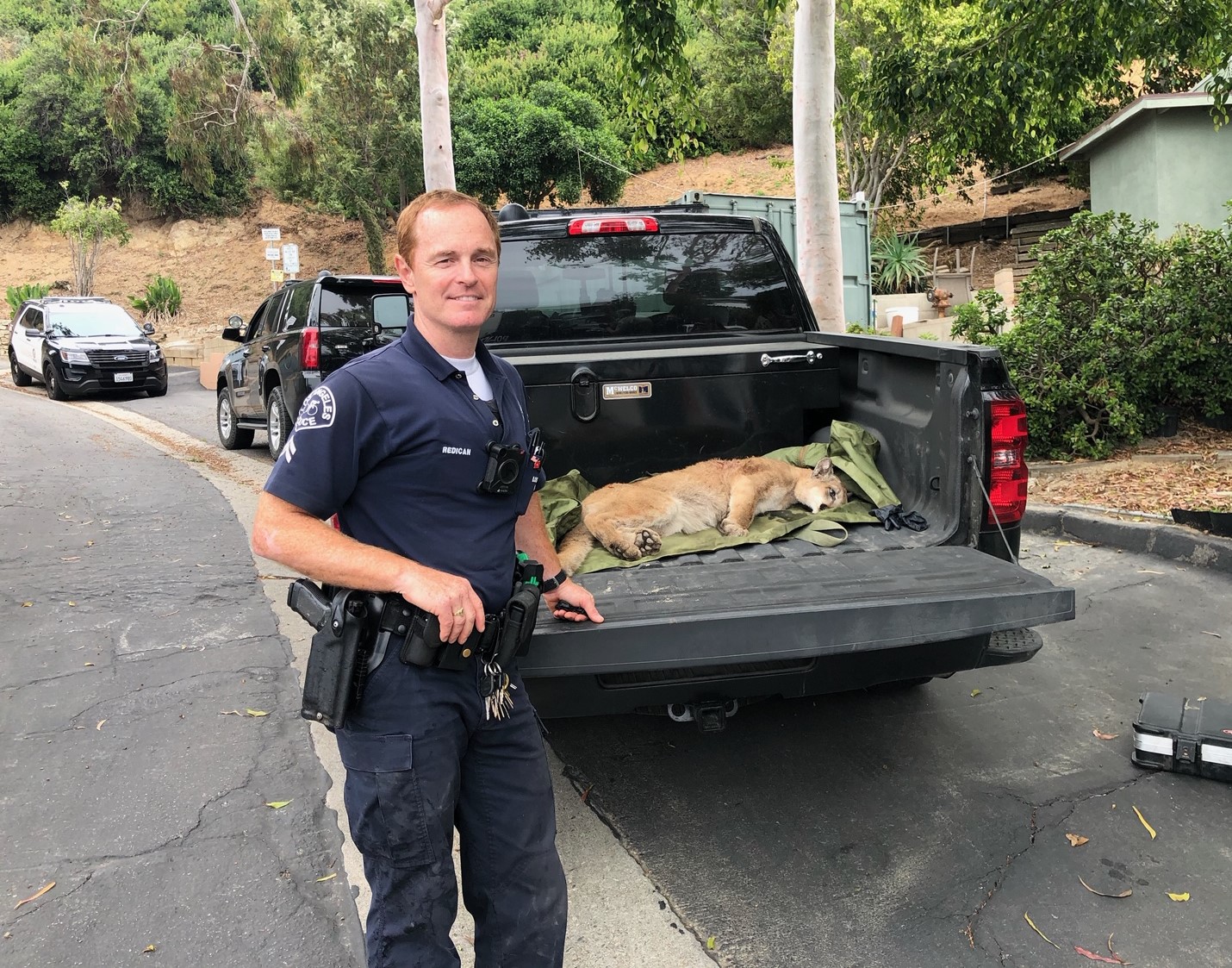
LAPD officer Rusty Redican took the lead in making sure the mountain lion was alive and safely transported to a new area.

Posted in Crime/Police | 3 Comments

Pot Shots #27

What are Pot-Shots?

Ashleigh Brilliant writes:

WHAT EXACTLY IS A “POT-SHOT” OR “BRILLIANT THOUGHT?”

Pot-Shots are epigrams, composed according to the following very strict rules.

The length must never exceed 17 English words. Note that this is a maximum. Some Pot-Shots are much shorter. Hyphenated words count as a single word.

Pot-Shots must be easy to translate into other languages. Therefore there can be no use of rhyme or rhythm, idioms, puns, or other word-play.

Pot-Shots should be capable of being appreciated in all times and cultures. Topical and cultural references must be avoided.

Every Pot-Shot should be as different as possible from every other one.

Every Pot-Shot must be totally original, and unlike anything else the author, or anyone else, has ever said before.

The words of a Pot-Shot must be able to stand on their own, and not require any illustration in order to be understood or appreciated.

Whatever is being said should be worth saying and said in the best possible way.

NOTE: These are ideal standards, and I myself have failed to meet some of them occasionally — but in general I have adhered to them quite scrupulously


Posted in Pot-Shot | Leave a comment

Santa Catalina Island: Aztecs Are Gone and So Is Sugarloaf Rock

Bathing beauties on Catalina holding the islands’ famed flying fish.

By STEWART SLAVIN

Did you know the birthplace of the Aztec civilization was Santa Catalina Island where the buffalo roam?

You’d be forgiven if you didn’t.

In September 1899, both the Chicago Sunday Tribune and St. Louis Post-Dispatch ran banner headlines declaring the discovery.

“After nearly 400 years of patient search, the home of the Aztecs has been discovered. It was the island of Santa Catalina, 30 miles off the coast of Southern California,” the Post-Dispatch announced. “From there, they journeyed into Mexico where they lived for centuries, until their power was destroyed with their civilization by the Spaniards in the 16th century.”

The “discovery” was credited to Dr. Charles W. Zaremba of Illinois, described as an antiquarian and profound student of ancient American history who spent 20 years traveling in Mexico.

“His Polish name and title is Count Zaremba Kalinowsky. One of his ancestors was the King of Poland. The great Pulaski was his grand uncle,” the newspaper noted.

Evidence for his claims was the matching of key geologic formations on Catalina to pictures found on parchment and deerskins drawn by Aztecs some 600 years prior. The natural formations on Catalina were known as Arch Rock, Eagle’s Nest and Sugarloaf Rock at the northern end of Avalon Bay.

“Arch rock and Eagle’s Nest, as photographed on Santa Catalina Island, show exact likenesses to an arched rock with an Aztec warrior standing below, of which the Aztecs left pictures in numerous places in their hieroglyphic histories,” the Chicago Tribune wrote.

“The Sugar Loaf of Santa Catalina in appearance is the same as that pictured by the Aztecs on many coats of arms,” the newspaper continued. “They carried the impression of that strange rock with them, and in many of their cities today it is to be found combined with other figures as a sign of the place of their nativity.”

Now it must be noted here that there is no other reference to this discovery that I could find in my investigation. In fact, there is no confirmation that Aztlan, or the land of origin of the Aztecs, has ever been located and it may be a mythical place like Atlantis.

What is known is that Catalina Island is not 30 miles off the coast as mentioned in the story, nor 26 miles as described in the Four Preps’ 1958 hit song 26 miles (Santa Catalina). The song’s composer, Bruce Belland, explained: “It’s really like 22.3 miles, but you try singing that. Think about that meter!”

And, as the Aztecs are gone from the island, if they ever were there, so too has Sugarloaf Rock left the landscape.

The volcanic monolith that rose 50 feet in height was once the most recognizable landmark on the island and became a tourist attraction in the 1890s with visitors braving a dangerous climb to the top. The rock had previously been a survey station starting in 1856.

Each Fourth of July, a fireworks show turned Sugarloaf into an erupting Mount Vesuvius with its summit ablaze and fiery hues of red, white and blue streaming down its sides.

A staircase was soon built onto the rock — named after Mount Sugarloaf in Rio de Janeiro, Brazil — to help climbers get to the top. But getting down from the promontory proved more difficult than going up and the town’s children would often charge climbers to help in their descent.

Sentential rock, as guidebooks called it, harbored a crystal-clear marine wonderland of brightly colored sealife, including striking tangerine-colored garibaldi, that elicited oohs and aahs from passengers aboard the world’s first glass bottom boats.

But all good things must come to an end and sometimes ancient landmarks have to give way to modern ones. Sugarloaf Rock went out with a bang.
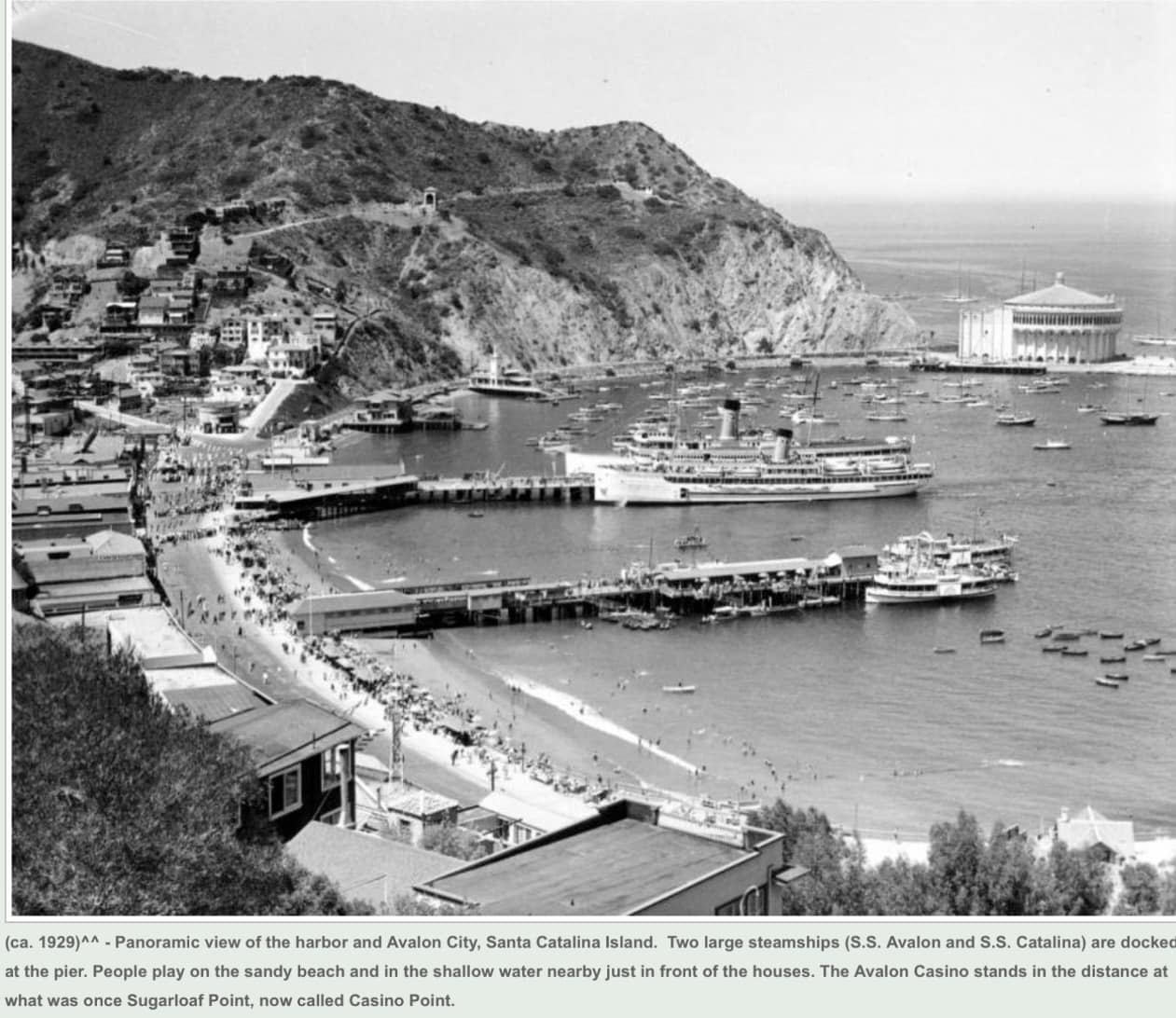
Chewing gum magnate William Wrigley Jr., who bought the island in 1919, always had a love-hate relationship with the rock. He built the iconic Catalina Casino right next to it in Art Deco style rising 12 stories high and featuring the world’s largest circular ballroom that could accommodate 6,000 dancers.

Big Band leaders Glenn Miller, Benny Goodman and Les Brown and His Band of Renown were headliners there. During the 1930s and ’40s, crowds arrived on steamships, including the S.S. Catalina, to shimmy on the dance floor until 1 a.m. to the sounds of the “Chattanooga Choo Choo” or “In the Mood”.

The Avalon Theater on the ground floor is the first ever built specifically for “talkies”. The acoustics are so good that a voice without amplification can be heard throughout the theater. The Casino has never been used for gambling, however, with the name derived from the Italian word for “social gathering place”.

Although the Casino is surrounded on three sides by water, Sugarloaf Rock blocked patrons’ view of the harbor and of the steamships carrying visitors from the mainland. This irked Wrigley and in 1929 on his orders, the landmark monolith was blasted into oblivion by dynamite.

Actually, Wrigley had built an earlier casino on the spot but found it too small for the growing tourist trade on the island. An avid bird watcher with his wife, Ada, Wrigley had the octagonal steel frame of the dance pavilion at the old casino dismantled and hauled inland where it became part of the world’s largest bird park. The attraction in Avalon Canyon covered seven and a half acres and was home to nearly 8,000 birds from all over the globe.

Catalina is an island of firsts. Big game sportfishing was also born here.
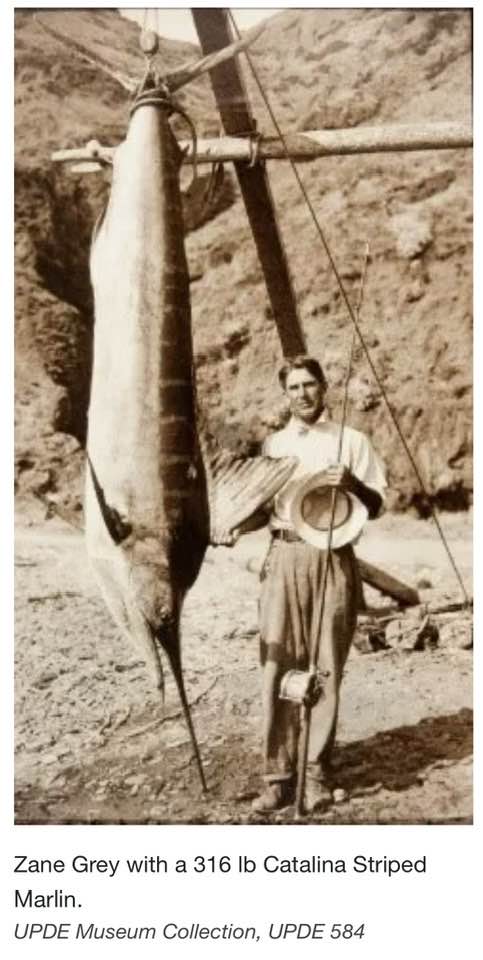
In 1898, the Avalon Tuna Club was established that attracted the membership of U.S. Presidents Theodore Roosevelt, William McKinley and Grover Cleveland, as well as notables like Ernest Hemingway, Winston Churchill, Cecile B. DeMille, Charlie Chaplin and Bing Crosby. They went after trophy-size yellowfin and bluefin tuna, marlin, swordfish, calico bass and others species.

Zane Grey, the author of Westerns who made a home on Catalina, battled five hours aboard his 50-foot fishing boat Gladiator, equipped with a crow’s nest, to bring in a world-record broadbill swordfish weighing 582 pounds. Grey had quit the Tuna Club because rules stipulated the use of light tackle for big game fish while he pressed for heavier gear.

On another occasion, Grey brought in a monster sunfish tipping the scales at more than 2,000 pounds and displayed it at the pleasure pier at Avalon to the amazement of thousands of visitors.

Winston Churchill was wearing a three-piece suit, bow tie and puffing away on a cigar in 1929 when he hooked a 188-pound striped marlin an hour out from Catalina and landed it 24 minutes later.

Catalina also boasts flying fish that can soar 50 feet above the water for distances of several thousand feet, enthralling visitors as they pass by their boats coming to the island. These fish actually don’t fly, but glide after leaping from the sea. Their fairylike gossamer wings are long fins that spread horizontally from their bluish bodies like glider wings.

On land, Catalina features a wide array of wildlife over its 76 square miles, from the Santa Catalina Island fox and mule deer to wild boar, mountain goats and the northern elephant seal.

But most amazing are the buffalo that roam the island from its lowest point on volcanic mounds lining the shore at China Point to its highest on Mount Orizaba, rising 2,097 feet above sea level.

Just how did the American bison get to the island?

We caught up with cowboy Jack White who was rounding up the island’s buffalo herd that had scattered during a rare snowstorm and blizzard in January 1949.

The tall and lean cowboy spoke with Los Angeles Times reporter Bill Dredge at Blackjack Ranch at the time after he had sheltered the herd in the safety of Skull Canyon.

The wrangler recalled that the island’s first group of 13 bison, all bulls and stags, were left behind in the canyon wilderness by a motion picture company in 1924. (The buffalo were believed to have originated in Yellowstone National Park.)

“Their Hollywood cowboys got ‘em over here on a boat, but they couldn’t round up cattle well enough to get ‘em back aboard,” White said.

“Worst insult a fella ever paid me was to ask me didn’t he know me in Hollywood.”

As he talked, Jack oiled a 30-30 rifle before a roaring pot-bellied stove. The weapon was one of a half dozen he added to his already filled gun locker during the first hectic weeks after the Pearl Harbor attack.

He indicated he had been prepared to make a last stand on the island should the Japanese invade.

Back to the subject of the buffalo, White recalled that in 1934 William Wrigley decided to build up the herd “to go with the wild pigs and mountain goats and deer that have made this a real spot for wild animal hunting.” (The buffalo, however, were never legally hunted although one was once found with an arrow in its head.)

“So I made a deal with him in Colorado, where there’s a big herd of wild ones. We bought 17 head — mostly cows.” He said five were dropped off at a resort hotel in Arizona to give it a western look, then the other 12 were shipped to the Los Angeles stockyards.

“There we packed ’em in big wooden crates and took ’em across the channel on the steamer,” White said. The buffalo were allowed to roam free and “they don’t pay attention to us, either,” he added.

“But once in a while one gets a little more lonesome and pokes down the hill to Avalon. Fellow down there was quite a heavy drinker a few years back. He walked out of the bar just in time to see a big old bull buffalo come gruntin’ along the waterfront. He went right back and bought him another drink. But they’re breeding right well. We counted about 60 head today.”

Today, the herd is maintained at about 150 to protect both the bison and the landscape of the island, which is eight miles wide at its widest and one-half mile at its narrowest point at Two Harbors/Isthmus, which was once the site of a Civil War barracks.

On Jan. 1, 1864, a detachment of 83 Union Army soldiers sailed from Wilmington Harbor to take possession of Catalina and secure the island for a proposed Indian reservation, which never came to fruition.
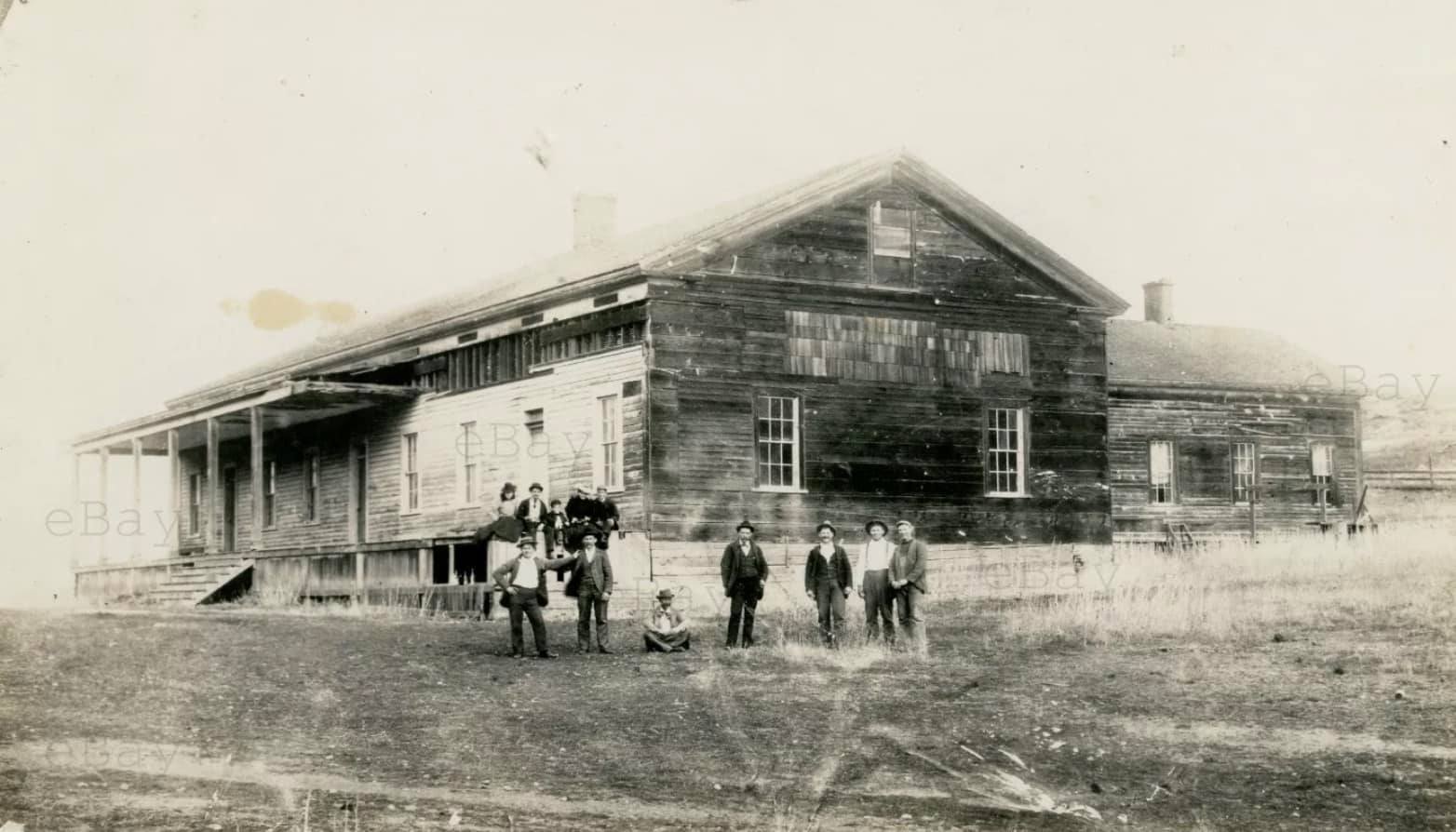
This was the Civil War barracks for Union soldiers at Two Harbors/Isthmus on Catalina.

At the time, about 100 people lived on the island, mostly miners and ranchers, with some being evicted to the mainland. Another reported reason for the occupation was to thwart any Confederate attempt to take over the island. After World War II, the barracks were converted to the Isthmus Yacht Club.

Over the decades, many Hollywood movie stars and celebrities have visited the island or been seen off the coast in their palatial yachts. Among the most frequent visitors back in the day were Charlie Chaplin, Humphrey Bogart, Errol Flynn, Clark Gable, Johnny Weissmuller, Bette Davis, Joan Crawford, Norma Shearer and John Wayne.

But one future star actually lived on Catalina. Before she became Marilyn Monroe, Norma Jean Dougherty, then 17, lived in an apartment in Avalon for less than a year while her first husband, James Dougherty, a merchant marine, was stationed on the island during World War II.

Dougherty recalled in his memoir that Norma Jean, although a dutiful housewife, “turned a lot of heads” among servicemen as she would walk to the commissary or to the beach. During one particular dance at the Casino, Dougherty said a sailor cut in on him and Norma Jean, then another, and eventually it seemed every soldier there wanted to dance with his wife. James shipped out to the Pacific in 1944, and their marriage ended two years later.

The future Marilyn Monroe lived on Catalina with her first husband.

Spring marked the arrival of Wrigley’s Chicago Cubs Major League Baseball team, which trained on the island from 1921 to 1951 with the exception of the war years.

Some of the greats of the sport played there, such as Grover Cleveland Alexander, Rogers Hornsby, Dizzy Dean and Hack Wilson. A young sportscaster, Ronald “Dutch” Reagan, was covering the team on Catalina when he lined up a screen test for Warner Bros. That led to the future president’s first movie role — playing a radio announcer — in the 1937 film Love Is on the Air.

Speaking of sports, the Catalina Island Country Club and Golf Course, built in 1892, is the oldest operating golf course west of the Mississippi River and the former home of the Bobby Jones Invitational.

No story about Catalina would be complete without addressing the mysterious death of Hollywood actress Natalie Wood that at one time occupied an entire wing of the Catalina Museum of Art and History. Wood gained fame co-starring with James Dean in Rebel Without a Cause, and later starred in Splendor in the Grass and West Side Story.

As of 2024, the 43-year-old case remained open and unsolved — with Wood’s husband, actor Robert Wagner, now 94, cleared of suspicion. Here are the basic facts.

The body of the actress, 43, clad in a long flannel nightgown, mukluk-style boots and a life jacket was found in the cold waters of Two Harbors on Catalina’s West end some 100 yards offshore on the morning of Nov. 29, 1981. Searchers had previously located the inflatable dinghy from the couple’s yacht Splendour.

Leading up to her death, Wood had just finished shooting the sci-fi movie Brainstorm when she and her husband, along with co-star Christopher Walken and boat captain Dennis Davern, took a Thanksgiving weekend cruise to Catalina.

Christopher Walken and Natalie Wood walked the shore of Catalina.

The couple and Walken had dinner and drinks at Doug’s Harbor Reef restaurant at Two Harbors on Saturday night, Nov. 28, with all three consuming a large amount of alcohol. After returning to the Splendour, Wood retired to the stateroom to sleep.

Walken and Wagner, meanwhile, began arguing, which was heard by other boaters in the area. There was speculation the argument centered on the friendly relationship Wood and Walken enjoyed that angered Wagner. But the pair “calmed down” and went to bed, according to Wagner.

At some point during the night, Wood went up on deck and never came back.

Wagner later said he believed Wood went topside because she couldn’t sleep due to the dinghy banging against the side of the yacht and fell in the water while trying to retie the dinghy to the cleat. The actress had a fear of the water, couldn’t swim, and had refused to do a water scene in Brainstorm.

Wagner said when he realized she had left the stateroom he went to look for his wife but couldn’t find her and noticed the dinghy was also missing. He contacted the Harbor Patrol, which was unable to find her, and then the Coast Guard joined the search.

Shortly before dawn on Sunday, authorities contacted Doug Bombard, who owned the restaurant the trio dined at and also was general manager of Two Harbors with extensive knowledge of the area. Bombard found the body, alerted by a red-colored “bubble” floating on the surface of the water that turned out to be Wood’s life jacket.

The Los Angeles Coroner’s Office originally ruled the death accidental drowning, but the case was reopened on the 30th anniversary of her death in 2011. No new evidence was found at the time to contradict the original conclusion.

Then, in a surprise announcement in July 2012, the Coroner’s Office changed the cause of death from “accidental drowning” to “undetermined.” The reason for the change was stated as being “some of the bruises on Wood’s body were inconsistent with death by drowning.”

Natalie Wood and Robert Wagner aboard their yacht Splendour.

In 2018, Sheriff’s Department Detective Ralph Hernandez declared Wagner a person of interest after interviewing witnesses who claimed Wood had been arguing with Wagner at the edge of their boat before she disappeared.

But in 2022, Wagner, who has long denied any wrongdoing, was cleared. “All leads in the Natalie Wood case have been exhausted, and the case remains an open, unsolved case,” Lt. Hugo Reynaga said.

My personal memories of visiting Catalina go back more than 65 years as a Boy Scout with Troop 2 in Santa Monica. We spent a week at Emerald Bay, canoeing, swimming and making crafts in the late ‘50s.

I remember hallowing out a piece of sandstone for my Scout neckerchief and affixing a seahorse to my Aussie-style straw hat. In later visits, I would snorkel in the bay, take in the sights of Avalon and journey to the other side of the island. To see the buffalo, of course.

Stewart Slavin returns to the mainland after a trip to the Boy Scouts campground at Emerald Bay.

(Editor’s note: Stewart Slavin, perhaps one of the gutsiest people to graduate from Palisades High School, made news even as he reported on it from the far corners of the globe. Slavin was the third editor-in-chief of the PaliHi student newspaper The Tideline in 1963-1964 before embarking on a career as a reporter, editor and foreign correspondent for United Press International. He is the author of two books With or Without Camel: Reporting from India, Atlantis, The Santa Barbara Jail and Memory-Go-Round — Ride of a Lifetime.)

Posted in History | 2 Comments

Commercial Building on Sawtelle Destroyed by Fire

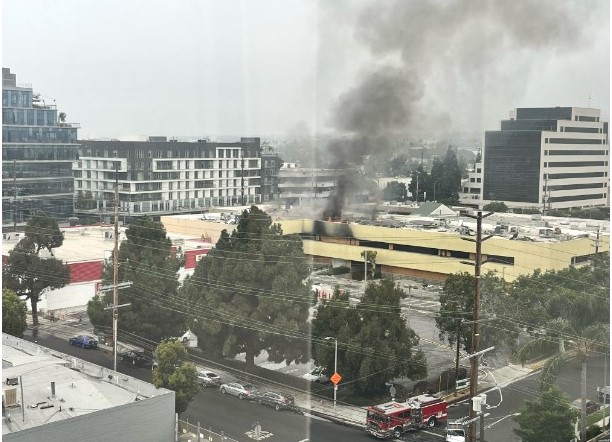
Andrew Wolfberg captured the beginning fire operations in the fire in the commercial building.

The Los Angeles Fire Department responded at 6:13 a.m. September 23, to a fire reported at a vacant and boarded 53,500 square foot two-story commercial building at 2050 S Bundy Dr.

Five hours later, LAFD reported “Well coordinated and methodical efforts continue to fully extinguish deeply entrenched pockets of stubborn flames throughout the building, the site of previous fires, that has sustained severe structural damage from today’s blaze. No injuries have been reported.

Firefighting efforts continued into Tuesday, and LAFD spokesperson Brian Humphrey said, “Stubborn flames are burning deep within the tons of smoldering debris created by the fire in the 53,500 square foot building.”

Humphrey said that “bulldozers and other heavy mechanized equipment are at the scene to assist in strategic demolition and physical hazard abatement.”

The firefighters worked to prevent the flames from spreading to other nearby structures, including a hardware store, Humphrey said.

“Though no injuries have been reported, and no escalating or off-site hazard identified, pursuant to protocol, an LAFD Hazardous Materials team and Department of Building & Safety inspector have assessed the location, and environmental officials have been notified of the firefighting efforts and controlled demolition related to the unstable structure,” Humphrey’s said.

Humphrey told KNX a homeless person was seen leaving the building, which had been vacant for a couple of years, but was not injured.

Station 69, which is part of Battalion 9, West Bureau, was also onsite helping fight the fire, which is still under investigation.

Station 69 firefighters were called on the help fight the fire.
Photo: ANDREW WOLFBERG

All lanes of Bundy Drive between Olympic Boulevard and LaGrange Avenue were closed until LAFD operations were completed.

One of the former tenants was Henry Radio. The property owner failed to secure or monitor its property. The fire resulted in road closures, a massive firefighting operation, and air pollution.

After a two-day fire the twisted steel is all that remains of a two-story commercial building.
Photo: ANDREW WOLFBERG

(Editor’s note: Are property owners fined by the City, if they have not secured their property or if the building have become inhabited by squatters? Not only is it uninhabitable for those living there, but a danger for the neighborhood.  This question was posed to Councilmember Traci Park’s office and if there is a response, the story will be updated.)

Posted in Accidents/Fires | 1 Comment

Money Sought to Restore the Temescal Canyon Mural

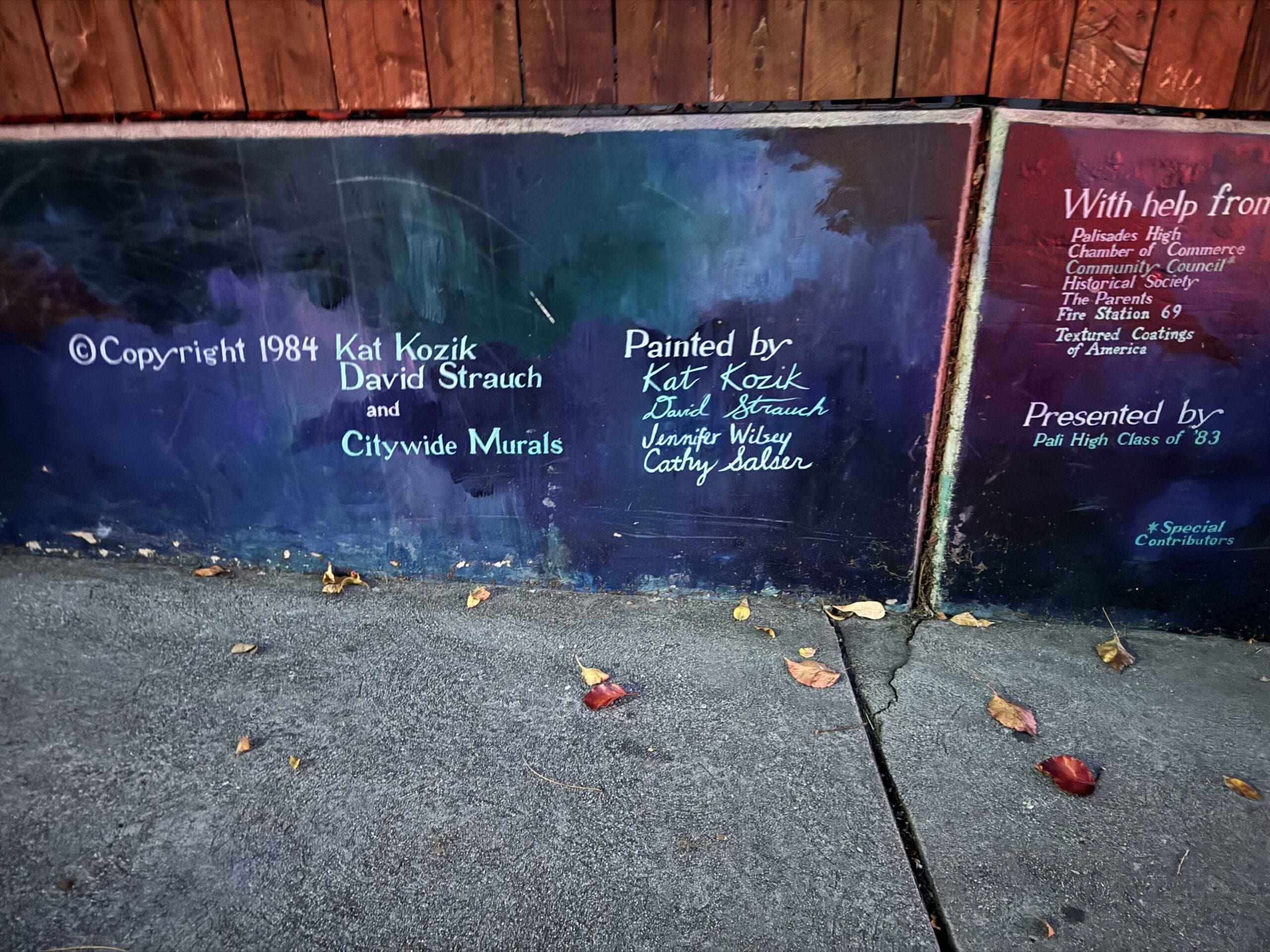
The Temescal Canyon historical mural needs to be restored.

Cathy Salser spoke to the Pacific Palisades Community Council on July 25 about the mural on Temescal Canyon Road that needs restoration.

To refurbish the nearly 500-foot mural across from the Palisades High School Stadium will cost about $105,000. So far about half that amount has been donated and all residents are invited to be part of the project.

In 1983, two Palisades High School students Kat Kozik and David Strauch received permission from the City of Los Angeles to paint a mural of the evolving history of Pacific Palisades, starting with its first people. Fellow students Cathy Salser and Jennifer Wilsey joined them.

The foursome and then Kozik on her own, painted the mural from 1983 to 1990.  The mural focuses on the land, animals and first people, and then shifts to a scene depicting the Milky Way, the cosmos and a trickster coyote leaping into the great beyond.

The Temescal Canyon Association sponsored a team of artists in 2002 and 2008, that included Terri Bromberg, Shirley Coleman and Merry Scanlon Ealy to restore portions of the mural.

Now Kozik and Salser have met with MuralColors co-founder Calros Rogel, who praised them because the original method they used was deemed the reason that the mural had weathered as long and as successfully as it had.

Now a mural wash and wet steam will be needed to remove the degraded urethane coating that was originally placed over the painting. The substrate will be repaired, and paint film will be reattached with mural gel.

The MuralColors team will repair peeling paint and areas of water permeation along fissures. That involves peeling back the paint film, cleaning the wall beneath and adhering the original paint film with a permanent gel adhesive.

A fundraiser campaign has begun and Salser said they are currently at $56,208 toward the goal. “Our donors so far include individuals and groups that contributed 40 years ago and some new donors,” Salser said. “We are so excited to welcome everyone to be part of this.”

Donations are tax-deductible and the link to donate online is: awbw.org/temescal

To support via check: make payable to: AWBW, Memo line: TCMP, and mail to: TCMP, 15332 Antioch Street, # 302, Pacific Palisades, CA 90272.

Posted in General | 1 Comment

Crazy Horse Monument Still Being Sculpted

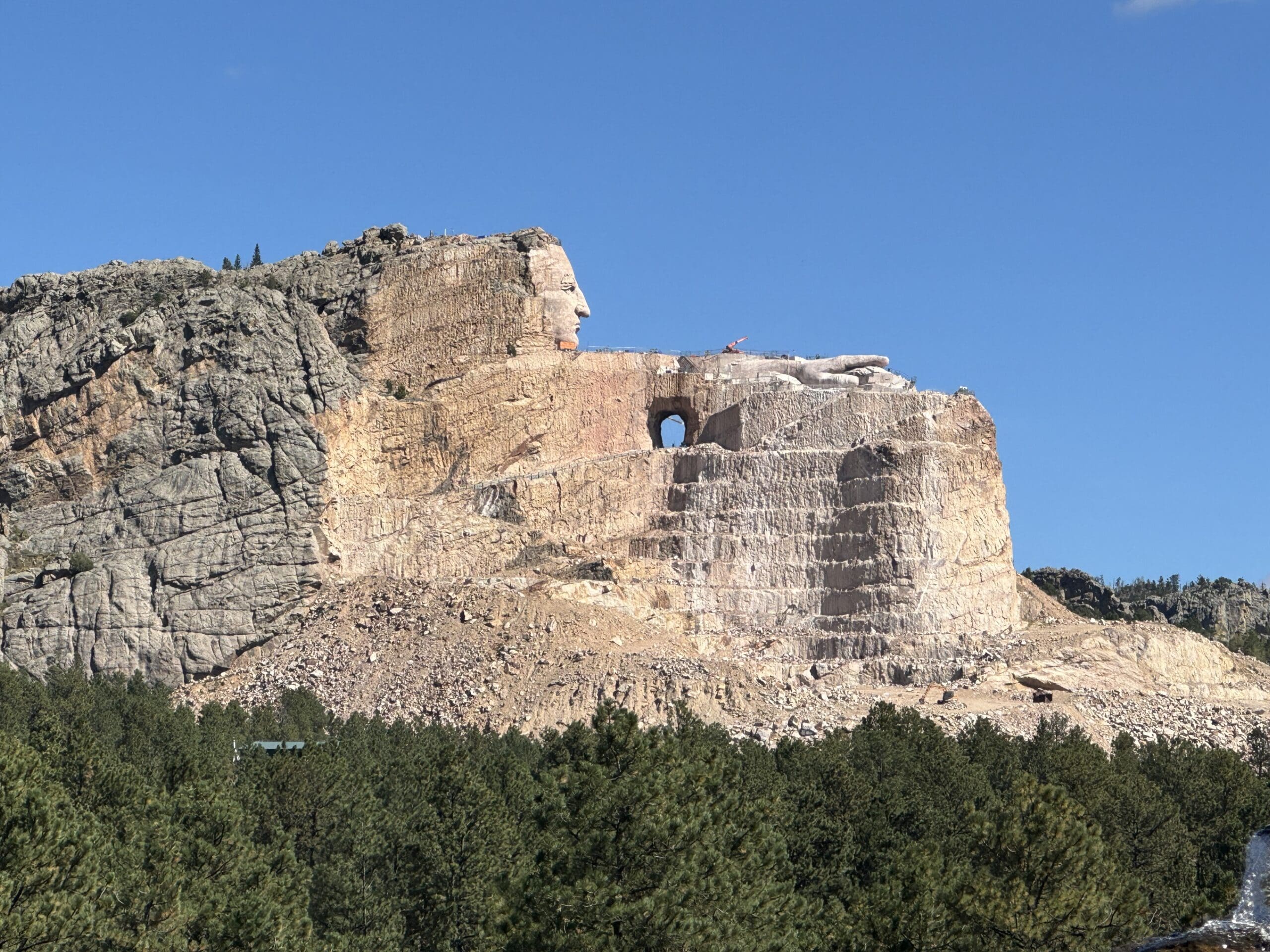
The fingers have been carved on the Crazy Horse Monument outside of Custer, South Dakota.

“My fellow chiefs and I would like the white man to know that the red man has great heroes also.” Chief Henry Standing Bear

The giant sculpture in a mountain that began in 1948 and is ongoing started with Chief Henry Standing Bear, a Brule Lakota. Born in 1874, he was one of the first natives to attend Carlisle Indian School in Pennsylvania where he took the  name “Henry.”

He realized that he would have to learn the non-Native ways to preserve his culture. After Carlisle, he attended night school in Chicago, while working for the Sears Roebuck Company to pay for his schooling.

Eventually he would work with the South Dakota State Senator Francis Case and was a member of the South Dakota Indian Affairs Commission.

He led the initiative to honor President Calvin Coolidge with a traditional name, “Leading Eagle.” At that naming ceremony he challenged President Coolidge to take up the leadership role that had been previously filled by highly-respected leaders such as Sitting Bull and Red Cloud.

As Mount Rushmore was being built from 1927 through 1941, Standing Bear wanted a memorial for his relative Crazy Horse. He wanted it carved in the scared Paha Sapa (Black Hills). At one point, the chief even approached Guzon Borglum, who carved Mt. Rushmore to advocate for a Native American addition to the faces.

He finally found an advocate with prize-winning sculptor Korczak Ziolkowski.

As a young man, Ziolkowski lived in several foster homes, before he became an apprentice patternmaker in the Boston shipyards.

In 1932, he used a coal chisel to carve his first portrait, a marble tribute to Judge Frederick Pickering Cabot, a famous Boston juvenile judge who had befriended and encouraged Ziolkowski.

Moving to West Hartford, Conn., Ziolkowski launched a successful studio career doing commissioned sculpture throughout New England, Boston, and New York. At age 34, he volunteered for service in World War II. He landed on Omaha Beach and was later wounded.

He accepted the invitation from Standing Bear to carve the monument in the granite of Thunderhead Mountain. On June 3, 1948, the project began with a dedication ceremony with the understanding that the memorial would serve to create cross-cultural understanding and to mend relations between Natives and non-Natives. Five survivors of the Battle of the Little Bighorn attended that ceremony.

This is a 1/ 34 scale model of  how the sculpture in the mountain will look when completed.
This editor’s mother and sister accompanied her on the trip.

Ziolkowski worked on the project until his death on October 20, 1982, at age 74. During his nearly 36 years of working on the Mountain, he refused to take any salary at Crazy Horse Memorial®. He is laid to rest in the tomb that he and his sons blasted from a rock outcropping at the base of the mountain. He wrote his own epitaph for the tomb door and cut the letters from steel plate.

KORCZAK Storyteller in Stone
May His Remains Be Left Unknown

Those growing up in South Dakota have watched the mountain, located outside of Custer, South Dakota, gradually being carved. This editor’s father in the 1970s said it would never be completed in his lifetime, and now this editor feels similarly, although the arm on the structure is now taking shape, a portion of the hand was carved.

The memorial, which had become a family project, is privately funded and takes no government dollars, state or federal. There is an entrance fee to go to the large cultural center that includes a museum, Native American artifacts, gift shop, the Laughing Water Restaurant and a visitor’s center.

The woman in green won the hoop dancing contest one year, which has only recently allowed women to compete in what used to be strictly a man’s dance. “I won it and I was wearing a dress,” she said.


The Memorial is located at 12151 Avenue of the Chiefs Crazy Horse, SD 57730-8900. (605) 673-4681.

Posted in General | 4 Comments

What’s Old Is New . . . Politically Speaking

Former President Donald Trump faces Vice-President Kamala Harris in the 2024 Election.

By HENRY KAMER

Deeply divided political parties, national tension, name calling and the question of whether or not there will be a peaceful transfer of power. Sounds like the upcoming election, right?

Not quite. I’m actually referencing the election of 1800, when Thomas Jefferson, a Democratic-Republican, defeated John Adams, the incumbent Federalist president.

The upcoming election bears a lot of resemblance to the election of 1800. Political tensions then between the Federalists, led by John Adams and the Democratic-Republicans, led by Thomas Jefferson were at an all-time high, very similar to the polarization in the Democrats and Republicans today.

National tension was extremely high as politicians and citizens alike disagreed on topics like interpretation of the Constitution, the use of slavery, and how big the federal government should be relative to the states’ governments. Compared to today, that’s two out of three.

Incumbent president John Adams had passed the Alien and Sedition Acts in 1798 which allowed for the deportation of any foreigners deemed suspicious. Of course, the foreigners in question were the French, the Scot-Irish and the Germans.

Today all these groups are well-integrated into the American fabric but the current anti-immigrant sentiment seems to stem from countries south of the border, especially Mexico. This wasn’t a problem in 1800 as sovereign Mexico didn’t exist and the United States didn’t include the land west of the Mississippi River.

Like today, discourse between parties wasn’t always civil and could often digress into name calling. In the election of 1800, Alexander Hamilton betrayed Aaron Burr, the man who tied Thomas Jefferson and through a long series of voting through the House of Representatives became vice president.

Hamilton thought Burr was the most unfit man to run the country and labeled him as an “embryo Caesar.”

Without quoting any of the ways the current candidates describe each other, I’d say we haven’t come very far.

After the events of January 6, 2021, many have wondered if there will be a peaceful transfer of power after the upcoming election. In 1800, the election results of switching the power from the Federalists to the Democratic-Republicans established the important precedent that the executive seat could switch between political parties without completely ending the world.

This was the second time the United States had a two-party election. Additionally, people voted for only the president in these elections, and whomever was runner-up would become vice president. You could have a split-party ticket for president and vice president.

Luckily it was ended in 1804 by the 12th Amendment which required separate tickets for president and vice president.


To be able to vote is a privilege that should not be taken for granted. The people in colonial America didn’t get to vote in Parliament or even have representation and look where that got them. King George III wasn’t very happy with that one.

Moving onto this upcoming election, which is rapidly approaching, remember that voting is important and is your voice in deciding how the government should work, locally and nationally.

I don’t have the privilege of voting yet, which is why I’m using this article to urge all of you who do have it to exercise your privilege to vote. So, when you go to make your voice heard on November 5th, be proud and remember no matter the result, we are all still Americans.


Posted in General | 1 Comment

Class of ’64 View Remains of Yacht Fire

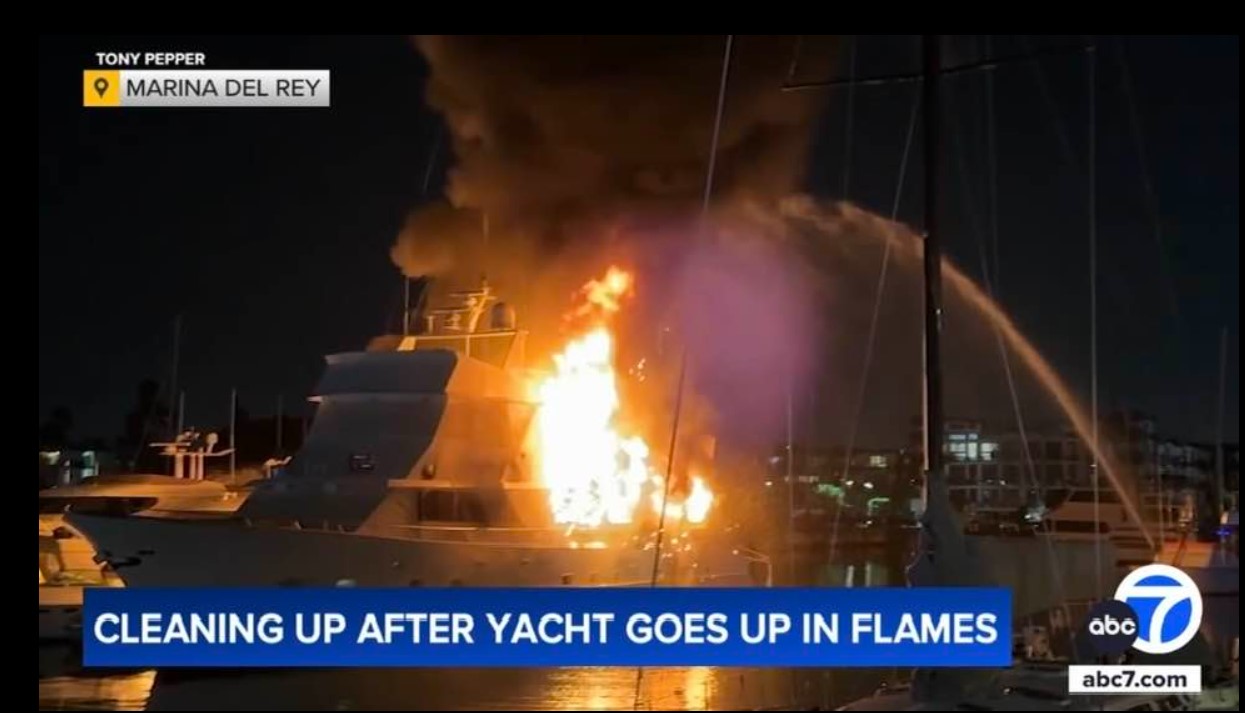
This is the remains of the yacht after the fire, as viewed by the Class of ’64.
Photo: WENDY PRICE ANDERSON

By STEWART SLAVIN

The Palisades High School Class of 1964 Spartans went on a reunion dinner cruise on September 20. That evening they saw the spectacular aftermath of an explosion and fire that occurred two nights before aboard a 100-foot yacht docked at Marina del Rey.

“We saw it while sailing, twice in fact,” Wendy Price Anderson told this reporter. “It was kind of a highlight of the cruise.”

Investigators said they are trying to determine what caused 1,000 rounds of ammunition and fireworks aboard the luxury yacht to explode. Two people were on board the vessel when the fire ignited, but both were able to get off safely, according to CBS News.

Crews spent the night extinguishing the fire with water and foam while also trying not to sink the boat. The yacht was partially sunk in the water, lying on its side. No other boats in the area were damaged.

By Friday morning, 2,000 feet of boom were installed around the area as crews coordinated with the Oil Spill Response Organization to assess the extent of impact.

The explosion lit up the Marina when the fireworks aboard the $1 million yacht started going off just after sundown Wednesday. Residents reported hearing multiple explosions and then seeing the yacht shrouded in flames and smoke. “It looked like there were a lot of fireworks going off,” one local resident said. “It lasted about 10 minutes before the whole boat went up in flames.”

Los Angeles County firefighters said it was a challenging blaze to fight because you couldn’t drive fire engines into the narrow docking area to put it out. If the fireworks weren’t enough, fire personnel learned ammunition was also on the vessel and responders had to use extreme caution as they approached the yacht.


Posted in News, Schools | Leave a comment