
(Editor’s note: This story first appeared in the Westside Current on February 18 and is reprinted with permission. Because of the sensitive nature of these issues, all last names have been withheld. )
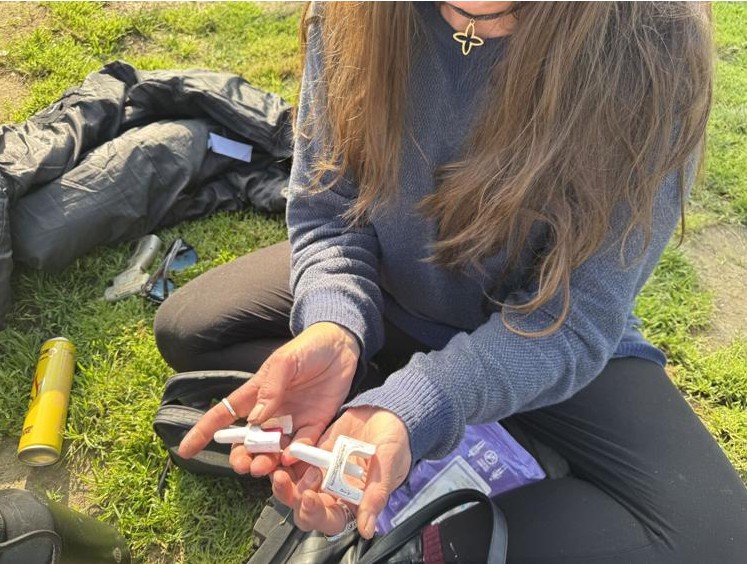
A woman shows a used Narcan nasal spray.
BY RACHAEL GAUDIOSI
When Hailey and Chandler agreed to move 2,000 miles to California, they said they were sold a dream, a couple’s drug recovery program that would be covered by insurance. Less than six months later, the Westside Current met the young couple crying in a McDonald’s parking lot — desperate to find a way back to their families in Alabama so they wouldn’t have to spend the night on the curb.
Over the past five years, the Westside of Los Angeles has become a hub for out-of-state drug recovery. In many neighborhoods across the county, Southern license plates and accents are not uncommon. Residents told the Current they quickly pieced together that many of the newcomers were walking back and forth from the same cluster of addiction recovery centers.
As neighbors watched people walk the same routes day after day, some said they began to recognize familiar faces turning up on the street after they disappeared from those houses. When residents asked the individuals what happened, they said the same explanation kept coming up — people recruited from out of state for treatment, then left stranded on the street when their insurance coverage ran out.
Hailey and Chandler said they were messaged on Facebook and asked if they wanted to come to California and get treatment for methamphetamine and marijuana addiction by the beach at no cost. The couple said they jumped on the offer, switched their insurance providers to join, and hopped on their free flight across the country.
“The place was a joke, if I knew the program was going to be run that way I would’ve never even come.” said Chandler. “We do nothing during the day and most of the people here just go over to MacArthur Park to do drugs.”
The couple claims to have then spent their days getting to know roommates and the West Coast surroundings in between detox, Zoom treatment sessions, and drug testing — until, they said they were told their insurance coverage had maxed out and they needed to leave immediately.
With no return bus or plane ticket back to Alabama and not enough money to purchase one themselves, they said they were stranded and homeless halfway across the country.
Despite moving thousands of miles to Los Angeles with the promise of a better life, Hailey and Chandler said they now found themselves worse off. Two people who came to Los Angeles with a promise of drug treatment ended up in a fast-food parking lot trying to figure out how to get back to Alabama before nightfall.
This is not an isolated case.
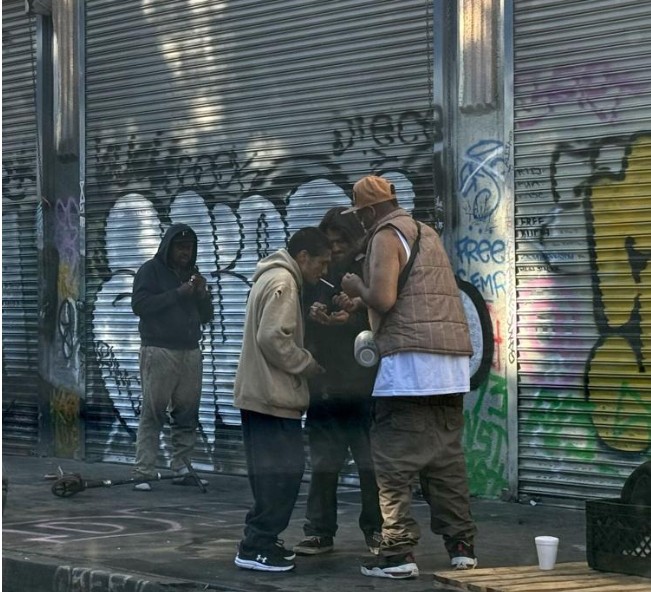
A group huddles on a sidewalk outside shuttered city storefronts, a snapshot of the street-level drug activity Angelenos say has become routine.
Angelenos across the Westside have said they’ve watched versions of the same story play out again and again — out-of-state clients cycling through addiction treatment programs, then turning up on the street when the program ends.
HIGH COST, ZERO HELP
In a similar fashion to a college campus, some addiction treatment centers will transition multiple lots in the same neighborhoods into different levels of care and housing. “Druggy Buggys” or white vans drive the same short circles all day, transporting people and meals from one facility to another. Patients like Hailey and Chandler describe free rein between all buildings, with the pair claiming marijuana was allowed to be smoked and MacArthur Park could be visited.
In a similar style to Hailey and Chandler, Vicky and Josh from Mississippi said they were sold a dream on Facebook to come and get sober for free by the beach. They said they quickly agreed to have their insurance coverage switched to California providers and grabbed their free tickets to the West Coast.
Before being denied further coverage and evicted from her eighth treatment center in the county, Vicky claims to have been bounced around across a various network of facilities in Sherman Oaks, Santa Monica, Culver City, Del Rey, and San Pedro — at absolutely zero cost to her.
While Vicky paid little to no cost, her insurance was billed for about $300,000 for services related to her addiction treatments. Shortly after Vicky discovered she was pregnant, her insurance provider deemed her as ‘recovered’ and the facility she was staying at literally kicked her to the curb. Josh billed up a similar amount before he exhausted his insurance and said he was helped to switch to MediCal so he could continue treatment. Josh has since been billed for $27,000 on the California taxpayers’ dime.
After this hefty cost and county tour, the young couple described minimal to no actual treatment or supervision for their substance issues, and now found themselves pregnant and struggling to find a bed to sleep in each night.
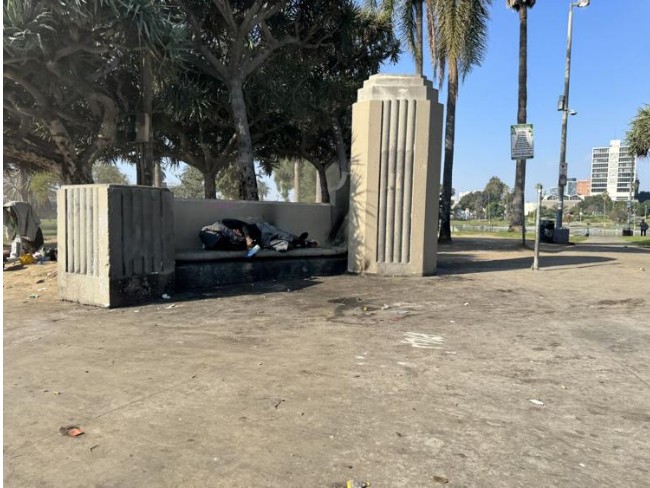
A person sleeps on a concrete bench in MacArthur Park, one of the scenes residents told the Current they’ve watched on repeat.
Under California State Law AB919, Hailey, Chandler, Vicky, and Josh all should have been offered a return ticket for up to one year following their discharge from treatment. But both couples, alongside an increasing number of individuals, are claiming this is becoming a more and more frequent case.
John Alle of the Santa Monica Coalition said the community group has personally sent home over 100 out-of-state homeless individuals since the start of their A.I. reunification program less than one year ago.
BIGGER THAN THE WESTSIDE
This issue is not new either. Four years ago, the Department of Justice filed criminal charges against 10 defendants for kickback schemes at substance abuse treatment facilities in Orange County.
“These cases reflect the continued efforts of the Department of Justice to combat fraud by substance abuse treatment facilities and patient recruiters,” said Assistant Attorney General Kenneth A. Polite Jr. of the Justice Department’s Criminal Division in 2021. “These schemes take advantage of vulnerable members of our society — addiction patients seeking help. These cases illustrate the government’s commitment to protecting patients and prosecuting those who try to victimize them.”
But the issue has continued to spiral out of control next door in Los Angeles unchecked.
Sean, who worked for an agency that helps place people in recovery treatment, said he noticed a trend of certain facilities in Los Angeles that he felt uncomfortable referring clients to. In Sean’s official position as a “business consultant,” he would receive calls or messages about people ready to enter treatment. Sean would read their files and figure out which facility they would fit best in, and then recommend placement.
But, Sean noticed he started to receive pushback when he would try to place patients at facilities that “did not have a high referral rate.” Sean said he was told to push more referrals to other facilities because those were more likely to send back new referral patients — this was what mattered most, not the best fit for care.
Sean said this process made him increasingly uncomfortable, so he started to look into the facilities more deeply. Sean said shortly after this, he was fired for a reason he believes has to do with the searches he was running in the system on the facilities he thought raised red flags. Before he was fired, Sean searched the total referral rate for the facilities he felt most uncomfortable with. He quickly noticed one company was accepting patients at nearly 100 times the rate of all others in the network — the company he believes is likely tied to the one Hailey, Chandler, Vicky, and Josh traveled across the country to come to.
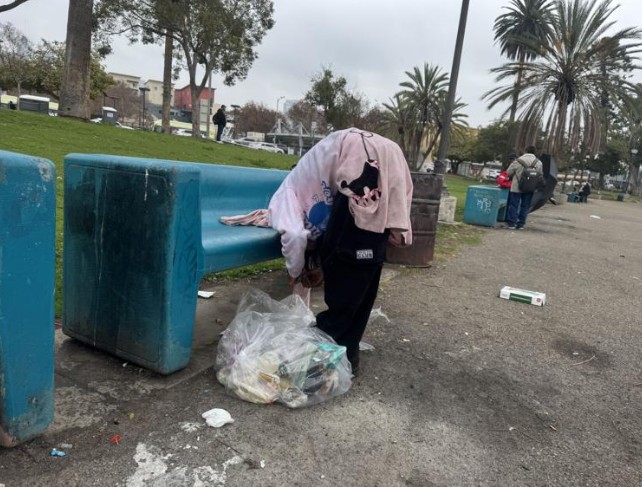
A person bends over a plastic bag of trash beside a MacArthur Park bench, underscoring the day-to-day instability former treatment clients say they face after being cut loose with nowhere to go.
CAN THIS BE STOPPED?
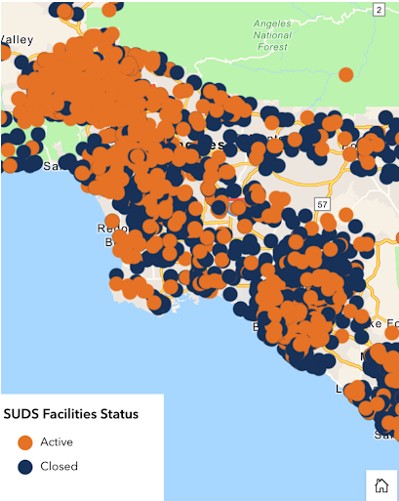 In total, Los Angeles has 909 active substance use disorder facilities, many located in clusters at the center of residential neighborhoods. A large amount is also operating using the same techniques that left a pregnant woman out on the street 2,000 miles away from home.
Locations of substance use disorder treatment facilities clustered across Los Angeles, as shown in a county map.
The city is taking some steps to work towards regulating addiction treatment centers in terms of density, with a motion currently going through the legal process to regulate the distance between each addiction treatment facility in Los Angeles. But even if the motion is passed once it returns from committee, it’s unknown what will happen to the facilities already in place within close distances to each other.
“Any service provider that brings people to Los Angeles for treatment and then abandons them onto our streets is irresponsible and unethical,” said Councilwoman Traci Park. “That is not recovery — it’s neglect. Los Angeles should never be a dumping ground for out-of-state programs that fail to see their clients through.”