
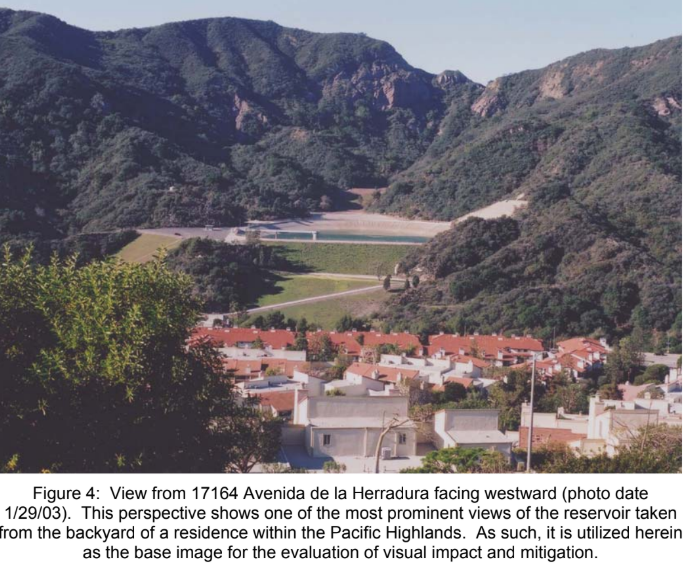
This photo and caption were taken from a 2003 DWP Report.
The Santa Ynez Reservoir, which holds 117 million gallons of water on 9.2 acres, was originally constructed following the Bel Air Fires as source for fighting wildfires. It was designed to allow aerial firefighting helicopters to “dip” their snorkels directly into the water (before the floating cover was installed). It was completed in 1970.
The reservoir cover would come 42 years later.
At a November 24, 2004 Pacific Palisades Community Council meeting residents were told by Norm Kulla (Councilman Bill Rosendahl’s District Director) that “There are two reasons for the reservoir cover, which is expected to cost $3 million: security (reducing the possibility of vandalism or terrorism) and to preserve the quality of the water when the planned chemical switch is made from chlorine to chloramine (a mixture of chlorine and ammonia), to treat the water.”
Glenn Singley, DWP’s director of water engineering when asked about emergencies, such as brush fires, said “arrangements would be made to also use the Chautauqua reservoir.”
Paul Shakstad, chief pilot of L.A.Fire Department’s air operations, pointed out that “‘grading needs to be done’ to accommodate the larger Erickson snorkel-equipped firefighting helicopters at Chautauqua (on a ridge between Temescal Canyon and Rivas Canyon). ‘And it is absolutely imperative that we have an adequate water supply. We need a hydrant and some kind of cistern,’ which would allow a helicopter to fill up in less than two minutes.”
The PPCC minutes reflect “When Singley offered to have a 3,000-gallon cistern placed on-site when necessary, Shakstad objected, saying ‘that would take too long.’ He suggested instead that a storage tank be permanently stored there with high-pressure pumps. Singley agreed and will meet with LAFD’s air operations unit and Bob Cavage of the Palisades community advisory committee in the next few weeks.”
Circling the News read the 2003 105-page Santa Ynez Reservoir Water Quality Improvement Project report regarding the cover. Page after page details aesthetics, agriculture, biological (plants) culture, and geology environmental impacts. There is only a small mention about fires if the reservoir were empty, on p. 37. When the question is asked if an empty reservoir would “Expose people or structures to a significant risk of loss, injury or death involving wildland fires, including where wildlands are adjacent to urbanized areas or where residences are intermixed with wildlands?”
The reports conclude “Less Than Significant Impact,” and noted that during constructionthe existing reservoir would be drained of all water, thus reducing the available supply of surface water for fighting fires (i.e., for use by firefighting helicopters) in the local area, which may potentially increase risks to people or structures from wildland fires.” The report specifies that other surface water sources exist in the vicinity of the proposed project site (e.g., Pacific Palisades Reservoir [approximately 3 miles east of Santa Ynez Reservoir] and Santa Ynez Lake [approximately 2 miles south of Santa Ynez Reservoir]) that could be utilized for firefighting purposes in the event of a wildland fire during construction activities.
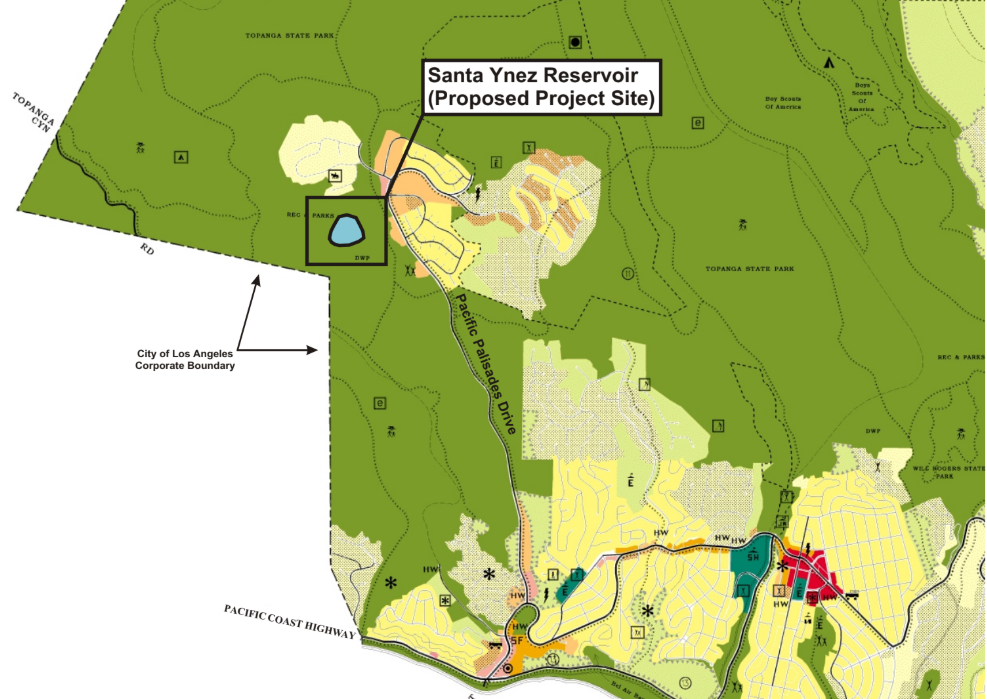
This map was included in the 2003 DWP report that barely mentioned the Santa Ynez Reservoir was used for fire-fighting.
During the Palisades Fire, the Chautauqua (Palisades) Reservoir was also empty (drained in June 2024). And now DWP wants to drain the Santa Ynez Reservoir again, because of a torn cover.
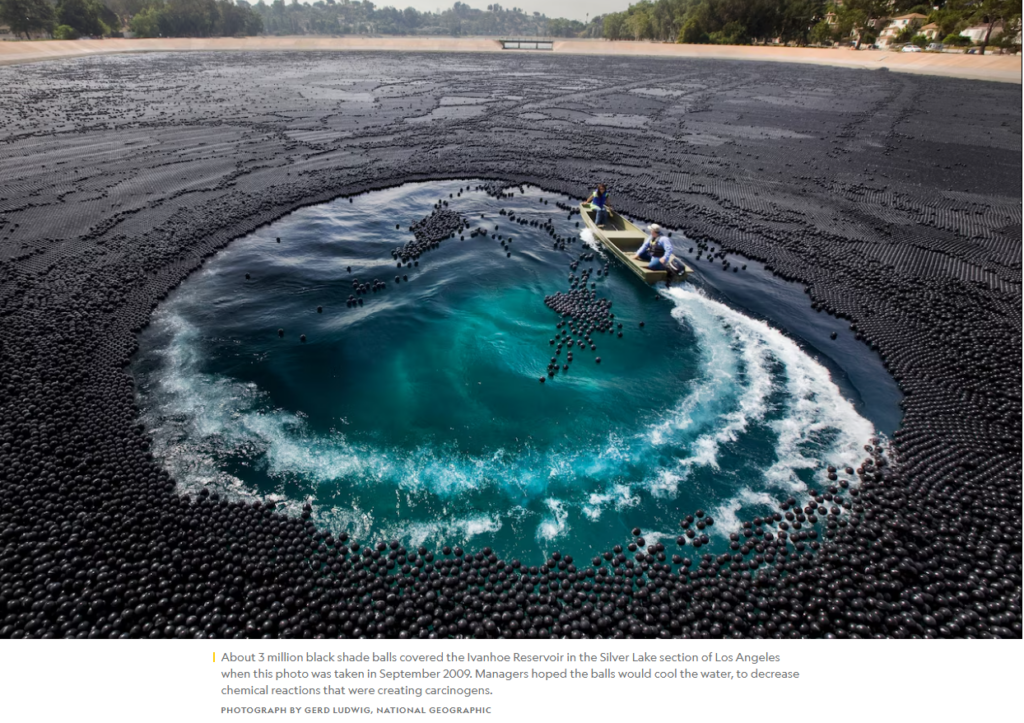
One resident wrote CTN “I’ve been thinking about the debacle of replacing the ripped reservoir cover and remembered a few years back LA deployed millions of black plastic balls Why Did L.A. Drop 96 Million ‘Shade Balls’ Into Its Water? | National Geographic, to actually do the same thing. I wonder why this has not been considered?”
Four-inch black plastic balls were placed Silver Lake, Elysian Reservoir and Upper Stone Canyon. Made of black polyethylene, shade balls are filled with water so they don’t blow away. A coating resists ultraviolet light and degradation. The manufacturers say balls last about 25 years.
Currently only LADWP’s Van Norman Complex in Sylmar is the only one remaining with shade balls. That’s because a cover there would have cost $300 million. Balls were removed because federal regulations require reservoirs containing treated drinking water to be covered — and shade balls don’t count. click here.
CTN contacted DWP to inquire the cost of a new cover and if balls had been considered. It seems that only the drinking water question has been considered and the firefighting has not. When a response is received this story will be updated.
(On January 13, DWP responded “Thanks for reaching out about the shade balls. In answer to your question: The shade balls were not evaluated because they do not meet regulatory requirements to ensure that treated drinking water is fully protected.” CTN asked “Given the high fire potential for this area, why would they not be considered?)
DWP MEETING WEDNESDAY:
A Los Angeles Department of Water and Power virtual town hall will be held from 5 to 6 p.m. on Wednesday, January 14, to discuss updated on the Santa Ynez Reservoir. To register click here.
Finally, accurate reporting. Thank you.
At the most recent PPCC meeting, Traci Park announced the SY Reservoir will be emptied again and there will be a meeting with LADWP and PPCC but date was unknown.
Anyone thinking that the SY reservoir was NOT built to fight fires in the Highlands, then look up the original LA City Planning meetings regarding the Original Deveolpment plans for the Highlands.
The Bel Air fire had just happened 10 years earlier, the planning commission could not get the Highlands approved without providing a water source for BOTH fire fighting AND drinking water.
Furthermore, the Highlands expanded up to the Enclave through the 1990s and early 2000s