
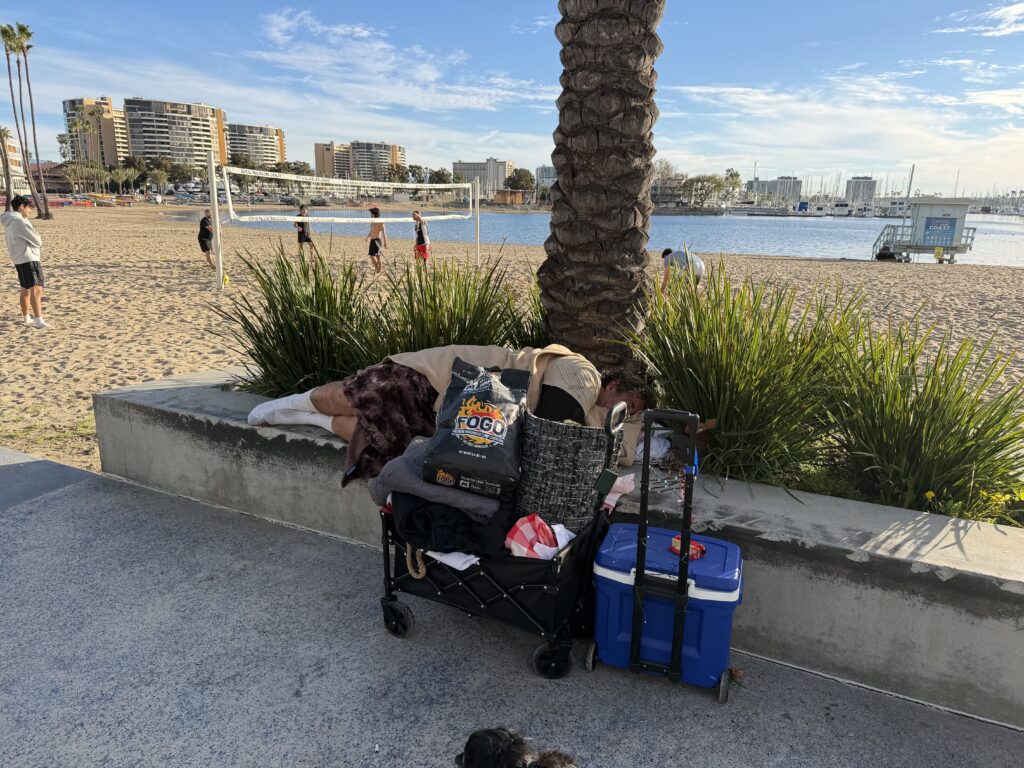
(Editor’s note: In a four block area, I counted five homeless on January 19, walking dogs in the Marina around 7:30 a.m. )
By TIM CAMPBELL
January 20 was the start of LAHSA’s three-day 2026 Point in Time (PIT) Count. According to a press release sent to the media, “The Count is an opportunity to reflect on the life-saving impact of our collective investments, the challenges we continue to tackle together, and the humanity of the homelessness crisis”.
We should consider the press release’s statement in terms of the Count’s spotty history.
According to an LAist article, the 2024 count was “complicated by policy changes at LAHSA, shifting guidelines and technical problems — with marked differences in how people were counted in the city of L.A. and in other areas of L.A. County.”
Another LAist article cited RAND as estimating the count could have undercounted the homeless population by as much as 7,900; more than the combined decrease in homelessness claimed by leaders in 2024 and 2025.
For years, LAHSA’s count has been plagued by missed areas, glitchy software, and an inability to empirically justify how it makes assumptions about the number of people sleeping in tents and vehicles.
In court testimony, a former LAHSA official called the count “smoke and mirrors.” Instead of the roughly 75,000 unhoused people LAHSA counts, a 2024 report from the Economic Roundtable puts the number as high as 139,000.
In reality, it is almost impossible to accurately count the number of unhoused in an area as large as Los Angeles County, because the homeless population, by its nature, is transient and people move from place to place.
Yet LA’s leaders continue to insist homelessness has declined based on the PIT count. They cite numbers that have been largely discredited by professional survey firms, questioned by other social researchers, and alleged to have been fixed by former managers. As with other inconvenient truths, leaders ignore or attack facts that don’t fit their narrative.
Yet San Francisco, which has also has a history of miscounting its unhoused population, has at least admitted its mistakes and is completely revamping its count, replacing undertrained volunteers with professional survey takers. Perhaps new mayor Dan Lurie’s focus on homelessness program reforms affected the decision, or maybe program leaders in The City have grown tired of using inaccurate data.
According to HUD, the PIT count should be used as a planning tool, directing resources to the most effective programs and the areas most in need.
Instead, LA’s leaders treat it as a public relations event, trotting out dubious numbers in carefully staged press events. The count has become just one more tool to be used to control the narrative about homelessness in Los Angeles. We need leaders who do more than just talk about reducing homelessness. We need leaders who will share the truth with Angelinos and make decisions based on facts. San Francisco understands that.
Is it too much to ask the same of LA’s leadership?
(Tim Campbell is a longtime Westchester resident and veteran public servant who spent his career managing a municipal performance audit program. Drawing on decades of experience in government accountability, he brings a results-driven approach to civic oversight. In his iAUDIT! column for CityWatchLA, Campbell emphasizes outcomes over bureaucratic process, offering readers clear-eyed analyses of how local programs perform—and where they fall short. His work advocates for greater transparency, efficiency, and effectiveness in Los Angeles government.)
The statements by the unnamed former LAHSA official and LA’s “leaders” highlight the basic problem with the whole homeless “industry”.
There’s a constant struggle between two competing groups who have their own self-serving agendas.
The non-profits and “activists” dispute the homeless counts and continue to demand more money.
The politicians use the lower counts to virtue signal and show how “effective” they’ve been in “solving” the homeless problem.
Tim’s summary is exactly right: “We need leaders who do more than just talk about reducing homelessness. We need leaders who will share the truth with Angelinos and make decisions based on facts.”