
(Editor’s note: At the weekly Hive meeting on Monday, the topic turned to the town’s library. Jimmy Dunne asked why does it have to be the same size and same layout? Why can’t we build something that puts Pacific Palisades on the leading edge that designs a new town space that takes us into the future. I asked him to pencil out his thoughts and he did.)
By JIMMY DUNNE
Dearest Palisadians,
Here’s a what if.
What if rebuild is too small a word? What if this is our chance to redesign the very idea of town?
Let’s talk about two of our most symbolic civic rooms, both burned in the fire.
Our town library. And our town theatre.
The library was our shared living room — where moms and kids wandered, where seniors lingered, where students studied, and where town events quietly stitched us together.
The Palisades Branch has been part of town life for generations; it opened at its current location in 1963.
Their “Daddy” is the Los Angeles Public Library System; we’re one of their 72 branches. They build it, control it, everything it. It’s theirs.
Led by Cameron Pfizenmaier, a fabulous Palisades group, “Friends of the Palisades Library,” has been wonderful helping hands at the library and raised local contributions.
And our town theater?
It was our creative hearth — the place where neighbors became artists — and the rest of us became the lucky audience.
In 1975, Lelah and Townley Pierson bought the land and built the theatre on Temescal, and then donated it to our town — so that live, local theater could have a permanent home.
Back to the library.
It was born in an era when “library” meant shelves.
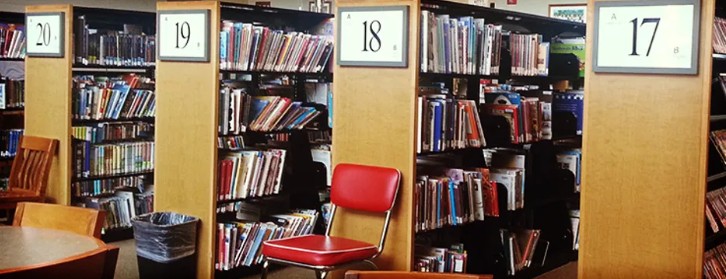
“11,500 square feet of books, media, and special collections.” A perfectly good 20th-century model. Here are shelves 17, 18, 19 and 20 in our library.
But today, if a kid wants to learn about a butterfly’s migration, Leonardo da Vinci, or how black holes work… they’re not reaching for World Book encyclopedias. They’re reaching for the internet — the biggest ocean of information humanity has ever created.
The old model assumes information is scarce — and that shelves are the solution. Not anymore.
The scarce resource is attention, mentorship, and a great place that draws people in.
So let’s say the quiet part out loud.
If our goal line is getting the most kids, teens, parents, and seniors through the doors, the honey isn’t “we’ll loan you a copy of Kafka.”
The honey is a place that feels alive — a town’s brain — connectivity, programs, information in every medium (including books), a cutting-edge civic stage, study rooms, indoor and outdoor gathering spaces… and constant alluring reasons to come back every week.
Now let’s talk about the theatre.
They’ve got an asset in the value of their building and parking lot. I’d guess $5 million.
In recent years, they’ve had a tough go of it to break even. Think about the model. Having shows maybe 150 nights a year, rehearsals on other nights. Completely dark, lots of nights. Generally, nothing is going on during the days.
Here’s the “what if.”
In this past year, we’ve all learned that the city has a very different agenda than we do.
To us, it’s a once-in-a-lifetime opportunity to reimagine a world-class town for tomorrow. Not the city. They’re trying to get something off their desks.
But what if, as a town, we said no?
Instead of them just building back what was there before, what if we stepped up, took ownership, and treated this as our one-time permission slip to build something truly extraordinary?
What if we told the LA Public Library System…
Curtain #1, we’ll raise a good chunk of the money. They partner with us to provide some services—but we’re the boss. We’ll build it with our architects, our ideas, and we’ll call the shots.
Curtain #2, they don’t give us anything. We fund it. We build it. We run it. It’s ours. No “Daddy.” No city baggage.
With either curtain, a wondrous place that celebrates the art of learning. Creativity. Belonging. Where intelligence, and imagination, and dreams reign.
And here’s the crown jewel.
We build something our town has always needed: a state-of-the-art town room — a true civic stage.
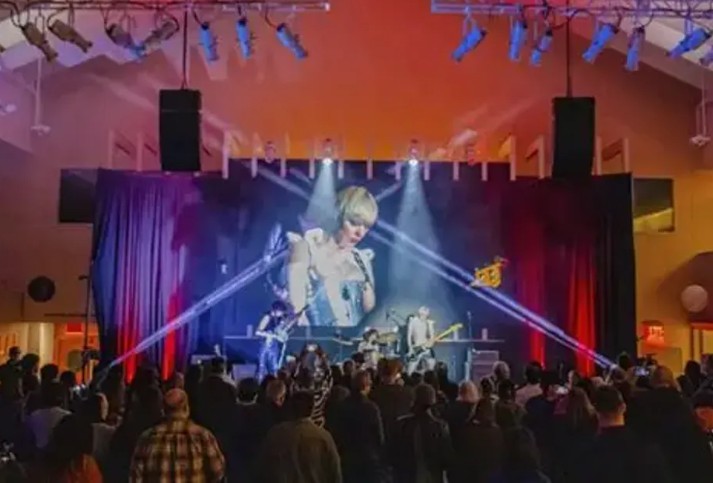
The public libraries in Westport and Boulder have community venues.
Picture this.
250–350 seats. World-class sound. A real stage for theatre, for “TED” talks. For musical performances. For town meetings. A digital backdrop screen that makes speakers, film nights, student performances, author events, debates shine. Livestream capability, too.
This isn’t fantasy. Plenty of modern libraries have become exactly this kind of community engine.
Westport, Connecticut, built a performance and gathering venue inside the library — the Trefz Forum — designed for theatre, lectures, performances, screenings, and civic programming.
In Colorado, Boulder’s public library includes the Canyon Theater—a community venue also used for every imaginable kind of town event.
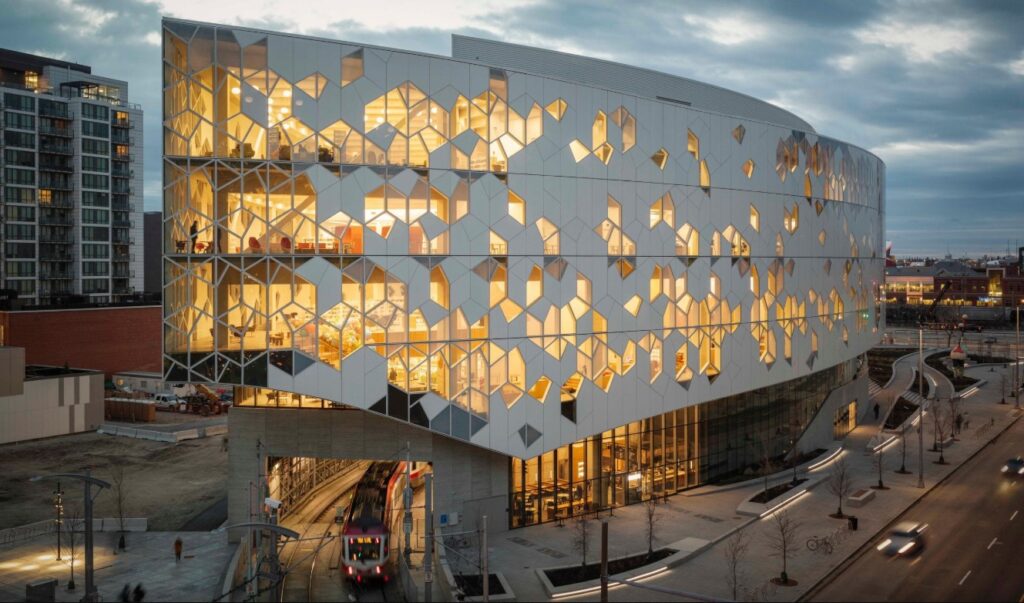
Here’s a forward-thinking library in Helsinki, Finland. They built Oodi as a literal living room for the city—complete with studios, maker spaces, and event rooms—because the modern library isn’t just where knowledge is stored. It’s where community happens.
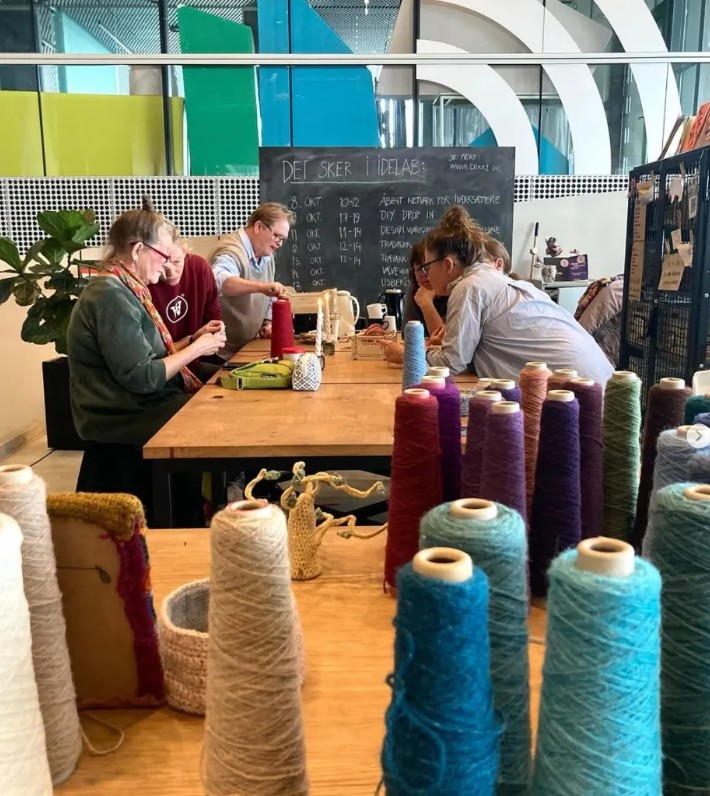
The library Finland is a community center, a living room for the city.
Let’s talk money.
What if the theater becomes a resident partner in this shared civic jewel — where it’s theirs for its theatre productions, rehearsals, and workshops… But, when they’re not using it, it’s a welcome home for all our grammar and high schools, and nonprofits, and town groups to use, too?
A shared stage is used more efficiently, cared for professionally, and supported more sustainably.
And when other groups use it, they contribute a donation or rental fee to help keep the whole place thriving.
Now everyone gets to swim in one fantastic, snappy pool.
I’d bet the ranch that in this creative, affluent community, which loves what their town stands for and believes in — this is a very fundable initiative.
It celebrates everything we value. Education. Community. Integrity and wisdom. Kindness. Belonging. Creating. Healing.
And we make it our own. Built for tomorrow, not yesterday.
A place that serves every age and every kind of curiosity: with an abundance of children’s books, plenty of treasured books, magazines, newspapers.
- Kids and families: storytime that feels like theater, reading nooks that feel like treehouses, “young inventor” corners.
- Teens: a real teen zone, study rooms, group rooms with screens.
- Adults: rooms with computers and printers, meeting spaces, “learn a new skill” workshops.
- Seniors: diverse book clubs, tech workshops, and—most importantly—a place to be included.
- Everyone: a robust calendar of year-round music shows, theater, salons, book clubs, knitting clubs, kids events, school performances — that becomes living proof of everything that’s unique and spectacular about the Palisades.
Here’s the exciting part. We’re all authors of this.
It’s a gift from all of us to every child, to every adult, every senior who calls themselves one of the kindest, most inspiring, precious words. Palisadian.
If this idea resonates, here could be first steps:
- A “Library and Theater of the Future” town meeting. One night in the gym, we clearly lay out what it will take. We decide if we’re a go.
- We jump in the pool. We create a great, ambitious team. Hire a fundraiser. Start lining up the ducks in a row to pick an architect, and design our dream.
We create something that is a mirror of all of us. Of our town. Of our hearts.
Are you in?
wonderful – literally I’d love to be a part of it.
Yes please!! I am so inspired reading this.
I love the suggestions in MODERNIZING the library and the theater.
That’s an exciting thought experiment about the library’s physical space! I’m particularly interested in Jimmy Dunne’s question about moving beyond the traditional size and layout. What kind of specific community programming do you think would be the *first* thing to demand a totally new design, rather than just repurposing existing rooms?
This is spot on. We need to bring as much creativity, culture, and imagination into our community as possible! A few years ago I went to one talk sponsored by Friends of the Library and it was brilliant, very interesting. But those were few and far between. We are surrounded by top notch educational and cultural institutions—major universities and museums—and we should be able to institute a regular speaker series, maybe harkening back to the Chautauqua days of the Palisades.
Also, there are towns that have community galleries or spaces, sometimes with big windows right onto their main streets, not hidden away (I know the Caruso project supposedly has a community room, but I never went to or heard of any events there). These are spaces where artists—groups and inviduals: painters, photographers, ceramicists, workworkers and so forth—can rent the space for a week for a very modest fee ($150 or so) and show and sell their works.
It is also VERY important that the community have input into the design of the library. The library that we lost could have been much better designed. Maybe there can be a design competition.
This is a great idea! I’m in!
Dear Jimmy and Sue,
You are showing us what creative leadership can provide for our whole community!
Sign us up!
Joe Hartnett and Dayle Hartnett, PhD
Yes, yes and yes!