Sea Life Dying in Massive Algae Bloom; Danger to Humans Low

Sick sea lions are washing up on the beaches. of Southern California.

By LAUREL BUSBY

Special to Circling the News

The most virulent and longest toxic algae bloom in Santa Monica Bay history is killing unprecedented numbers of dolphins, sea lions, and birds along the coast, according to John Warner, the chief executive officer of the Marine Mammal Care Center.

Compared to previous blooms, “this is by far the worst,” Warner said during a webinar of experts hosted by City Councilwoman Traci Park on April 22. Previously, the 2023 bloom was the most damaging, but “this is exceeding that on many fronts.”

At the beach, Warner noted that “what people are witnessing is really emotionally difficult to watch” with sea lions foaming at the mouth and aborting fetuses, while dolphins suffer seizures and die.

While some sea lions recover, “there’s no recovery for dolphins,” he said. “It’s mortality plain and simple.”

The bloom, which began in December, is releasing not only domoic acid but the more lethal saxitoxin, Warner said. Usually only one toxin enters the ocean in bloom, but the combination of toxins is particularly dangerous for sea life. The substances build up in the animals’ bodies not only through swimming in the ocean, but also through eating contaminated sea life.

Since the bloom began before the January 7 fire, it’s not yet clear if the fire and the subsequent toxic run-off increased the bloom’s severity, although it’s a possibility, Warner said. The Marine Mammal Care Center is testing blood, urine, milk, amniotic fluids, and fetuses from affected animals for heavy metals, pesticides, and alga toxins to try to determine the cause, while other experts were simultaneously testing the ocean water in multiple locations.

In addition to the algae toxins, Heal the Bay found that lead, chromium, and beryllium exceeded safe levels for marine life at multiple locations, according to Tracy Quinn, the organization’s chief executive officer. In addition, nickel and copper exceeded safe levels for marine life at Big Rock, while copper was also high at Temescal Canyon.

In order to determine whether humans might be impacted, Quinn said one challenge was understanding the prior levels of the varied pollutants in the ocean as well as safety thresholds for people. Heal the Bay’s previous testing checked for bacteria levels but not toxins from urban fire runoff, such as polychlorinated biphenyls, polyfluoroalkyl substances, polycyclic aromatic hydrocarbons, heavy metals, and benzene.

“No one is out in the ocean testing for these, so we have no health limits for them in ocean water,” Quinn said. “What are we going to compare this data to so we can understand the human health risks?”

Drinking water and fish consumption are two areas where established limits have been set, Quinn said, so Heal the Bay used those levels to determine areas of concern. Both polycyclic aromatic hydrocarbons and beryllium exceeded safety thresholds for fish consumption, but whether that might translate into a danger for swimming and surfing was not at first clear.

The organization reached out to the LA Regional Water Quality Control Board, which was also conducting testing of not only water, but beach sand. The board’s tests found that arsenic exceeded risk thresholds at all 14 of their water and sand sample sites, which stretch from Zuma Beach to Torrance. However, the arsenic levels were similar to normal background levels, so they weren’t higher than normal due to the fire, according to representative Jenny Newman. The board’s testing results are available at this link click here.

In terms of the levels of toxins in the water, “they seem to be going down slowly,” Newman said. “They were never at levels that exceeded human health standards, except the arsenic.”

Quinn agreed that the ocean should be safe for recreational use for four hours of water contact at a time for up to 120 days during the year.

“Humans are only in the water for a few hours at a time and potentially inhaling or ingesting in small quantities,” Quinn said in the webinar’s Q & A.

However, she recommended avoiding beaches between Carbon Beach and Santa Monica Beach at Montana, while also remaining 250 yards away from burns and debris removal areas.

Homes along the ocean were burned during the Palisades Fire.

In addition, the ocean should be avoided 72 hours after a rain and within 100 yards of a storm drain, she said. Since 327 houses were destroyed that sit within the high tideline zone, waves can easily wash their debris into the water, which makes swimming near them a poor idea. This pollution danger has made these homes a focus for the U.S. Army Corps of Engineers’ debris removal teams.


“We have higher levels at Santa Monica Pier and Dockweiler,” Quinn said. “Either the currents are pooling the contaminants in those areas, or maybe there’s another source that we hadn’t noticed because we hadn’t been testing for [these pollutants] before.”

Dr. Noelle Held, a USC professor, shared that nitrogen, which people often use in their gardens, can also precipitate larger algae blooms when it flows into the ocean. She recommended that gardeners avoid both artificial pesticides and fertilizers because of how the run-off from lawns and gardens can negatively impact the ocean.

Another potential issue stems from the contaminants bioaccumulating along the food chain, “which can make fish unsafe for people to eat.” About 180,000 anglers fish along the bay’s beaches, Quinn said. “We want to better understand the impact on the wildlife and the Angelenos who are fishing,” she noted.

A last difficulty is the expense of the testing. Quinn said that testing for this extensive variety of pollutants costs $3,000 per sample, not including the staff and gear costs. If residents would like to contribute to the effort, donations can be sent to either Heal the Bay click here or the Marine Mammal Care Center click here.

Posted in Animals/Pets, Palisades Fire | Leave a comment

“Our Town” Palisadians and Bocce Linked at the Heart


By JIMMY DUNNE

Photos: RICH SCHMITT

23,000 B.C.

Put about a thousand “Greats” in a row before the words “Grandma and Grandpa.” The year is 23,000 B.C.? A tad hairy, but they’re family. Picture ‘em enjoying a lovely sunset together, holding hands around a cracklin’ fire with their band of thirty more of your relatives and their best pals.

Maybe on the Tibetan Plateau, or in the Nile Valley of Africa. Maybe your peeps were in Beringia (cooking up a tasty woolly mammoth the teenagers speared that day).

Here’s what they all shared in common. When it was time to move on from their band’s cave, or their mud hut, or their bison skin tent—they just all filled up their trusty backpack with their favorite tools and treasures—and off they went, as a band, to the next charming spot down the way.

Here’s why I’m yapping about all this. Home—to them—was wherever they went. Town wasn’t the cave, or the beachfront hut property they interior decorated in a trendy “branches & leaves” style on the Red Sea.

“Town” was them.

That’s what mattered. Staying together. Figuring it out. They protected each other, shared with each other, comforted each other.

2025

Fast-forward 25,000 years and about a thousand romantic rendezvous later. It’s ten in the morning, under a clear baby-blue April sky—at temporary bocce courts on the lawn bowling courts at Douglas Park in Santa Monica.

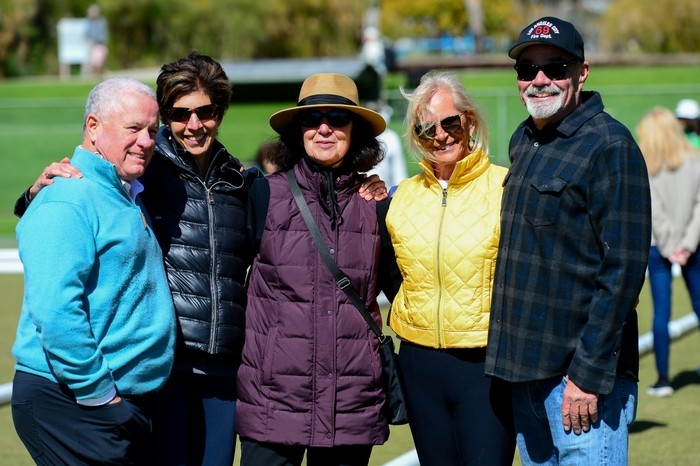
It’s kind of like an African prairie, but the grass was mowed. And not a single “lions, tigers and bears” in sight. Just a whole bunch of the most wonderful people, all there to play bocce.

Sort of.

All lived in the Palisades before the fire on that January night. Along with a thousand Palisadians, they played on a team together every week at Veterans Gardens at the Recreation Center.

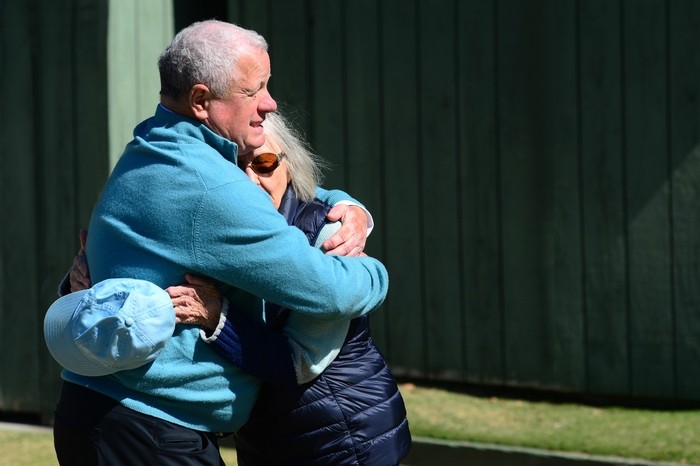
The reason I said “sort of” — is because they really weren’t there today to play bocce. They were there to be together. To hug each other. To share their stories and their worries and their challenges—and to hold the blanket of each other’s eyes. That’s why they come, every week, since the January 7 Palisades Fire. For that.

I was standing on one of the make-shift courts with everyone else. It was about an hour after we started, and I looked over about fifty yards away. I saw one of my favorite faces from our bocce days in the Palisades.

Pippa Orecklin. Tip-toeing into her seventies. A face where you see the childhood girl in her smile. They don’t make ‘em any better.

Standing by herself, Pippa was just looking over at so many of her friends in her bocce “band” from months ago before the fire. I saw her break down crying. By herself.

I went over to her and hugged her. She was weeping hard in my arms.


She told me she hasn’t been ready to go back to see the Palisades. How she had a very difficult surgery on the day of the fire—dealing with real health complications since the surgery.

And here she was. Looking at these friends for the first time. Remembering those feelings with all of them that they’ve shared. And realizing how she needs them now, more than ever.

I realized something in that moment.

Our “town” was right there on those courts. Town isn’t really about buildings, or homes, or stores. It’s about people. And something else I’ve learned.

What this word means…Palisadians.

One of the kindest, caring, beautiful, loving words in the world.

Our band will be back. Oh, we’ll be back. You can burn our buildings to the ground. You can turn our homes to ashes. But you can’t burn our town.

Our town is alive. And it’s more beautiful than ever. With a heart that’s pounding harder than it’s ever pounded before.

I dream of the days ahead. Seeing you. Hugging you. Many in new “huts and tents.” And we’ll all look up at that night sky, at the wonder of it all.

And know where the Palisades is. Right in our hearts. The most stunning home of them all.

(Editor’s Note: Jimmy Dunne is a modern-day Renaissance Man; a hit songwriter with songs on 28 million hit records; songs, scores, and themes in over a thousand television episodes and many hit films; a screenwriter and producer of hit television shows; award-winning book author; an entrepreneur—and a past Palisades’ “Citizen of the Year.” Reach out to him at j@jimmydunne)

Posted in Palisades Fire, Sports | 2 Comments

Reliving the Palisades Fire

(Editor’s note: Henry Kamer is a junior at Palisades High School and he was asked if he would share his remembrances about the Palisades Fire.)

This is the Kamer residence in the Alphabet Streets.

By HENRY KAMER

It’s shocking to see how much time has passed since the January 7 Palisades Fire, but how that time has still felt so slow. The feeling that the fires happened yesterday becomes familiar as life progresses and we are forced to, too. Every person’s account of the fires and their life through them are important to highlight and thoughtfully observe. After all, tradition and history are only recorded once an individual passes their stories onto the next.

Here’s my story.

My family, and our dog, had planned a trip for a few days to Santa Cruz to get out of the house and spend time together because my brother had come back from college in December.

On the morning of the sixth, we finally left the house around 10:30 a.m., taking the small, brand-new electric Audi, my mom had leased just a week earlier instead of my dad’s Jeep Grand Cherokee which was better suited for road trips.

As I volunteered to pull my mom’s old Audi into the driveway to put on the appearance that we were home in case of burglars, there was an annoyed and frantic mood in the atmosphere. It was further amplified by my accidental spilling of paint that was in the driveway.

After a quick drive to the Fed-Ex store on Via de La Paz, we were off. Eventually, after many rounds of taking turns driving (which was the first time for me since I had acquired my permit) and a crucial stop for lunch at In-N-Out, we arrived in Santa Cruz, exhausted and ready to settle in.

My mom forgot to check if the hotel was dog-friendly, sending us on another journey to find one that was. By then, it was dinner time and my brother was complaining as he often does (sorry Ben, I love you) so my dad chose to stick around with him while my mom and I walked through the city of Santa Cruz to find take out food. I still remember playing a historical chronology game, the NYT Flashback, while we waited.

On January 7 around 10 a.m., we walked downtown to scout out a breakfast place. We eventually decided on Mad Yolks, which would turn out to be a very fitting name. After eating our sandwiches and eggs, which our dog Wally enjoyed to the fullest, the three of us (my mom, my dad, and me) explored the city while my brother headed back to the hotel to join an online meeting for a possible summer internship.

Not long after we started walking, my phone began to blow up with messages. They were from the Track and Field group chat, and numerous people were asking what was going on while pictures of the fire – from the news and from Pali High and the Alphabet Streets – streamed through the chat.

The time was 10:37 a.m., just thirty minutes before the second of the spring break track practices were set to begin.

I remember feeling guilty as we walked for not being at track, but as I would quickly learn, practice would not be happening for a long time.

I shared the fire news with my parents, but we thought it would be out fairly quickly, just like the small burn that occurred on New Year’s Day in the Highlands; my dad and I had actually walked through the burn area to Skull Rock after that fire.

Boy, were we wrong.

As we spent the rest of the day in Santa Cruz and Carmel, the news of the evacuation and the community crisis began to reach us. My dad is a very active member of the community, and given that fact, he was alerted by city officials to help coordinate evacuation processes for those who were at high risk: the elderly, the disabled, and those who were adamant on staying.

We were trying to enjoy the beach in Carmel, while my dad was busy with the crisis. As we drove back to our hotel, I remember a family friend called. He and his family were in Thailand at the time and were extremely worried about what was happening in the Palisades.

We were too anxious to go to dinner. In the hotel room, we crowded around my dad’s laptop and watched our security camera footage.

A branch from a nearby tree had fallen and smashed my dad’s car, embers were everywhere but that would be the least of our worries. We all tried to reach out to any group that could help, from ABC7 to LAFD to my dad directly calling the fire leader covering our area, but to no avail.

As we continued to watch, we saw the fire grow closer and closer to our house. First the shrubs on the side caught fire, and then the embers started to get dangerously close to the house, and then it was over.

The security cam footage cut out along with other neighbors when the internet poles collapsed. We accepted that there was nothing we could do. A small sliver of hope remained, but that would quickly die.

I awoke the next morning, my family was already all up and seemed grim. I could immediately sense that our house was gone, but I didn’t know the extent of the damage. That would quickly be revealed to me as I saw or was shown drone shots depicting the devastation left in the Alphabet Streets as well as the attempts of a neighbor to salvage their house in the worst of the fire on January 7.

As soon as the realization seeped in, we all went into a stage of panic. We wanted to get out of Santa Cruz because the hotel was very cramped, but didn’t want to rush down to LA because there was no home to return to and the fire was still very actively raging. So, we made our way to San Luis Obispo, where we stayed for two nights.

We were still grappling with the whole situation, and the realization hit us in different stages and in different ways.

My mom got very sick for around a day while the rest of us just embraced each other as we dealt with our sadness and the unknown of what the future would bring.

We celebrated my dad’s birthday on January 9, watching a rocket launch from the roof of our hotel. So much had changed when we all viewed a rocket launch on December 31 from the Highlands.

We arrived back in LA on January 10. Our original plan was to stay in an Airbnb in the valley near the family, but after long and hard thought, we decided to unbook the Airbnb and instead went to my grandma’s (dad’s side) house in Brentwood. She was not there because my step-grandpa had fallen and broke his hip not too long before the fires. He was due for surgery in a few days, so she was staying in a hotel close to the hospital.

When we arrived at her house, it was hard to settle in, and we all were in flight-or-flight mode, especially me. Just as my dad and I were taking the few items of clothing we owned out of the washing machine, we received the alert to evacuate immediately from Brentwood.

We lugged wet laundry to the car and got out and drove to my grandpa’s house (dad’s side again) in Bel Air, where we spent the night.

It was great to be with family, but everyone was worried, constantly playing the news of the fire on the TV, which was definitely not healthy for my brother and me.

The next day, we visited a prospective house to rent, which was overrun with people from the Palisades. My mom saw multiple people she knew, including someone talking on the phone, who had a friend looking at the rental for them.

We were able to secure a temporary home in West Hollywood that belonged to one of my dad’s clients who was out of town.

I went to a friend’s house in Santa Monica for the night.. My birthday had been on the fourth, and I didn’t get to do the sleepover that was originally planned. Generously, my friend offered to host a birthday party sleepover, and we all had a great time.

Then my dad picked me up and took me to the house in West Hollywood, which was an inconvenient location but had beautiful views. We stayed there for more than a month.

I started a whole new life there: going online for Palisades High School classes; took my ACT test; failed my driver license test; and went to track practices in Kenneth Hahn State Park and West Los Angeles College. (Track practice is now at West Los Angeles College).

We moved to Mar Vista, where we will be until the end of the summer. Our good family friends who lived down the street from us in the Palisades, now live around the corner, and bonus, they have a pool! School is back in-person now at the old Sears building – and it is interesting.

When people asked how I felt after the fire, I told them I felt two sides of differing emotions and responses.

One side was filled with mourning and sadness as I remembered the life I was forced to leave behind. I’ve only ever lived in the Palisades, the same house since I was born.

However, the other side was filled with immense gratitude and acceptance. It took an event of terrible devastation like the fire to make me realize how insanely lucky and privileged I was to live in the Palisades. It looked like paradise to so many people, but to me it was just my everyday home, and I took that for granted.

I found the fire to be a necessary humbling and maturing experience, as it restored my humility and forced me to be grateful for what I had.

That is why after the fire I said to my mom: “I feel so fortunate.” So much love and support had been poured into me and my family from so many people. Everyone from family and friends to coaches (looking at you Coach Rolfe) to random people who were so kind.

It made me wonder what I did to deserve all of the love that I had received. That love is so necessary in times of crisis however, because throughout time, human culture and community have proved the only means of survival. We’re human. We all need each other and need to be kind to each other.

Posted in Palisades Fire | 3 Comments

Dust No More – Army Corps Took Care of It

Many may remember the overflow parking dust bowl at Will Rogers State Historic Park. For polo events, people had to park in a lot south of the field.  The Genesis Tournament also used that lot, as did other local events. But it was always a dusty, nasty mess, and a car always needed to go to the car wash after being parking there.

Today, it was different. There was a light mist that hit my face when I exited the car—because there were two mist machines. Men with hoses were focused on different debris piles and there was a water truck continually going over the lot.  “We use the wet method here,” said Colonel Jeff Palazzini. “There is a constant flow of water, and we have mist machines over the concrete.”

This second concrete recycling site, run by the Army Corps of Engineers, joins the TDSR (temporary debris staging & reduction) site on Temescal Canyon Road.

“There is a systematic process to protect the workers, community and environment,” said Colonel Palazzini, who now oversees Pacific Palisades debris removal, replacing Colonel Brian Sawser, who was deployed to Germany, “and to help homeowners so they can start to rebuild.”

The ACE has been to numerous national disasters, and the approach has been refined and fine-tuned. “We’ve done this before,” Palazzini said about the process.  In the Palisades Fire, there are four different kinds of debris that are shipped to 17 landfills in the state that are specific to: 1) concrete; 2) metal; 3) vegetation; or 4) ash debris.

Whether a loaded truck goes to Temescal or Will Rogers is generally dependent on which is closer. The aim is efficiency and to cut down the number of trucks on the road.

When loaded trucks first pull into Will Rogers’ lower parking lot, they are weighed. “We know how heavy the material is,” Palazzini said about the site that opened on April 14. “Yesterday there were 1,200 tons delivered.”

Once the material is weighed, the truck either dumps at the parking lot concrete site or the vegetation site. There is no metal recycling in Will Rogers.

Palazzini pointed out that the large chucks of concrete are inefficient to haul, which is one reason there is a need to break the concrete down to smaller pieces. The smaller pieces mean more concrete can be carried in a truck bed, which means fewer trucks on the road and lower fuel emissions.

Concrete is ground into smaller pieces which can more easily be transported.

The Colonel said that almost 600,000 tons of debris have been trucked out of the Palisades and that more than 100,000 tons of it has been concrete.

If contractors want to reuse the ground up concrete, they take it to their site. “A great part of this concrete can be used in other construction, for example as a base layer for roads,” the Colonel said.

Trees and bushes are chipped—much like if you had a tree company come to a property. It is then transported to a landfill specifically for vegetation. “We use just enough water to keep the material saturated so there is no dust,” Palazzini said.

This site opened in coordination with California State and L.A. County governments. ACE does not generally clear commercial or historic sites, but with the arrangement of use of the parking lot, a $2.6 million contract was awarded that will address the complete fire debris removal process for Will Rogers Park, which includes the historic farmhouse, the barn, the polo fields announcer’s booth and the tourist center. Work to be completed includes fire debris removal, environmental monitoring, hazard site assessment, hazardous tree removal and vehicle removal. The work is expected to be completed in early June.

An air monitor is placed on Will Rogers Polo Field, a second is across the dirt parking lot.

Air quality is a big concern for many Palisades residents. ACE is on it. There are two air monitoring stations at this site. One is in the middle of the polo fields (which were being mowed) and the second is on the far side of the parking lot. They are monitored in real time by AQMD (South Coast Air Quality Management District). The Colonel explained that they have placed the settings to go off below what is required because “we want to ensure the safety of the workers.”

The site foreman points to the air monitor he wears while on site.

Additionally, the site foreman wears a monitor that continually checks air quality. “He wears it for the entire shift,” Palazzini said, and added that an industrial hygienist checks the readings to make sure no one is exposed unhealthy air.

“Once we no longer need this site, it will be returned to the state, the way it was,” the Colonel said.

When will they no longer need the site? “It will solely be dependent on the debris removal,” Palazzini said, he noted that there were about 5,000 who submitted debris removal opt-in forms to the County. “We’ve already cleared 2,000 properties.”

More than 160 ACE employees from all over the United States are working in Southern California. Palazzini is based in Alaska. “By the end of June, we’ll be close to 70 percent complete,” he said.

Army Corps of Engineers’ Colonel Jeff Palazzini stands in front of a truck weighing at a scale at Will Rogers State Historic Park.

Posted in Palisades Fire | Leave a comment

PaliHi Returns to School . . .at Sears

Palisades Charter High School started the week in person by attending a temporary high school until the campus in Pacific Palisades is reopened.
Photo: HENRY KAMER

By HENRY KAMER

Almost 2,500 Palisades Charter High School students flooded into the renovated Sears Building in Santa Monica on April 22. After three months of online school due to the devastating Palisades Fire, students had an actual campus. The January 7 Palisades Fire had rendered the campus and the town unusable, sending students back to COVID-reminiscent online learning. Many others were displaced.

The building used to be a Sears and Roebuck department store back in the 1990s, but when e-commerce developed and overcame in-person shopping, it closed down. The building, bought in 2015 by Seritage Growth Properties, was converted to office space, and finished in 2020.

Now, in 2025, the department store where many bought tools and clothes (including this reporter’s father) serves as a school for thousands of students.

In just one month, the building was transformed into a place for learning and socialization, something these students (this reporter included) desperately needed. Of course, no replacement location could match Pali, and compromises had to be made, such as space and the lack of windows – two things that top students’ grievance list.

However, despite the flaws of the building (of which there are quite a few) “Pali South,” as it is called, has been able to serve as an excellent hub for students and teachers, thanks to the hard work and dedication of Principal Pamela Magee and the rest of the administration as well as the City of Santa Monica.

On the first day, this reporter was dropped off along with a friend at the Metro E Line Expo/Sepulveda stop, which conveniently let them off just across the street from 302 Colorado Avenue, the former Sears building.

As we stepped out at the Downtown Santa Monica stop at around 8:15 a.m., there were multiple police officers as well as security guards and other volunteers/workers welcoming and guiding Pali students to the campus.

The news station ABC-7 was there, covering the scene as hordes of students came down the Metro steps into the tunnel leading to the building. The news also interviewed two ASB members (Associated Student Body) who had been involved in the process of keeping the student population updated.

As crowds of people rushed into the parking lot, where the temporary restrooms are staged, this reporter’s first impression was of an overwhelming and claustrophobic place. Walking towards the building, the massive crowd outside the doors came into view. There were people everywhere, and that would apply to the inside of the building too.

Attempting to get to the second floor for an American History class, there was lots of shoving and chaos as hundreds of students attempted to use one, tiny stairwell to get to their classes on higher floors. After struggling to move even a few feet, this reporter finally made it to class.

Every student received a special Sears student ID along with a message from University High students encouraging them. That was about all that could happen, as unfortunately, the WiFi remained down for most of the day and there were no copy machines available to produce assignments or tests.

As the rest of the day slowly trailed along, students were reminded of the pains of a full school day, having gotten used to ending at noon since the fire. Students also struggled to find places to convene or sit during the mid-morning break and lunch.

By the end of the first day, students found themselves exhausted and ready to escape the sweaty, claustrophobic concrete box, very different than the wide-open campus we know well. The first day felt extremely surreal, one student said “the day felt like a dream.” Students left with many negative impressions, but to the administration’s credit, they are taking steps to rectify all issues.


Things began to get slightly better on the second and third day as changes were made. The various chokepoints around key entrance and exit areas were reduced by redirecting flow and releasing different floors and grade levels at staggered times.

The key doors students used were held open by large water containers. Security was more tightly regulated. The WiFi was actually up but was still so slow to the point where any work was impossible (this one is for sure a work in progress).

The return of Palihi students to in-person learning at the old Sears building turned “Pali South” was full of stress and chaos. Despite this stress and chaos, students still appreciated the opportunity to leave their screens and reconnect with friends and teachers they had not physically seen for months.

The opening of Pali South is a success, despite issues, which this reporter is confident will be fixed with patience and time. With students, teachers, and administrators working together, the Sears building has the capability to serve as an excellent temporary site for students to return to normal life and carry on while the beloved Palisades campus and surrounding area slowly rebuilds.


Posted in Palisades Fire, Schools | Leave a comment

Renewing a Driver License Could be a Problem

(Editor’s note: A reader wrote “Can you run a story about renewing one’s driver license online? And then the reader explained what happened.)

I received a notice from California Department of Motor Vehicles (DMV) that I was eligible to renew my Real ID license online. I had to create a CA DMV account and followed all the prompts.

I made sure that I had updated my MAILING ADDRESS, and not my residential address. I paid my $45 renewal fee and got a temporary Driver’s License with my MAILING address on it – not my Pacific Palisades residential address.

I went back online to see if it said anywhere that the Driver’s License would have the mailing address on it — it does not state that anywhere.

I assumed the address on my driver’s license would be my residential address, but I was WRONG!

I then went online to see if I could get it corrected, and discovered that I would have to pay another $36 to get it corrected.

I went to the DMV in person to plead my case on Monday, as it had been only two days because I had done it online on Saturday.

I was told the only way to get it replaced for free, and make a correction with the residential address:

1) wait 30 days so DMV can process the renewed DL

2) make an appointment with DMV after the new license arrives

3) tell the DMV that I never received the new license (even if I did receive it). AND tell them to use the residential address because of the Palisades fire AND tell them to mail it to the TEMPORARY mailing address.

4) DMV will replace it for free, I hope!  The DMV rep said it should work, but he also said, “cross your fingers.”

DMV said the only way to get the residential address (if it is different from mailing address) on the DL is to renew at a DMV office – not online – not at a kiosk – not anywhere except at a DMV office in person.

We’ll see if this works.  Hopefully I’ll get a renewed DL before mine expires in July.


Posted in News | 6 Comments

Palisades Will Celebrate the 4th on Home Turf


Artist Katie O’Neill designed this cover for last year’s July 4th celebration.

“We’ll celebrate raising up Pacific Palisades and returning stronger than ever with our 78th Annual Pacific Palisades July 4 Celebration,” said Palisades Americanism Parade Association President Matt Rodman and Secretary Daphne Gronich.

In a message to the community, Rodman and Gronich wrote “Now, more than ever, nothing will stop Palisadians from celebrating our Palisades 4th. While tending to our properties, working to find places to live, and fighting for insurance coverage, the volunteers of the Palisades Americanism Parade Association (PAPA) have also found precious time to start planning an event worthy of a Palisades Fourth.”

Although the January 7 Palisades Fire burned a large share of commercial and residential properties, it has not destroyed the spirit of the community.

This year the celebration will take place on Paul Revere Charter Middle Schools’ six-acre athletic field on the evening of the Fourth. There will be music, great entertainment, kids’ activities and more than 20 food trucks.

The event will be capped with a drone show that will light up the sky with an amazing display. Pyro Spectacular has orchestrated fireworks for Pali for years, and this year they will switch it up with a massive drone show, which will be one of the largest in Southern California.

“We’ll make sure to keep that Palisades hometown feel that’s unique to our community,” PAPA organizers wrote. “We’ll have time to see our neighbors and friends and make plans to see each other again. But most importantly, we’ll celebrate raising Pacific Palisades and returning strong.

This year’s celebration will be open only to Palisadians, their friends and family, and people will need to register in advance (starting in June) to obtain complimentary tickets.

PAPA organizers said they will be in discussions with Santa Monica July 4th Parade organization about how Palisades representatives might be able to participate in that parade.

While living in the Palisades, many residents started their July 4 with an early morning run of Will Rogers 5/10K Run and Kids Fun-Run. This year the Will Rogers 48th Run will be a 5K Run and Kids Fun Run held at Venice Beach.

Look for more updates on Circling the News and on www.Palisades4th.com.

Posted in Holidays | 2 Comments

Frustration Remains High: Why No Fire Information for Residents

The start of the Palisades Fire was captured by a reader.

A resident wrote the Los Angeles Fire Department on April 17 and asked, “Is it possible to get an Incident Report for our home, which was destroyed (1/7/25) in the fire?”

LAFD responded on April 21, “The fire report is still in progress. Please check back with us in two weeks for any updates.”

The resident responded “That’s what you said two weeks ago and then two weeks before that. Come on.”

The resident sent the interchange to CTN and said, “What’s up with the LAFD? No incident report, and it’s been three months. Sounds like a good article to me.”

On April 23, this editor contacted the Bureau of Alcohol, Tobacco, Firearms and Explosives (ATF), which is conducting the investigation. ATF is a federal agency with jurisdiction for investigating fires and crimes of arson. Prior ATF investigations have included the Maui Wildfire Disaster and the Conception Dive Boat Fire. Fifteen ATF investigators arrived in L.A. the weekend after the fire.

This editor spoke to ATF media spokesperson Douglas Shore. He said that the investigation is still underway  because investigators are thorough.

He was asked if there was a timeline or an estimation when the investigation might be complete. Shore said it was a fair question, but he did not have one.

CTN, the Westside Current and the Los Angeles Times have all asked that records be released and have written articles about the failure to do so click here.

There have been 115 public records requests for the Palisades Fire by different media groups. To see all the queries, click here.

The Methodist Church started burning on January 8. The Condo building behind the Y is still there, but burned later that day.

Requests range from specific information such as, “I am working with Community United Methodist Church in Pacific Palisades. We had buildings at 801 Via de la Paz, 568 Via de la Paz, and 15121, 15123, 15125,15127, 15129, and 15135 Sunset. Do you have records on when calls came in for these locations saying what time, what day, each of the properties were on fire?”

To something more general: “Records Requested:

(1) The Incident Action Plan (IAP) or comparable documents as produced for the Palisades Incident covering the operational period from January 7, 2025, until January 9, 2025.

(2) For the dates January 7 and 8, 2025, all audio recordings or transcriptions of the tactical radio channels used on the Palisades Incident by resources in Division Zulu and Division Alpha, including but not limited to LAC V-1, V Fire 22, V Fire 23, Air-to-Ground and CDF T40 and T25.

(3) A list of fire resources on the Palisades Incident positioned, assigned or deployed to the Palisades Highlands on January 8, 2025, along with the time at which they were assigned to that geographical area. Additionally, if they were subsequently reassigned away from that area, the time at which they were reassigned.

If you determine that some but not all of the information is exempt from disclosure and you intend to withhold it, I ask that you redact it for the time being and make the rest available as requested.

Because this request is on a matter of public concern, I request a fee waiver. I am also requesting that documents be provided in electronic format, as this is already the manner in which they are retained.”

LAFD’s standard response is “Please be advised that the LAFD has not identified any documents that are responsive to your request, and therefore considers this request completed and closed.”

The Chase Building was still standing on the morning of January 8.

On February 11 CTN wrote: On January 8 and 9, about an additional 100 structures burned in Pacific Palisades. Can you provide communication, email, message or telephone calls to or from LAFD Chief Crowley that referenced the cessation of all firefighting efforts in Pacific Palisades, that might have included asking for additional water tanks, using swimming pools to supply water or aerial help. This would have been late January 7 or in the am on Wednesday, January 8.

THE RESPONSE: Please be advised that the LAFD has not identified any documents that are responsive to your request, and therefore considers this request completed and closed.

The Chase Bank building burned January 8 after the Palisades Fire had swept the town.

On March 8, CTN wrote: “At the start of the Palisades Fire on January 7, how many engines/firefighters were assigned to the Eastern Flank of the fire and where were they located:

THE RESPONSE: The Palisades incidents are the subject of an active investigation by the ATF National Response Team, which prevents information related to the fire from being disclosed at this time. The Department is cognizant of its responsibilities under the Act. It recognizes the statutory scheme was enacted to maximize citizen access to the workings of government. The Act does not mandate disclosure of all documents within the government’s possession. Rather, by specific exemption and reference to other statutes, the Act recognizes that there are boundaries where the public’s right to access must be balanced against such weighty considerations as the right of privacy, a right of constitutional dimension under California Constitution, Article 1, Section 1. The law also exempts from disclosure records that are privileged or confidential or otherwise exempt under either express provisions of the Act or pursuant to applicable federal or state law, per California Government Code Sections 7927.705, 7922.000, and 7928.300.

This request is considered closed.

On March 13, CTN wrote: “When people evacuated down Temescal Canyon Road around 8:30 p.m. on January 7 there were lines of fire trucks in the Will Rogers Beach Parking lot. When a separate group of residents evacuated early morning on January 8, there were still lines of fire trucks in the Will Rogers Beach Parking lot. Why were the trucks not up in neighborhoods putting out spot fires? Why was the Palisades High School swimming pool on Temescal (at Bowdoin) and other neighborhood pools not used to put out the fires on Radcliffe, that eventually burned all the way to the bluffs. I was told that both City and County fire trucks have an eductor pump that would allow them to use swimming pool water.

THE RESPONSE: The Palisades incidents are the subject of an active investigation by the ATF National Response Team (same as above).

Only one request of the 115 about the fire department is still OPEN: I’m with the Wall Street Journal. Under the California Public Records Act, I request the following records related to the January 7, 2025, fire in the vicinity of Pacific Palisades that later became identified as the “Palisades Fire.”

  1. Records from January 6-7, 2025, showing:

– Number of LAFD water-carrying engines available for pre-deployment across the city.

– Deployment times and locations of these engines across the city.

– Writings, including but not limited to planning documents, and emails and texts between the command staff/supervisors, concerning the pre-deployment of these engines.

  1. Please provide the answer as to how many LAFD firefighters were on the shift starting Jan. 6 into the morning of Jan. 7, and what time they would be due to be relieved by the next shift.

-Communications (including but not limited to emails, texts or internal documents) between LAFD command staff/supervisors from January 6-7, 2025 regarding:

  1. a) Deliberations and decisions on whether to order that outgoing shift of firefighters to stay on duty Tuesday morning, Jan. 7 as a second shift came on.
  2. b) Timing and details of additional firefighter activations

Please note that this information has already been made public in the Los Angeles Times click here.

Please provide records in electronic format where available. If any portion of this request requires clarification, please contact me rather than denying the request.

And so, we wait.

Posted in News | 5 Comments

The Mayor Has Not Waived Rebuild Fees, Yet

Mayor Karen Bass has said that building fees will be waived by those impacted by the Palisades Fire.

In Mayor Karen Bass’ State of the City address on April 21, she said she is calling on the L.A. City Council to pass an ordinance to waive all plan check and permit fees so that rebuilding could be streamlined in Pacific Palisades.

CTN emailed the Mayor’s office after the speech and asked for the timeline for fees to be waived.

Bass’ office responded in an April 22 email “Mayor Bass will issue an Executive Directive that directs relevant City departments to work with the City Attorney to prepare an ordinance to waive all permit-related fees to rebuild structures damaged or destroyed in the fires for Council’s consideration. This will be supported by a report by the City Administrative Officer (CAO) and other relevant departments with recommendations to City Council.”

No timeline. How do residents rebuild if 1) they don’t have enough insurance money and 2) they don’t know the cost of  City building fees. CTN has been told those fees could be between $40,000 and $80,000, depending on the property.

It goes back to the movie Jerry Maguire: Show Me the Money. Residents need actual proof that fees will be waived. The Mayor needs to prioritize this issue and get fee waivers on the books.

During her speech, Bass also issued two executive orders: self-certification and using artificial intelligence to review project plans.

SELF-CERTIFICATION:

This a pilot program focuses on Pacific Palisades rebuilding. Qualified architects can self-certify that their plans meet the California Residential Code. That means these plans will no longer require a plan check. But, after construction the buildings will be inspected for code compliance.

TECHNOLOGY:

This would also be a pilot program, using artificial intelligence technology to support City staff review of project plans against building and zoning codes – supposedly saving time in the rebuild process.

OTHER EXECUTIVE ORDERS:

A link to an  April 16,Inter-Departmental Correspondence, provides additional guidelines and is titled “Implementation Guidelines for Revised Emergency Executive Order No. 1: Expedited Community Rebuilding and Recovery” click here.

On pages 9 and 10, plan check fees, permit fees, LAUSD fees and linkage fees are not listed as forgiven.

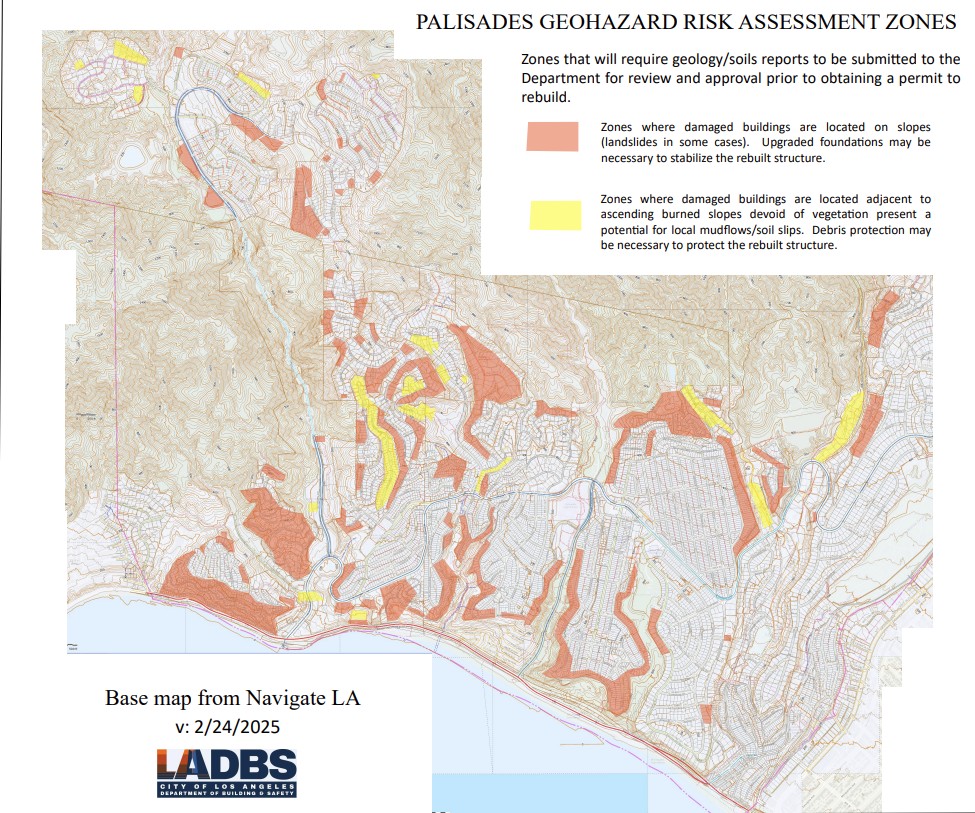
On April 17, the Department of Building and Safety released information about submitting Geotechnical and Soils Report. The bulletin identifies two separate geologically sensitive zones that are either on or next to steep slopes or potential landslide areas. Before rebuilding, those areas will require a Geotechnical and Soils Report to be submitted to the Grading Division for review click here.


Posted in City, Palisades Fire | 5 Comments

Anyone Else Ready to Leave California?

By KRISHNA THANGAVELU

Last week Gavin Newsom’s Administration released a plan to impose a MILEAGE TAX on all California drivers! And this week, CA Democrats are taking up 5 additional tax hikes in the state legislature. Details on these costly and unfair tax hikes are below –

PROPERTY TAX (9 bills): Democrats have introduced nine separate bills that would increase your property tax in some way – with the worst being a costly property transfer tax that would give state and local government 5% of the value of every home sold – on top of the capital gains tax! Worse, Democrats are working with labor union bosses to put a repeal of Prop 13 on the ballot in 2026.

PAYROLL TAX (Newsom Annual Budget): Newsom has included a job-killing hike in the payroll tax – costing struggling small businesses $1 billion more per year in payroll costs. That means fewer jobs in our state.

VACANCY TAX (SB 789): After forcing businesses to close with excessive taxes and regulations, Democrats now want to impose a tax on vacant offices and retail stores that used to house all the businesses they destroyed. Talk about adding insult to injury!

SOCIAL MEDIA TAX (AB 796): This week Democrats will vote on a bill to impose a tax on the social media platforms you currently get to use for free. Expect that tax to be passed on to users of these platforms.

INCOME TAX (AB 1428): California already has the highest income taxes of any state – but this bill would increase it to a whopping 13.8%.

MILEAGE TAX (AB 1421): Newsom proposes to track every driver’s mileage and charge them 6-9 cents per mile they drive. That is the equivalent of an 80-cent-per-gallon hike in the gas tax. The typical California driver will be forced to pay $900-1200 a year in higher taxes just to drive on poorly maintained freeways they already paid for with the original gas and sales taxes!


Posted in News | 2 Comments