(Editor’s note: in 2012, it became apparent there wasn’t enough energy to meet electricity demand with the current distribution station in the Palisades. Then a DWP executive Jack Waizenegger said there were problems with the proposed pole-top distribution stations “the PTD is fused and has no backup transformer, plus it has overhead exposure and minimal remote monitoring.” Both switching/monitoring and overhead exposure may have caused problems during the Palisades Fire.)
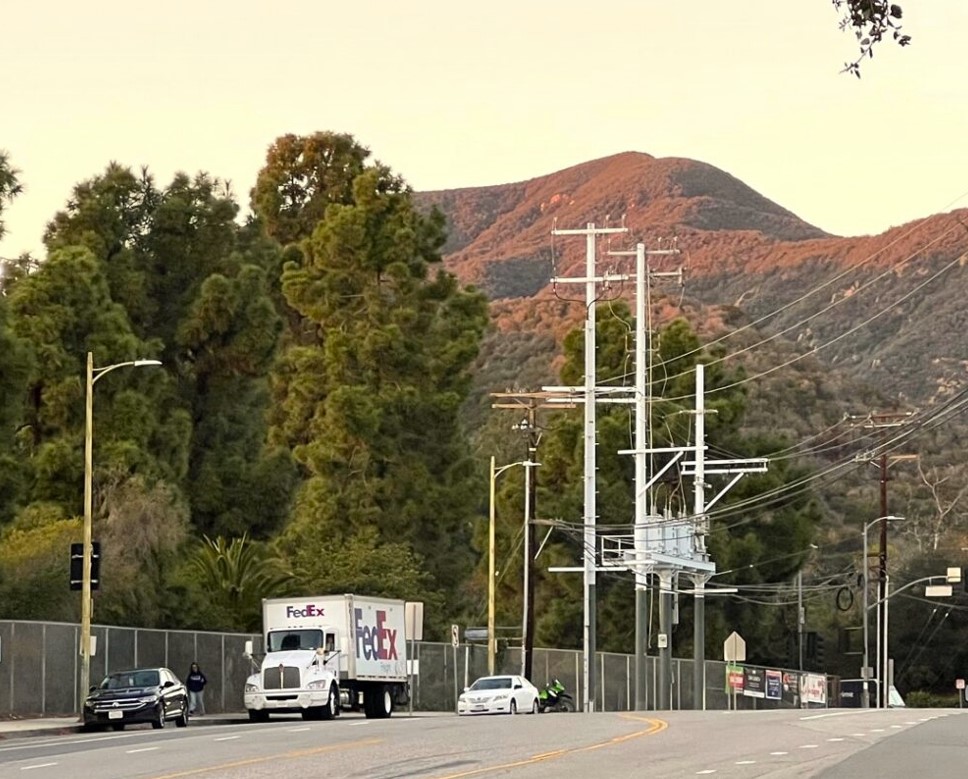
These high voltage electrical poles at Temescal and Sunset were to be torn down once a new distributing station is built. Now they are to be replaced, once undergrounding is complete.
By HANK WRIGHT
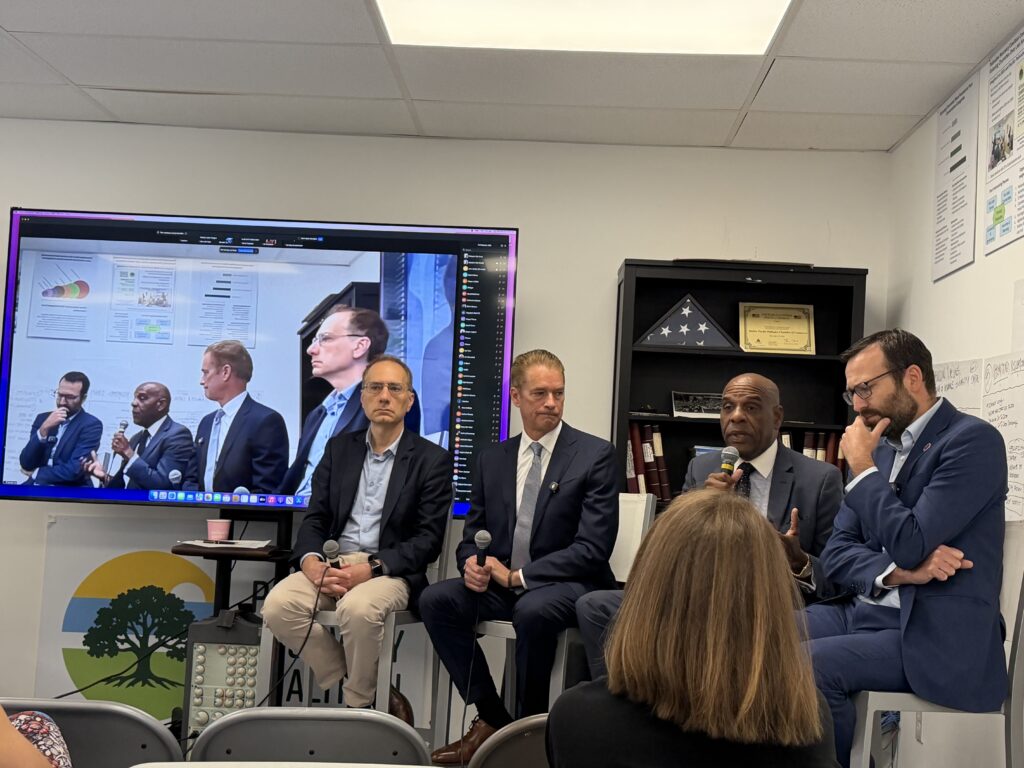
Well, blow me down with a feather and call me a DWP ratepayer… After sixteen months of what can only be described as an Olympic-caliber performance in the art of saying nothing with great authority, the Los Angeles Department of Water and Power showed up to the March 26 Pacific Palisades Community Council webinar and did the unthinkable. They outlined a plan. With milestones. Hedged milestones, mind you — this is still Los Angeles — but milestones nonetheless…
Watching nearly 350 Palisadians on Zoom react to an actual sequenced timeline was like watching hostages receive a sandwich. Gratitude, suspicion, and hunger, all at once…
Now, did I hear a parent in the back of the virtual room — let’s call him a taxpayer with a long memory — muttering the most devastating eight words in civic governance: “Now, how hard was that?”
Sixteen months of whining, kvetching, lecturing, and performing various bureaucratic interpretive dances after the Palisades Fire, and it turns out LADWP had a plan all along. They just needed the right motivation to share it…12 people dying and nearly 7,000 business/residents destroyed during the Palisades Fire. The emotional and economic toll is staggering and continues to mount.
Which brings us, as it always does in Los Angeles, to the motivation…
Funny thing about undergrounding power lines — at some point, you need the people whose ground you’re going under and place transformers on to sign something. A Right of Entry affidavit, they call it. Sign here, allow our equipment on your property, and we’ll schedule the actual conversation about compensation levels sometime before our board meets in Q2.
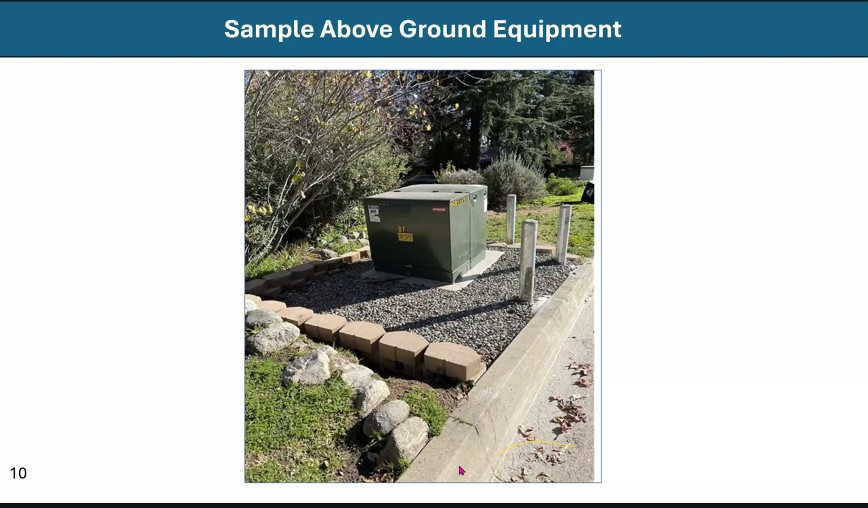
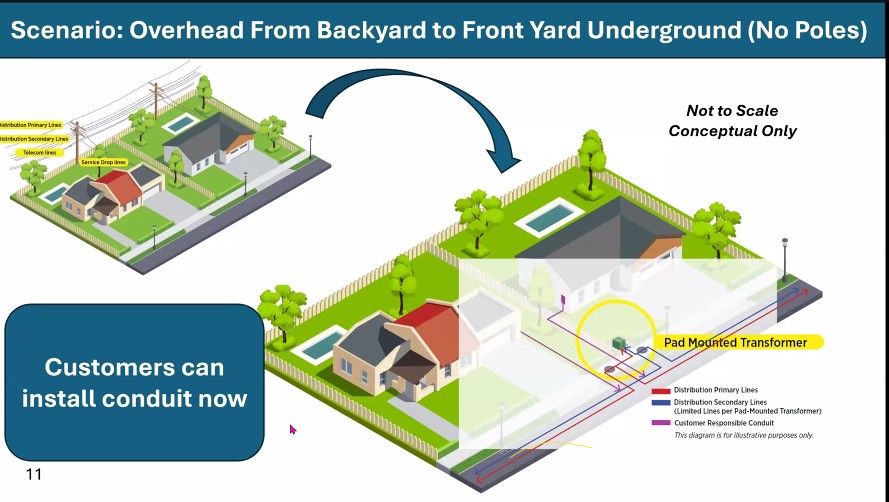
This is an example of what the above group equipment that is used when utilities are put underground. It may have to go on some resident’s property.
The community, naturally, is being asked to trust the same institution that spent 16 months describing its plans as “ongoing.” To be fair, LADWP did note they are working with the city attorney on “compensation levels.”
One is tempted to note that the timing of LADWP’s sudden transparency — Alphabet Streets starting in January 2027, with full completion by 2031— coincides precisely with the moment that DWP needs something from residents.
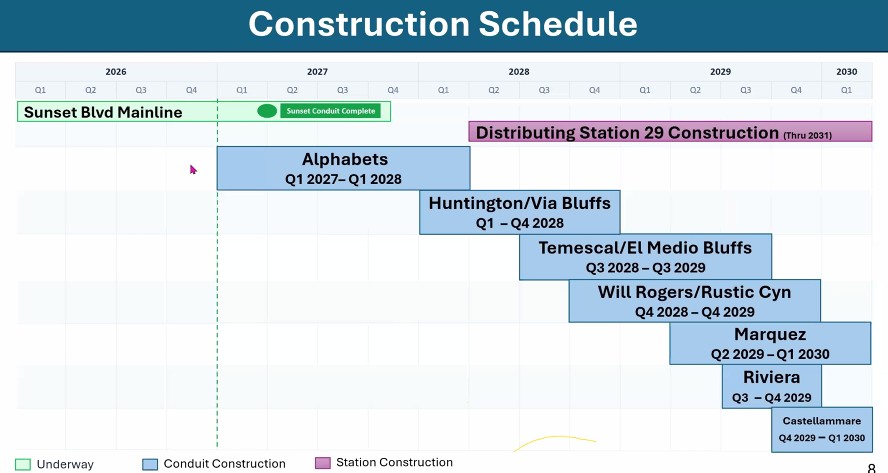
One is tempted to ask what alternatives were explored, what community input beyond the unanimous cry of “we want undergrounding” shaped the sequencing, and why Castellammare and Sunset Mesa drew the short straw and will be watching the rest of the Palisades go underground while they wait.
One is tempted. But one was cautioned not to look a gift horse in the mouth, particularly a horse that took 16 months to arrive at the stable (and more than 15 years after the call)…
The plan, in all its glory: residential undergrounding begins January 2027 — and DWP is “actively trying to accelerate this,” which in city-speak means 2027 is the floor.
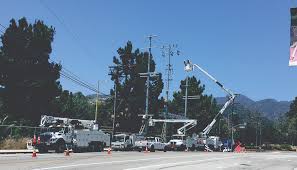
According to a new California law electrical wires should go underground.
Overhead line removal begins late 2029. Full project completion: 2031. The Sunset Boulevard backbone conduit, which has been under construction since March 2025, continues through June 2027 — work that was temporarily halted last year after a contractor fatality.
DWP terminated that contract and, with the mayor’s office holding their hand, onboarded a replacement in three weeks – a process normally takes close to a year.
Remarkable what a little scrutiny can do for institutional efficiency…
The voltage upgrade in Pacific Palisades from 5 kV to 12 kV is genuinely good news. It matches what Burbank uses — “if Burbank can do it” being apparently the gold standard of LA civic achievement — and conveniently eliminates the need to build a new distribution station at Marquez Elementary. One assumes the PTA is relieved…
An $877 million request to FEMA was made to cover the cost of undergrounding was denied. An appeal was submitted on or around March 19. The government has 90 days to respond.
Meanwhile, the DWP’s Zaraya Oliver Griffin noted that the current federal environment is “unlike anything she’s seen in 22 years.” She has seen things. DWP spent approximately a week in Washington, D.C. meeting with federal legislators.
Some funds were released. They went to other states. Perhaps because Governor Gavin Newsom has been bagging on the current Administration. Nothing like biting the hand that feeds you. This is the part of the story that would be darkly funny if it weren’t happening to people who lost their homes…
If the FEMA appeal fails and arbitration is lost, the cost gets spread across all LADWP customers citywide. Every Angeleno paying a DWP bill would help fund Palisades undergrounding. This is the outcome Zaraya described as something “DWP is trying to avoid at all costs.” One imagines Boyle Heights ratepayers would agree…
The state, in a move Zaraya said she had never seen before, wrote an extensive letter of support for the appeal (better late than never and probably without Governor Newsom’s knowledge). The state never does that. When Sacramento writes a letter voluntarily, you know something unusual is afoot. Whether the current federal administration finds the argument persuasive remains, shall we say, an open question…
Zaraya’s top ask to the community: contact federal representatives and, in her word, “avalanche” them with requests to approve the appeal. DWP will share specific names and contacts through the community council.
This is how we’ve arrived at a situation where a utility is asking fire survivors, in addition to rebuilding their lives, to do federal lobbying after our leaders have rhetorically poisoned the well.
Welcome to the new normal…
Reza Akef, the PPCC infrastructure committee chair, added his own ask: when DWP begins right-of-entry outreach in Q3 2026, respond quickly. He mentioned a goal of 30 days for community-wide turnaround. Thirty days. For agreements involving easements on private property whose compensation terms haven’t been finalized yet. One marvels at the optimism…
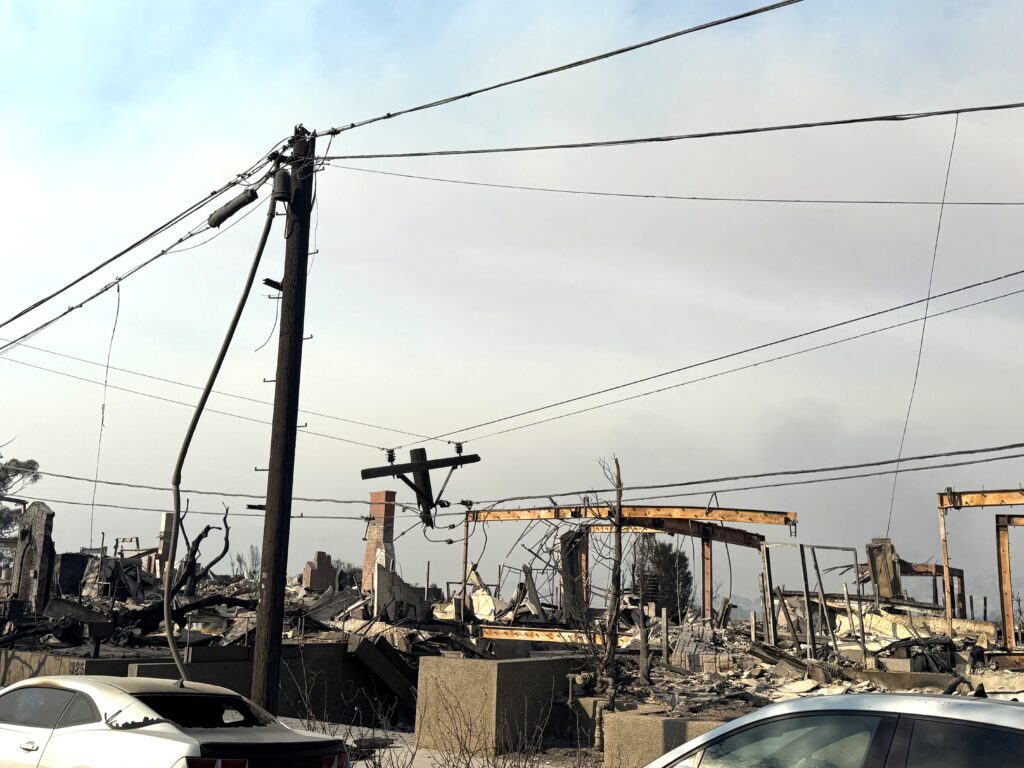
Snapped electrical poles/lines may have contributed to the fire.
A community member raised the obvious question about Rustic Canyon and Santa Monica Canyon — vegetation-heavy areas sitting at the end of the undergrounding queue — and the fire risk that implies. Dave Hansen, LADWP’s new interim director, explained that undergrounding is one of several hardening methods: covered conductor, composite poles, steel poles, fiberglass crossarms. Overhead doesn’t have to mean unsafe, he said, with the confidence of a man who did not watch his house burn after the transformer blew. Another DWP official added that those areas are in the 4th interval, with active work beginning in 2028. Hardening measures will “bridge the gap.” The gap being, conservatively, two to three fire seasons…
A note on the water pressure question: during the Palisades fire, the problem was not power. The pumps had power. What they lacked was water pressure (some might call it water volume – like the volume removed when the Santa Ynez reservoir and the Chautauqua Dip reservoir. Where is 100 million+ gallons of water when you need it?) — demand overwhelmed the system and the pumps couldn’t pump empty lines. DWP had crews out trying to boost pressure (perhaps they should have brought some of their 300 water DWP trucks with them). They couldn’t overcome the demand.
The new electrical design includes remote-operated sectionalizers allowing circuits near vegetation to be shut down remotely, without waiting for a technician. This is the kind of detail that, had it existed sixteen months ago, might have changed the conversation considerably…
And then, the moment of the evening: the yard sign.
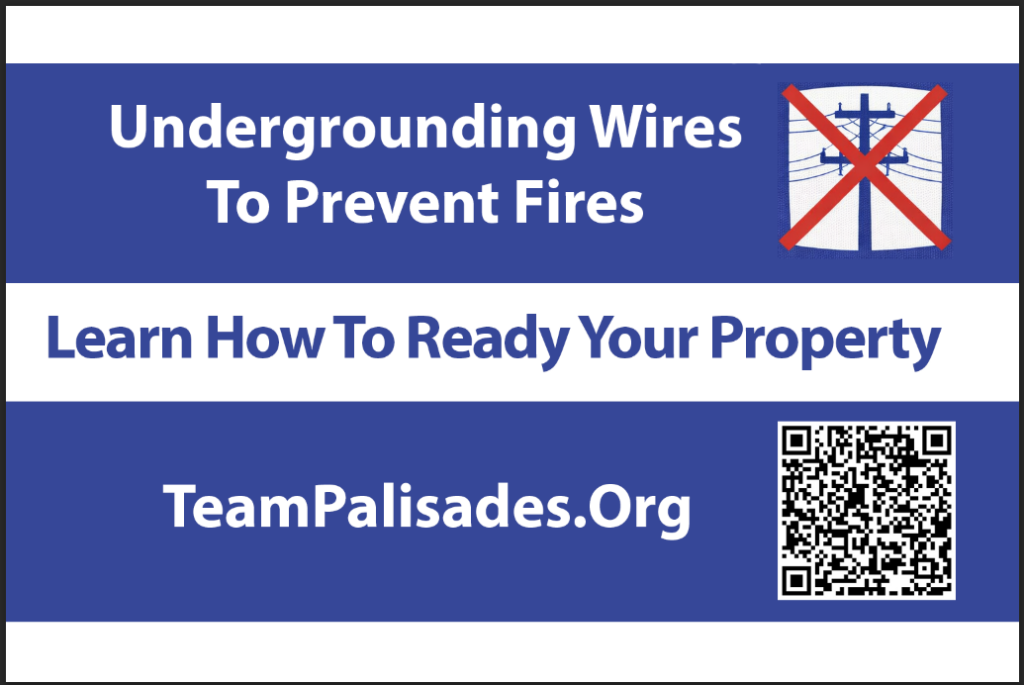
Team Palisades and the PPCC have produced a sign. A physical, corrugated-plastic sign, to be installed in your parkway, expressing community support for undergrounding. Democracy, rendered in lawn signage, 24 by 18 inches, visible from the street…
To be fair — and one is trying, genuinely trying, to be fair — the sign serves a real purpose. It signals organized community support to the officials who still need that community’s easements.
It is, in a very real sense, leverage. The sign says: we are watching, we are coordinated, and we remember what happened when you weren’t…
Sign up for your sign — and yes, the pun was absolutely intended — at: click here.
Team Palisades handles installation. You provide the name, address, and optional phone number. They provide the sign. The city provides the inspiration, free of charge, sixteen months running…
For more: palisadespower.ladwp.com. Infrastructure committee: [email protected].
To view the March 26 meeting . . . .the recording was promised to YouTube by March 27 (Whopps missed it). DWP slides will appear on the PPCC website (due date uncertain).
April brings a water-specific presentation from DWP, a public works town hall on streets and sidewalks, and a right-of-entry town hall. The calendar is suddenly full. One notes that it took a denied FEMA claim and a community that won’t sign anything to produce this level of scheduling ambition…
Meanwhile, Mayor Bass heads to Washington in mid-April to continue advocating for federal funding. She and Councilwoman Park sent a joint letter to the CPUC the day of the meeting urging telecom companies to underground their lines in parallel with DWP trenching. Park called it “senseless” to trench for power without burying comms simultaneously. It is senseless. It has been the default approach for decades. Better senseless late than never…
More dots to follow. There are always more dots.
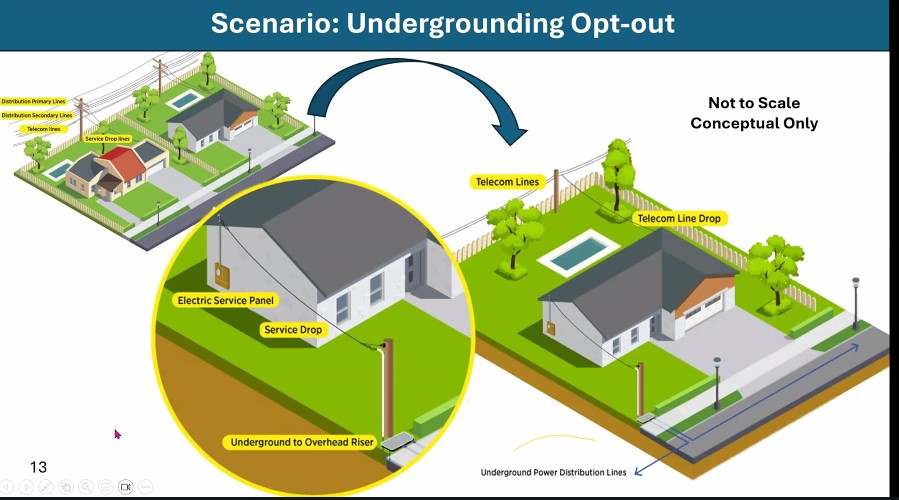
(The first picture below shows a property where all wires have been put underground. The second shows no undergrounding, communication lines are on poles at the back existing easement. Electricity goes to the house from the front of the street.)