EPA (Lee Zeldin) and SBA (Kelly Loeffler) Listen to Rebuilding Concerns of Residents

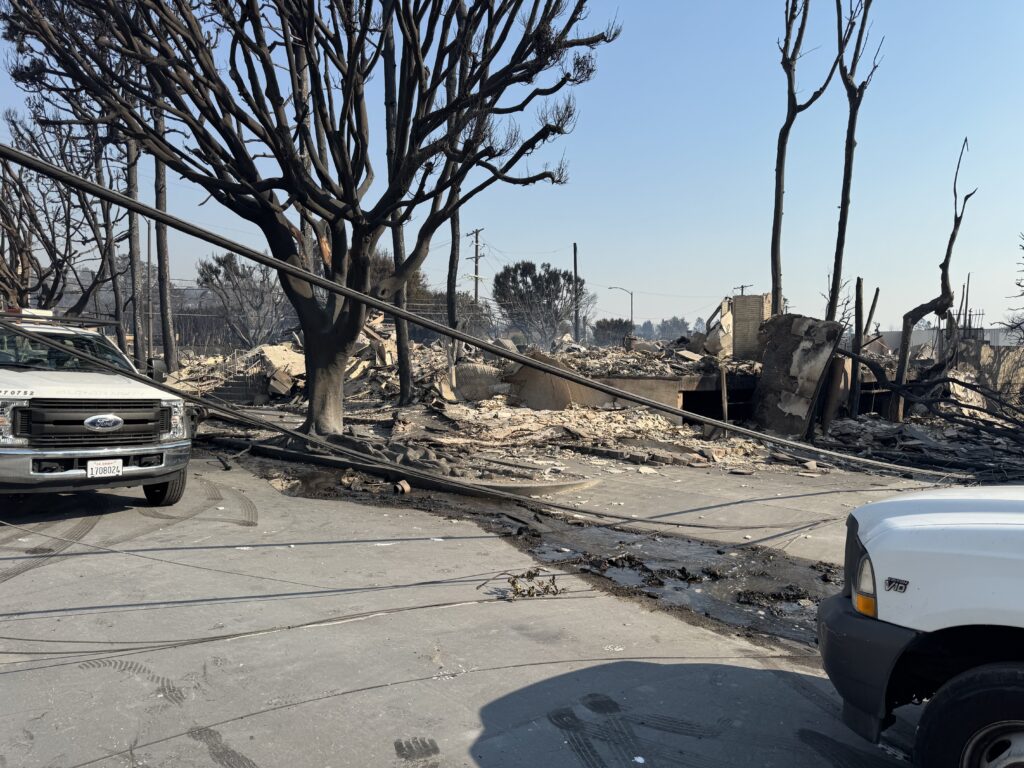
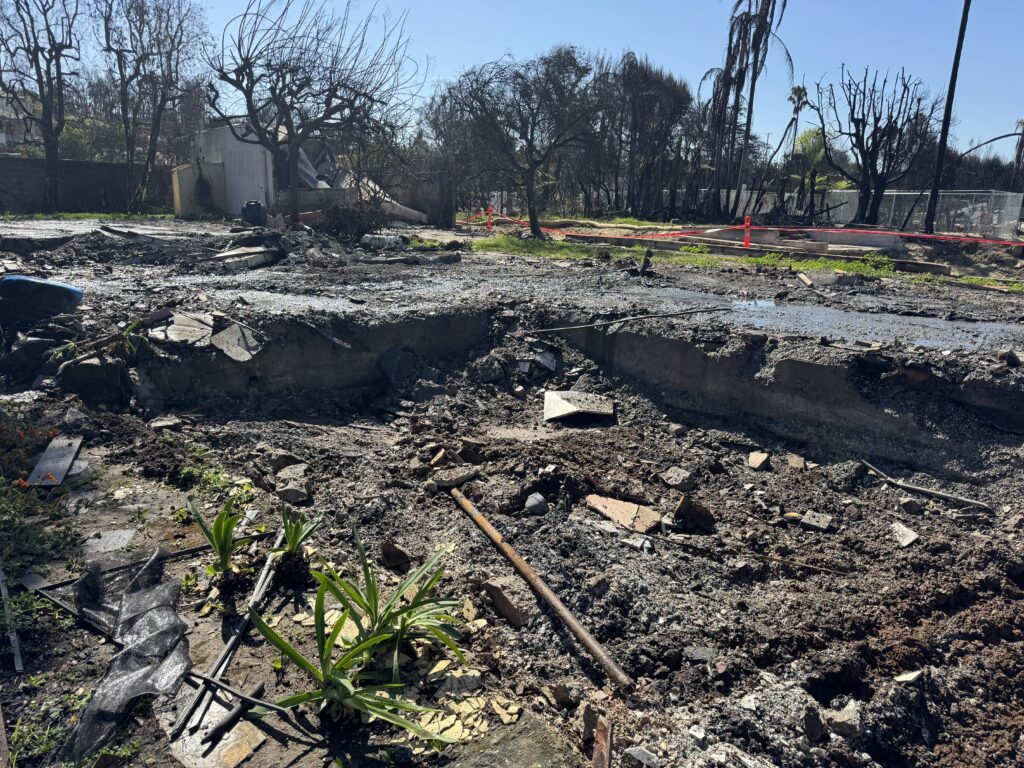
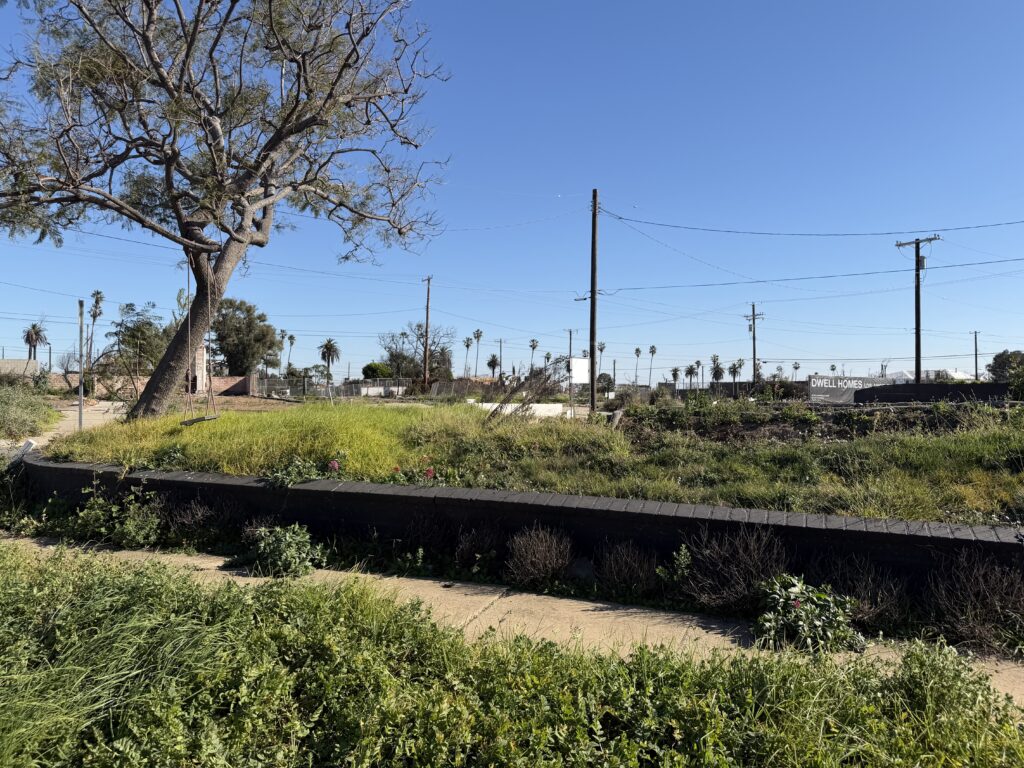
Lot after lot in the Via de las Olas bluffs are still empty a year after the fire.

President Donald Trump was distressed by lack of rebuilding a year after the Palisades and Eton Fires. In a January 27, executive order, Trump addressed that failure.

On January 28, he appointed Environmental Protection Agency administrator Lee Zeldin to help homeowners get permits and move forward click here.

During the morning of February 4, 2025, Zeldin and SBA Administrator Kelly Loeffler met first with L.A. County Supervisor Kathryn Barger and then L.A. Mayor Karen Bass for feedback on why the rebuild process has been so slow.
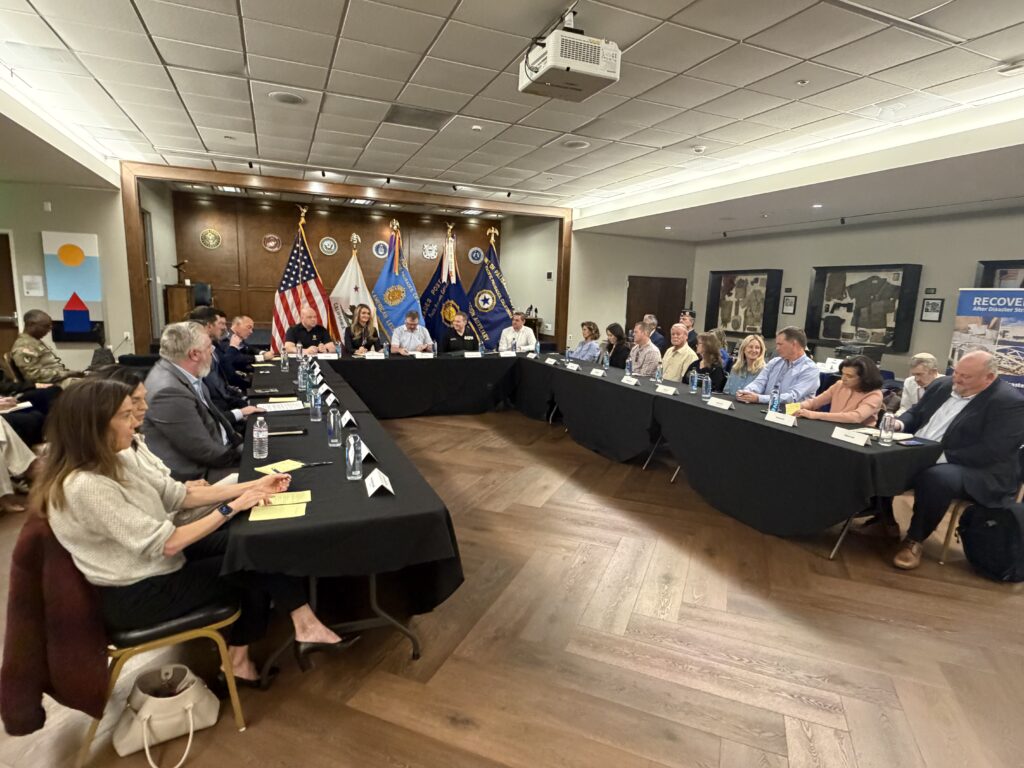
A roundtable discussion to address the slow rebuild process was held at the American Legion Wednesday, led by EPA’s Lee Zeldin.

A few hours later at the Ronald Reagan American Legion Post 283 in Pacific Palisades, the two listened as about 12 residents with different perspectives and from different parts of town, detailed the issues they had experienced.

Zeldin told them they were here to figure out “how to break the log jam.” He said he had heard about HOA’s and those challenges and about the fire hydrants not working. He said he wanted to hear everything and that “nothing is off limits.”

Loeffler and Zeldin urged people to “let us know how we can help” and “be candid.”

The first Palisadian who spoke said that permitting was going at light speed, that debris removal had been fast, but that residents have heard from the city that “we don’t have the money” . . .to fix infrastructure, such as undergrounding, streets and streetlights.

Several times Zeldin emphasized that there should be specific asks from the city/state to the federal government, not aspirational asks. If the street repairs will cost a certain amount, ask for that amount not several billion over what the actual cost will be.

A reoccurring theme with residents was ensuring that when federal money might came, there should be oversight, so it didn’t end up in a “black” hole.

Zeldin said that Trump had said no affordable housing would be built in the Palisades.

A resident pointed out that Pacific Palisades had received a five-year reprieve from new affordable housing by Newsom under SB 79, but after five years it could be built.

“But we still don’t have ingress and egress in Pacific Palisades (for evacuations),” the resident said and pointed out that Palisades had affordable housing in the form of mobile home parks and housing at the base of Highlands Drive. Zeldin was asked if there was a way to help those residents come back. . . . “maybe through HUD,” he answered.

“We are struggling with insurance,” one resident said, and explained they had to provide receipts and photographs of possessions to insurance companies to get a payout. (Most people had a total loss and there are no records.)

One pointed out there’s “not enough money with the insurance gap,” between what construction costs and what insurance pays.

“It’s hard to rebuild when you don’t know what you’re going to get from insurance,” the resident said. “A year later people are still trying to get money.”

Zeldin asked specifically about the money, “What is the difference?”

“The policy said $1.8 million and we received a million,” the man said. “But even if we got the whole bucket, we’d still be underwater.” Construction costs in Southern California are generally between $800 and $1,000 a square foot.

The residents were asked if the State had weighed in or helped with insurance issues and the answer was “No.”

Another resident tried to explain about possessions. “Some carriers pay between 50 to 70 percent, but if you want the full amount they ask for photos and receipts.”

“With standing homes, insurance has not been helpful,” another said, who had paid for the remediation on their own, so they could move back home.

Another issue for many is that the mortgage on their burned home will come due after a year’s fire reprieve. That means that residents will have to pay mortgage and also rent (because many insurance companies only paid additional living expenses for a year). That leaves residents no money to rebuild.

“At the core, there’s no one size fits all,” a resident said, but for most, “It’s a real cash issue.”

Several of the residents asked Zeldin to look at setting up a local authority such as was done in lower Manhattan after 911. They pointed out Pacific Palisades has never received services from the City.  “We’re an afterthought.”

A resident, who is back in her home, said, the streets need to be repaired because people pop tires driving on them, there are no streetlights, there are no police, the park is not fixed, and there are no street services.

More than one resident said, “no one trusts the local government. Why would you give them millions of dollars that will disappear?” and added that conditions should be put on any federal money.

Zeldin urged the panelists to respond via email to him, “if there was one thing for me to take back to the president, what would it be?” He reassured everyone that notes had been taken during the roundtable and that he would be back in Pacific Palisades to help, because Trump wanted to help residents recover.

Afterwards Zeldin spoke at a press conference across the street, at the former site of Seven Arrows School. He said that Trump’s Executive order was the result of Palisades residents contacting the President for help.

Trump had toured the Palisades in January 25, 2025. A month later, Trump sent the EPA and the U.S. Army Corps of Engineers in to do debris removal. This first in Pacific Palisades was February 11, and the entire town was done by August 26.

“Trump wants us to identify any possible way to help residents rebuild,” Zeldin said. “Follow through will be essential and critical. Trump expects the best of this team and we accept that challenge.”

He was asked if anything stood out. “One thing that hit me hard . . . it is apparent that there are a number of people waiting for insurance.

“Not every insurance company is equal,” he said. “I find it outrageous that insurance companies are holding people up. . . .having to prove that everything that burned, existed.”

Governor Gavin Newsom has asked for $33.9 billion in federal disaster relief. The state has already received $3 billion in Hazard Mitigation Grant Program funding and Trump wanted an audit of California’s use of that funding.

Zeldin said it didn’t help residents that the Newsom traded barbs with the President and then said “Where’s my money?

“The whole ask has been completely leveled by the governor campaigning for President,” Zeldin said. “There’s a strategy to ask for money.”

Palisades Long-term Recovery Coalition President Jim Cragg told CTN “I was happy with my discussions with Secretaries Zeldin and Loeffler, as well as the presentation they gave.

“They appear to be hearing us and understanding the depth of the challenges,” Cragg said. “I liked that Secretary Zeldin offered a road map to getting federal funding and support.”
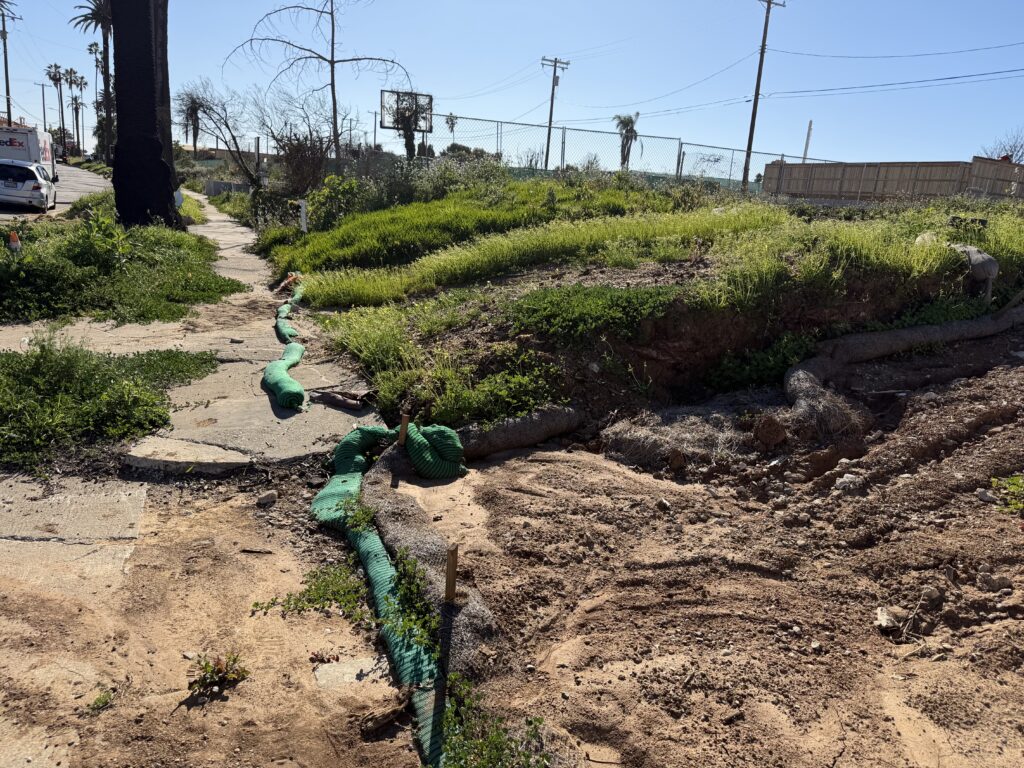
More empty lots in Pacific Palisades. The streets, driveways and roads are in bad shape.

Posted in City, Community, L.A. County Supervisors, Palisades Fire | Leave a comment

Art Theft: One of O’Neill’s Stolen Paintings Recovered

Artist Katie O’Neill’s painting, which was one of 11 that was stolen, was found after the Palisades Fire.

Eleven of Katie O’Neill’s paintings were stolen from her studio on Antioch in October 2022.

Then, Los Angeles Detectives took down the following information: about 10:30 p.m., on that Saturday night, a Gelson’s employee saw a man that was described as black and about 6 feet tall, use a crowbar on the window, so he could open the door and gain access to the studio.

The employee shouted out, but the man was threatening. Another person drove by and asked the man what he was doing and supposedly he said, “Some burglar robbed my store,” and that he was dealing with it.

The man then went in and removed 11 paintings. Around 12:30 p.m., a friend of O’Neill’s who was driving by the store called her to say that someone had broken into the store.

The police were called, and after they left around 2 a.m. O’Neill was left alone in the studio, trying to find a company to board up the broken window to keep the rest of her paintings safe.

The next day detectives looked at video cameras from across the street and told O’Neill that the art theft looked like a professional job.

“It’s so personal,” O’Neill said about the loss of her paintings. “I can’t even type this without crying. Why would anyone do this?”  click here.

Her question was never answered, and the paintings were never located.

Until now.

After losing everything in the Palisades Fire, O’Neill was in her current studio at 1819 Stanford in Santa Monica, painting.

She received a mysterious email. “I believe this is yours” was the subject line. An unsigned email informed her that they had one of her paintings but would only be in Los Angeles for a few more days. A grainy photo of one O’Neill’s stolen art works was attached, with the notation “in case you think it is a scam.”

They didn’t give a name, but left a phone number.

With all the internet scams, O’Neill considered not answering. Eventually curiosity won out.

“I called,” O’Neill said and a woman answered and explained the situation. Her husband’s aunt, Ella Zarky, had died last year. Her house had survived the Palisades fire, and they were in town doing remediation and sorting through her estate.

Most of Zarky’s art collection was abstract or street/folk art but when the niece went to the garage, she found this painting which she didn’t seem to think fit the rest of the collection.

She did a google image search of the painting and found the page on O’Neill’s website which showed the stolen art. The woman said she’d be there a few hours if O’Neill wanted to stop by.

“I convinced myself that this was probably not some elaborate plan to murder me and I headed off into the dark and foggy night, through the deserted Alphabet streets, winding up Chautauqua onto a little street with a few inhabited houses,” she said.

“I’ve watched enough true crime shows that I didn’t want to ring the door of the plastic covered entrance, so I called. A friendly woman came out and opened the garage,” O’Neill said. “Wonder of wonder, miracle of miracle – there was my painting! After a year of so much loss and grief, something came back. Something literally survived the fire!”

“I spent hours and hours of my life on the Paris painting,” O’Neill said. “It wasn’t quite done. I had put it aside and planned to go back to it.” That painting and one other “Towards High Point,” had not been signed, yet.

On the back of the Paris painting someone had signed it as K Carr. O’Neill told CTN that if someone tried to sign the front with acrylic, since the painting was oil, it would have just flaked off.

Zarky, who spent seven days a week doing volunteer work and participated in Multiple-Sclerosis Bike-a-thons, until she was 88, most likely bought it from someone who claimed to be the artist.

O’Neill is hoping that maybe one of Zarky’s neighbors knows where she purchased this painting, which might lead to the other 10 pieces of art that are still missing.

Someone signed the back of Katie O’Neill’s painting.


Obituary- Ella Zarky

Ella Zarky at her last MS-Bike ride at age 88.

Born in Manitowoc, Ella Zarky had a happy life; one of summer vacations swimming across nearby Pigeon Lake, piano lessons, volunteering during the war at Anshe Poale Zedek synagogue, and during college at the University of Wisconsin writing for the Octopus, the campus humor magazine.

Moving to southern California for a fresh start, Ella filled the ensuing decades as a teacher, fundraiser, volunteer and friend. For many years, she taught English at Venice High School, and later ESL to immigrants trying to make their way in America. Assisting people in need was something she had first learned from her father, who had himself arrived in Two Rivers, Wisconsin, as a child refugee fleeing Czarist Russia. She also absorbed the example of her mother, whom she joined at the synagogue to help assemble care packages for Jews trapped in the Soviet Union.

Single until her mid-30s a remarkable independence for her era Ella was eventually married and widowed twice. Her first husband was Irv Chernuchin, with whom she worked at his belt company. Her second was Hilbert Zarky, a highly accomplished attorney who during the Roosevelt years had argued cases before the U.S. Supreme Court.

After retiring, Ella devoted herself to volunteer work, usually seven days a week. She collected food from local bakeries which she distributed to homeless people, along with surplus government blankets, thousands of socks, second-hand clothing, toiletries, books and whatever other necessities she could find, finagle or wrangle. Despite the dangerous reputation of LA’s homeless encampments, Ella showed no fear in carrying out her humanitarian work she was on a mission, and she went where she was needed most.

Ella also was a longtime fundraiser for Jewish causes, as well as for research into Multiple Sclerosis, a disease that afflicted her niece and nephew, Jill and Mike Sigman. Relentless in pursuit of pledges for her annual participation in MS bike-a-thons, Ella eventually raised more than $145,000 for the National MS Society, before finally completing her last race at age 88.

In 2021, in recognition of her public service, Ella was honored at the MS Society of Southern California’s “Dinner of Champions,” where she was presented with its prestigious Impact Award. Similarly, the Del Rey Yacht Club long a locus of her social life established the Ella Zarky Distinguished Community Service Award, and the Mariners Outreach Foundation created the Ella Zarky Venice High School Scholarship. Despite such public recognition, Ella remained humble to the last, but never soft. Told once that the homeless people to whom she gave canned food might lack can openers, she snapped: “They’ll find one!”

On July 6, in declining health but just a day after her weekly yoga class, Ella passed away in her sleep. A month shy of her 99th birthday, she died just as she had lived on her own terms.

Ella Zarky is survived by her brother Leon Sigman of Manitowoc, her nephew Mike Sigman and his wife Kelly of La Crosse, her nephew Howard Sigman and his wife Ellen of Paramus, NJ their daughter Jenna, as well as many cousins. Contributions in Ella’s memory may be directed to the National Multiple Sclerosis Society.

Posted in Arts, Crime/Police | 1 Comment

Valentine Concert, Dinner and Dancing for Palisadians

A special Valentine’s Celebration is planned for Pacific Palisades senior members, starting at 5:30 p.m. on Friday, February 13. The evening will feature a catered meal, drinks, special entertainment and dancing. The cost is $55 and the event will be held at Ronald Reagan American Legion Post 283, at 15247 La Cruz.

Former Citizen of the Year Jimmy Dunne, who has partnered with a new organization, the Sunset Club, is sponsoring the event. It is being underwritten by two Palisadians Cary and Will Singleton.

Even if you are temporarily living in Santa Monica, Marina del Rey, Culver City, this event is for you.

Dunne said. “We are honoring our senior members with a special Valentine’s Celebration. It will feature a standout performance by Brandon Wattz, who will be singing throughout the evening. It will be a fun, beautiful, and memorable night with dinner and dancing!”

This is the perfect Valentine gift—a great meal, drinks, music, not having to make reservations at overcrowded restaurants on heart day. And it’s all planned out for you – just show up.  To make a reservation, visit https://securepayment.link/veteransgardens/valentines-concert/

Posted in Community, Holidays | Leave a comment

It Passed! Permit Fees Waived for Fire Rebuilds

Palisades Fire rebuilds will not have to pay plan check and permit fees.

In April 2025, L.A. Mayor Karen Bass signed an executive order to waive plan check and permit fees associated with the reconstruction of residences that burned during the January 7 Palisades Fire.

Residents soon learned that it would take a full City Council vote to pass the executive order.

Many Palisades resident journeyed downtown three times to speak on the need to waive fees: twice before the City’s budget and finance committee and a third time in front of the full council.

Most residents have a large gap between what insurance will pay and the cost of construction in Los Angeles. Building permit fees could range between $40,000 to more than $80,000 and could make the difference between rebuilding and coming back to the community or selling a lot.

Today, February 3, about 40 residents once again went to City Hall  to urge the Council to pass this legislation. All who wanted to were able to make public comment.

The fee waivers passed 15-0.

Afterwards resident Allison Holdorff Polhill said, “This is a BIG deal for fire victims. Together with our collective voices we have been heard. The City included fees for condos, apartments and mobile homes, too.”

She said the one exception was those who had fees waived and then sold the property prior to receiving a Certificate of Occupancy, would have to repay the fees.

In his presentation to the Council, Matt Szabo the City Administrative Officer  wrote,” Waiving of plan check and permit fees for rebuilding properties that were damaged or destroyed as a result of the January 2025 Wildfires represents a clear public benefit inasmuch as the wavier would remove barrier to reconstruction and benefit the economy of the City of Los Angeles.”

In Szabo’s report he noted that “the Council approve the waiver of fees for all structures, regardless of rebuild/repair scale, only up to the amount attributable to 110 percent of the original footprint.”

If someone builds larger than 110 percent, those property owners would be liable for fees in excess of 110 percent.

Since Bass’ order, Szabo said about $10 million has been suspended, while waiting to see if the Council passed the waiver legislation.

Szabo wrote, “This will have a General Fund impact of $98.3 million.” This was far less then the office’s initial October 2025 estimate of $280 million which was given to the City Council in December.

Posted in Palisades Fire | 3 Comments

Not Going to Lie to You

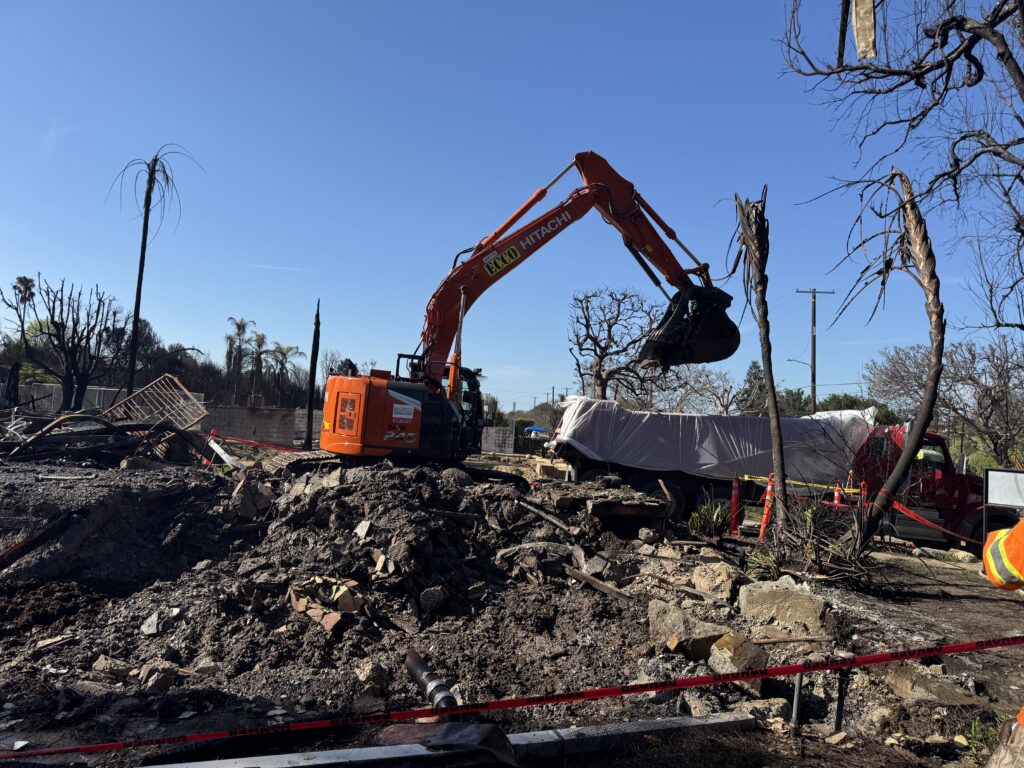
Our lot being cleared of “debris.”

Somedays I wake up and I feel low, so low I don’t want to get out of bed.

I feel like all the money that people sent to Fire Aid that went to nonprofits (and the people that made that responsible) will never go to the people it was intended.

It’s hard to stomach all of the people in Tahitian Terrace and Palisades Bowl that are not being helped. Lawmakers seem to throw up their hands and say there’s ‘nothing we can do.’ All those people who lost everything have no concrete way of coming back.

The town was 30 percent seniors, who had worked their whole lives and bought into the Palisades when it was cheap. They had their largest financial asset, their home, taken away in the Fire. These people, who participated and ran clubs, and were the “eyes” on the streets, may never come back.  And I sob. Even if we ever get through insurance to rebuild, my friends won’t be in the town.

And the politicians talk. They talk a lot. They all say they want to help, they’ll take meetings with everyone, but there is no help.

And I take it personally that so many people were wronged and have no way of coming home.

I look at the decimated streets, the burned-out lots, the weeds growing everywhere, no streetlights, the town center still struggling to come back and it’s hard to stay positive.

Last night a reader sent this video—I opened it this morning and I cried. It was easier to get out of bed this morning because it’s the residents–so many, in so many different ways who are trying to keep our community together and bring as many people home as possible.

click here


Posted in Film/Television, Kids/Parenting, Palisades Fire | 8 Comments

Letter: No More Taxes Until There’s Improvement

(Editor’s note: At the Palisades Democratic Club’s Annual Meeting, Councilmember Traci Park was among the speakers. She urged everyone to sign a petition to get a half cent sales tax on the ballot for the fire department, with that money going towards equipment and staffing. In response Palisadian Krishna Thangavelu, who lost her home in Tahitian Terrance wrote the following letter.)

The Palisades Fire destroyed nearly 7,000 buildings.
Photo: CAL FIRE

A little detail to help you understand why I cannot support yet another measure asking money from the public.

I think the issue is putting the pressure where the pressure belongs. And it is most certainly NOT on the public and their pocketbook. The City must simply do a better job at fire response management.

This measure to raise money for Fire department/firefighters?  If only money would actually solve the real issues:

  1. A reactive and casual culture at LAFD — poor 911 response. Why was Station 23 at the beach during a windstorm?  Why was the 911 call not responded to? It took 30 minutes for a station further away to fight traffic to get to the Palisades Fire.  I did bring this up with LAFD Chief Jamie Moore at the last PPCC meeting. And he heard all points. And promised to change culture.
  2. Failure to study earlier fires like Lahaina and prepare accordingly …  why did no one know about rekindle risk, burn scar patrol, and appropriate predeployment? What sort of shabby Fire department is this? Is there no learning… are we to recreate fire response from scratch each time around?
  3. Failure to use current technology like drones and imaging.  Chief assured us he does have drones now. But they will only be used reactively to put eyes on fire. I want them to be used proactively.  There is exactly zero reason why drones cannot patrol the Santa Monica mountains and at a fraction of the cost of a human.
  4. The morons at LADWP. Will money make them smarter?  They are once again going to do repairs during peak fire season? Yeah… can’t support this sort of casual behavior from city departments that will once again put us at risk.  Six miles of untested BS pipes from District 12. This is from the same geniuses that drained our reservoirs. Count me a skeptic.  I am not convinced this patchwork will keep the Palisades safe.
  5. Failure to employ innovation to staff better, fix engines better, using zero to low-cost global talent.  I’ve submitted proposals before to Chief Crowley and now to Chief Moore. Too bad LA City is too dumb to learn from corporate America.  Why are firefighters making CEO level salaries on overtime?  Bring in hundreds of free trainees using the best talent the world has to offer … offer them dormitory housing and feed them.  A good spin might even have them paying to learn from LAFD.
  6. Get a handle on the permissive mismanagement of homeless encampments throughout the city. This is where most of LAFD’s work appears to be going. Use some of the previous homelessness measure money to fund LAFD.  Oh wait.,, you don’t know where that money went. What makes me think you’ll manage money any better now?

EVERY SINGLE operation of LAFD and LADWP needs to be studied by outside experts in their fields. Every bad outdated policy needs to be kicked to the curb.  Every bad actor needs to be fired.

This is not business as usual where more money will solve problems. More money will simply bring us MORE bad services. The system is broken. We don’t need a BIGGER broken system.

Our biggest exposure to fire risk is our poorly managed city services. Get these houses in order before daring to ask the public for more money.

FINALLY… when our judgements lawsuits from the Palisades Fire hit the State and City will be broker than they are now. We will need a federal bailout.  Maybe ask the FEDS for money for all the issues detailed above.  Stop wasting the public’s money and betraying their trust, one burned town at a time.

Krishna Thangavelu

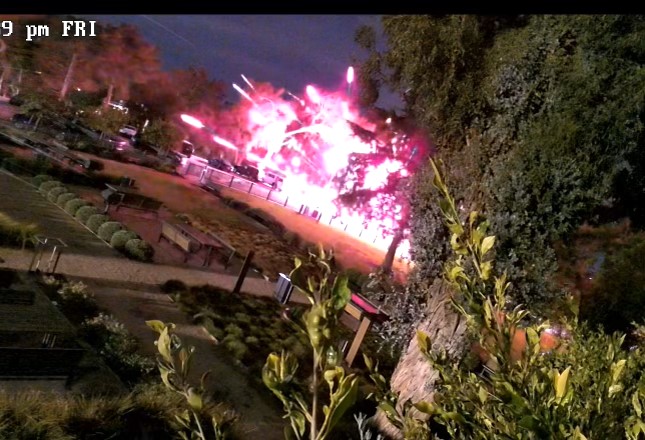
P.S.  The  Palisades community has for YEARS complained about teenagers using explosives and setting off fires. The lack of response addressing this issue by LAPD and the Council Office has not gone unnoticed. Y’all need a tune up as well.

Kids scramble to avoid being hit by embers a year ago. These fireworks were lit at the Rec Center and no one was ever held accoutable.

Posted in Accidents/Fires, Letters | 7 Comments

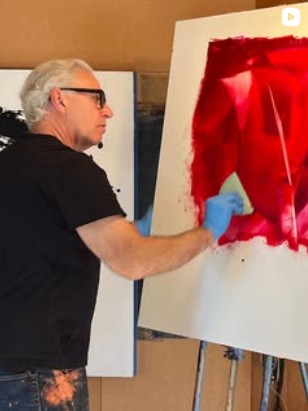
“Recurrence” Solo Exhibition Opens February 5

Leo Marmol

A solo art exhibition “Recurrence” by Leo Marmol, will have an opening reception from 6 to 8 p.m. on Thursday, February 5. The exhibition will run though March 1, at the Charles Arnoldi Studio, 721 Hampton Drive, Venice. A rideshare is recommended, valet is $16. RSVP to [email protected]

The exhibit brings together paintings inspired by the artist’s long engagement with the shifting light and sand of the California landscape, alongside a new series centered on cyclical gesture. These gestures form the thematic root of the exhibition: repetition as an ongoing act of attention and perpetual return—a consistent element informing Marmol’s practice.

Leo Marmol is a Los Angeles-based artist and architect. He is a founding partner of Marmol Radziner and is known for his leadership in architecture and his expanding presence in fine art.

Working primarily with oil paint and cold wax medium on canvas or wood panel, Marmol’s negotiation of material is vital to his practice. Marmol’s paintings explore the nature of color and personal history through abstraction.

His first solo show, Los Colores de Assimilation, focused on his search for heritage as the American-born child of Cuban immigrants. Marmol has exhibited his works in solo and group exhibitions at the Landing gallery in Los Angeles, Melissa Morgan Fine Art in Palm Springs and Patrick Gallery in Cambria. The artist’s professional and creative life bridges architecture and art, guided by a deep appreciation for beauty in all its forms.

Instagram: @leonardo_e_marmol

Posted in Arts | Leave a comment

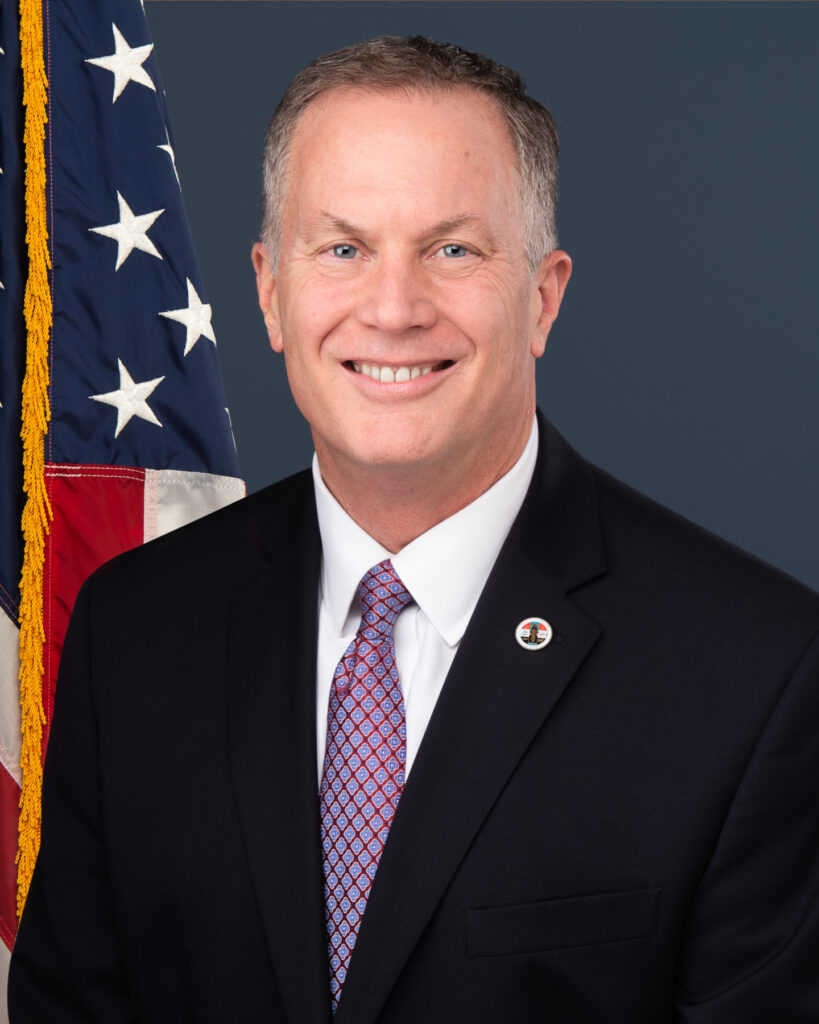
Assessor Prang Reconciles Building Code with Assessment Code

(Editor’s note: At the Palisades Democratic Club’s annual meeting on February 1, one of the last speakers on the dais was Jeff Prang, L.A. County Assessor. Although shoved to the end of the program, he received more applause than any of the speakers. When several audience members had specific assessment issues because of the Palisades Fire, he gave them his card and asked them to call his office so he could help.)

L.A. County Assessor Jeff Prang

By JEFF PRANG

The January 2025 wildfires that devastated Los Angeles and Ventura Counties did more than destroy homes. They upended lives, displaced families, and forced thousands of residents into a rebuilding process that is complex, expensive, and emotionally exhausting. In the aftermath of such loss, government has a simple obligation: do not make recovery harder than it already is.

That principle was at the heart of a legislative bill that I sponsored, Assembly Bill 1253, authored by Assemblymember Nick Schultz (D-Burbank).

AB 1253 was a narrowly tailored, temporary proposal designed to align emergency rebuilding standards with long-standing property tax assessment rules. It would have allowed wildfire victims to rebuild homes up to 110-percent of their original size without triggering a reassessment and an unexpected property tax increase. This modest flexibility recognized a basic reality: modern building, fire, and environmental codes often require changes in design, layout, or square footage that go beyond a strict “like-for-like” replacement.

The bill did not weaken Proposition 13. It did not create a loophole. It did not reward overbuilding. It simply acknowledged that families rebuilding after a disaster should not be penalized for complying with updated safety standards that were established under the Governor’s Emergency Proclamation issued to help wildfire victims.

Yet AB 1253 never received a vote. It was placed on the Assembly Appropriations Committee’s suspense file and quietly died there, without debate, without public accountability, and without offering wildfire victims any clarity about what awaited them.

The fiscal rationale for shelving the bill was never persuasive. My office analyzed the potential revenue impact and found that even if every eligible homeowner rebuilt to the 110 percent threshold, the total statewide impact would be approximately $5 million, spread across a multitude of counties, cities, school districts, and special districts. Against the scale of the disaster, that figure is negligible. Against the burden placed on individual families, it is meaningless.

When the Legislature declined to act, the underlying problem did not disappear. Homeowners were still rebuilding. Confusion persisted. Misinformation circulated. And without guidance, some families faced the prospect of higher property taxes simply for restoring what they had lost.

That is why I issued an administrative directive clarifying how my office will apply existing law.

Under Revenue and Taxation Code Section 70(c), property owners who rebuild after a disaster may retain their original assessed value if the replacement structure is “substantially equivalent” to the one destroyed. The statute does not define that term. For decades, assessors across California have exercised reasonable and uniform judgment in applying it, guided by State Board of Equalization (BOE) advice, local building standards, and the factual circumstances of each rebuild.

My directive interprets “substantially equivalent” to include rebuilt homes up to 110-percent of the original square footage in wildfire-impacted areas. This is not arbitrary. It mirrors Los Angeles County’s own zoning and disaster recovery ordinances, which already permit rebuilds up to 110-percent to accommodate modern code requirements. It is also consistent with BOE guidance recognizing that modest increases may be justified by changes in building codes, safety standards, labor costs, or environmental regulations, so long as there is a rational basis.

I do not take lightly the fact that this approach departs from past practices and earlier guidance. Assessors statewide operate under the same laws — and consistency matters. But fairness matters more. The law was never intended to punish disaster victims, and rigid interpretations that ignore real-world rebuilding requirements undermine both equity and public trust.

This policy does not open the door to abuse. Homes that substantially exceed their original footprint or value will still be reassessed. It simply ensures that families who rebuild responsibly, within clearly defined limits, are not hit with surprise tax bills at the very moment they are trying to recover.

Good government is not just about following precedent. It is about exercising judgment, especially when extraordinary circumstances demand it.

The Legislature had an opportunity to resolve this issue cleanly and uniformly through AB 1253. It chose not to. Faced with that inaction, I chose clarity over confusion, compassion over rigidity, and recovery over bureaucracy.

Fire victims deserve nothing less.

Los Angeles County Assessor Jeff Prang has been in office since 2014. Upon taking office, Prang implemented sweeping reforms to ensure that the strictest ethical guidelines rooted in fairness, accuracy and integrity would be adhered to in his office, which is the largest office of its kind in the nation and provides the foundation for a property tax system that generates about $20 billion annually. Assessor Prang was the 2025 president of the California Assessors’ Association.


Posted in General | Leave a comment

Palisades Fire Law Suit to Go Before Judge Feb. 5

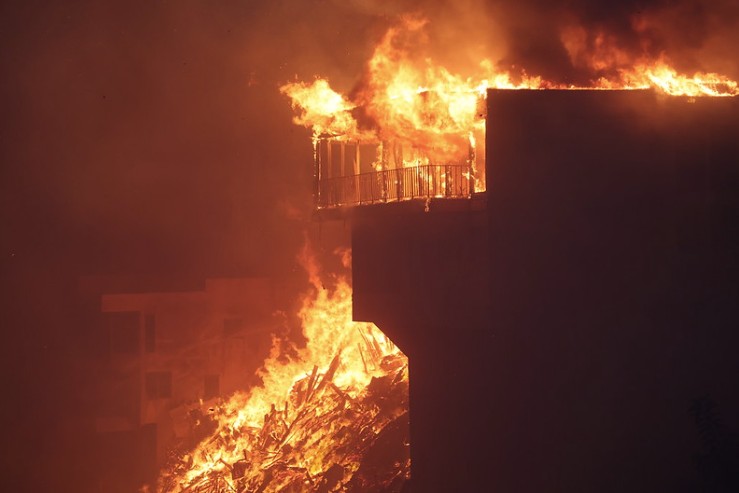
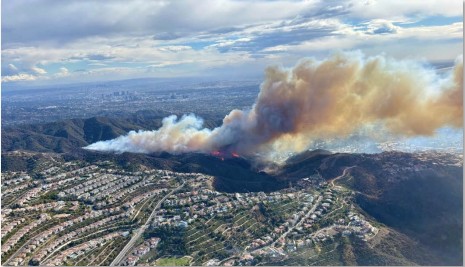
Start of the Palisades Fire on January 7, 2025.

About 7,000 homes and businesses were destroyed in the Palisades Fire.

By JEREMY PADAWAR

A judge will hear arguments in the Palisades fire lawsuit that will determine more than scheduling or legal procedure on February 5. This hearing goes to the heart of whether victims will ever be allowed to uncover facts through discovery, or whether the case will be cut off before evidence is examined.

The decision being considered is not about damages, and it is not yet about assigning blame. It is about whether government agencies can be held accountable at all when systems fail at a catastrophic scale.

This is important to Palisades fire victims because it determines whether their losses are ever examined in a courtroom or quietly erased by legal doctrine before facts come out.  Harsh, but this is the reality faced by my neighbors – roughly 40-50% of whom are financially devastated.

At the center of this hearing is government immunity. The defendants are asking the court to dismiss large portions of the case before any depositions, documents, or sworn testimony are produced.

Their position is that even if mistakes were made, even if risks were foreseeable, and even if infrastructure or emergency response failed, the government should not be subject to suit.

The judge must decide whether these claims are legally barred by immunity or whether they deserve to proceed so the facts can be tested in court.

Government immunity was never meant to function as a universal escape hatch. It was designed to protect good faith policy decisions, not to shield systemic neglect, ignored warnings, or preventable breakdowns between agencies during emergencies.

When immunity is stretched this far, it sends a dangerous message that public entities can fail the public and never be required to explain how or why. That is not accountability. It is insulation from scrutiny. If immunity arguments prevail, the consequences are severe.

Claims may be dismissed before discovery begins, meaning no internal emails, no depositions, no timelines, and no sworn explanations. Victims may never learn what decisions were made, who made them, or when critical opportunities to mitigate harm were missed.

That outcome would not only affect Palisades. It would shape how future disaster victims across California are treated when they seek answers. If the court instead allows the case to move forward, the result is not an automatic judgment against the government. It simply means the truth is allowed to emerge through evidence rather than public relations statements.

Discovery exists for a reason. It replaces speculation with facts and forces accountability through transparency. This moment is bigger than one fire. If courts continue to expand immunity each time something goes wrong, there is no incentive to fix broken systems, no consequence for repeated failure, and no reason to improve preparedness.

Accountability is not antigovernment. It is pro competence and pro responsibility. The judge is unlikely to issue a ruling on February 5. A written decision will likely come weeks later. That ruling, line by line, will determine whether this case proceeds, whether victims get discovery, and whether government immunity remains a shield or becomes an impenetrable wall.

At its core, this case asks a simple question. When public systems fail the public, should the public be allowed to ask why, under oath, with evidence? That is what this hearing is really about.

 ABOUT THE JUDGE – SAMANTHA P JESSNER

Judge Samantha P. Jessner has a reputation in Los Angeles Superior Court as a judge who plays it straight. Lawyers on both sides generally view her as even-handed, well-prepared, and serious about the law rather than outcomes. She does not tip the scales emotionally, but she also does not rubber-stamp government arguments simply because they come from public agencies.

She is not a “plaintiff-friendly” judge in the sense of bending rules or overlooking pleading defects. At the same time, she is not reflexively deferential to government defendants. In prior wildfire and public-entity cases, she has shown a willingness to let claims proceed when plaintiffs plausibly allege failures that go beyond discretionary policy decisions and into operational or systemic breakdowns. That distinction is critical here.

Importantly for our case, Judge Jessner TENDS TO BE SKEPTICAL OF OVERBROAD IMMUNITY ARGUMENTS. She understands that immunity is meant to be narrow and purposeful, not a catch-all shield to avoid scrutiny.

When immunity is asserted expansively, she typically demands a clear legal basis rather than accepting generalized claims of discretion or emergency response protection. That doesn’t mean she rejects immunity outright, but she applies it carefully and claim by claim.

She is also known for caring about the integrity of the process. Judges like Jessner place real weight on whether cutting off discovery would prematurely prevent facts from ever coming to light. In complex, high-impact cases, that concern often shows up in rulings that allow cases to proceed past the pleading stage even if the ultimate merits are unresolved.

The flip side is that she writes careful, detailed rulings. If she dismisses claims, she usually explains why. If she allows them to move forward, she does so deliberately. Her decisions are built to withstand appeal, which is why she rarely rules from the bench on matters of this magnitude.

TO ACCESS THE HEARING ELECTRONICALLY:

The hearing will be streamed live on the court’s LACourtConnect website. Plaintiffs in the case will need to log in using the case name and number, which is Grigsby, et al. v. City of Los Angeles, et al, Case No. 25STCV00832. Anyone who is interested to view the hearing should do so remotely using the Court’s website.

Posted in Palisades Fire | 7 Comments

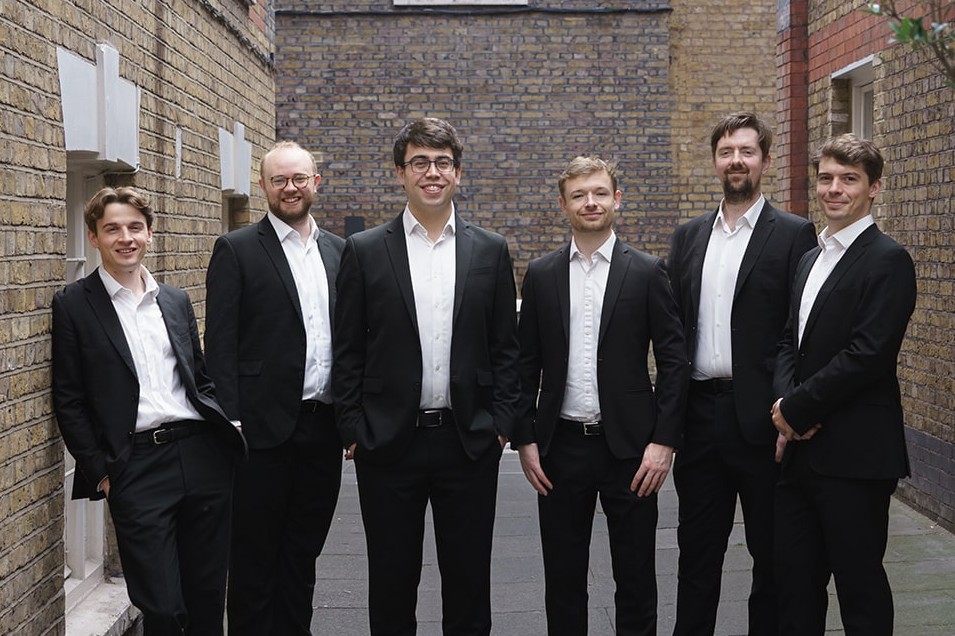
“Queen of Hearts” Presented by Gesualdo Six at St. Matthew’s


“Ingeniously programmed and impeccably delivered, with that undefinable excitement that comes from a group of musicians working absolutely as one.” 
– Gramophone Pacific

The Gesualdo Six will perform at St. Matthew’s Music Guild.

St. Matthew’s Music Guild will present a special concert at 8 p.m. on Friday, February 6. Pacific Palisades will be one of the stops on the tenth tour of the internationally acclaimed British vocal ensemble The Gesualdo Six.

Their musical program “Queen of Hearts,” present a selection of Motets and Chansons from the French Court, focusing on European Queens: Anne of Brittany, Margaret of Austria, Anne Boleyn and Mary Tudor.

The program traces how composers of the sixteenth century used music to reflect power, devotion, intrigue, and personal identity. Short contemporary works are interwoven throughout the program, creating a dialogue between Renaissance music and modern perspectives.

The music itself spans motets—sacred vocal works written for worship or contemplation—and chansons, which are secular songs often centered on poetry, courtly life, and human emotion.

Performed by six unaccompanied singers, this style of vocal consort music emphasizes clarity of text, blend of voices, expressive nuance, and “word painting,” – the representation of the text in sometimes extravagant musical gestures and vocal effects.

The Gesualdo Six is an award-winning British vocal ensemble founded in 2014 by conductor and scholar Owain Park. Comprising six of the United Kingdom’s finest consort singers, the group is widely praised for its precision, expressive depth, and innovative programming.

The ensemble takes its name from the Renaissance composer Carlo Gesualdo, whose emotionally intense music reflects the dramatic expressive possibilities of unaccompanied vocal writing.

Critics have consistently highlighted the group’s ability to unite historical insight with compelling musical storytelling.

A free pre-concert talk, “Liner Notes,” will take place at 7:10 p.m. with host Tom Neenan. “Liner Notes” is free and open to all ticket holders.

Tickets are $45 general admission. Students with ID attend for just $10 at the door. Tickets may be purchased online at MusicGuildOnline.org. This performance marks the first subscription concert presented by St. Matthew’s Music Guild in St. Matthew’s Church since the Palisades fires of January 2025.

Posted in Music | Leave a comment