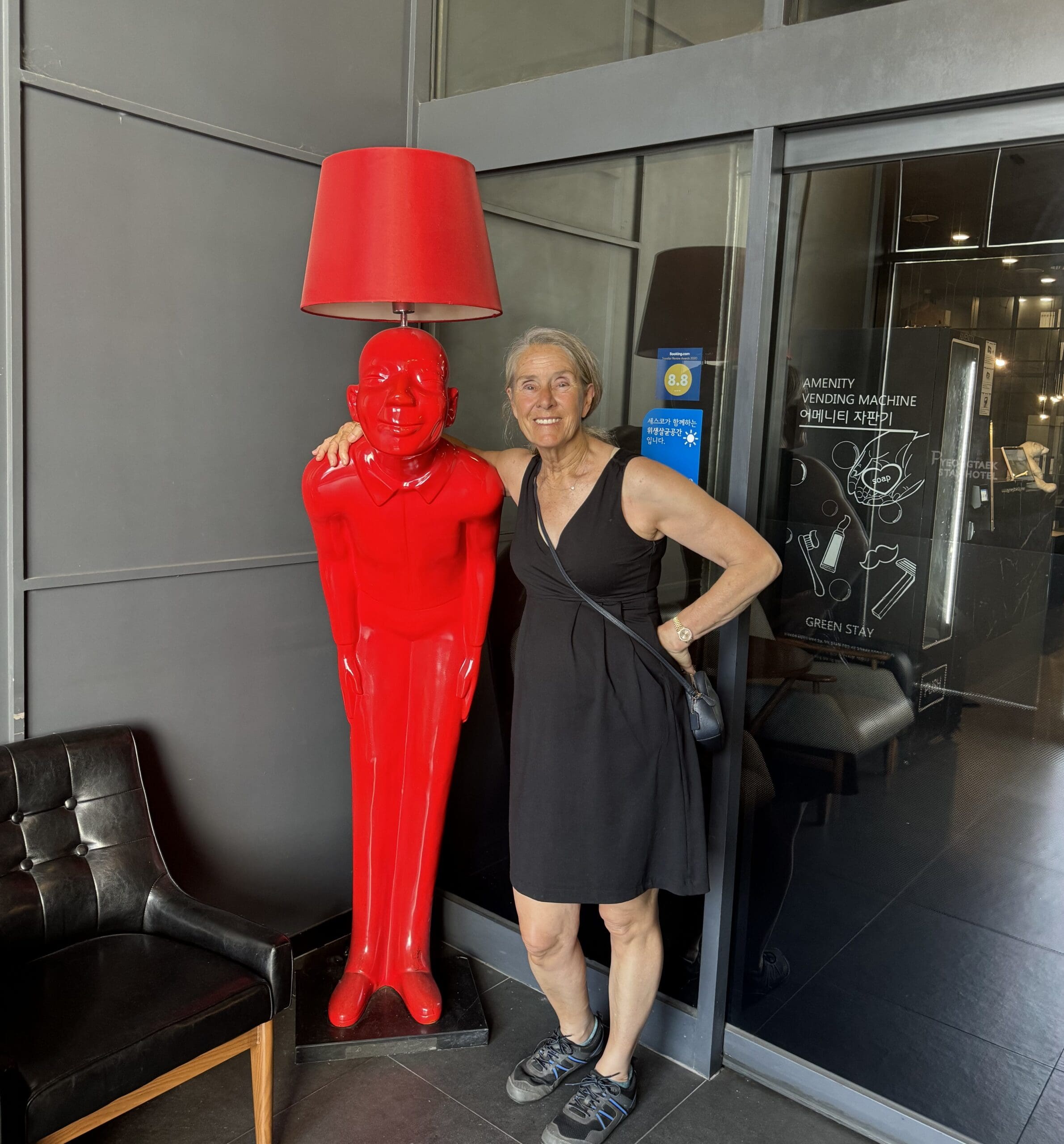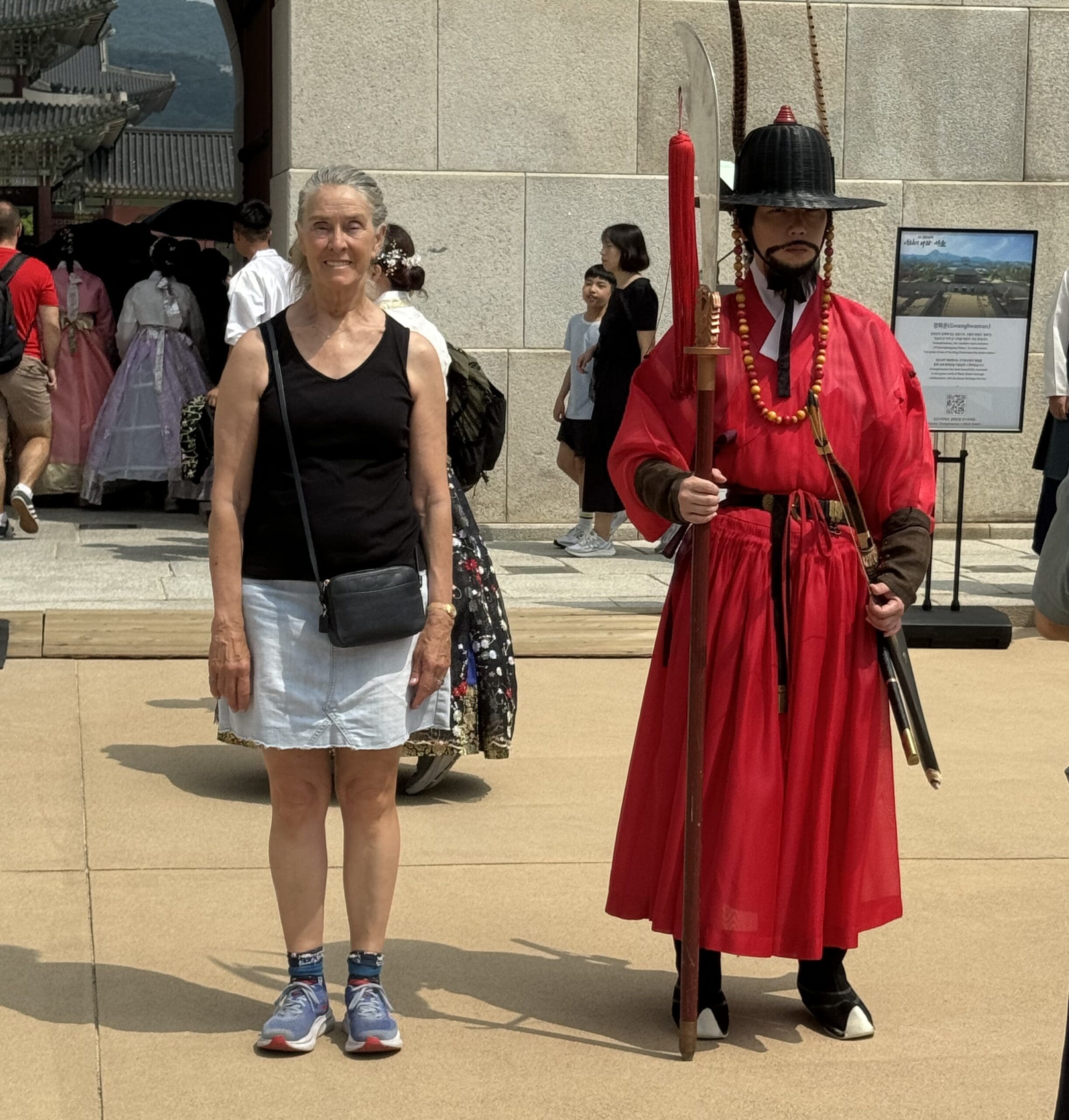
Taking a Tour to the North and South Korean Border: the DMZ.

Never having studied the Korean War in school (The Vietnam War got the press), I was only marginally informed about the Demilitarized Zone and the history of the two countries.

After my visit, I learned that issues today in that part of the world are often easily ignored for simpler and mindless clickable stories, such as the divorce of Jaylo and Ben Affleck and what really works on toenail fungus.

We had spent a weekend in August with our son, who was based at a camp near Pyeongtaek, South Korea. He was required to be back on base, so my husband and I signed up for a tour of the DMZ.

The tour originated in Seoul about 30 miles from the North-South border, and we were warned it could be cancelled at the last minute because of political instability and the possibility of conflict.

What? Today in 2024?

Our tour group, which included us, two Americans, also had two Brazilians, two Canadians, two Italians and a French woman. Our guide was a 30-year-old that had served in the South Korea air force. He patiently led us through the geography and dynamics of that area.

The 155-mile-long, 2.5-mile-wide DMZ is the world’s most heavily-armed border.
The Korean peninsula borders China and Russia. China is North Korea’s largest economic partner. As we traveled toward the DMZ, high-rises were fewer, and mountains filled with trees and greenery became dominant.

The long-time unification attempt between North and South Korea is once again on hold as Russian Prime minister Vladimir Putin gave North Korean leader Kim Jong-un two Aurus cars. In June, the two countries declared themselves as allies because Russia needs large quantities of munitions for Ukraine, which would be supplied by North Korea.

I wondered if President Biden had visited and offered three cars to Kim Jong Un, would that have persuaded him not to give arms to Putin? (Okay, so I’ll never be an international negotiator.)

Military service in South Korea is mandatory for men and lasts about two years.

By contrast compulsory military service in North Korea varies from 5-13 years; reportedly up to 10 years (7 for women) for those serving in combat units and 13 years (7 for women).

No individual automobile trips are allowed to the DMZ. According to the guide, passports are now required, ever since South Korean-based US Army soldier Travis King ran away to North Korea.

King had been in a South Korean prison for assault charges and possible child pornography charges. He was under military escort to board a plane at Incheon. But he did not board, left the airport and joined a group going to the Demilitarized Zone. At Panmunjeom or the Joint Security Area (JSA), which is inside the DMZ, he bolted across the border.

Now, tourists are not allowed at the JSA, where the armistice was signed. On this day we were also not allowed near the speakers that broadcast the propaganda from South to North Korea because of retaliation concerns.

Tourists were not allowed to visit the hill, where the speakers were located because of rising tensions.

The 1950 war started when North Korea backed by China and Russia invaded South Korea. The United Nations approved an offensive by UN forces and combined forces prevented North Korea from imposing communist rule on South.

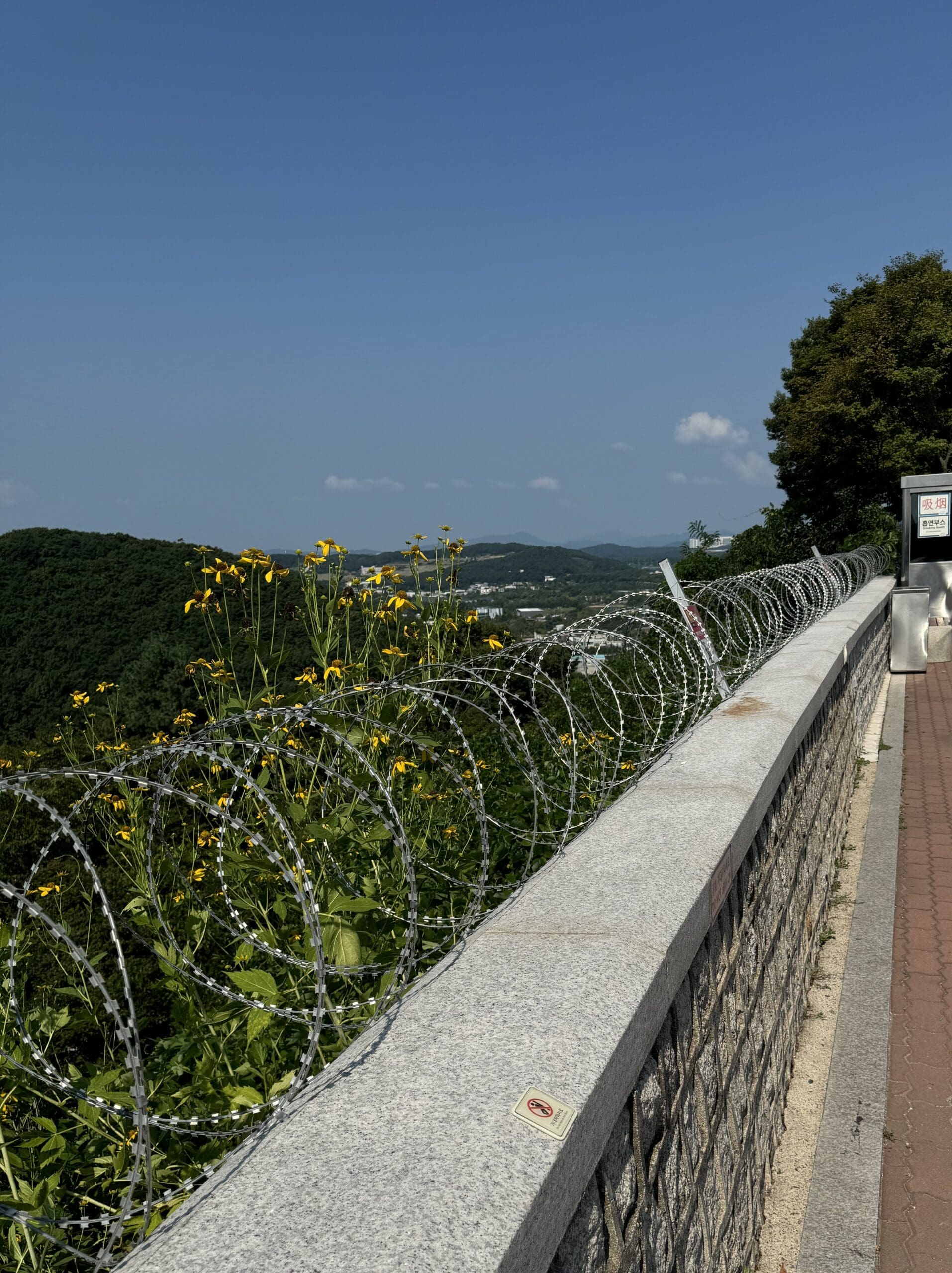
The country was divided in half at the 38th parallel, communism to the north, capitalism to the south. The DMZ is still patrolled, there are barbed wire fences.
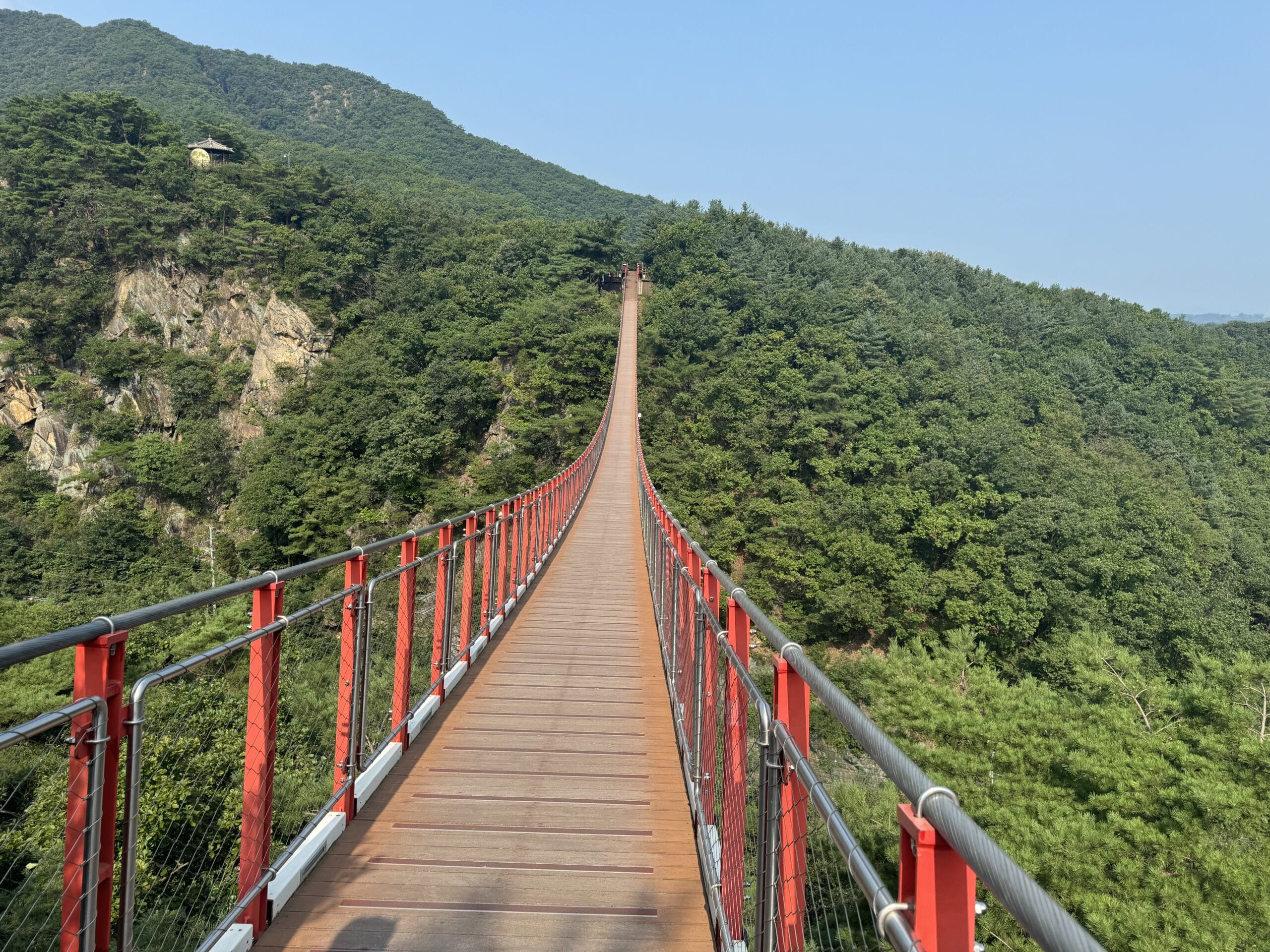
This bridge is near the Gloucester Hill Battle Monument.

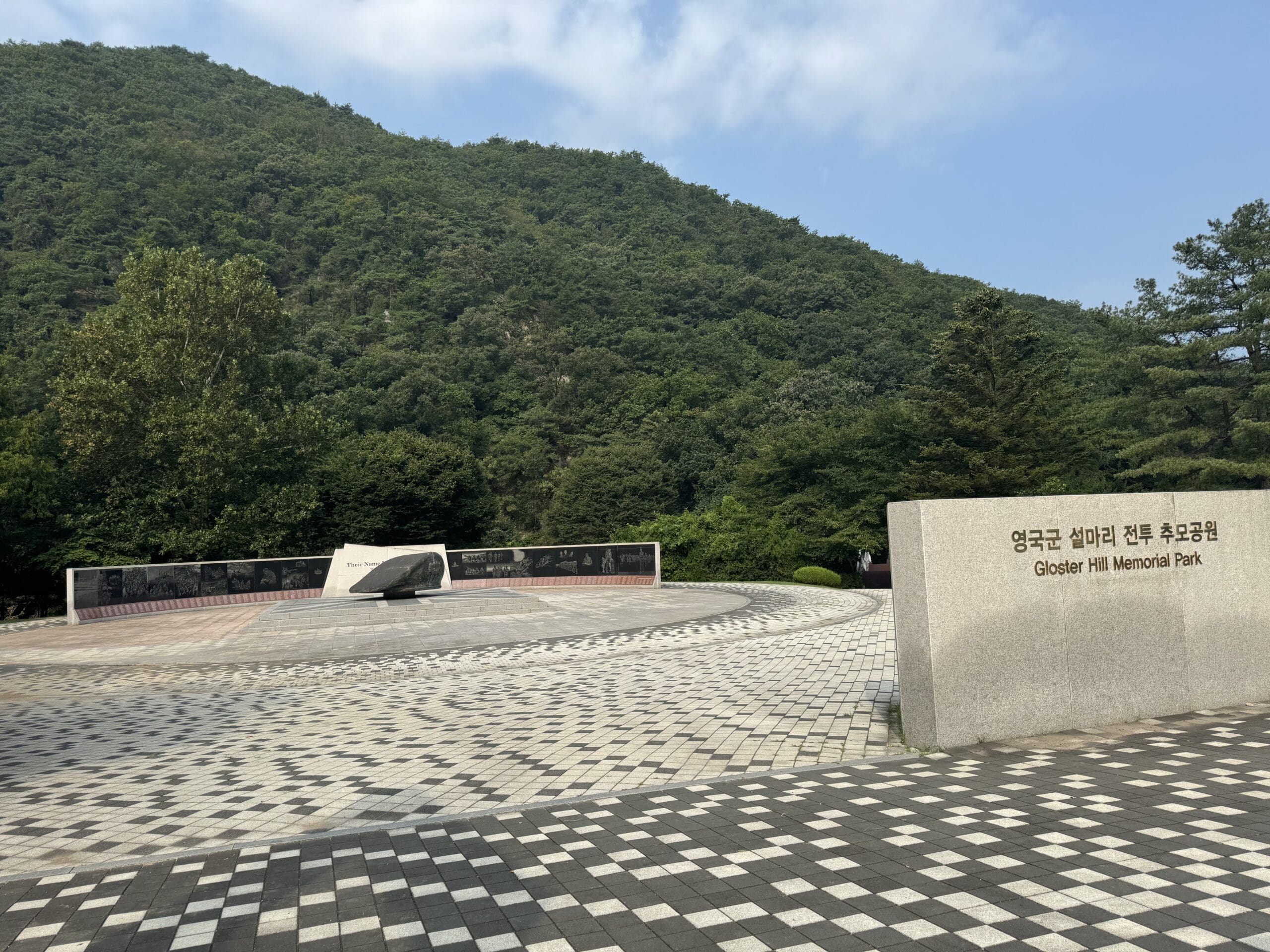
Our first stop was the Gloucester Hill Battle Monument 파주 영국군 설마리전투비. The memorial stands at the foot of Gloucester Hill, the initial location of the Gloucestershire Regiment’s headquarters during the battle at Imjin River (April 21 to 25, 1951). The 29th Brigade of the British Army despite being outnumbered held the line and disrupted the North Korean offensive, preventing an advance to Seoul.

According to Lee In-jae, the mayor of Paju who raised money among local citizens to expand the park which was unveiled in 2014, “Freedom is not free – it is earned with blood.”
We drove by Dorasan Station, a modern rail station, which appeared to be closed. Our guide said it was built so that at some point in the future, Koreans could leave Seoul, travel to North Korea’s Phyongyang and then travel to Europe by Trans-Eurasia Railway. He said that immigration and custom offices had been installed, for the day when a rail service, could cross Asia and then Europe arriving in Paris.

Former South Korean President Kim Dae-jung and former U.S. President George W. Bush signed their name on a railroad tie, expressing hope for peaceful unification in February 2022.

Imjingak, our next stop, was built at the South Korea border in 1972 for the benefit of displaced North Koreans. Our guide said there are two major holidays in Korea, New Year’s Day and Chuseok (Korean Thanksgiving). During those holidays, people return to their ancestral home.
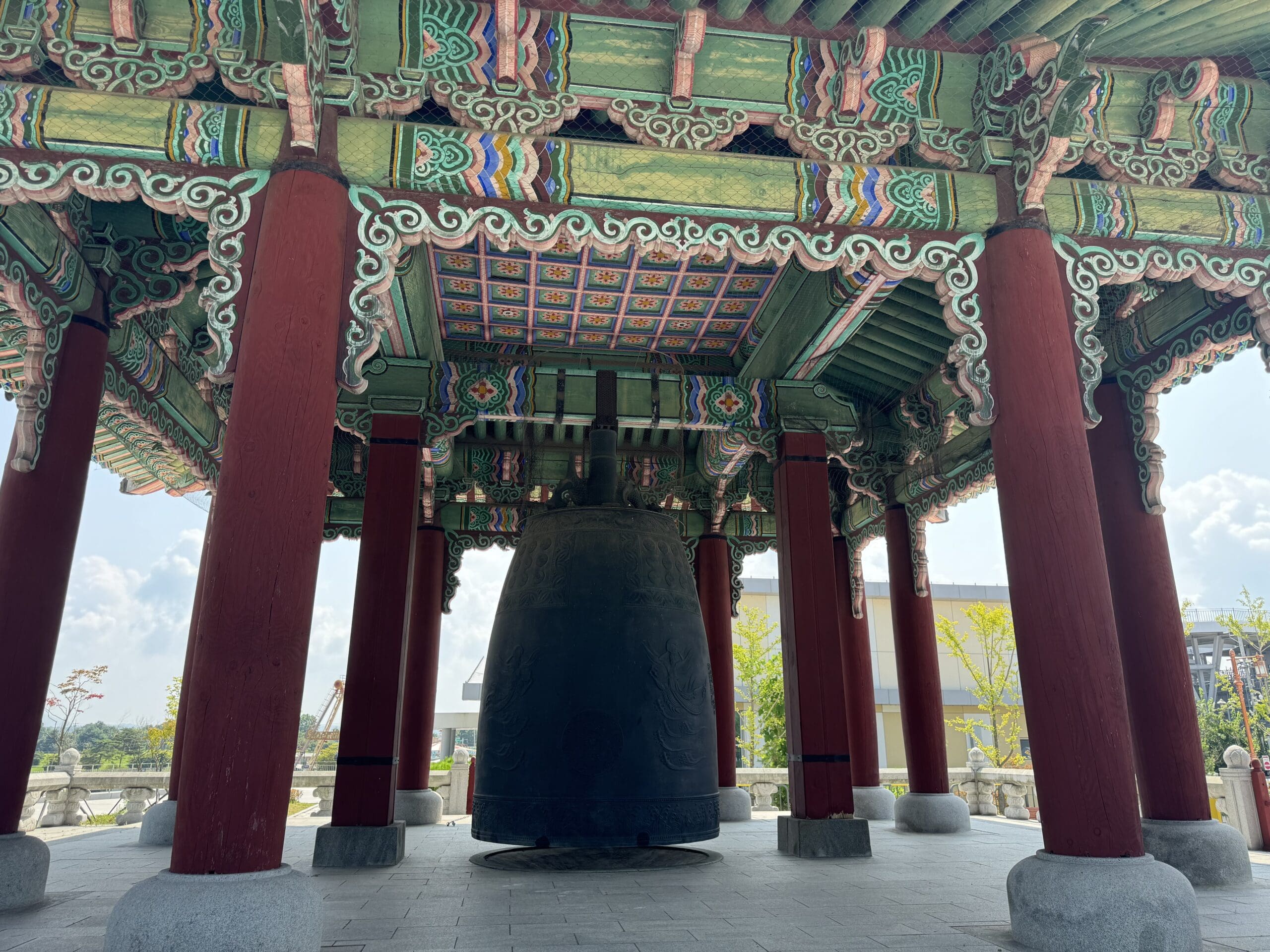
This bell is located at Imjigak near the Freedom train.

Now, since South Koreans cannot travel to North Korea, they visit this location, the Mangbaedan, to perform ancestral rites. Our guide showed photos of several families and especially of the older people who were crying because they could not return to North Korea to visit their hometown.

The Bridge of Freedom, which South Koreans crossed when they came from North Korea after the Armistice Agreement was signed, stands behind Mangbaedan Alter.

Looking out from this location, we could see the demilitarized zone across the river and the Unification Bridge or “Cow bridge,” which we would cross.

At 17, Chung Ju-yung, who later developed Hyundai, left North Korea with 70 won, he took from his father, after a family cow had been sold. In 1988, almost 66 years later, Ju-yung returned to North Korea with a long line of trucks carrying cattle, to pay back his late father a thousand times for his wrongdoing in his youth.  (There’s a life-sized plastic cow below the beginning of the bridge.)
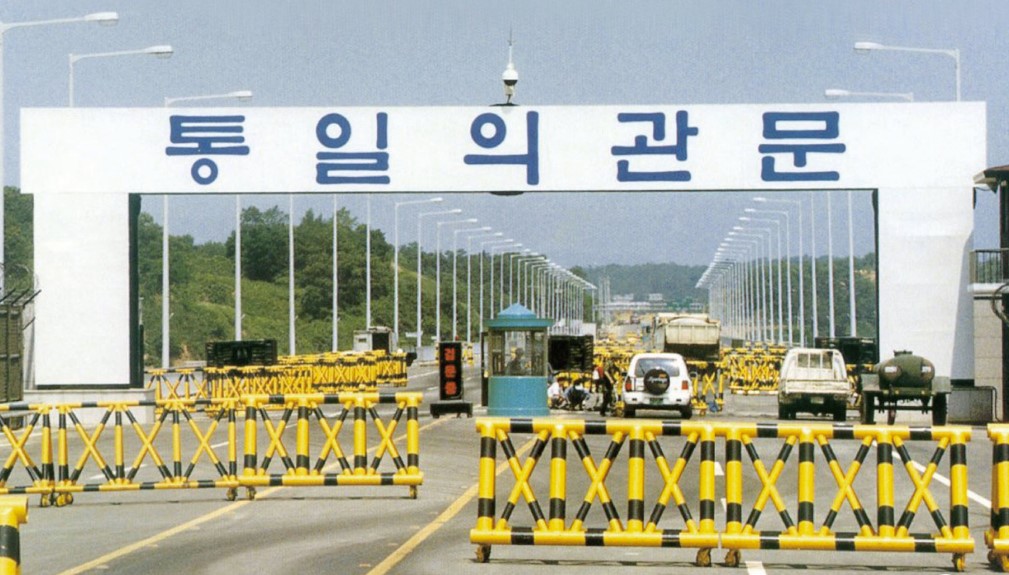
After passports were examined by South Korean military (no photos could be taken), our bus was allowed to proceed.

As we went by the countryside, our guide said there are an estimated two million mines inside and near the border that North Korea air dropped. A South Korean detachment goes into the countryside, to try and find and denote the bombs.

We arrived at the third tunnel and the DMZ.
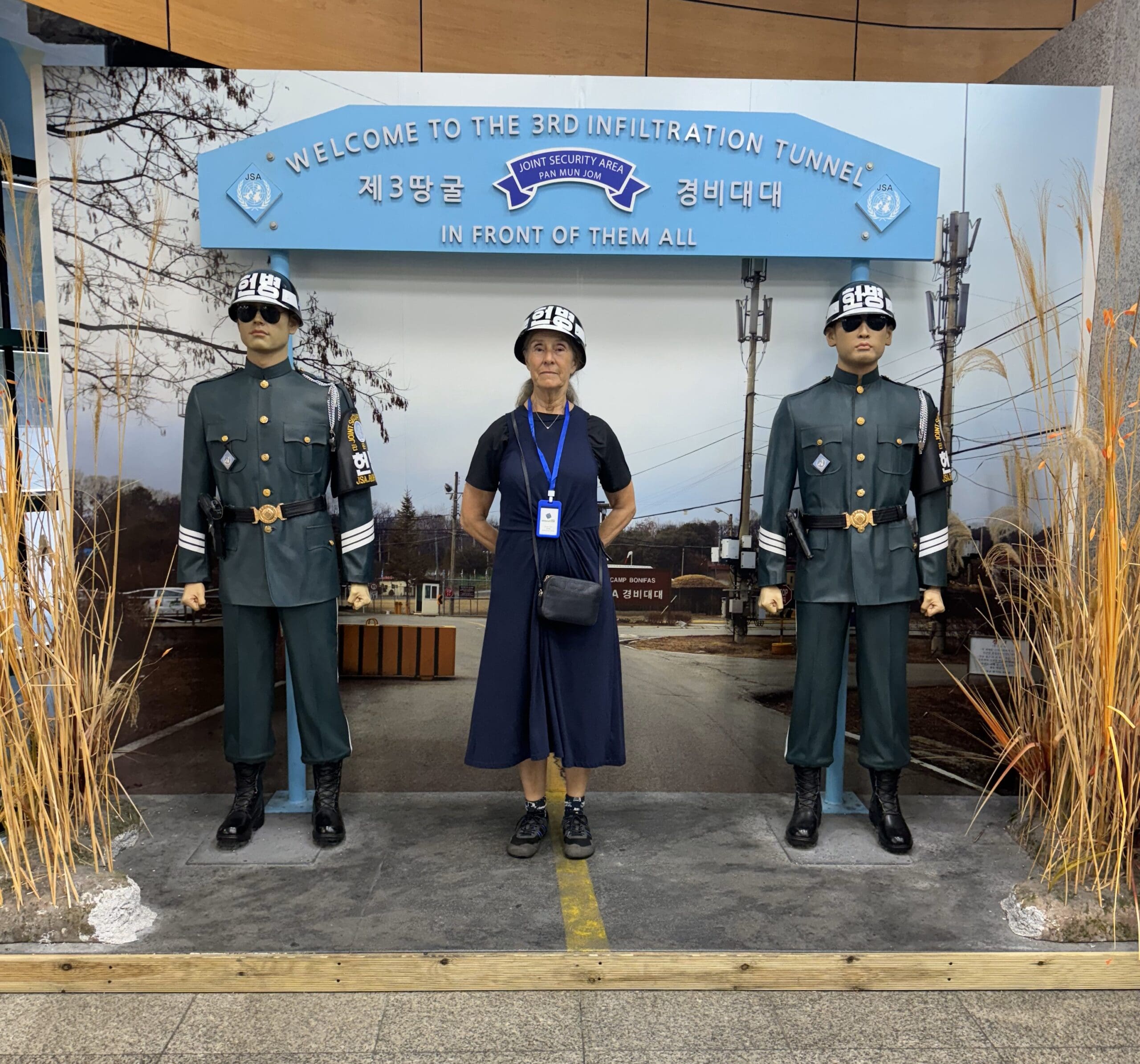
The third tunnel refers to one of the tunnels dug by North Korea southward under the DMZ from 1960s-1980s with plans to conduct a surprise attack, sending troops underground toward Seoul.

The first tunnel was discovered in 1974, the second in 1975, the third tunnel, which visitors are allowed to visit, was discovered on October 17, 1978. A fourth tunnel was discovered in March 1990.

The third tunnel measures 2m wide, 2m high, and is over 1,635m long—large enough to accommodate some 30,000 soldiers per hour.

Kim Bu-seong, a tunnel engineer who defected from the North to the South, reported the third tunnel’s existence. Detection work began on September 5, 1974 and it was discovered south of Panmunjom in 1978. North Korea claimed the tunnels dug in granite were for coal mining, but there was no coal.

The day we visited, neither the elevator nor the tram was working. We were given hard hats and allowed to walk down about seven stories on a sloping walkway, to access the tunnel. All phones and cameras had to be stowed in a locker.

Our Brasilian tour companion, who was close to seven feet tall, had to hunch over for the majority of the walk. Even this editor, that stands at 5’9” had to crouch in several places to avoid hitting her head.

It was blissfully cool underground, especially after enduring the extreme heat and humidity above.
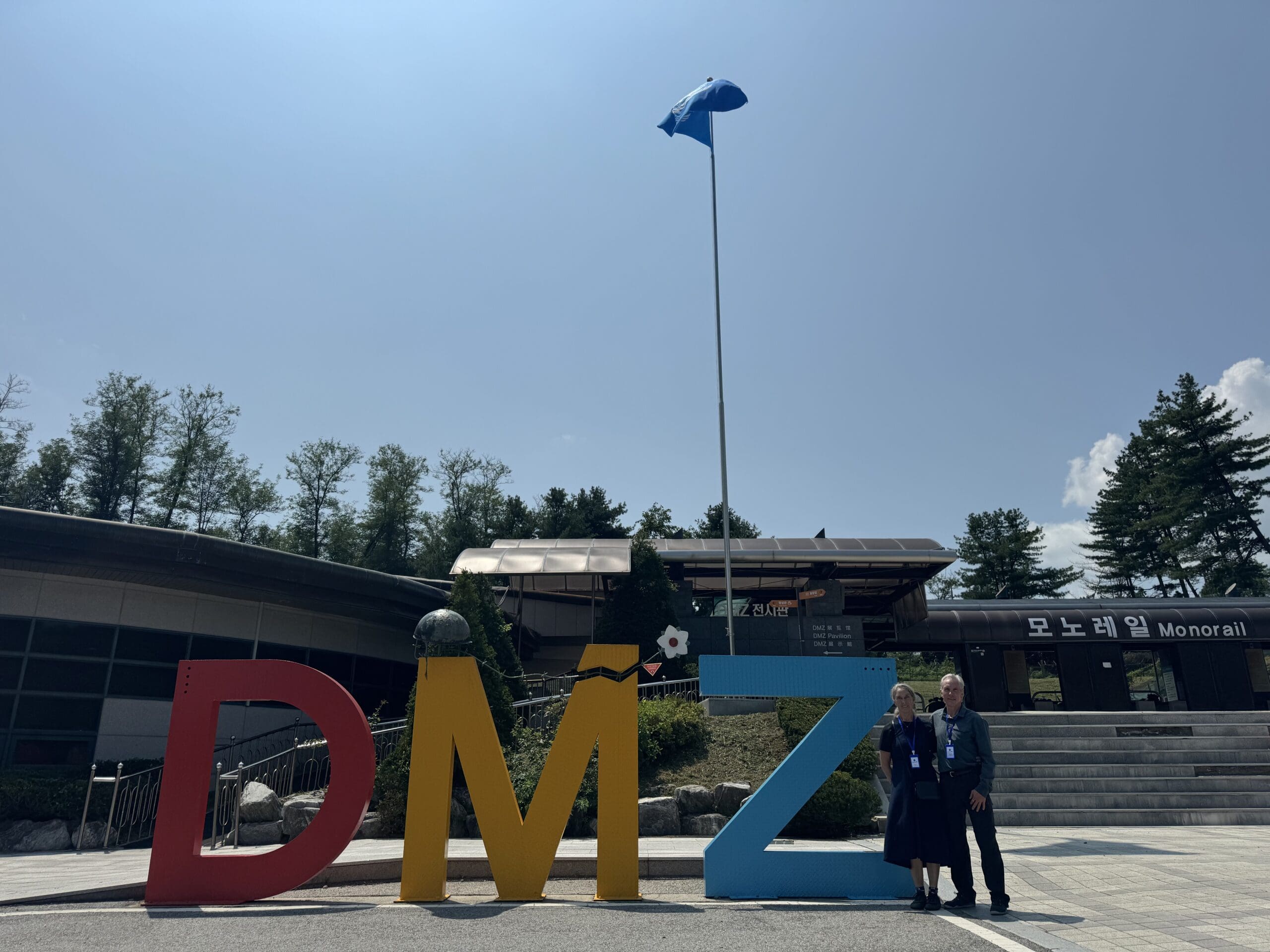
After the obligatory photo in front of the DMZ sign, the bus loaded and we headed back to South Korea—once again displaying passports to soldiers.

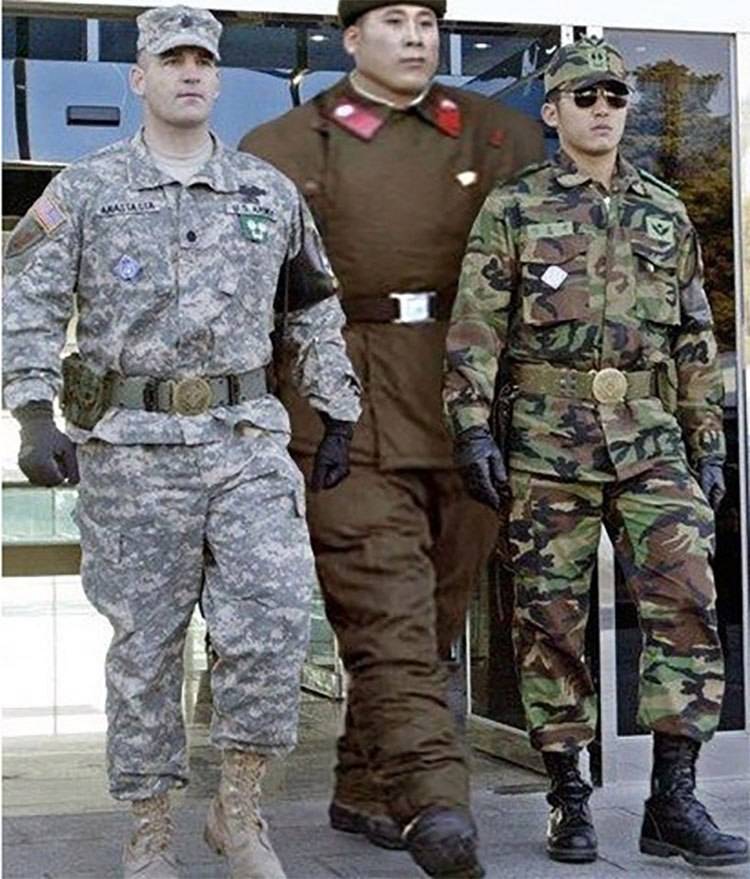
The guide showed us a photo of three soldiers, which had greatly displeased the North Korean leader. Because of food shortages in North Korea and inadequate nutrition, the men tend to be shorter than their U.S. and South Korean counterparts.
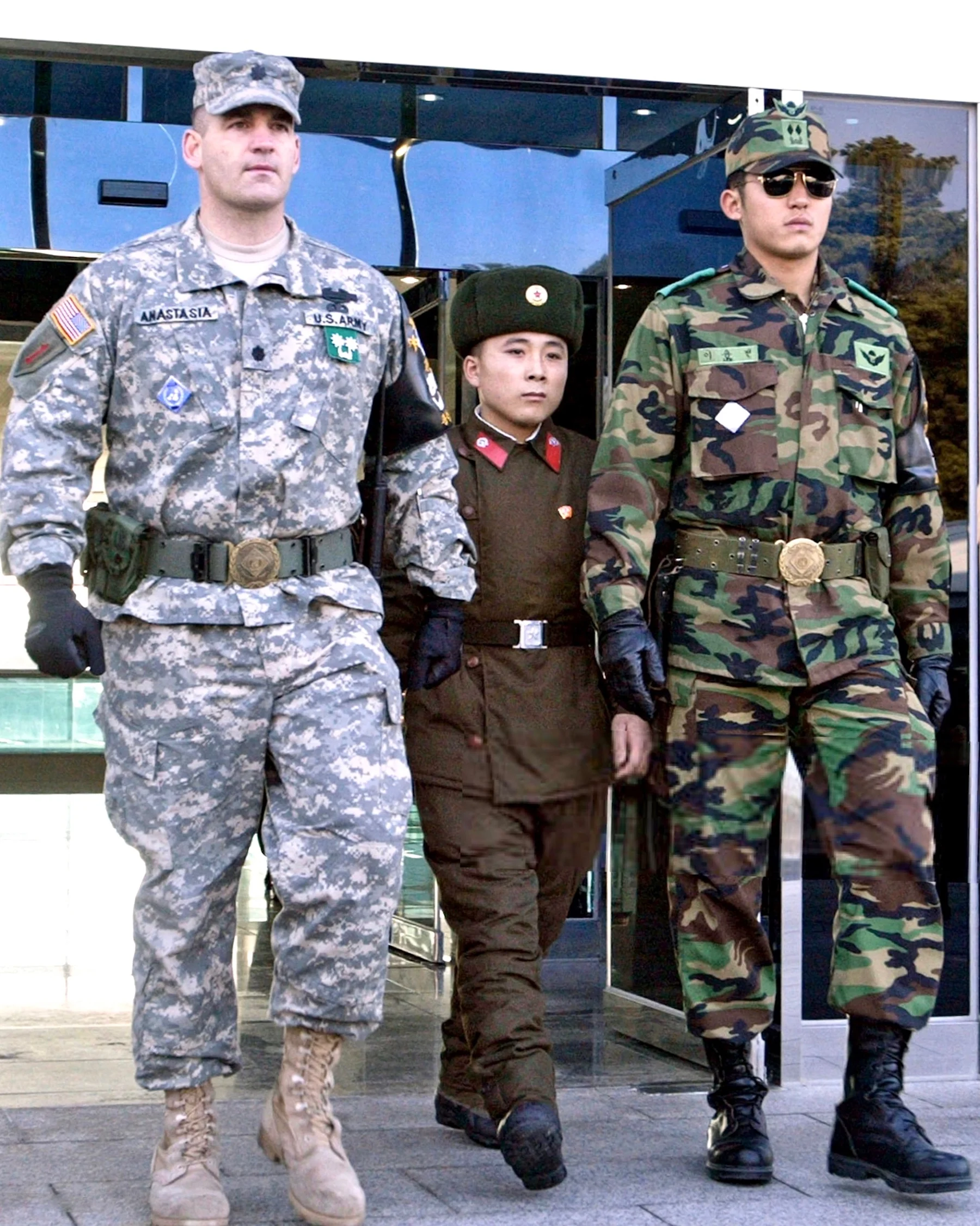
The World Food Program estimates that 6 million of North Korea’s 25 million people need food aid and one-third of children are chronically malnourished or stunted. Analysis of escapees from North Korea shows that those born after the Korean War in the late 1950s were on average about 2 inches shorter than South Koreans.

No problem for Kim Jong-un. Photoshop.
South Koreans work at Kaeson Industrial Complex in North Korea, which was opened to encourage cooperation and to also allow North Koreans employment.

The guide said that once the South Korean government learned that the North Korea government was taking 70 percent of what workers were making and using it for military expenditures, the employment stopped. “Why should we pay people to build arms that might hurt us?” the guide asked.

North Korea spent about one third of its national income on the military, according to a 2011 report from the South Korean government.

Our final stop was Odusan Unification Tower click here.

There is an observatory overlooks the confluence of the Han and Imjin Rivers. From the building, one can look across the river to North Korea. On the other side of the building one can look at South Korea.

North Korea is across the river and to the left from the Odusan Tower it is a rural area and with the telescopes you can see farmers. Seoul is to the left.

The Imjin River flows into the Han, but the rivers are tidal so when the tide is low one could walk to North Korea. The river is only two kilometers wide, but people have not been allowed to cross it for more than a half century.

There was massive flooding in North Korea’s northern regions in late July.  South Korean media reported a possible death toll of up to 1,500 people. Our guide said that many in South Korea had cut the trees from the hillsides to burn for fuel in the winter, which probably did not help the hillsides and flooding.

As of August 8, two North Koreans have successfully defected. Park Won-gon, a professor at Ewha Woman’s University, said a rise in defections suggested the “internal situation is bad in North Korea.”

Annually, South Korea and the United States hold joint military exercises, the Ulchi Freedom Shield, and this year they were set to run from August 19 to 29. North Korea historically brands the exercises as rehearsals for invasion, and often uses them as justification for its continued development of nuclear weapons and missile systems.

Recently, the North has launched thousands of balloons carrying trash, contaminated with fecal matter, across the border. In response, South Korea suspended a military tension-reducing deal and restarted propaganda campaigns along the border.

I asked our guide how he felt about unification between North and South Korea. “A survey was done and only about 40 percent of the younger people want to unify,” he said, noting that that generation doesn’t have the history with the North that the older generation does.

And then, there would be a great cost to South Korea. He said that the West German government had to pour enormous amounts of money into the impoverished East Germany to bring it up to the standards in West Germany, possibly has much as $2 trillion. The same would have to be done for North Korea.click here.

This was the first photo our guide showed us. It was taken at night, and Elon Musk quipped Additionally, the photo was captioned with a provocative thought: “Crazy idea: Let’s divide a country into half capitalist and half communist and check on it 70 years later.”

Posted in General | 6 Comments

Pot Shots #24


What are Pot-Shots?

Ashleigh Brilliant writes:

WHAT EXACTLY IS A “POT-SHOT” OR “BRILLIANT THOUGHT?”

Pot-Shots are epigrams, composed according to the following very strict rules.

The length must never exceed 17 English words. Note that this is a maximum. Some Pot-Shots are much shorter. Hyphenated words count as a single word.

Pot-Shots must be easy to translate into other languages. Therefore there can be no use of rhyme or rhythm, idioms, puns, or other word-play.

Pot-Shots should be capable of being appreciated in all times and cultures. Topical and cultural references must be avoided.

Every Pot-Shot should be as different as possible from every other one.

Every Pot-Shot must be totally original, and unlike anything else the author, or anyone else, has ever said before.

The words of a Pot-Shot must be able to stand on their own, and not require any illustration in order to be understood or appreciated.

Whatever is being said should be worth saying and said in the best possible way.

NOTE: These are ideal standards, and I myself have failed to meet some of them occasionally — but in general I have adhered to them quite scrupulously

Posted in Pot-Shot | Leave a comment

Palisades Symphony Orchestra Will Perform Opera Favorites

Come listen to the Palisades Symphony concert on August 25.
Photo: RICH SCHMITT/CTN

Residents do not have to leave Pacific Palisades to enjoy quality concerts, and this end-of-summer concert should be spectacular.

The Palisades Symphony Orchestra will perform “Opera Favorites,” under the direction of guest conductor Alan Medak at 7:30 p.m. on Sunday, August 25 at the Palisades Lutheran Church, 15905 Sunset Boulevard. The concert is free, and donations are appreciated. There is free parking.

Singers participating are soprano Natalie Salins, mezzo-soprano Jessica Mamey, tenor James Nathaniel Salazar and baritone Eric Castro.” They will perform arias from Donizetti, Mozart, Puccini, Offenbach, Verdi and Rossini.

Special guest flutist John Barcelona will be featured in Doppler’s Hungarian Fantasies.

The program includes selections from:

Hänsel und Gretel by Engelbert Humperdinck

Lucia di Lammermoor by Donizetti

Fantaisie pastorale hongroise by Franz Doppler

Don Giovanni and Cosi fan Tutte by Wolfgang Amadeus Mozart

Turandot and La Bohème by Giacomo Puccini

Tales of Hoffman by Jacques Offenbach

Barber of Seville by Gioachino Rossini

La Forza del Destino by Giuseppe Verdi

As a special treat, a young Ukrainian Azusa Pacific grad student Andrii Karatai will conduct the aria from Tails of Hoffman “Bella Nuit.”

The Symphony, a nonprofit, was founded by Joel B. Lish, in 1966 and remained under his direction until his death this past March.

He handed the baton to Dr. Maxim Kuzin, who led his first concert in June. Prior to his newest role, the Ukrainian-born conductor is currently the Music Director of the Thousand Oaks Philharmonic and the UC Santa Barbara Chamber Orchestra. He also guest conducted for several Eastern European orchestras, including the National Philharmonic Orchestra of Ukraine, Presidents Orchestra of Ukraine, and the National Symphony Orchestra of Georgia.

Kuzin, who moved to the United States in 2014, received his doctoral degree in Orchestral Conducting at UCLA.

To email: [email protected] or to make a donation mail a check to: Palisades Symphony Orchestra, Inc. P.O. Box 214, Pacific Palisades, CA 90272


Posted in Music | Leave a comment

South Korea – Part II Subways and Homeless

(Editor’s note: After a weeks trip to South Korea the comparisons between Seoul and Los Angeles was glaring.)

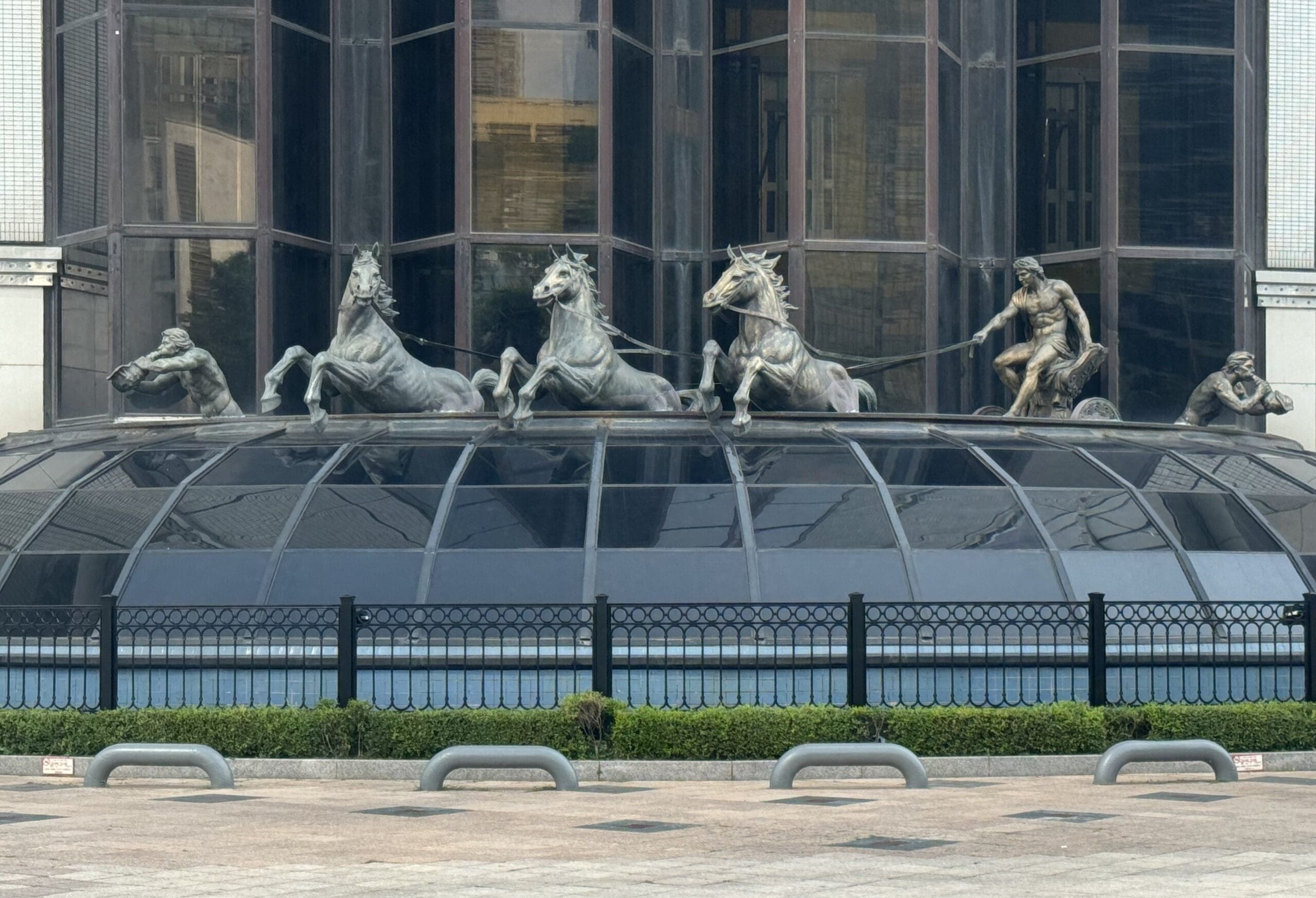
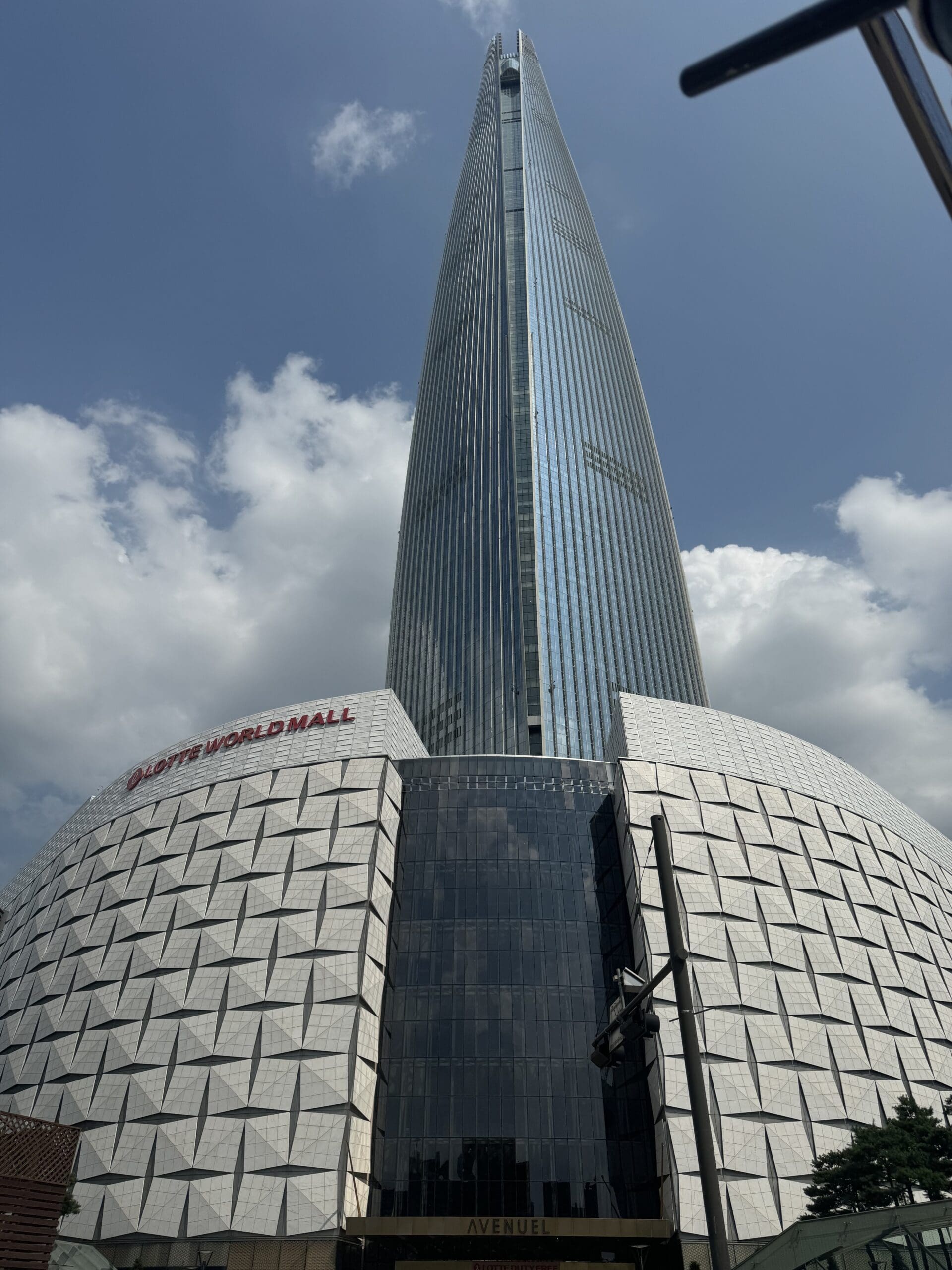
Seoul had parks and interesting street sites between the many high-rises, such as this one in front of Lotte World.

You live in a nice house, but then you are invited to a party at a large-scale and grander house. When you come home, your house looks shabby – and you never really noticed it before.

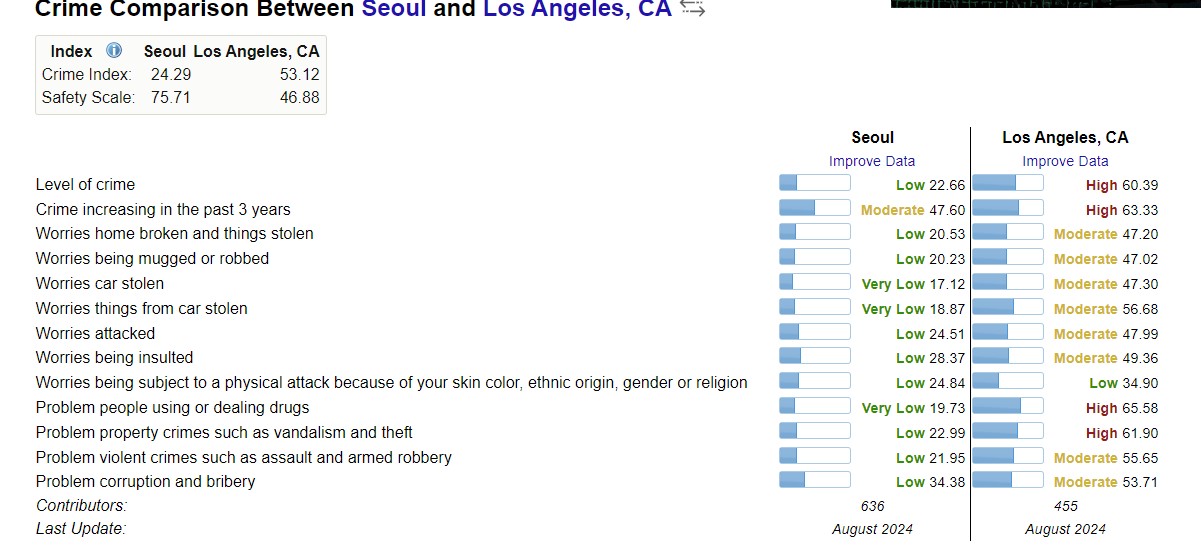
South Korea has high rises with interesting architecture framed by parks specifically built to ensure green space. The roads in Seoul wide, clean and well-kept. Homeless were not apparent, the streets safe, the subways safer and there was no trash anywhere.

When I arrived back in L.A. It seemed dirty and small, and I once again had to be hyper cognizant of my surroundings. I read that “Federal authorities have charged two men with stealing a million-dollar Patek Philippe from at the patio restaurant of the Beverly Wilshire Hotel on August 7.” In March, L.A. residents were warned by police that “wearing expensive jewelry in public could make them a target for thieves.”

But that was not the case in South Korea.


Waiting for the #1 train.

THE SUBWAY:

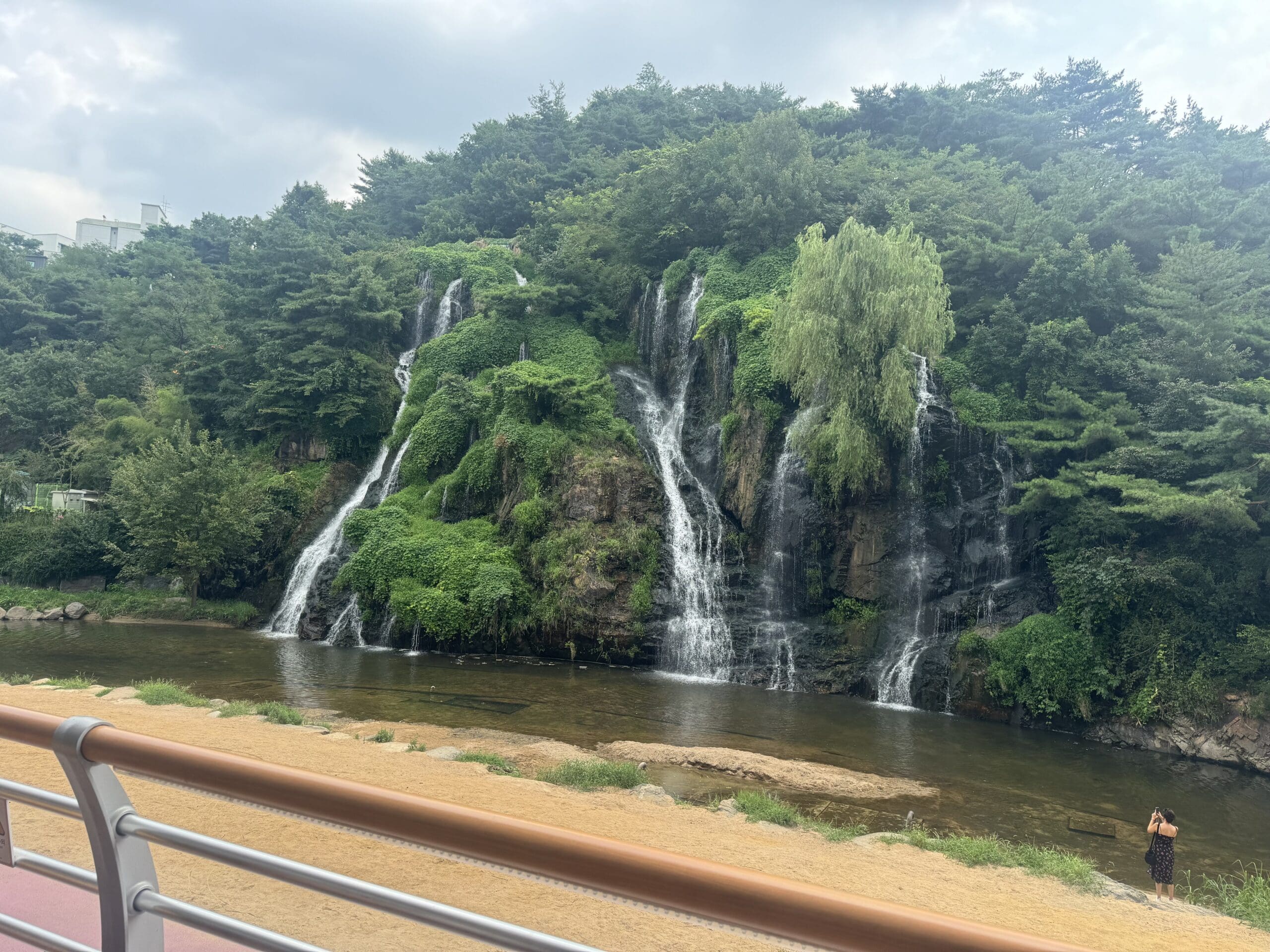
After leaving the lovely larger regional train at the Seoul Station on Sunday, we spent three hours in the subway 수도권 전철, trying to make our way to the waterfalls in Ansan Park.

There were large underground shopping areas at the subway stations. This exceptionally clean station was typical.

The description to reach our destination sounded easy: to reach the trailhead, take the 7713 or 7738 from Exit 4 of Hongje Station (홍제역) and get off at Dongsin Hospital (동신병원). After crossing the crosswalk, you’ll find the Hongjecheon Artificial Falls, where the trailhead is.

Somewhere we must have missed a transfer, or taken the wrong train, and we rode and rode. But, there was air-conditioning, and clean public bathrooms with toilet paper, no matter what part of the underground we walked in. I read that climate-controlled seats are automatically heated in the winter.

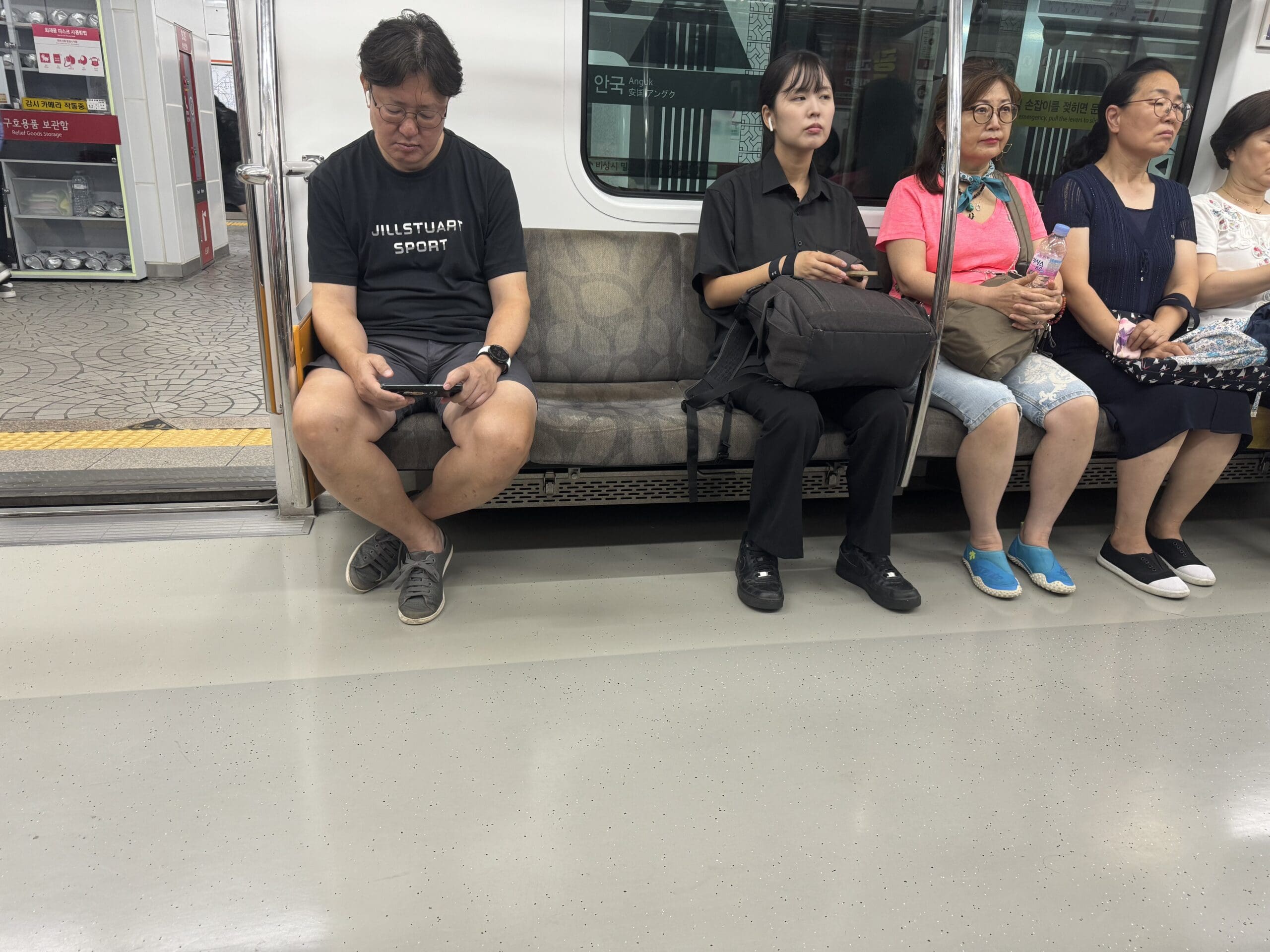
Traveling in large cities, I had learned in my 20s not to wear any flashy jewelry or carry expansive handbags on the train. Here I could have, people took pride and responsibility for keeping the trains safe. No one speaks loudly or plays music – or they’d be reprimanded by the train security officials. Having suffered in New York City subways in the hot summers in my 20s, I never wore sandals or open-toed shoes, because the floors and steps were so dirty. In Seoul, every subway floor looked like it had just been waxed.

Subway floors were all shiny clean.

One person on a platform, who tried to help us with directions, explained that you could “leave your backpack here. No one would take it and the people who work here would be able to trace it to you and give it back.”

Seoul has the world’s longest metro system by length. The first train opened in 1974 and now there are 768 stations, and the system length is about 809 miles. They say annual ridership is 1.91 billion riders on the Seoul subway lines 1-9. That doesn’t include the KORAIL, the regional trains. (By contrast, the modern L.A. Subway system was first proposed in the 1970s and opened its first station in 1990, annual ridership is listed as 61 million passengers and safety concerns are ongoing.)

All directional signs in the system are written in Korean, using Hangul, as well as English and Katakana/Chinese characters in Japanese and Mandarin Chinese. There are LCD screens that give service announcements and prerecorded voice announcements that give the upcoming stations.

There were no hawkers, beggers, homeless sleeping – and CCTV was everywhere. One elderly woman came through the train, slapping little posters on the wall by the doors. Not even 10 minutes later, an official came through and took the unauthorized verbiage off.

We finally took an exit–just to get off the train and out of the subway, and wandered through a street market.

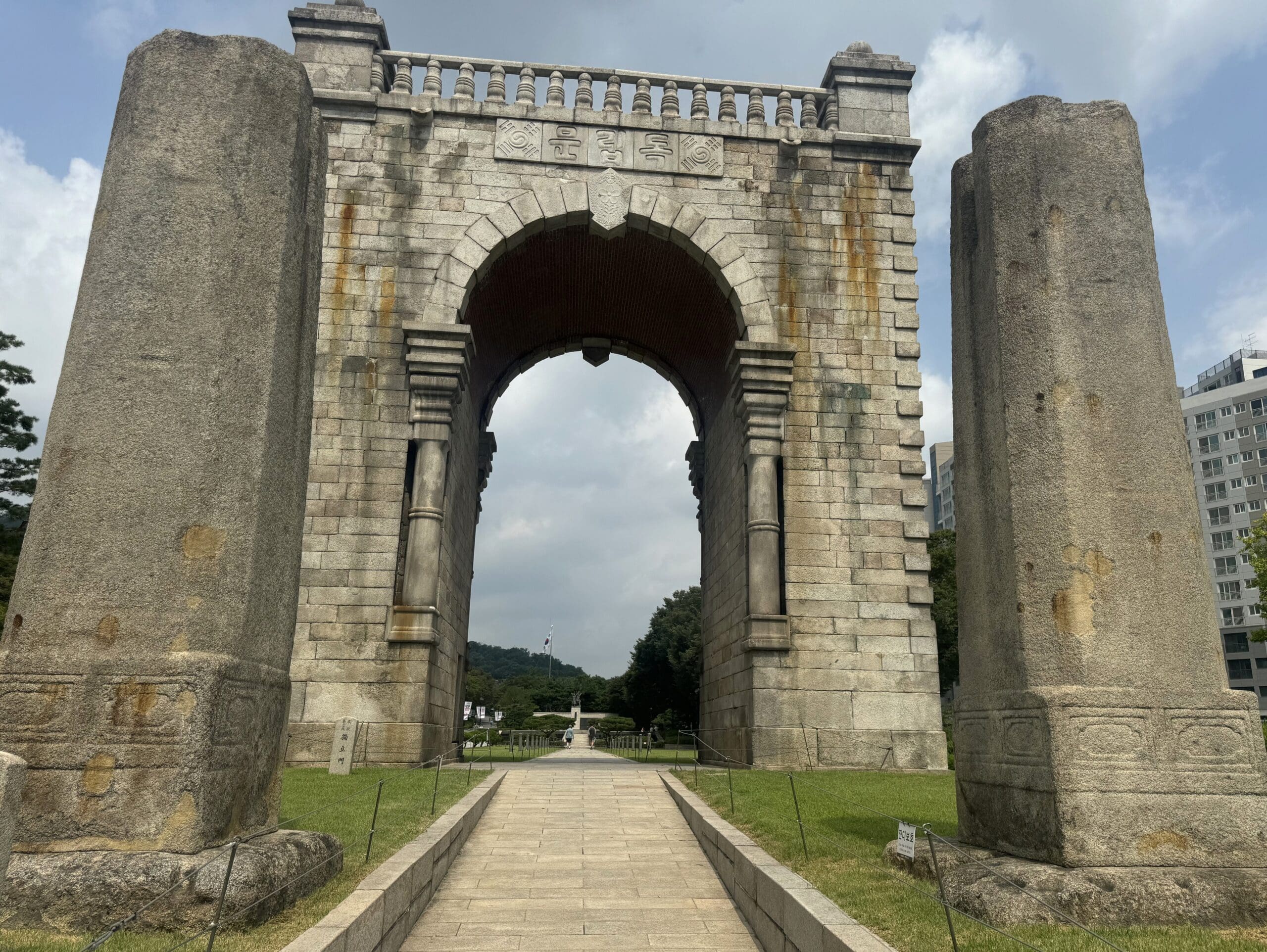
By accident, it was unplanned, we found Seodeamun Independence Park 서대문독립공원). Plinths of Yeongeunmun Gate, where Chinese emissaries were received during the Joseon Dynasty, are all that remain. Behind it are the Independence Gate Yeonjunmun 서울 영은문 주초 ( 서울 迎恩門 柱礎 ). A short walk through the park, put us at Seodaemun Prison, which was used to imprison thousands of Korean independence activists until the liberation from the Japanese occupation on August 15, 1945, as well as the political prisoners during the political turmoil in the 1960s.

I know nothing about Korean history, but learned the peninsula has been occupied by Chinese, Japanese and during the 1950 Korean War, much of South Korea had been destroyed. During that war, the Soviet Union provided training for North Korean and Chinese troops and South Korea received support the UN: United States, Canada, United Kingdom, Turkey, Philippines, South Africa, France, Australia, Columbia, Greece, Belgium Luxembourg and Ethiopian Empire.

We eventually found the waterfall, which was surrounded by a park with hiking trails.

HOMELESS:

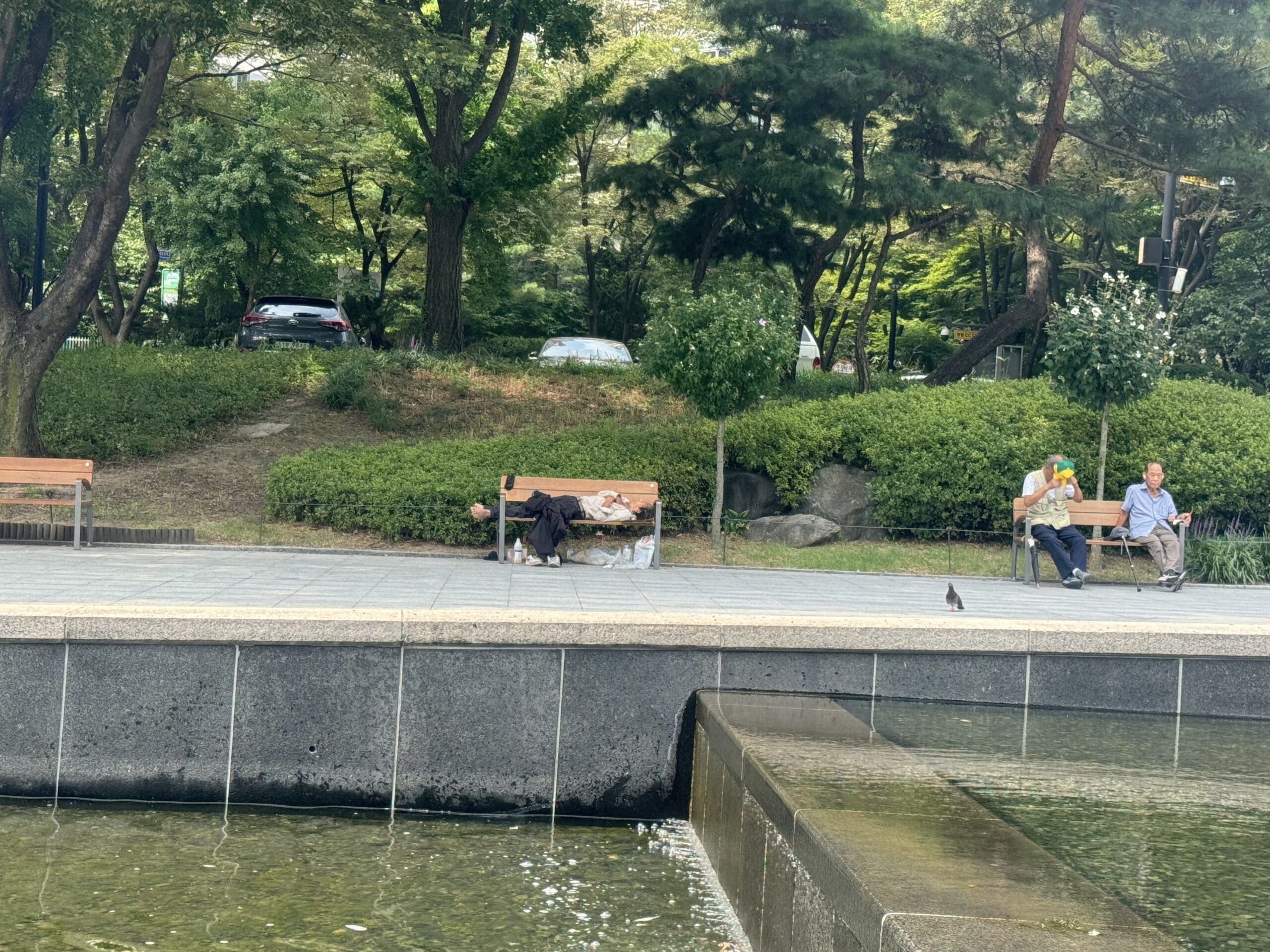
In all our travels around Pyeongtaek and Seoul and the numerous miles walked in the subways, I saw one homeless person sleeping on a bench. One. Seoul, a city of around 10 million, has an estimated 2,600 people on the streets or in shelters.

Dealing with the homeless in Los Angeles, and watching the people die on the streets, I wondered why the difference between the two cities? Homelessness in South Korea is caused by financial bankruptcy and alcoholism, according to the Seoul Metropolitan Government.

According to that group’s study, 24 percent of the homeless lost their homes due to snowballing debts. The study found that the average age of homeless people in South Korea is in their mid-50s.

People are offered shelters, but those sites have a zero tolerance to alcohol. This can make people who are homeless and struggling with alcoholism unable to find shelter (Borgen Project, 2020).

Could Los Angeles take lessons from Seoul?

Of all the train stations, the subways and parks we visited, we saw one homeless person by Seodeamun Independence Park.

LACK OF TRASH:

There seems to be litter everywhere in Los Angeles, unlike parts of South Korea, where cities and countryside were clean. There were no trash cans on the street, and people were urged to take trash home to recycle.

There are so many huge high rises, there are 10 million people in South Korea, I wondered  “where’s the trash going?”

I read South Korea is a global leader in sustainable waste management initiatives with a recycle and composting rate of around 60%. “The average Korean citizen now throws out about 1.02 kilograms of household waste daily, about a third of the amount produced in 1991 . . . By 2030, South Korea aims to reduce its plastic waste by 50 percent and recycle 70 percent of it.”

According to the internet source, South Korea has emerged as a global frontrunner in diverting food waste away from landfills and incinerators, thanks to the government’s substantial investments in processing facilities and the dedicated efforts of its citizens to repurpose waste. From a mere 2.6% in 1996, the nation’s food recycling rate skyrocketed to nearly 100% in 2022.

We finished the day by visiting the Lotte World Tower and Mall 롯데월드타워&롯데월드몰. It is the fifth largest building in the world with 123 floors https://www.lwt.co.kr/en/main/main.do

The amount of luxury stores was overwhelming and included Givenchy, Ralph Lauren, Bvlgari, Gucci, Louis Vuitton, Cartier – and even more – were located in the base of the building (and a large aquarium) and is considered the largest luxury department store in South Korea.

South Korea – Seoul’s Lotte Tower

The view at the top reminded me of when I had visited New York’s World Trade Center.

On the 118 Sky Deck floor, part of the floor is glass, and if you step on it, you look straight down.

Look at the glass on the floor by the windows. If you stand on the glass and look down, one can see all the way to the ground floor.

The Tower is relatively close to Olympic Park, and we passed the buildings used for the athletes for the 1988 Olympics.

We said goodbye to my son and then spent the remaining time in Incheon before taking a trip to the DMZ.

Tomorrow: Part 3, the DMZ, the third tunnel and looking at North Korea.

Posted in General | 3 Comments

Bull Bash and Tim Walz

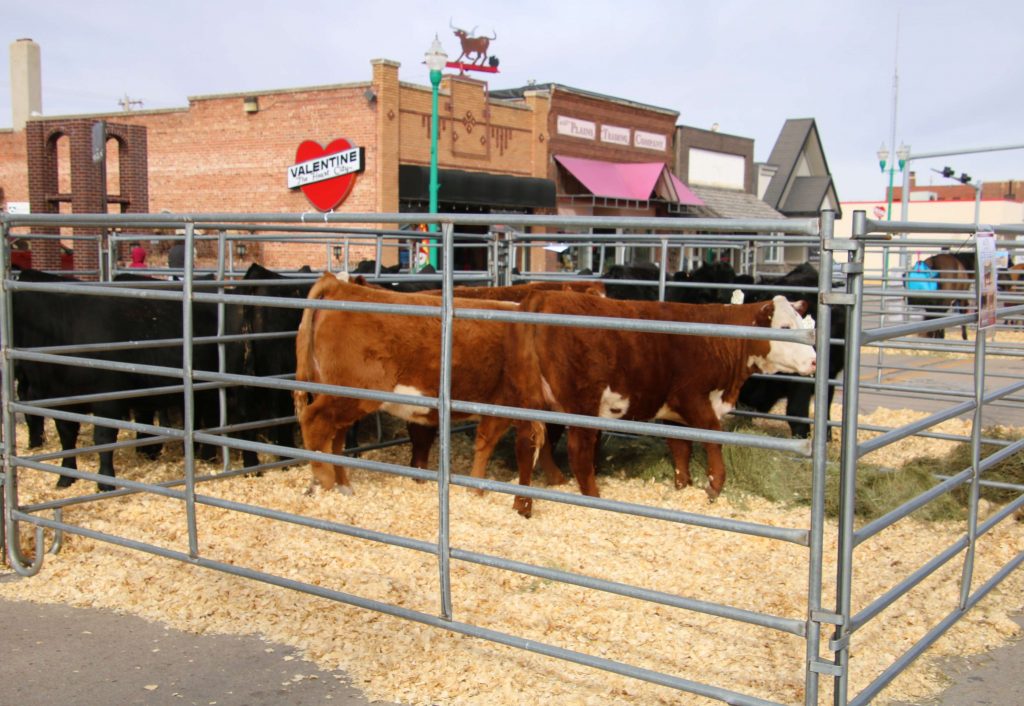
The Bull Bash is an annual event on the Main Street of Valentine, Nebraska.

The former Palisadian-Post editor Bill Bruns wrote CTN that “You ought to have a Musing that, “Who knew my relatives would be growing up next to a future VP candidate, in little Valentine, Nebraska.” He was referring to vice-presidential candidate Tim Walz.

We often visited Valentine, population 2,600, to visit Corrine and Emory Pascoe, my husband’s parents, who owned a beauty shop in town. I had even penned a story about the Heart City Bull Bash, a celebrated community event.

For at least the past two decades the Bash was “to showcase bull power that was available to ranchers to improve their herds,” and always took place around Valentine’s Day. Main Street was closed down, so that bulls could be showcased. There were a series of other events that could include fundraising for 4H (Luck of the Draw), wine tasting, a quilt show, dummy roping and even shopping specials at the local stores. https://www.bullbash.net/

People from all over the nation sent letters to be postmarked “Valentine” for February 14 and there was a Valentine’s Day coronation at the high school.

Corrine and Emory knew everyone in town—and my mother was a source of much “information” – and most of it accurate.

Sadly, they both have passed away or I’m sure one of the National journalists would have pumped her for information.

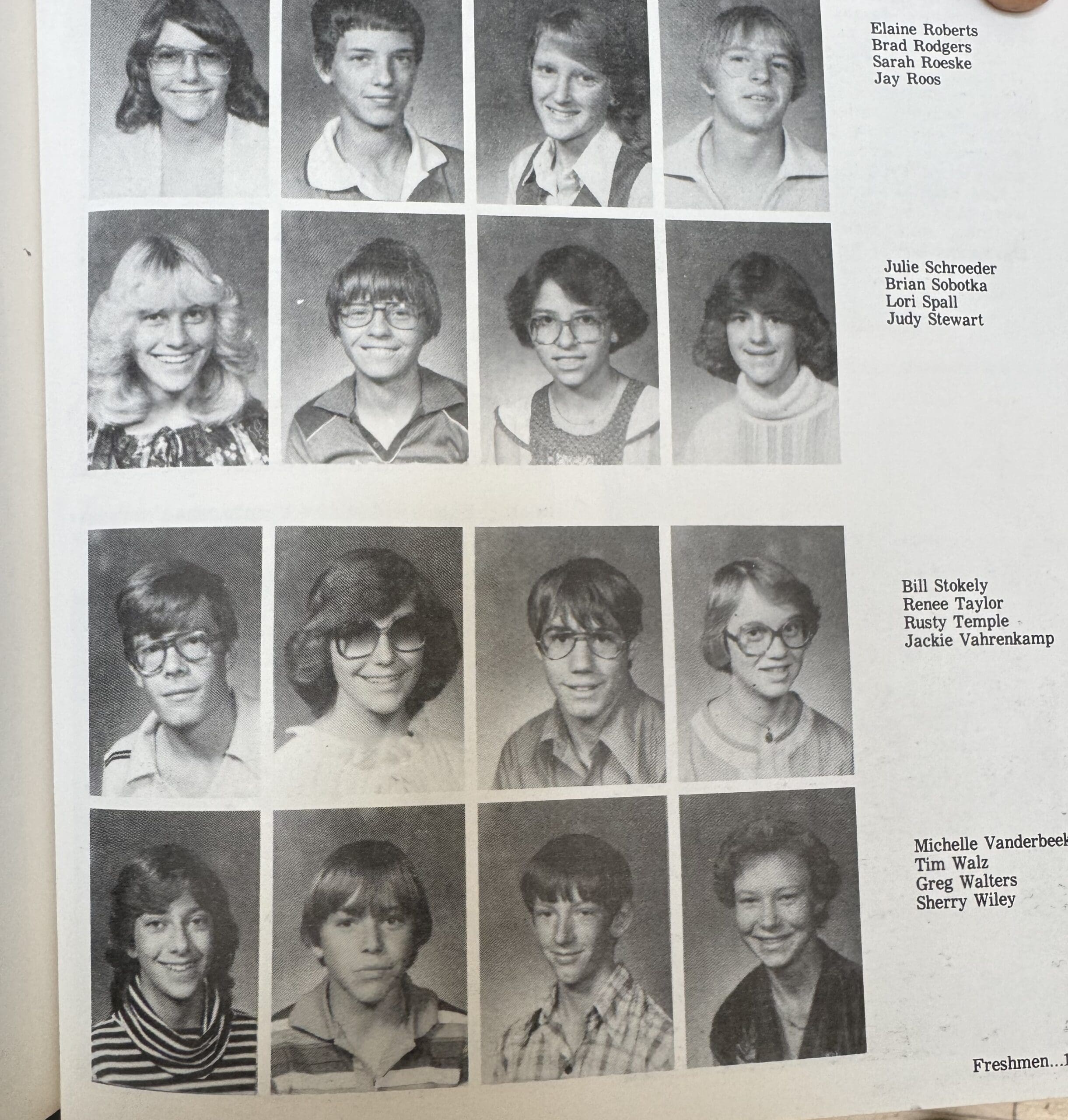
Tim Walz captured in his freshman year.

L.A. Times covered Walz on August 15. They wrote he “is a white guy who spent formative years in Valentine, the remote seat of Cherry County, the nation’s top producer of beef cows.

President Trump won 87 percent of the vote there in 2020 and when a reporter asked a local if Walz might flip any votes. “Um, no,” he said.

CTN still did not plan to do a story, but when the Wall Street Journal ran an August 21 piece (“Walz’s First Stop to Win Rural Voters: His Hometowns”), it was time to join other journalistic endeavors. Luckily my husband is roughly the same age and was able to produce a few yearbook photos.

Most people haven’t mentioned that Walz was also on the high school golf team (back row, far right).

The WSJ wrote “But while many in the towns where Walz grew up are impressed by his political ascent from a map dot near the state’s rolling Sandhills, they aren’t ready to vote for him.

“Even some of Walz’s cousins, many of whom live east of Valentine in Butte, Ne., a town of roughly 300 people where Walz graduated from high school plan to vote for former President Donald Trump.”

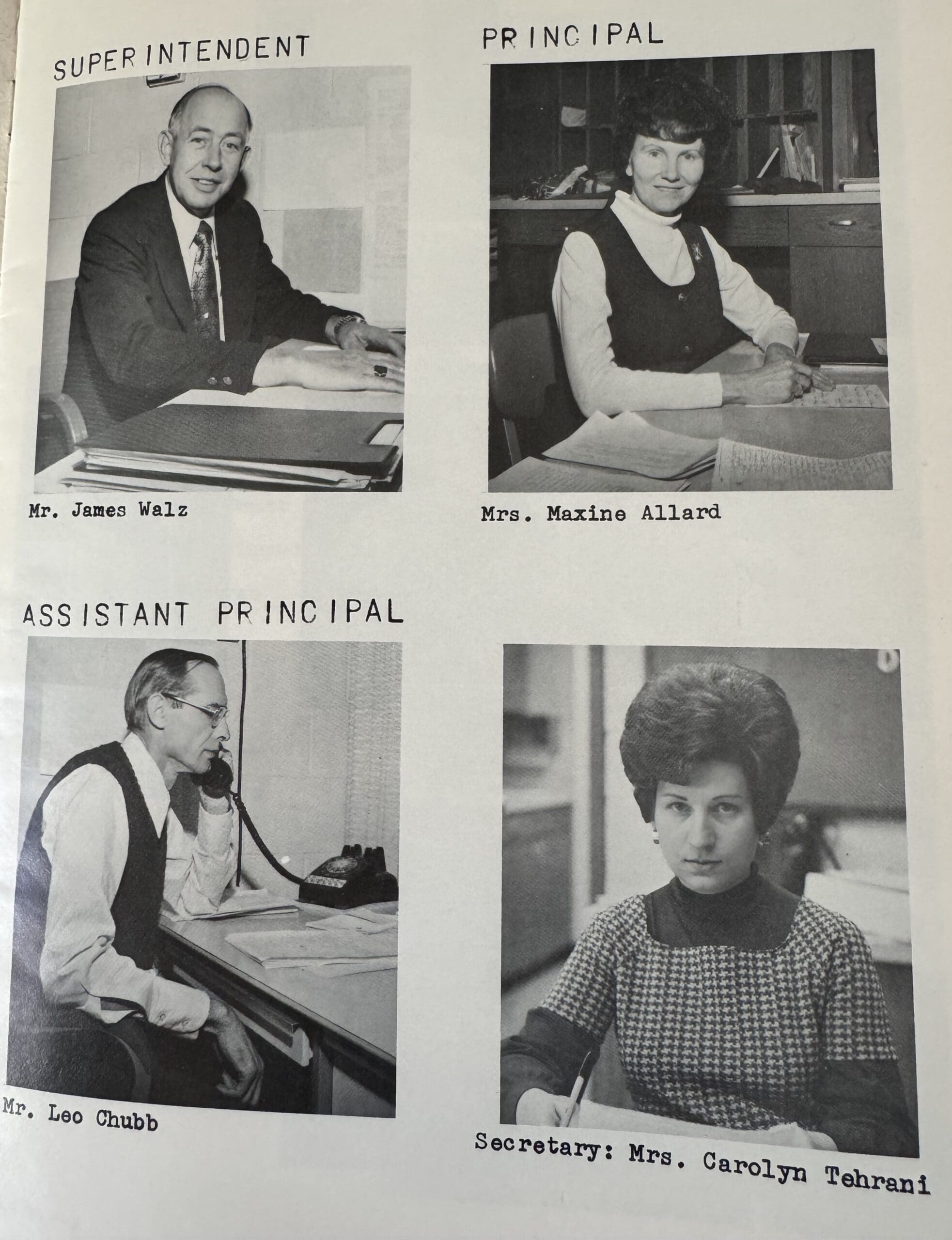
Walz father James, who fought in the Korean War, was the superintendent in Valentine “that made the family seem slightly more affluent than others, according to former classmates.”

Ranchers’ kids often attended one-room elementary schools and when it came time to attend Valentine High School, often stayed at rented homes in town during the week because the drive to school in the winter months was dangerous and long.

Even though both articles concluded that it might be difficult for rural America to change its mind, a resident said, “Take all politics out of it, what Tim has done is the American dream.”

Posted in General | 2 Comments

Trial for the Man who Stabbed Briana Kupfer to Start

Briana Kupfer was brutally murdered.

Jury selection for the trial of Shawn Laval Smith, who is accused of killing Brianna Kupfer, is supposed to start on Thursday, August 22.

The court is dark on August 23. If the jury is seated on August 22, opening statements could begin as early as August 26.

Kupfer’s mom Lori said she would let CTN know exact dates as soon as she found out. “The media asked to live stream the trial, but the judge denied the request and said that all reporters are allowed but no video cameras or cameras in the court room,” Lori said.

Todd and Lori’s 24-year-old daughter was stabbed on January 13, 2022, when she was working alone at Croft House, a Hancock Park boutique furniture store. Kupfer was found on the floor by a customer.

The young woman suffered 46-sharp force wounds. There were 26 stab wounds and 11 of the wounds were to the chest, which punctured both lungs. According to the autopsy, she died from exsanguination – the loss of blood.

Kupfer attended St. Matthew’s Parish School and then Brentwood School before going to the University of Miami. Upon the completion of her degree in 2019, she returned to attend graduate school at UCLA.

On “Fox and Friends,” her dad said “”She was a kind soul and always was trying to make herself better and everything around her better. She cared about people.”

The slain woman loved to sew and made a lot of her own garments by hand. “She liked fun clothes and thought they said something about people’s personalities,” he said. “She wanted to create a clothing line.”

“She was the kind of person we need on this Earth,” Todd said. “She was strong and vivacious.”

Kupfer, an optimistic, petite woman, was much beloved in the Pacific Palisades community by neighbors, classmates and friends.

By contrast, Smith, 6’2” and 190-pound male has a long rap sheet with 15 arrests. He has at least 11 arrests in Charleston, S.C., dating back to 2010, when he would have been in high school.

There is still a pending November 2019 South Carolina case against Smith for allegedly discharging a firearm into a stranger’s vehicle while a toddler was in the back seat. Records show he was released 10 days later after posting $50,000 bond. He was told not to leave the state but went to California.

He was arrested in Covina in 2020 for misdemeanor possession of stolen property after allegedly shoplifting at a Home Depot but L.A. County prosecutors didn’t press charges, the Covina Police Department said. He was released on $1,000 bail.

In January 2021, Smith vandalized a car in Daly City, California and when officers arrested him, he resisted and bit one of them, according to court records. He was charged with assault on a police officer and resisting arrest.

Dist. Atty. Steve Wagstaffe said that Smith’s defense attorney claimed he was mentally incompetent to stand trial. But the suspect was examined by two doctors and, based on their findings last May, a judge determined he was competent to be tried. He served 133 days of an eight-month sentence and was released, but failed to report to his probation officer and his probation was revoked in November.

A bench warrant was issued for Smith’s arrest, but he vanished from the scene, Wagstaffe said. South Carolina authorities never contacted his office, he said, despite Smith being held in San Mateo County jail for eight months.

In addition to the murder charge, Smith also faces two special circumstances allegations: lying in wait and use of a knife. If convicted, he could be sentenced to life in prison without parole.

Smith is being held at the Men’s Central Jail in Los Angeles on $2 million bail.


Posted in Crime/Police | 4 Comments

Jimmy Dunne Signs Book at Zibby’s Bookstore

Zibby’s Bookshop will host Jimmy Dunne to celebrate the launch of his book Jimmy Dunne Says! at 6 p.m. on Wednesday, August 21 on 1113 Montana Avenue. As an added bonus, Palisades resident and actor Ted McGinley will join him for a discussion. This is free event, but to reserve a space click here.

Dunne has arranged the book into 47 heart-warming chapters/stories, such as “First Jobs, The most Precious Word, Three-Pound Weights and Firecrackers.” The 224-page book is published by Savio Republic.

The first tale “Downsizing” is a sweet tale of moving from the house where he and his wife Catherine raised their two children to a smaller place.

“From newlywed days to witnessing our babies go from little girls to young adults. Som many great memories in every inch of every room.

“I liked walking through our girl’s bedrooms and still seeing their stuff on the walls and on the shelves. I liked our backyard. I liked imagining our kids coming down the steps every Christmas morning.

“We put it on the market, it sold in a week, and suddenly agreements thicker than my leg were instructing me to clear everything I ever had and knew – out.”

Dunne is described as a positive, inspiring voice. Many may remember that he was largely responsible for the success of Palisades bocce ball, with his enthusiasm and encouragement.

He was one of seven kids from a suburban Chicago midwestern family, who headed to California to find success. Dunne is a songwriter with dozens of gold and platinum records— with songs on twenty-eight million records worldwide. His themes, scores, and songs have graced over a thousand television episodes and recorded numerous solo records as a piano artist.


Ted McGinley

He will be joined in a discussion at Zibby’s by Newport-born actor Theodore Martin ‘Ted’ McGinley, who is best known for his long-running roles in the television series Happy Days, The Love Boat, Dynasty, Married .. .with Children and The West Wing. 

Formerly a model, McGinley was spotted by a casting director after appearing in the magazine ‘GQ’, and was subsequently offered the role of Roger Phillips in Happy Days.

Posted in Books | Leave a comment

Traveling to South Korea an Eye-Opening Experience

Stay Hotel lobby in Peongtaek, South Korea.

If you want one of the best lattes in the world for under $5 (and no tipping allowed), visit Ediyah 이디야 커피. Unfortunately, it is a coffee chain in South Korea, making a quick visit a bit harder, but supposedly there’s also a branch in Beijing, China.

Korea was never on my bucket list to visit. I had hoped someday to visit my grandfather’s Swedish relatives in Halmsted or to visit Machu Picchu or Ned Chand Saini’s Rock Garden of Nathupur, India or the Great Wall of China, but once you have children, the place you most want to visit is where they are.

My son is in the Army and stationed in South Korea, near Pyeongtaek. When he told my husband and me that he had a full weekend he could spend with us, we cashed in frequent flyer miles and flew to Incheon on August 7. A mere 14 hours and a day later, after crossing the International Date Line, we arrived in Incheon on August 8 in the late afternoon.

The camp where my son is based is about 62 miles south of the international airport, which is in Incheon. The choices for getting near the camp were taking two buses (3 hours and 33 minutes), two trains (one hour and 33 minutes), a taxi (52 minutes) or renting a car. I figured it was worth the approximate $100 to take a cab, just for ease the first day in a new country.

Before we left L.A., I assumed that since we were close to Japan and China, tea would be the drink – meaning this coffee addict would be suffering withdrawal. No, there were coffee shops everywhere and the caffeinated drinks were pure bliss.

I also assumed that English would be spoken by at least a few people, since it was near an Army base and close to a train station – and that’s what the internet said. And the hotel we chose online, the Stay Hotel, noted that English was spoken.

Not true.

We checked in and the clerk spoke as much English as I did Korean, so Google translator came out – and would be our constant companion for the next week.

We were put in the “golf suite” on the 8th floor of a 3-star hotel ($45 a night).  We had a nice view, a mini-washing machine, a refrigerator, a large movie screen for golfing purposes, a toilet with a bidet – and of course in case of a fire, we had the strap to put around our waist to rappel down the side of the building.

Most importantly, the room had air conditioning. During the entire stay daytime temperatures were in the high 90s, about 11 degrees above normal and the humidity varied between the high 80s and low 90s.

The air quality index was considered “moderate” – in the 60s, about double what is in Pacific Palisades.

On return to the U.S., a person asked if the bad air was because of smokers.

There were no smokers on the streets, in restaurants or in the train station. At some locations, there were tiny glass booth rooms set aside specifically for smokers.

The bad air is courtesy of China, Korea’s western neighbor. That country has abysmal air quality and since the wind blows west to east, South Korea is the beneficiary.

After checking in, we went looking for dinner—supposedly we were going to go to a Korean BBQ place, but the directions from the clerk, on a piece of paper without the name of the restaurant, left us wandering down narrow streets.

Giving up, we walked into an eatery. The menu on the wall was in Korean, we couldn’t get the google app to work, and finally, we pointed at what two workers seemed to be eating. One came over to help. (It seemed no matter where we went, people tried to be helpful. If they saw us struggling with the map on the phone, they would come up and try to provide assistance.)

Through much gesturing, we were able to ascertain we could either order cow’s stomach or cow’s joint in the soup. We chose joint, which was in a flavorful broth, and came with kimchi and rice.

For utensils, there was a drawer at the edge of the table, that one opened to pick out chopsticks and spoons. A small container of water/tea was served with two small glasses, which allowed you to refill your own glass.

Up early the next day, we learned that most of the population was not. Even the transit trains, Korail that operate in South Korea, didn’t leave from the Pyeongtaek station until 7 a.m. We walked into the only eatery that seemed to be open at 6:30 a.m.

There was a screen/machine to order and pay on. Photos of photos of food showed, but descriptions were in Korean. One helpful customer showed us that we could push a button that gave the title of the dish in English, but I still managed to order a pork cutlet for breakfast.

We learned that breakfast in Korea generally is the same as the other two meals and includes broths filled with vegetables, noodles or meat, rice and a side dish.

After a day of wandering around Pyeongtaek, my son joined us to go to Seoul. He was no more knowledgeable about the train to Seoul than we were, because his time had been spent at bases in different parts of the country.

Luckily, I heard a woman speaking to guy in English and introduced myself. She was from Guam, her husband from Jacksonville, Florida. They had both served in Afghanistan and met in Kuwait where they were being processed.  They had been at the site, Bagram Airbase, where 11 Marines, an Army soldier and a member of the Navy were killed in 2021 when the U.S. withdrew from the country.

He was still in the Army, she was out and going to school online. They were planning to spend the weekend in Seoul and see the waterfalls by Ansan Park.

She said that google and Waze didn’t work and suggested adding Naver as an app to negotiate travel. (According to Wikipedia: More than 25 million Koreans have Naver as the start page on their default browser, and the mobile application has 28 million daily visitors. Naver has also been referred to as ‘the Google of South Korea).

Changing of the guards at Gyeongbokgung Palace.

Before leaving us, they helped us navigate from the train, which was air-conditioned, with lovely seats, Wi-Fi and clean bathrooms to the subway system to go to Gyeongbokgung Palace 경복궁.

She also explained about the TAP cards. To access subways, these cards which can be bought for different amounts at local convenience stores are simply tapped on the subway entrance stile.

Unfortunately, we didn’t understand that it is one card per person and when my husband tried to tap a card twice, once for him and once for our son, he couldn’t exit. Luckily, a transit worker (and they seemed to be everywhere), came over and let him out, and pantomimed that he needed his own card.

Upon arrival at the palace, I wanted to dress up in a Hanbok 한복 Korean ceremonial clothes to visit the palace, but my two companions outvoted me.

Trying to aid the palace guard, I stood at attention, too. In the background you can see tourists in the traditional Hanbok ceremonial clothes.

As we walked around this beautiful area, I was struck by no trash, no graffiti, lack of guards and total respect for the property by all visitors.

It was pointed out that there are CCTV cameras everywhere. If someone does something wrong, the person can be identified and eventually will be found and held accountable.

The garden at the palace was clean, no police or guards, but CCTV cameras were everywhere.

Next, we visited “Chinatown” in Seoul. Once again, we ordered from a screen, and took our silverware from the drawer. We had selected this eatery because we could see a cook handmaking the dumplings. Indian and Nepalese restaurants are also available in South Korea and serve excellent food.

We discovered and ate at Chinatown in Seoul.

We hopped on a tour bus, and we made our way to Namson Seoul Tower 남산서울타워, built in 1969. It is the highest point in Seoul and gave us a panorama of Seoul, which seemed to go on forever with its high rises. The city has almost 10 million residents, but we were totally impressed by how the high rises were centered around small parks/green spaces – and the number of larger parks in the City.

We located a subway line to Korail at the Seoul station and made it easily home.

Sunday proved much more difficult for navigating the subway. Before arriving at the Seoul station, we started on the Korail again, and I was seated next to a woman who was originally from Colorado and had married a man in the Air Force. They had been stationed in several places but would be in Korea for two years, because married military couples are allowed to stay in a location for two years.

They had three kids, and although there are schools on the bases, many military elect to home school, because the curriculum is “woke” and often hostile to religion. She also gave another tip that Naver Papago is much better at translating Korean than Google translate.

I admired the woman’s nails and asked in “sign language” if I could take a photo.

Tomorrow, Part 2:  the subway, homelessness, the Lotte tower.

Posted in General | 1 Comment

Kruse, Local Bike Shop, Goes Mobile

Kruse and Company will become a mobile operation starting September 1.                                         Photo: KRUSE

The local bike shop Kruse, which not only sells bikes, but offers bicycle repairs, is going mobile starting September 1.

Store owner Andrew Grove told CTN that “the brick-and-mortar store was nice and we’re proud of the space, but the number of customers that just come into browse is relatively small.” The store opened on Sunset Boulevard across from Ralphs two years ago.

He explained that most of the sales were not from walk-ins, but from customers that had contacted the store. “Now we can save them a trip,” said Grove who co-owns the business with his wife Tara. “We’ve been getting more and more customers from other parts of the city as well, and sometimes driving to the Palisades isn’t the easiest. We are hoping to make things simpler for them, too.”

The Groves, who are Palisades residents, are excited about expanding the business by going mobile. “We love being a part of this community, and we see an opportunity to bring the neighborhood bicycle shop to wherever it’s most convenient for our customers,” Grove said.

They will continue to offer e-bike sales, bicycle repairs and be active at community events. The store’s mechanic will continue to work with Kruse, going to locations where bike repairs are needed.

If a customer wants to buy a new e-bike, the first step will begin online or over the phone. Then Kruse will bring electric bicycles to the customer for a personal test ride.

“We know that everyone enjoys the ease of online shopping, but customers should be able to try these bikes before they make a decision,” Grove said. “The test ride experience has always been a core part of our business, and what better way to try out a new bike than on the streets where you plan to ride most often?”

Kruse will continue to be a proud authorized dealer of premium electric bicycles made by some of the world’s leading bicycle brands, such as Tern, Royal Dutch Gazelle, Riese & Müller, Stromer, Velotric, Yuba, and VanMoof.

The company will provide service and repairs for the brands it sells, as well as all Bosch-equipped e-bikes, plus many non-electric bicycles.

Before the store closes on August 31, residents are invited to visit the Kruse Pacific Palisades location at 15121 Sunset Boulevard, to take advantage of special sales and discounts on bicycles and accessories.

To find out more about the mobile operations and upcoming special events, www.krusebikes.com. Or (310) 526-7668

Kruse and Company, which was founded in 2022 by Tara and Andrew Grove, has become known in Pacific Palisades for its premium selection of e-bikes and professional customer service. Dedicated to service and sustainability, Kruse and Company aim to make e-bikes the first choice in local mobility.

Posted in businesses/stores | Leave a comment

Do Not Fool Yourself about Benefits of Alcohol

Alcohol is a Class 1 carcinogen.

Earlier research seemed to suggest that a low intake of alcohol could be beneficial. That research is now questioned.

“We did not find evidence of a beneficial association between low drinking and mortality,” said Dr. Rosario Ortola, the lead author of a paper published in JAMA. An assistant professor of preventive medicine and public health at Universidad Autonoma de Madrid, Ortola’s study tracked 135,103 adults aged 60 and over for 12 years.

She added that alcohol probably raises the risk of cancer “from the first drop.”

Some scientists now believe there were serious flaws in the earlier research that reported a small amount of alcohol was beneficial for health.

Currently in the United States, two separate scientific groups are preparing reports on the effects of alcohol and health in advance of an update of the U.S. Dietary Guidelines. One group is an intergovernmental subcommittee of representatives from different health agencies.

The second group is the National Academies of Science, Engineering and Medicine (NASEM). One of its experts Dr. Kenneth Mukamal’s trial of moderate drinking was halted in 2018, after it was revealed, he had solicited funding directly from the alcohol industry. He was replaced with another Harvard scientist who also has ties to the alcohol industry.

In 2022, sales of alcoholic beverages in the U.S. surpassed pre-pandemic levels at $259.8 billion dollars, according to Statista.

Deaths attributed to alcohol have risen almost 30 percent in the period between 2016-1017 and 2020-2021, according to the Centers for Disease Control.

The Canadian Centre on Substance Use and Addiction commented “no amount or kind of alcohol is good for health” and that “even a small amount of alcohol can be damaging to health.”

According to Ortola’s study “Overall, moderate drinking – defined as between 20 and 40 grams of alcohol daily for men and between 10 to 20 grams for women – was associated with a higher risk of death from all causes and a high risk of dying.”

The World Health Organization wrote: “Alcohol is a toxic, psychoactive, and dependence-producing substance and has been classified as a Group 1 carcinogen by the International Agency for Research on Cancer decades ago – this is the highest risk group, which also includes asbestos, radiation and tobacco.”

WHO notes that alcohol causes at least seven types of cancer, including the most common cancer types, such as bowel cancer and female breast cancer.

A question some might ask is, if “Cancer is growing among younger people in the United States, could it be attributed to drinking?” CTN could not find research on this topic.

To read the 2023 WHO article click here.

(Editor’s note, given that alcohol is a carcinogen, but also a money-making business, it should be interesting to see if the U.S. puts out new guidelines for alcohol consumption.)

Posted in Health | 1 Comment