Cupid’s Arrow Hit Me in the Heart


It was a great Valentine’s Day dinner and dance on February 13.
Photo: RICH SCHMITT

By HANK WRIGHT

I received a Valentine’s party invitation “Do you want to join us Friday night?”

It sounded good, but then they said it was for the elderly. I don’t like thinking of myself as an elder. . .I’m sixty-eight. The river of de Nile isn’t deep enough to keep me thirty. My wife Ann and I went anyway. The American Legion. The Sunset Club. Valentine’s Day celebration. Jimmy Dunne hosting.

Drinks were included with the dinner/dance Valentine Day’s party package.
Photo: RICH SCHMITT

The hall was decked out. Balloons and candles everywhere. Deloris, our American Legion goddess, and the rest of the AL crew had done their magic. We had cocktails first. Elders don’t need to show ID at the bar. Then the lights dimmed. My eyes are tired. They needed time to adjust. But it helps keep the dream alive.

The room was full of people talking. Catching up. They talked about the rebuild. There were the grounders. The ones who lost their homes. They were deciding whether to rebuild or move on. There were the smokers. Their homes survived but needed repair. They were living in insurance hell. Two states I never wanted to learn about. Not in 2025. Not ever.

The food was outstanding. There was so much. My eyes were bigger than my mouth. Chicken. Salmon. Pasta. Beef. It was all there. Straight to the hips after a moment on the lips.

Brandon Wattz sang beautifully. He took us back to songs from our youth. Motown. He belted out Barry White. The memories came back. X-rated memories. Maybe triple-X. My ship ran aground on the river de Nile.

Brandon Wattz sang.
Photo: RICH SCHMITT

Jimmy Dunne was the MC. He had his usual antics. He got us up to sing. A herd of us. “L is for the Way You Look at Me.”

“Just keep going,” he said. “Don’t worry about the words. Belt it out!”

We were shy even with the microphone. But, we finished with a flourish. We laughed at how seriously we took his instructions.

Then Jimmy read his latest love poem to the Palisades. Par for the course, he teared up. He read his sappy poem to a loving audience. I felt happy to be part of this. An adventure nobody imagined. Our community coming together. Getting each other through hell. Jimmy is our Cupid. His arrow hit my heart. He has the heart of the Palisades.

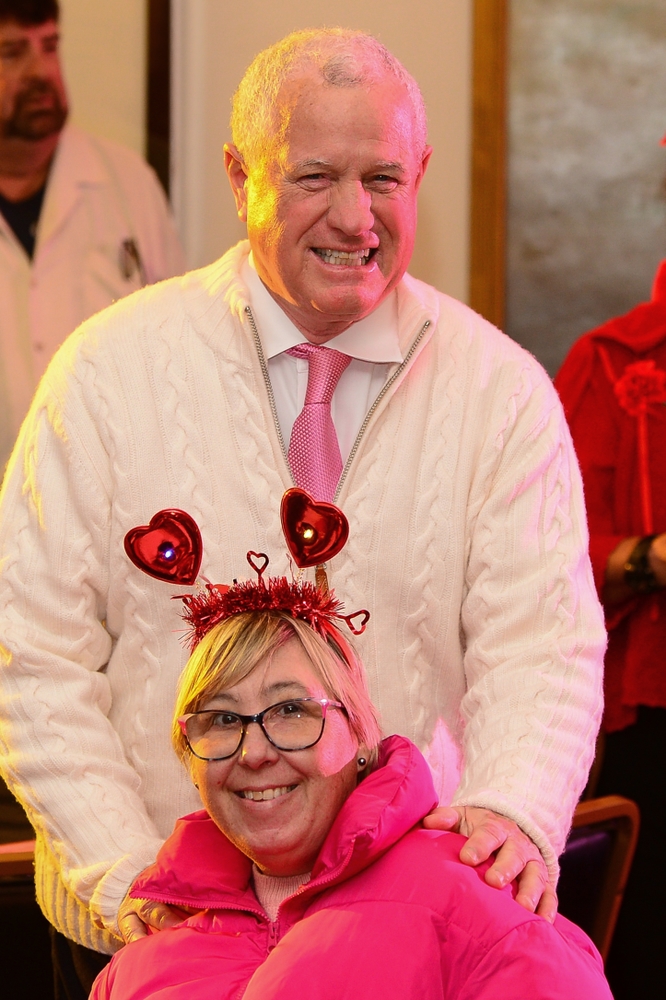
Party host Jimmy Dunne with partygoer Bentleigh Borgeson.
Photo: RICH SCHMITT

I can’t tell you how blessed I felt. To be there. At this time. In this place. Pacific Palisades. The American Legion. The Sunset Club for one lovely evening.

Photo: RICH SCHMITT

Posted in Holidays | 10 Comments

Expert to Speak on Most Important Requirements for Growing Orchids

Catasetum spitzii SVO Burnished Gold AM orchid

The Malibu Orchid Society will feature guest speaker Fred Clarke at its February meeting speaking on “Becoming an 80 Percentile Orchid Grower.” The meeting will be held via zoom at 7 p.m. on Tuesday, February 17. To receive the link, email: [email protected]

Clarke will speak about the most important requirements to grow the best orchids. He will discuss the underlying reasons of how and why orchids grow as they do, then explore the fundamentals and advanced techniques to best grow them.

The Malibu Orchid society says orchid plant culture will be explained as you have never heard it before. Learn how to become an 80-percentile grower.

Clarke has been growing orchids for over 34 years as a professional grower and manager in the horticulture industry. He applies these skills at his nursery Sunset Valley Orchids in Vista in San Diego County.

A passionate grower, Clarke’s curiosity in orchids is broad and varied. Although developing Cattleya hybrids is his sustaining interest, he is actively creating new Paphiopedilum and Aussie Dendrobium hybrids plus others to be named if it works out.

His pioneering work in Catasetum intergeneric hybrids led to the development of several notable hybrids. Most recently his work involved the grex, Fredclarkeara After Dark, which produced “the blackest flower ever witnessed.” This cross-pollinated plant or grex has received over 100 awards worldwide with nine FCC’s and thirty AM’s from AOS judges.

Additionally, Clarke is also an accredited judge in the Pacific South. To view the Sunset Valley Orchids website region click here.


Posted in Community, Environmental | Leave a comment

A Focus on the Feminine Comes to Gallery 169 on February 21

By LAUREL BUSBY

Courtesy of Canyon News (the-canyon.org/news)

Nine female photographers will bring an array of portraits and self-portraits to Gallery 169 for a Feb. 21-22 event titled Femina: A Pop-Up Exhibition Considering the Female Gaze.

“The photographers are all exploring the idea of femininity through a very personal lens,” said curator and photographer Sal Taylor Kydd, a former Canyon resident. “The work is just so beautiful, and each photographer brings their own unique sensibility.”

Five of the artists, Alexandra De Furio, Aline Smithson, Catherine Just, Erica Kelly Martin, and Sarah Hadley, are Angelenos, and, along with Taylor Kydd, they will be available at an Febuary 21 reception from 5-8 p.m. to talk about their work. Jo Ann Chaus, Shari Yantra Marcacci, and Jennifer McClure will also be featured in the exhibit.

Instead of focusing solely on her own work, Taylor Kydd, who has had two previous solo shows at Gallery 169, formed a collective of photographers for the show.

“I thought that I’d love to celebrate the work of these women who I really admire,” Taylor Kydd said. “I’m really interested in lifting up women’s voices. I’ve found such great friendships and support through my fellow artists.”

Before centering her career on photography, Taylor Kydd, who grew up outside London, England, worked as a project manager for Yahoo movies and television. She first lived in Australia, and in about 2000, she moved to Los Angeles, where she met her husband, Steven Kydd. The couple eventually married and raised two children, Oliver, 20, and Lola, 19, who both attended Canyon Elementary.

In 2008, when her children were in preschool, her stepfather passed away, and his death inspired her to reflect on what she wanted to do with the remainder of her life.

“Photography had already been a real passion,” Taylor Kydd said. “But I was at a point where I was ready to explore my photography more deeply, expanding the possibilities of the medium.”

A few years later, she began a low-residency master of fine arts program at Maine Media Workshops + College, where she graduated in 2018. That same year, after eight years of living in the Canyon on East Rustic Road, the family moved to Maine, a state they had often visited because her husband grew up there.

Since then, Taylor Kydd has been both creating art and teaching either online or in-person at varied schools, including her alma mater, Los Angeles Center for Photography, Santa Fe Workshops, and Nord Photography in Norway. She also conducts destination photography retreats in Maine, Tuscany, and Paris.

Her solo work has focused on memory, personal history, and understanding where we come from and who we are.

“I think these are things that all of the exhibition’s artists connect to,” Taylor Kydd said. “They’re very much exploring an internal expression of femininity. It’s not about the surface or traditional ideals of beauty. It’s about stories that are being told.”

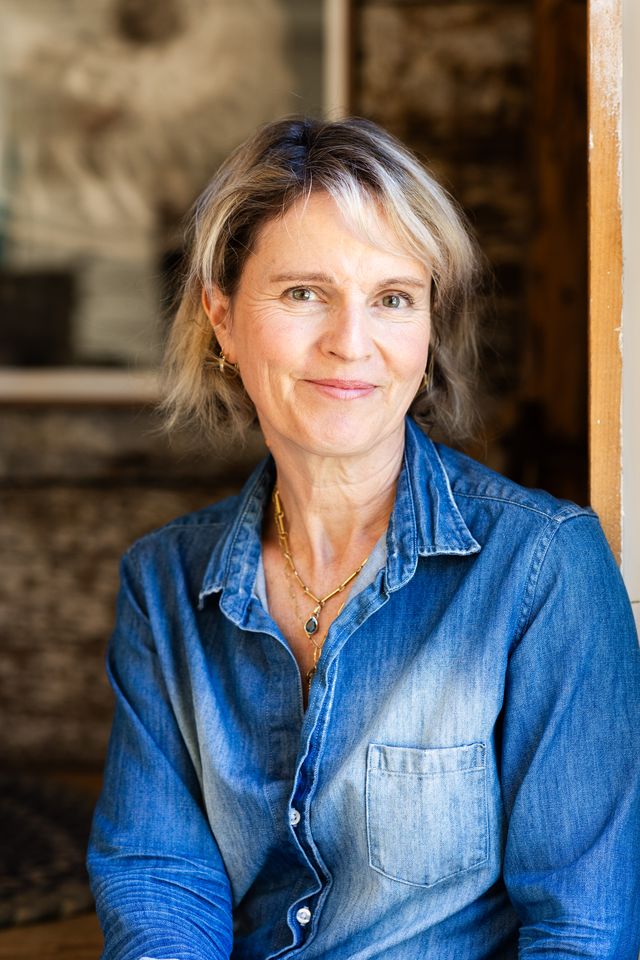
Photographer Sal Taylor Kydd

Femina: A Pop-up Exhibition Considering the Female Gaze will be at Gallery 169, located at 169 W. Channel Rd. at the opening reception on February. 21 from 5-8 p.m. and by appointment on February 22.

Posted in Arts | Leave a comment

Palisades Street Lights Gone: Some Could Return in March

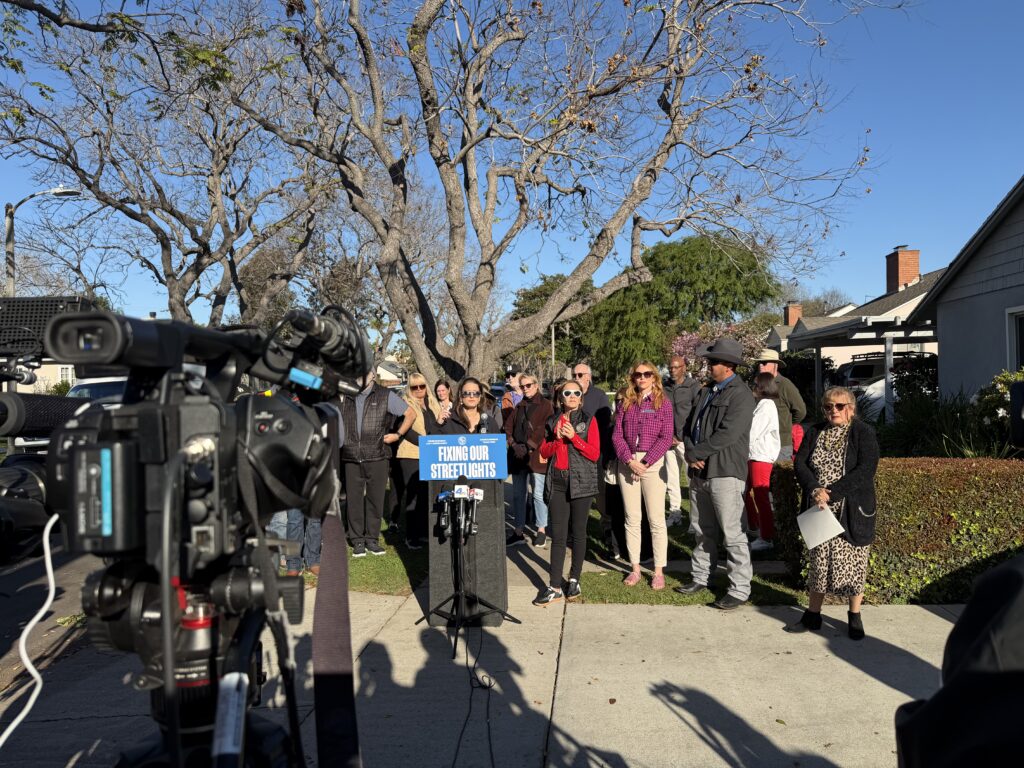
Councilmember Katy Yaroslavsky at the podium and Traci Park ((to her right) announced a plan to fix street lights in their districts at a press conference in Mar Vista.

At a joint press conference in Mar Vista, Councilmembers Traci Park (CD 11) and Katy (CD5) Yaroslavsky, announced a plan to bring lighting back to Westside communities affected by copper wire thefts. There are more than 1,100 open streetlight repair cases across the Westside.

“Inoperable streetlights are a direct public safety issue,” Park said. “Darkened blocks increase the risk of collisions, create opportunities for crime, and put pedestrians and families at risk. Nearly half of the lights that are out today are down because of theft. While the City works to get ahead of this epidemic, we are taking action locally to dedicate funding and restore lighting in our Westside neighborhoods.”

Yaroslavsky added, “Los Angeles has a streetlight emergency. One in ten lights are out, and my colleagues and I on the City Council are done asking residents to wait on a broken bureaucracy.”

The two have pooled dollars to fund a dedicated streetlight repair crew for their districts and formally co-introduced that motion to allocate those funds at a February 13 City Council meeting.

In Mar Vista, Park was asked where the councilmembers will get the money to repair lights, because unlike most other council districts, CD5 and CD11 do not have access to AB 1290 funds — discretionary tax increment dollars that other districts around the city rely on for infrastructure improvements and repairs.

Park and Yaroslavsky have isolated about half a million between their two districts and would use that to start repairs.

Mar Vista resident Andrew Martin said, “The usual feeling you have is that government doesn’t work, but this is a clear example that it does, starting at the bottom with local community members and local leaders like Traci and Katy.”

Initially when he reported inoperable lights, he was told repairs could take up to 270 days. “We’re hopeful that our lights will be up and running very soon,” Martin said.

Also speaking was Karen Wallerstein, CEO of the Venice Chamber of Commerce. “People feel safe walking home. When streets are lit, residents feel more secure and for businesses evening foot traffic increases.”

Over the past several years, Los Angeles has experienced a surge in copper wire theft that now accounts for nearly half of all streetlight outages citywide. Repairing vandalized infrastructure is significantly more expensive than routine maintenance, with costs reaching into the tens of millions of dollars.

It has been estimated that as many as 700 streetlights have been destroyed in Pacific Palisades after the 2025 Fire – and that doesn’t include the lights that were not working before the fire.

As people move home, they find neighborhoods black at night – making standing homes targets for criminals. Streets are rife with wildlife such as coyotes searching for food. The lack of light causes hazards for drivers who are navigating pot-holed and crumbling streets that were also destroyed during the fire.

At the press conference Park was asked specifically about Pacific Palisades. Funding for this community will come from a different source.

She said that the L.A. City Administrative Officer Matt Szabo has identified $1 million to front fund repairs to be used specifically for the Palisades street lighting, so that construction and replacement can start now. That city money will be replaced with FEMA money once it is received from the Federal government.

“El Medio is the top of the priority list,” Park said. It is based on the number of people who have returned to the neighborhood and have contacted her office about lights.

Repairs should start in the next two to three weeks, according to Park’s office.


Posted in City, Community, Palisades Fire | 1 Comment

Brentwood Athletic Facilities Belong to VA

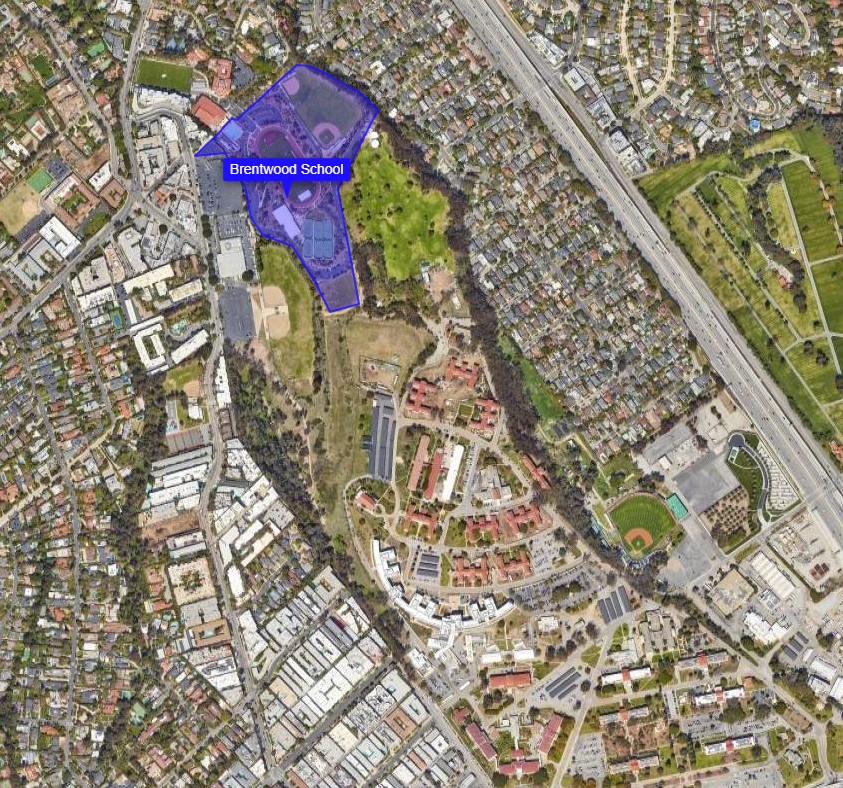
The area in blue, which contains Brentwood School’s athletic facilities, is VA land.

Brentwood, a private high school in Los Angeles, spent more than $4.5 million in 2001 to build an athletic facility on VA Property. CTN reported the story in March 2023 (“Brentwood School Athletic Facilities Are Build on VA Land”).

Almost three years later on February 9, 2026,  the VA announced (“VA Terminates Illegal and Wasteful West Los Angeles VAMC Leases and License”) that “effective today VA has terminated its lease with Brentwood School – an exclusive K-12 private school.”

A district court and the Ninth Circuit Court of Appeals said the leases and license violated federal law. “VA last year also found that the department has been underpaid by more than $40 million per year based on the fair market value of the properties.”

“These groups have been fleecing taxpayers and veterans for far too long, and under President Trump, the VA is taking decisive action to ensure the West LA VAMC campus is used only as intended: to benefit veterans,” VA Secretary Doug Collins said in a statement. (In addition to Brentwood School, a for-profit parking lot north of the Post Office and an oil-drilling company have also had leases terminated. (UCLA’s Jackie Robinson baseball stadium, which has also operated on VA land since 1981, was not included in the termination order.)

Brentwood School athletic facilities include the Caruso Watt Aquatic Center, the Stadium Field, the Upper Field, the Tennis Courts, the Pavilion, the Weight Room and Fitness Center. Athletic facilities are on about 22.06 acres of VA land, about 13 percent of the 300 acres of the West Los Angeles campus.

When Pacific Palisades American Legion Post 283 learned about the proposal in 2000 to give a private high school land meant for vets, legionnaires opposed it.

“This didn’t have anything to do with vets,” one Legion member remembered. “They didn’t listen to us.”

The arrangement was not only controversial with veterans, but also Brentwood store owners. A January 18, 2001, LA Times story (“Brentwood Shops Protest VA’s Parking Fee Hike”) because they felt the VA was favoring the school over merchants.

The story noted “. . .business leaders are questioning what they describe as a ‘sweetheart deal’ between the U.S. Department of Veterans Affairs and the exclusive Brentwood School for rental of a much larger government parcel next to the parking lot at a much cheaper rate.”

Then, VA Contract Officer Ralph Tillman and Brentwood School Headmaster Hunter Temple said the “sharing agreement” between the VA and the school meant that veterans would have the use of the sports complex, when students are not using it, during the 20-year life of the contract.

At the time, it appears there was little or no oversight of many of the leases on the West L.A. VA land. Beginning in 2001, the VA granted nearly a dozen leases for non-veteran uses, including contracts for an Enterprise Rent-a-Car, a UCLA baseball stadium, a Marriott hotel laundry facility and a school bus parking lot.

A federal judge ruled in 2013, that the campus should be used for veterans’ healthcare, not for profit, and the VA booted out eight lease holders, including a hotel laundry and a movie studio warehouse.

Tillman, who resigned in 2014, was convicted and imprisoned four years later for taking cash bribes for leases on the campus.

Although almost all of the leases were terminated, UCLA and Brentwood School were allowed to remain – after a lobbying campaign in Washington, D.C.

The schools were told that their use of the land had to be “veteran-centric” — meaning of more benefit to veterans than not.

In November 2016, the lease with Brentwood School was renegotiated for a 10-year term.

Brentwood would now pay $850,000 annually and $918,000 in non-monetary consideration. (In a 2017-2018 audit, $670,000 of the non-monetary consideration was spent on the upkeep, repair and replacement costs of the high school athletic facilities.)

According to a January 21, 2019, LA. Times Story (“UCLA and Brentwood School Accused of Shortchanging Veterans at West L.A. Facility”) VA Inspector General Michael Missal said the Brentwood School misused its lease “because the principal purpose of this lease is to provide the Brentwood School with continued use of the athletic facilities.”

So, Brentwood School changed the name of its athletic complex to Veterans Center for Recreation and Education (VCRE), and announced it would also partner with vets by allowing them to use athletic facilities, whenever students were not using them.

The entrance for veterans to the Brentwood Athletic Complex is through the VA on the road by the Japanese Garden.

For example, a vet could swim in the Caruso Aquatic Center 10-lane pool on Monday, Wednesday and Friday from 5:30 to 7:30 a.m. and on Saturday and Sunday from 11 a.m. to 3 p.m. . . .but, high school water polo and swim teams would have priority.

A vet accessed the Center by driving through the VA north campus, past the Japanese Garden, and parking in the school lot next to the booth. CTN contacted Brentwood School to ask how many vets were using the complex, but never received an answer.

CTN drove to the VCRE Welcome Center and learned there are about 27 vets signed up the first three months  of the year, which had to be done on the website.

CTN followed two vets going through the process of trying to access the Brentwood School athletic facilities. It involved several emails, telephone calls and a tour of the campus — stretching over several months. According to the vets, it was not an easy process and neither were accepted.

CTN sent another email to Brentwood and was redirected to the school’s Chief Communication Officer Gail Friedman and asked how many vets were signed up to use the facility.

Friedman said that since the program began about 1,546 vets had signed up and between November 1, 2021 and October 31, 2022, there were 5,783 visits. The facilities are open 359 days of the year, according to the website.

At a January 2023 meeting at the Ronald Reagan American Legion Post 283, Dr. Steven Braverman, the director of the West L. VA, was asked about Brentwood and UCLA leasing space on land meant for veterans.

Braverman said that the money the schools contribute was important to veterans because of a 1958 law, that states the VA is not allowed to build housing unless it is specifically tied to a treatment program.

Braverman said the money from those schools was being used to rebuild utilities and infrastructure on the VA. Circling the News looked for the 1958 law but could not find it and contacted VA public affairs for clarification, several times, but no one responded with the law.

High School students attending Brentwood pay about $55,700 tuition. Up in the air is whether an agreement will be made for Brentwood to keep athletic facilities, again, or whether the high school will have to find new facilities.
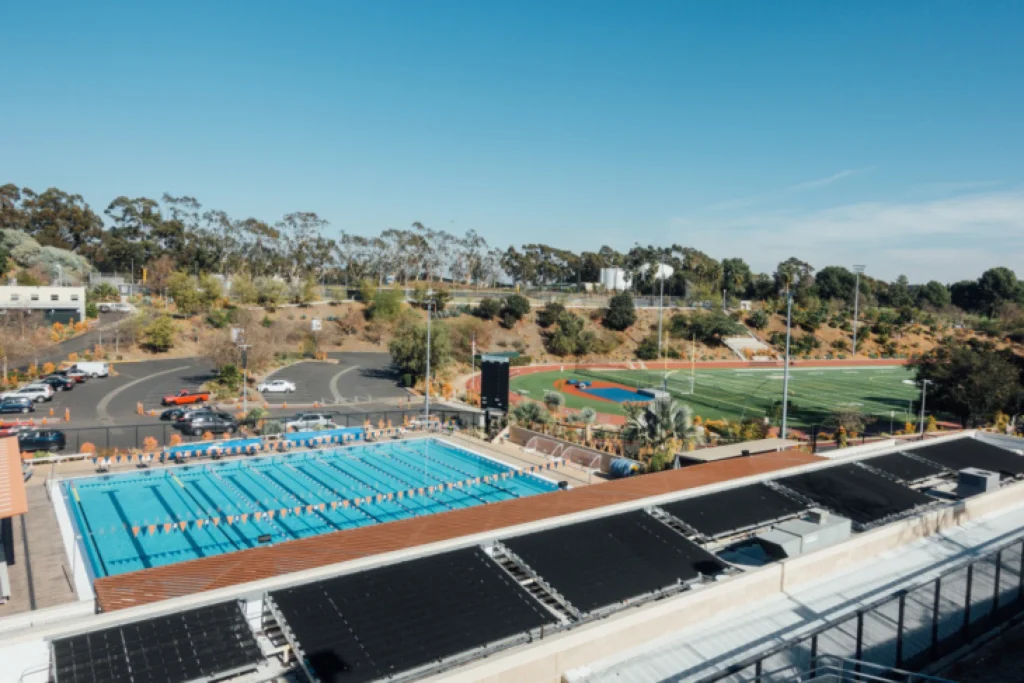
The Brentwood High School pool and stadium are located on VA Land.


Posted in Schools | Leave a comment

Lattes & Love Invitation Provides Lovely Morning

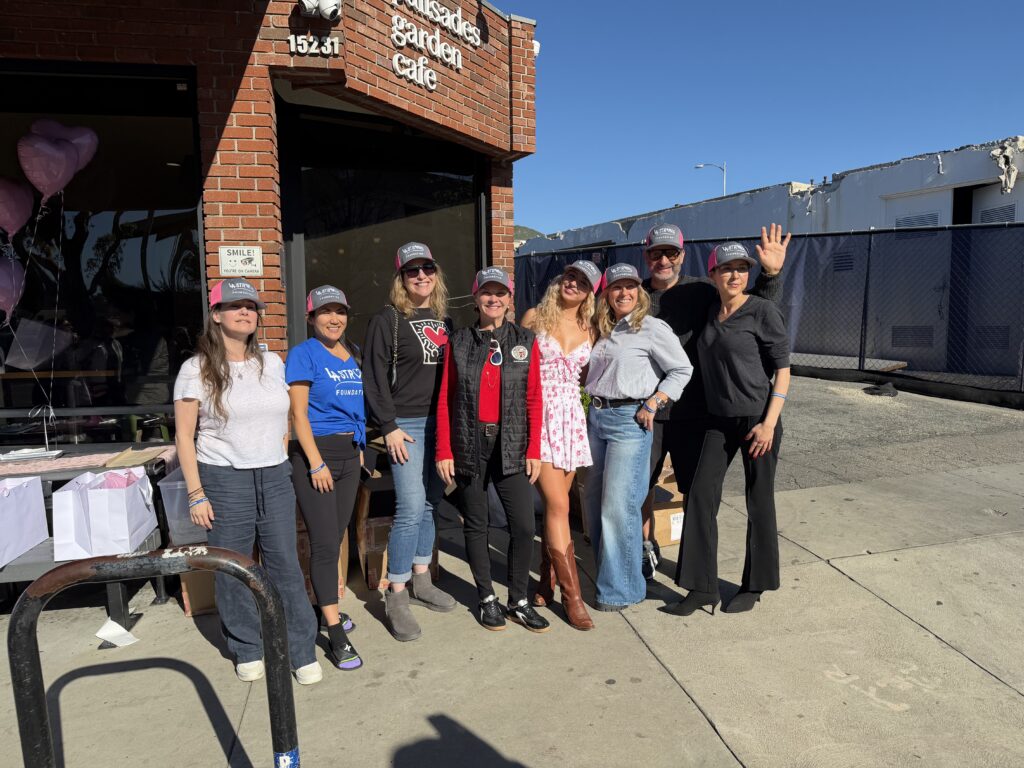
Councilmember Traci Park (center – red shirt), joined L.A. Strong founders Maxi Kozler Koven and Drew Koven (second and third) from right and volunteers to celebrate “Galentine’s Day,” on February 13 at the Palisades Garden Cafe.

This editor was among many Palisadians who received an intriguing invite “Lattes & Love” on February 13 at the Garden Café from 8:30 to 11:30 a.m.

The email invitation came from L.A. Strong and went to about 150 Palisades and Altadena women.  “Galentine’s Day,” with lattes and a little gift was promised. Women were encouraged to bring their friends to the Café, for what turned into a social gathering and reunion for many women who had not seen each since last year’s fire.

L.A. Strong was created by philanthropists and venture capitalists Maxi Kozler Koven and husband Drew. They come from consumer products businesses background and have helped provide products for those in need since 2012.

Maxi explained that in January 2025 after the Palisades Fire, the two have focused on fire survivors. They have hosted several events for those affected, but this event was different.

Drew, who was handing out white shopping bags that included a fruit cup, madeleines and lip gloss said, “What we found is everything has been meetings” and a decision was made to “do something social.”

Roseanne Landay, who is one of the Pali Condo Captains said, “I jumped out of bed this morning feeling so much lighter, knowing that I was coming to something social and not another recovery meeting.”

As Drew handed out another bag, he said, “I’m here to make sure everyone is happy.”

Maxi said, “We talk to nonprofits and long-term recovery groups to find out what people need,” which has changed over the months following the fire.

As people are moving back into homes, LA. Strong co-founders have asked, “What’s the next round of items you need?”

Based on what they’ve learned, the next event will be a “mattress event.” Many people, who had homes still standing had to throw out mattresses, towels, sheets and blankets and need to replace them.

Maxi said the “Galentine’s Day,” came about for women because they received T-shirts and sweatshirts from rag & bone and products from YSE Beauty.

Based on the tables of women sitting around, drinking coffee and chatting with friends and meeting new people, this event accomplished everything it set out to do. To find out more about L.A. Strong click here.


Posted in General | Leave a comment

Viewpoint: Campbell on Auditing, City Transparency and Homeless Industrial Complex

By TIM CAMPBELL

AUDITING:

What is the “philosophy” of auditing? To maintain my professional certifications, I have to take at least 20 hours of continuing education every year.  Over the years, I’ve learned interview techniques, fraud recognition, how to use graphics to make audit reports more interesting, and, of course, ethics.

The one thing I’ve never seen is a discussion of the philosophy of auditing.  This, of course, relates to L.A. Deputy Mayor of Community Engagement Vahid Khorsand’s town hall statement about debating the “philosophy” of audits.  There is nothing philosophical about performance auditing. A program either achieves its goals or it doesn’t.  Contracts are either properly managed or they’re not.

The Deputy Mayor was trying to reframe the conversation as an abstract subjective argument instead of a substantive discussion of outcomes. He claimed he “wanted to hear more questions” from the audience when what he was hoping for was something he could address with rhetoric and cliches.

CITY ATTORNEY FEES:

The LA City Controller Kenneth Mejia is running for re-election.

To date, the City has spent $7 million paying Gibson Dunn to avoid transparency and accountability for its homelessness programs. The Mayor, council, and City Attorney have also stonewalled the Controller’s office in its attempts to root our waste in homelessness programs. Meanwhile, the US Attorney and DA have charged two city contractors with fraud totalling about $50 million to date.  Instead of dodging accountability, maybe the City Attorney’s time and money would be better spent investigating its own programs for fraud and waste.  I have no great love for Kenneth Mejia. His audits are tainted by his bias against anything that’s not Housing First. But he inherited a top-notch audit shop and his staff are still doing good work despite him.

HOMELESS INDUSTRIAL COMPLEX:

Does the Homeless Industrial Complex exist? Those of you with whom I’ve spoken know I rarely use the term Homeless Industrial Complex.  It smacks of conspiracy theories and is nebulous.  I also think it relieves people of individual responsibility.  Its easy to write off unethical behavior as just another example of the HIC .

If there is a Homeless Industrial Complex, its far more subtle than mere fraud or bribery.  I very much doubt anyone is giving Nithya Raman envelopes stuffed with cash to grant contracts to a chosen few nonprofits.

I believe the corruption is structural and is centered around power instead of money.  Its easy to design a contract with requirements so onerous only the largest nonprofits can qualify.  Those nonprofits, in turn, lend their support to the elected officials who approve those contracts.

LAHSA CEO VaLecia Adams with L.A. City Mayor Karen Bass.

Councilmembers hire their homelessness aides from the same nonprofits, and those aides often return to similar positions after their tenure with City Hall. For example, Dr. Va Lecia Adams Kellum went from CEO of St. Joseph Center to being a special homelessness policy assistant to Mayor Bass, to CEO of LAHSA, and is now a member of Harvard’s Advanced Leadership Institute, a social research policy organization.

This, despite resigning after LAist discovered she approved more than $2 million in contracts with a nonprofit where her husband is a senior manager, and after LAHSA paid our $800,000 to settle whistleblower complaints about her mismanagement. So, if the HIC exists, it is based on political power and personal relationships, and not just money.

SUMMARY:

Despite numerous audits of the City, County, and LAHSA over the past few years, nothing has changed.  Programs trade leaders like the MLB trades baseball players. Elected officials desperately try to defend a system anyone else would recognize as broken and completely dysfunctional.

Even as other agencies are uncovering fraud and waste, leaders seem content to let the status quo continue.  Some are even discussing yet another tax increase to backill lost federal and state funding, despite overwhelming evidence of waste. The current system has yet to produce any statesman-level leader who is willing to speak truth to power without pushing his or her own agenda.  What will it take to create and implement lasting structural change?


Posted in Viewpoint | 4 Comments

Residents Raise Questions of Parking and Safety over Proposed Sunset Project

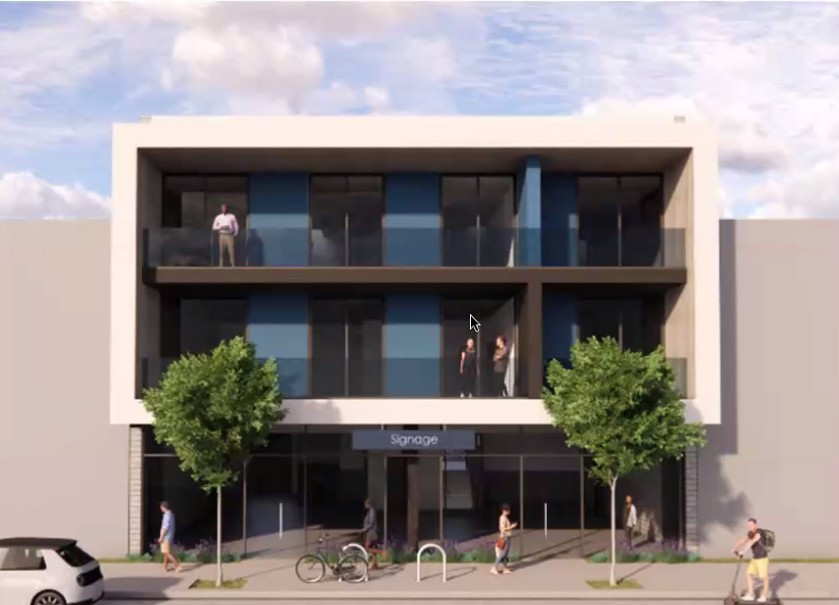
This is an architectural rendering of the proposed three story building at 15113 Sunset Boulevard.

At the Palisade Community Council Land Use Committee (LUC) meeting held via Zoom on February 11, a proposed three-story mixed-use building was discussed. About 50 people attended the discussion.

The building, at 15113 Sunset Boulevard, would have two ground-floor commercial businesses and two stories of apartments.

Each floor would have one two-bedroom apartment, a one-bedroom apartment and a studio apartment. One of the apartments would be designated as a “very-low-income” unit. Owners were asked which apartment would be designated as the low-income apartment. They did not know, but possibly the studio apartment.

Prior to the meeting, an introductory report was placed on the PPCC website: click here.

That report emphasizes that because of California’s Density Bonus Law (DBL), waivers and incentives would be provided to builders. State Law overrules The Pacific Palisades Commercial Village and Neighborhood Specific Plan.

LUC Chair Chris Spitz, who oversees the seven-member board, emphasized that DBL is a state mandate that supersedes local zoning and specific plans and Los Angeles must follow the DBL mandate.

Property owners Josh Stein-Sapir and Brad Keyes, with architect Andrew Alper of DesignArc and Nick Leathers from Crest, voluntarily attended the meeting to present and answer questions.

In 2021, Stein-Sapir and Keyes bought the 1958 building that was located on a 5,000 square-foot space.

The incentives owners would receive through DBL is a height of 40- ft, in lieu of  30-ft.; increase the height limit measured from grade to the ceiling to 34’9” as opposed to 27ft.; not have to provide commercial parking (eight spaces generally required); and an open space reduction to 50-sq.ft. instead of 650-sq.ft.

Waivers would include decreasing the setback on the north and side from 6 ft. to 0, not providing a loading zone, and removing the landscaping buffering requirement  in the rear parking lot between residences on Embury Street.

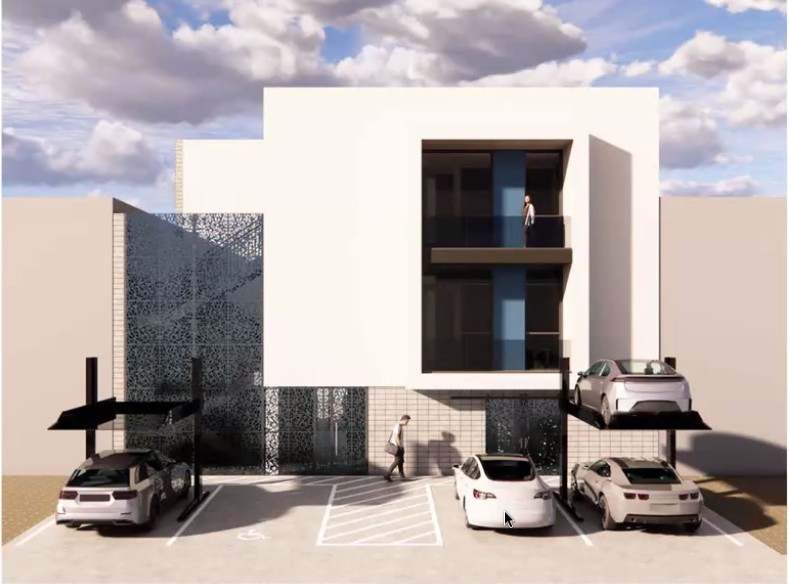
Parking waivers would include reducing bicycle parking from 17 to 8 and instead of 9 car parking stalls as required by the specific plan provide six.

One way to ensure that they have six parking spaces was to provide a car lift on two of the ground spaces. One resident asked, “How noisy are lifts because there are residences behind the building?”

Crest’s Leathers said, “We’ll double check on the noise and sound issue.”

The back of the building would have to two car lifts. There would be no space for commercial parking, and no loading or unloading zone for the two commercial spaces.

Resident Scott Cullen asked, “What If you have two people living in every apartment, where will they park?” He pointed out it could mean as many as 12 cars, but they only have parking for six people.

Leathers said street permit parking might be an option.

Cullen pointed out that parking on Embury is only on one side of the street and asked if people on Embury had been made aware of the project.

Spitz pointed out that owners came to the meeting, even though it was not required and that the next step would be to go before the Design Review Board, before finally going to the City Planning Commission.

Owners were asked if they had considered subterranean parking. They had, but limited space and turning radius made it impossible.

Rena Repetti asked about the plans for loading and unloading for the commercial stores. She was told it probably would be in the back alley where cars were parked, but there would be set hours.

One resident asked, “Could you consider two stories? Would it still be economically feasible?”

That wasn’t answered.

A member of the LUC, Howard Robinson, suggested maybe they could get parking in Rick Caruso’s Palisades Village. Another audience member joked they could park in Ralph’s parking lot.

In the chat, someone suggested that lawsuits are now happening around the state over Density Bills and wondered whether this could be disputed. There was no answer.

Cullen said, “This is critical, owners along Sunset could go three stories with no parking if this goes through.”

Spitz reminded everyone that the meeting was “informational” and that there would be other upcoming meetings. She reminded owners that there seemed to be specific questions about safety and parking from the public.


Posted in General | 2 Comments

Ray Kappe Brooktree Home Is on the Market for the First Time

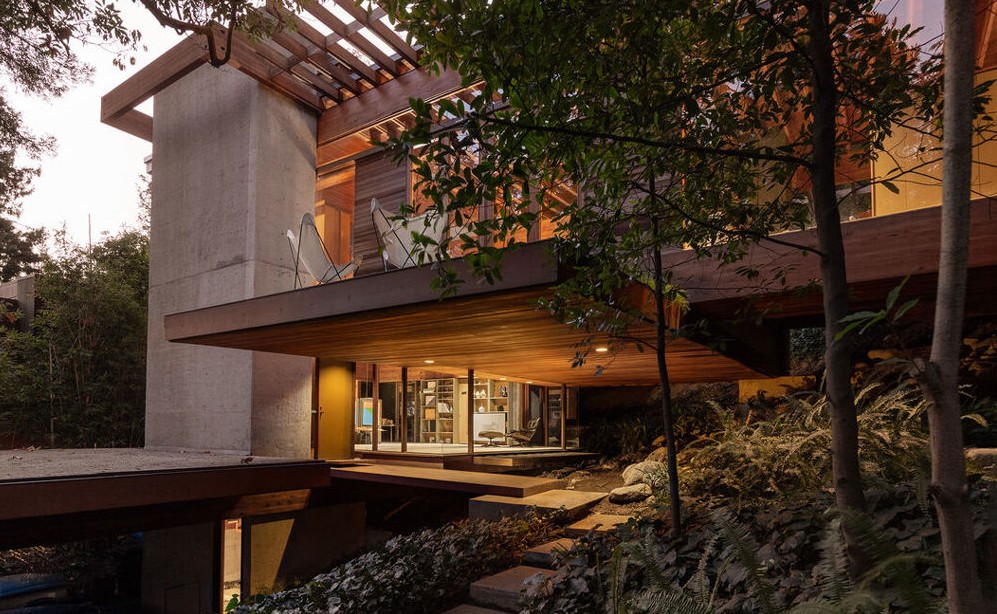
The Kappe house on Brooktree Road is for sale.

The home on Brooktree Road in Rustic Canyon that was designed and built by noted Mid-Century Modern architect Ray Kappe is for sale for the first time. It has been in the Kappe family since 1967.

Now it  is on the market for $11.5 million. The five-bedroom, five-bathroom structure has been described as both an “essay and poem.”

This home was designed and owned by Kappe, who passed away in 2019 at age 92. The L.A. Times described it as “The Greatest house in Southern California,” and it was designated as a Cultural Historical Monument in 1996.

The residence has been described as a master class in the “additive process of design,” and embraces the surrounding landscape of Rustic Canyon.

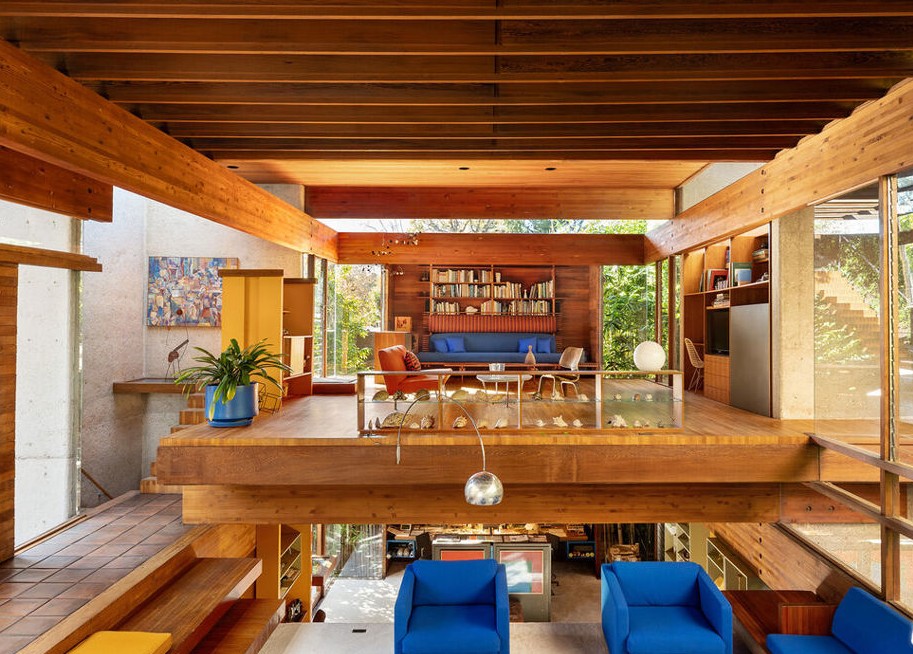
Kappe bought the property, which  was considered almost unbuildable in 1962 for $17,000. The house has seven split levels and totals 4,157 square feet. There are redwood ceilings and redwood detailing that is combined with walls of glass and massive skylights. The home receives direct, indirect and dabbled light from sunrise to sunset.

A primary suite anchors the northeast wing, and three additional bedrooms are on the southwest wing. Below the main living area lies a glass walled studio with views of the rock garden.

There are four outdoor spaces, including a cantilevered deck, a lap pool, spa, sauna and cabana with its own kitchen and bath. Only pre-qualified buyers can tour the house.

An interior view of the Kappe House.

Kappe was born in 1927 in Minneapolis to Romanian immigrant parents who changed the family name from Kapelowitz to Kappe. In 1940, the family moved to Los Angeles, where he attended Emerson Middle School designed by Richard Neutra. Years later, in 1987, Kappe received the Richard Neutra International Medal for Design Excellence.

Kappe graduated from UC Berkeley in 1951 and then worked as a draftsman on Eichler Homes for Anshen+Allen. He then moved back to LA to work two years with Carl Maston before going out on his own. (To see homes designed by Kappe click here.)

Posted in Real Estate | Leave a comment

Wattles a Serious Problem

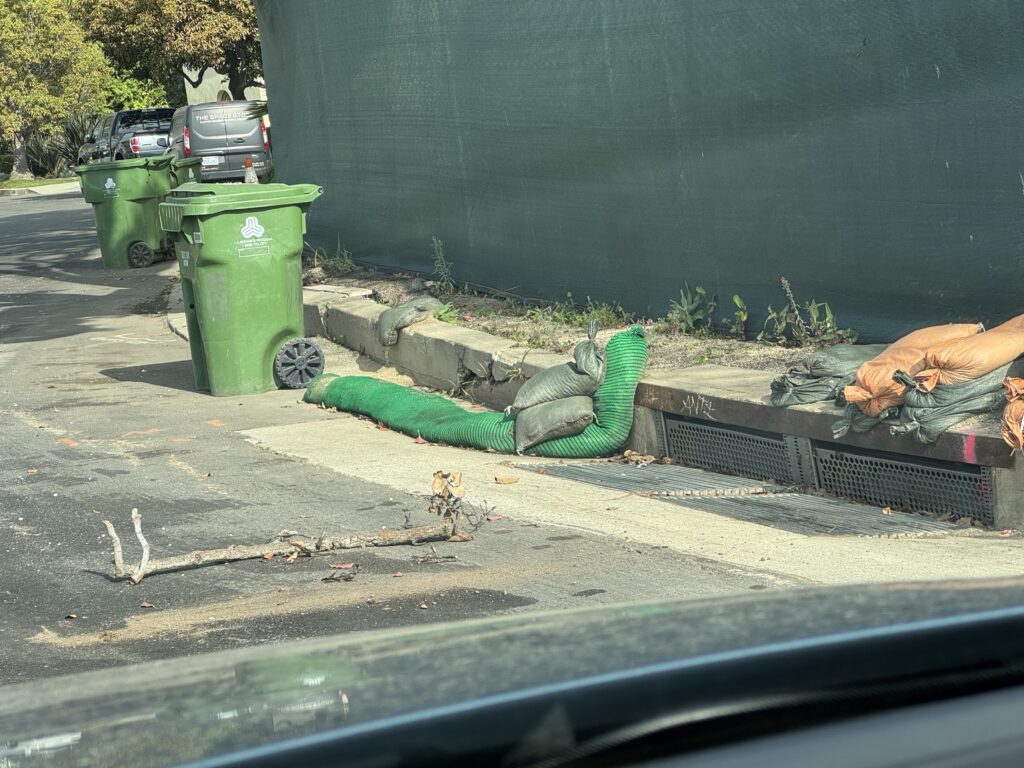
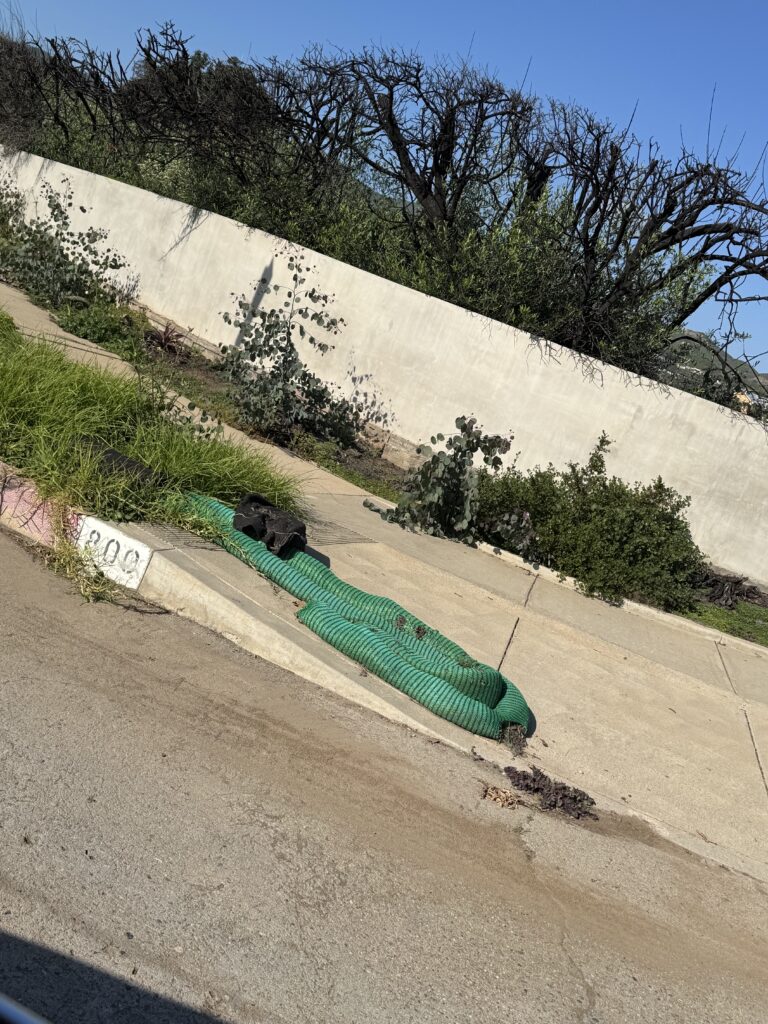
The green snake-like thing in the gutter is a waddle.

Wattles are not lumpy bumps on women’s outer thighs. Wattles, in this case is not a description of how ducks get from place to place.

Rather, that’s the name given for the green wads of straw trash that seem to litter gutters of streets in the Huntington, along Sunset and Chautauqua Boulevards, in the village and along other Palisades streets.

Councilmember Traci Park’s legislative Deputy Sarah Flaherty told resident Cindy Simon, “When installed correctly, the wattles prevent sediment runoff from the many vacant lots in Pacific Palisades from entering city stormwater infrastructure and/or the Santa Monica Bay.

“They function, as I understand it, by trapping the sediment within the straw which can then be replaced when the sediment accumulates to capacity,” Flaherty said. “This allows stormwater infrastructure to function as intended for longer periods of time, reducing the time and resources necessary to maintain said infrastructure.”

Dirt may have been an issue in the beginning, but now many lots and parkways are so overgrown with weeds that other issues, such as brush clearance and weeding has become a priority.

Resident Cindy Simon wrote to the Council office,  “It’s been one year since the fire. The wattles have morphed into complete street trash. They are everywhere. They are dirty, very very heavy, toxic, very unsightly, unwanted and serve no purpose as homeowners or rain have moved them away from street drains.

“They are impossible for the normal individual to move – they are heavy and unmovable.  They are street trash that cannot be cleaned up by volunteers. We are stuck with these unwanted, unasked for street trash and are fed up.”

Simon was told to let Flaherty to let her know if they were moved in the next week.

(Editor’s note: With the Genesis Invitational coming to the Riviera Country Club February 19-22, it would be nice for the streets to be cleared because of the extra traffic traveling through the area.)

Wattles are everywhere in Pacific Palisades. This one broke and threw up dirt/straw.

Posted in Palisades Fire | 3 Comments