Attend the Marquez Halloween Festival Saturday

“Harry Potter” attended last year’s Carnival at Marquez.
Photo: RICH SCHMITT/CTN

In Pacific Palisades, perhaps nothing says October better than the Marquez Halloween Festival.

This annual event will be held from noon to 3 p.m. on Saturday, October 20, at Marquez Elementary Charter School, 16821 Marquez Avenue. Entry to the event is free, and tickets can be purchased for carnival games, the haunted house and food. Five tickets for $5 or 110 tickets for $100.

Each class sponsors a booth, such as the lollipop pull, the duck pond and graveyard golf. There will inflatables, a dunk tank and a Sports Zone Camp.

Once again, the fifth grade will be tasked with creating a haunted house – “Enter, if you dare.”

During the afternoon, there will be special performances by Fancy Feet Dance Studio, the Palisades Dance Studio, Gerry Blanck’s Martial Arts Center, the Tae Ryong Taekwondo School and singer/songwriter Matty Gottesman.

Tickets may be purchased in advance at www.friendsofmarquez.com or at the door. The Friends invite you to come have some “ghoulish fun.” All money raised from the event will be used to support the Friends of Marquez, the parent-run nonprofit that funds supplemental educational programs to enrich the curriculum offered to all students at this elementary school

Posted in Schools | Leave a comment

Proposition 2 Asks for $10 Billion: Actual Cost $18 Billion

Community Colleges, such as Santa Monica Community College, would be eligible to receive some of the  $1.5 billion for renovations of the $10 billion asked for, if Prop. 2 passes.

Proposition 2, which has been labeled “Californians for Quality Schools,” asks taxpayers to back bonds of $10 billion. It is estimated that Prop. 2 will ultimately cost $18 billion when repaid with interest. The voter guide noted: “A bond works like a government credit card—paying off that credit card requires the government to spend more of its residents tax dollars.”

The State’s Legislative Analyst has said this would increase state costs by about $500 million a year for 35 years to repay the bond. California already has over $109 billion of outstanding and unissued bonds.

The Reason Foundation pointed out that school districts in California already have $220 billion in debt and liabilities, which is over $40,000 per student. And most of it is bond debt. “Instead of the state taking on debt to make it easier for local school districts to also take on debt, the state needs to adopt stricter standards for when capital projects—and school closures—are necessary.”

According to proponents there is a need because “Many schools were built over 70 years ago and 38 percent of children attend schools that don’t meet minimum standards when they are exposed to dangers like asbestos, mold, unsafe drinking water and extreme heat.”  (Note: California has specific laws regarding asbestos in schools, including standards for air monitoring and worker training for asbestos abatement projects.)

“School districts have an annual budget. So, if these repairs were really needed, these repairs should be budgeted in their annual budget,” said Francisco Alanis of the Libertarian Party. “It’s just that these school boards are not living within their means.”

The bond would include: $8.5 billion for public schools, including charter schools, with a higher share going to school districts with lower assessed property values and whose student body are low-income English learners. Community colleges would receive $1.5 billion.

What about lottery money that was supposed to go to schools? When voters approved of the lottery, 34 cents of every dollar was slated for education. In 2020, The California State Auditor found the lottery had shorted schools tens of millions of dollars (click here).

Are there ways to raise money for schools other than asking retirees to pay more to renovate schools?

Require students in community college to pay more than a minimum amount. At Santa Monica Community College, if someone is taking a class while in high school, the tuition is waived. A regular student pays $46 a unit (12 units would be $552 a semester), but of the 31,000 students attending SMC, more than half are given tuition assistance through the California College Promise Grant or the California Dream Act, which provides free community college.

Additionally, many bemoan the fact that California schools, which at one time led the nation, are not doing the job in the classroom. View The Nation’s Report Card click here.

The Reason Foundation (click here.) writes that nearly three quarters of California school districts  have declining enrollment, and more than 1,400 schools have lost at least 20% of their students since the pandemic. Also, federal staffing and financial data 2002 to 2020 exposed that despite no aggregate change in enrollment over that period, total staff in California public schools increased by 6.7%, and non-teaching staff increased by 26.3%.

Support Prop 2

As of September 5, supporters had raised $3.6 million and included the California Building Industry Association with $1 million and the Coalition for Adequate School Housing Issues Committee with $1 million. Also supporting the Prop are the California Teachers Association, California School Nurses Organization and Community College League of California and the Los Angeles Times.

Against Prop 2

The Howard Jarvis Taxpayers Association

Republican Assemblyman Bill Essayli.

The Daily News writes: “No on Proposition 2: A highly expensive, poorly designed state bond for schools.”


Posted in Schools | 1 Comment

Opinion: Gascon-minded Judges on Ballot

Judges oversee law and justice.

By PETER DICHELLIS

For many reasons, voters can find it difficult to gather information about judges, who are on an election ballot.

This November voters have a clear choice between three public defender attorneys  or three prosecutors.

The three public defenders are: George A. Turner Jr. (Office 39), Ericka J. Wiley, (Office 48), and La Shae Henderson (Office 97), who call themselves “The Defenders of Justice.” The three told Bolts Magazine they would prioritize alternatives to incarceration.

On the other side of the voting guide, their counterparts are attorney and Manhattan Beach City Council member, Steve Napolitano (office 39), and two Deputy District Attorneys Renee Rose (Office 48), and Sharon Ransom (Office 97).

The local public defenders union endorsed all three defense attorney candidates, and all favor criminal justice policies similar to those of LA County DA George Gascon, who vowed his approach would “enhance safety.” (But California Department of Justice statistics reveal both violent and property crime increased in LA County since Gascon took office.)

And, coincidentally or not, DA Gascon packed his senior staff with former defense attorneys, including a vocal defund-the-police advocate.

So this November voters must decide whether to elect three committed criminal-defense attorneys to the judge’s bench, ensuring Gascon’s criminal-friendly policies endure, regardless of the outcome of the District Attorney election.

Indeed, Gascon’s policies are so criminal-friendly that a convicted child molester boasted about receiving a light sentence, a convicted murderer was so enamored with Gascon’s soft touch that he vowed to tattoo the DA’s name on his face, and a convicted felon killed two police officers after Gascon put him back on the streets via a plea bargain.

And in each case a judge oversaw the entire process, underscoring the importance of electing judicial candidates whose views one favors as a voter.

After all, in many cases, laws are ambiguous enough that judges proceed according to their personal interpretation. Judges also decide what evidence a jury is allowed to see, and can exercise judicial discretion in determining penalties, such as what type of sentence a convicted criminal receives.

So in my view November’s choice is clear: those who believe George Gascon deserves re-election can vote for the three public defender judicial candidates who most closely align with his beliefs.

Others are urged to vote for their opponents Steve Napolitano (Office 39), and District Attorney’s Renee Rose (Office 48), and Sharon Ransom (Office 97) click here.


Posted in Viewpoint | 1 Comment

What Is It? # 43

 This is an old apothecary cabinet that I bought in the mid 60’s. I believe it was imported from England. It was an antique then, so I assume it was made in the 1800’s.

The drawer fronts are nicely carpentered. The knobs are not original. A base has been added. The pharmacist kept medications, chemicals leeches and all sorts of devices in them.

Name plates were probably attached to front of each drawer. Most apothecary cabinets of that age were made in England, Germany or the United States.

Most were basically utilitarian for modest pharmaceutical shops. The Chinese who believed in spiritual cures made elaborate chests with carvings of dragons, and in red and gold colors for Chinese herbalist shops.

About the value of this cabinet: I paid about $150 a long time ago. On the internet one like this might be bought today for about $2,000.

If you want a massive stunning Chinese chest in red with worked brass for your living room, it will cost much more..

(Editor’s note: Palisades resident Howard Yonet has an interesting collection of curios from around the world and with his permission, Circling the News is publishing one a week. About the collector: Dr. Howard Yonet was born in Brooklyn in 1934 and attended Brooklyn College. He went to Baylor Medical School and then returned to do an internship at Bellevue Hospital. Yonet completed his residency at the Manhattan V.A. and the Montefiore Hospital. During this time he went skiing in Vermont and the Catskills, and while traveling found barns filled with early American pieces. This led to his interest in American Antiques.

In 1965, he married Daniele, who was originally from Nancy, France. During the Vietnam War, Yonet was drafted as a medical officer and stationed in Landstuhl, Germany (1966-1969). This was close to the French border, which meant he and Daniele and could visit her family.

While abroad, the Yonets took weekend trips through France and Italy, purchasing many interesting pieces at flea markets.

The family settled in Pacific Palisades in 1970 and Yonet practiced general radiology until 2006. He continued to acquire antiques and collectables at estate and garage sales and the Salvation Army Store. He also enjoyed looking for collectibles while traveling in Montana, Idaho, Colorado and Massachusetts. Daniele’s family helped add to his collection.)


Posted in What is it? | Leave a comment

Pot Shot #30

Ashleigh Brilliant writes:

WHAT EXACTLY IS A “POT-SHOT” OR “BRILLIANT THOUGHT?”

Pot-Shots are epigrams, composed according to the following very strict rules.

The length must never exceed 17 English words. Note that this is a maximum. Some Pot-Shots are much shorter. Hyphenated words count as a single word.

Pot-Shots must be easy to translate into other languages. Therefore there can be no use of rhyme or rhythm, idioms, puns, or other word-play.

Pot-Shots should be capable of being appreciated in all times and cultures. Topical and cultural references must be avoided.

Every Pot-Shot should be as different as possible from every other one.

Every Pot-Shot must be totally original, and unlike anything else the author, or anyone else, has ever said before.

The words of a Pot-Shot must be able to stand on their own, and not require any illustration in order to be understood or appreciated.

Whatever is being said should be worth saying and said in the best possible way.

NOTE: These are ideal standards, and I myself have failed to meet some of them occasionally — but in general I have adhered to them quite scrupulously

Posted in Pot-Shot | Leave a comment

Prop 33, Prop 34 and the Controversy Over AIDS Healthcare Foundation

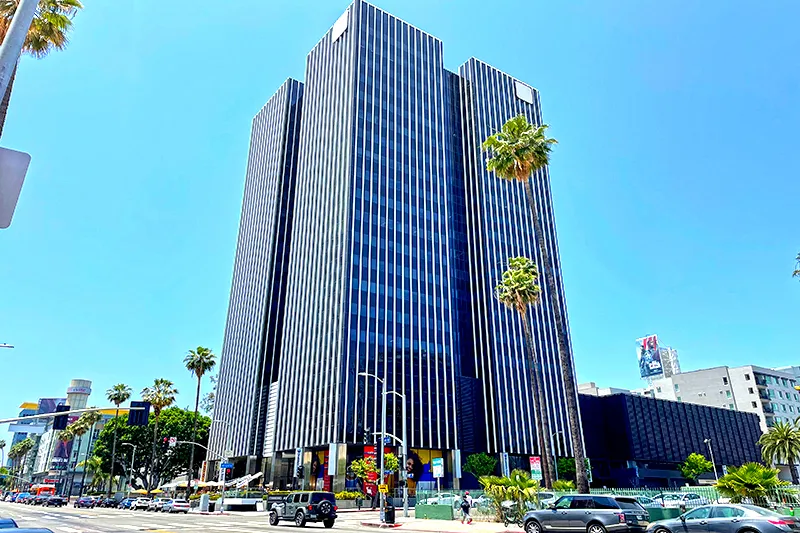
The AIDS Healthcare Foundation is located on the 21 floor of the Sunset Media Center, which is described as Hollywood’s most innovative vertical office campus. AHF makes about $2 billion in revenue per year and has spent millions lobbying to pass Prop. 33.

By ANGELA MCGREGOR


On the face of it, there would seem to be little in common between Proposition 33 – which would do away with a 30-year-old, statewide rent control law in favor of local control over rent regulation – and Proposition 34 – which would allow the state to negotiate lower Medi-Cal drug prices.  But in fact, the two measures are inextricably joined.

And the glue that holds them together is a nonprofit AIDS Healthcare Foundation.

AHF was founded in 1987 with the stated goal of ending the AIDS epidemic.  In the 1990s, as advancements in medical treatment for AIDS progressed, the organization’s focus evolved from providing hospice care for patients to distributing medical care for patients.  Because AHF is able to charge government insurance programs more than it pays for drugs, through a federal program known as 340B, the organization generates about $2 billion in revenue per year.

AHF has spent millions on funding the campaign to pass Proposition 33, the so-called “Justice for Renters” Act.  While ads for the proposition refer to it as “pro rent control,” in fact, the only thing this proposition would do if passed would be to overturn California’s existing, state-wide rent control legislation – a measure passed in 1995 called the Costa-Hawkins Act.

Costa-Hawkins exempts units built before 1995 from rent control, and allows landlords to reset rents when units become vacant.  The Act also exempts condos, single-family homes, and new construction from rent control.  At the time it was passed, it was seen as a way to pull back on overly restrictive municipal rent control legislation while still allowing cities to protect tenants and leave in place financial incentives for new construction of rental properties.

Proposition 33 is the third ballot measure since 2017 calling for the repeal of Costa-Hawkins, all of which have been bankrolled by AHF.  According to critics, AHF spends a disproportionate share of their excess revenue on political lobbying (for a nonprofit).

Critics of the proposition argue that it would ultimately discourage development by opening the door to onerous rent control restrictions that would effectively eliminate the profit motive for developing multi-family housing.  For example, municipalities opposed to development but under pressure to create more housing could adopt rent control policies so restrictive that no one would want to build there.

In addition, AHF has also spent millions of dollars on the purchase of more than a dozen single-room occupancy apartment buildings in Los Angeles, which charge rents as low as $400 per month.  According to its website, these buildings are being “built” by one of AHF’s spin-off 503c’s, The Healthy Housing Foundation, and “provide decent housing units at an affordable cost”.  However, they are not listed on that organization’s 2022 income tax returns (nor that of AHF).

According to a November 2023 report by the LA Times, many of AHF’s 1300 tenants are living in squalid, unsafe conditions, including “one tenant’s dog [who] was scalded to death after a radiator exploded…[and] a legally blind tenant who fell more than 12 feet down an open elevator shaft.

When some of these tenants withheld rent to pressure AHF to make repairs, they were evicted and, in some cases, had their belongings confiscated.  This would appear to contradict the positions taken by an initiative that was created and funded by AHF called  “Housing is a Human Right,” which lobbied for an eviction moratorium during the pandemic and has relentlessly lobbied against Ellis Act evictions.
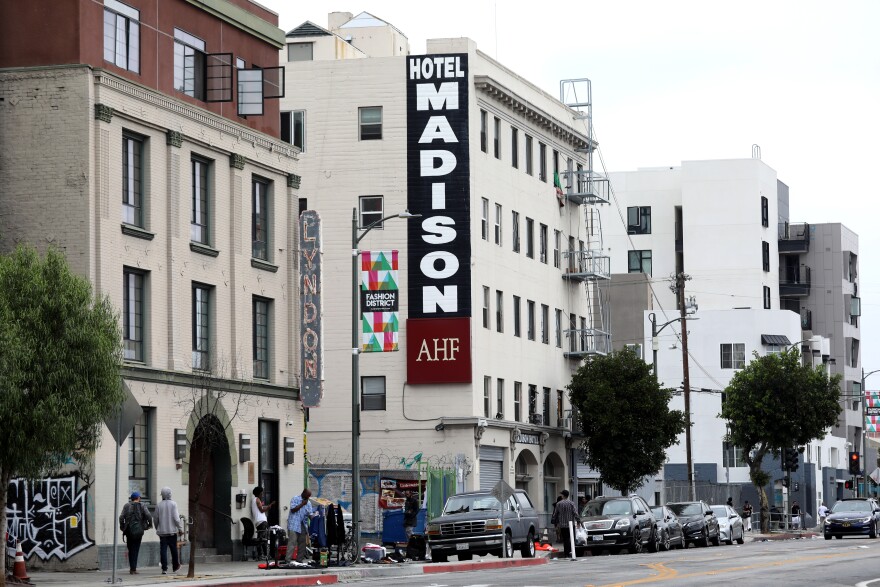
The Madison is owned by the Aids Healthcare Foundation.

In September, AHF settled a lawsuit with tenants of one of their properties, the Madison, located at 423 East 7th Street, near Skid Row, agreeing to pay $575,000 to the plaintiffs and address insect infestations, broken elevators, and other issues.

In return, tenants were required to “acknowledge that AHF has invested significant resources into improving and upgrading the Madison, which represents an effort to improve the conditions in L.A.’s Skid Row district.”  Although AHF told the L.A. Times that, since 2017, they had spent $7 million to upgrade the Madison, a search of LA’s Building and Safety website could find no permits issued for work at that address.

Proposition 34 would restrict the activities of healthcare entities licensed in California who participate in the 340b program, and have spent more than $100 million on purposes other than direct patient care over the past ten years. In other words, it would mandate that AHF spend at least 98% of its revenue on direct patient healthcare.  And according to its 2022 income tax statement, AHF spends over $250 million a year on employee benefits and wages – more than  8% of its total revenue – alone.

Since AHF is the only organization that fits the description of one that would be regulated by Proposition 34, it’s not surprising that their campaign against it has deemed it a “revenge initiative” by the California Apartment Association,  one of the major donors to the No on Prop 33 campaign.  However, CAA is not the measure’s only proponent; it includes a wide variety of patient advocacy groups (including the ALS Association and the California Chronic Care Coalition).

The argument for Proposition 33 comes down to whether one attributes L.A.’s current rent affordability crisis to landlord excesses enabled by Costa-Hawkins, or to a shortage of available units.

As for Proposition 34, voters must decide whether AHF’s expenditures constitute permissible advocacy on behalf of AIDS patients or an abuse of its status as a nonprofit and the federal program that has filled its coffers.

According to recent polling, both measures are currently slightly ahead, creating the distinct possibility that AHF could wind up finally winning the battle to overturn Costa-Hawkins, while also losing its ability to continue to be a major political player in state government.


The LA Daily News summed up Prop. 33 & 34 on their October 15 Opinion Page:

No on proposition 33: Rent control doesn’t work and it never will.

Yes on Proposition 34: The AIDS HealthCare Foundation has abused our democratic system and must be stopped.

(Editor’s note: This story first appeared in the Westside Current and is reprinted with permission.)


Posted in News | 3 Comments

Young Adult Librarian Ziba Perez Promoted

Young Adult Librarian Ziba Perez participated in the annual 4th of July parade.

Ziba Perez, Palisades Young Adult Librarian, has received a promotion and her last day at the Palisades Library was Wednesday, October 16. Just shy of two years at this location, Perez will next work as a Young Adult Librarian III at the Van Nuys branch.

Perez started the circulating zine section at the library (lapl.org/zines) and also the Zine Club. Pronounced like magazine—without the mag—zines are self-published, independently made, usually photocopied, and have a small print run.

During the club time, members, under Perez, chatted and shared inspiration for projects. They discussed zines they were working on, and zines they like. Zine content can be personal, political, niche, artistic, visual—there are no rules.

Perez said, thanks goes to “branch manager Mary [Hopf] who has always been very positive and open to new ideas, I appreciate Mary so much and will miss her greatly.”

Once she is “settled in” at the Van Nuys library, she hopes to start a similar Zine program.

One downside among many leaving this library is, “the commute will be longer for me as I live in this area and do not plan to relocate.” In an earlier story, Perez said that she loved the hiking opportunities at Will Rogers and Temescal Canyon and that she had just learned to surf.

She said she felt one of her greatest accomplishments in the Palisades was upgrading the team area. She credited Palisades Library Association (PPLA) member Sandy Eddy, for helping her.

“It became a more welcoming environment for teens, and I saw the teen area of the library bloom from no teens to full of teens every day after school,” Perez said.

“I worked with Ziba for nearly two years on refurbishing the Teen Area,” Eddy said. “During that time, I observed her in action as she juggled a variety of projects – from overseeing Palisades Teen Council, to establishing relationships with many local organizations, to creating a Zine collection for our branch… not to mention her involvement in many other activities, too many to mention! We will miss the energy and enthusiasm that Ziba brought to our branch.”

When Perez was in elementary school, she would walk with her best friend to the Los Altos Neighborhood Library, before going home to meet her parents, who were returning from work. Her Iranian father was a mechanical engineer at Boeing and her Mexican mother worked as a chemical engineer for the Los Angeles County Fire Department Hazmat Division.

Perez did not initially plan on a library career. She attended UC Irvine, majoring in biological science, receiving her degree in 2005, with plans to go to medical school. Plans changed, and Perez said, “I decided to be a librarian after a few years working full time as an academic library assistant at UC Irvine Libraries.”

She attended the University of Illinois Urbana-Champaign and received her master’s degree in library and information science. After graduation, Perez interned at the American Film Institute’s Louis Be Mayer Library Special Collections.

Her first position was with the OC Public Libraries in California at the Costa Mesa Donald Dungan Branch as the Bilingual Adult Librarian in 2013.

Perez said the Teen Council will continue under Hopf until they find her replacement.

Ziba Perez has been promoted and relocated to a new library.

Posted in Books | Leave a comment

“Mokusatsu” Official LA City/County Policy to Residents

A World II Japanese propaganda poster

By TIM CAMPBELL

In the summer of 1945, once the US knew the atomic bomb worked, the western Allies issued an ultimatum to Japan: surrender or face complete destruction.  The Japanese government met each call to surrender with what is known as Mokusatsu, or “to treat with silent contempt.”

Although revisionist historians suggested the Allies misinterpreted the word and it was supposed to mean “ignore,” modern researchers agree with the Allies’ 1945 understanding. War hawks in the Japanese government hoped that by not responding to the surrender demands, they would eventually wear down the allies and make them accept peace on Japan’s terms.  It didn’t work.

When it comes to negative news about homelessness, Los Angeles’ elected leaders seem to be following the same path of silent contempt.  They habitually try to ignore anything that diverges from their false narrative of success.  Just a few examples include:

  • When Jaime Paige and Christopher LeGras exposed the fact that almost half of the motel rooms purchased under Project Homekey have been vacant for as long as two years. City officials said nothing to show they were interested in addressing the problem.
  • When Paige and LeGras found more than 70 percent of the rooms purchased by the County were vacant, the Board of Supervisors did not respond, other than to send a few generic emails about construction costs and regulatory issues.
  • When Sue Pascoe of Circling the News revealed LAHSA’S failure to count homeless in beach areas, officials responded with a vacuous word salad that didn’t address the count failure.
  • When the L.A. Alliance for Human Rights released a report showing the County has chronically underspent funding for mental health and other support services for the unhoused, County officials’ response was it “didn’t tell the whole story”, but offered no data to refute the report’s findings.  Since the report used county financial and program data, not telling the whole story would mean the county did not provide accurate budget or performance documents. The response was very similar to a 2020 State Auditor report that showed the county chronically underspends its Mental Health Services Act money, to the point it is sitting on an unencumbered balance equal to 175% of its operating budget. The County claimed the audit’s numbers were inaccurate, but never offered a verifiable alternative amount.
  • At an October 2 hearing in federal court,  independent auditors described how the city, county, and LAHSA were stalling or refusing to provide data required to measure homeless program performance.  Officials responded with vague assurances the data would be forthcoming—if it exists.
  • When the City Controller announced he was investigating nonprofit organization Urban Alchemy after a video of one of its employees using a perssuer washer to force a homeless person off a sidewalk,   L.A.’s City Council continued to grant the nonprofit large service contracts. A few months after the Controller announced the investigation, the City Council and City Attorney inexplicably tried to shut it down.
  • When Christopher LeGras exposed serious problems with LAHSA’s latest PIT count,  officials continued to insist the count was accurate and that it showed a meaningful decrease in homelessness.

Homeless encampment near City Hall taken in July.

These are just a few examples of how local officials try to ignore or dismiss criticism of their programs.  Often, there’s more contempt than silence.

I’ve read official reports blaming “NIMBY’s” for the city’s failure to require its providers to properly manage shelters, and for the county’s inability to create more mental health beds.  When public agencies choose not to hurl insults themselves, they can depend on their surrogates in the advocacy industry, who are quick to brand negative news as “hating the homeless” and pack Council meetings with their screaming followers.

Seventy-nine years ago, the Japanese government used silent contempt and obfuscation on its own population as well as its enemies. The government withheld news of military defeats from the population, even as American bombers appeared in the skies above their cities.

Our local government uses the same practice. I defy anyone to point out a single instance where an elected official has stood up in front of the press and admitted homelessness programs have a performance crisis.  Even as independent auditors detail the lack of performance measures and payments made without documentation, officials remain silent or defend their agencies.

What are we making of our elected leaders’ silent contempt?  They treat their constituents as obstacles to be overcome instead of the people to whom they are responsible.

When residents raise legitimate concerns about homelessness program performance, they are subjected to lectures about our “unhoused neighbors”, or promised success is just around the corner (as long as taxpayers continue to cough up sufficient revenue).

Our leaders’ attitude also shows tremendous arrogance.  Despite multiple press stories exposing systemic failures in homelessness programs, despite professional auditors questioning how public money is being spent, despite the city’s own Controller investigating at least two nonprofits, despite one of Judge Carter’s special masters suggesting there are signs of fraud in the audit’s evidence, and despite all these problems, public officials continue to insist their programs are working and are the only solutions to homelessness.

Just as the arrogance of Japan’s leaders brought their country to the edge of annihilation, so local leaders turned a blind eye to the suffering on our streets.

They are more interested in political posturing, defending theories about social justice, and guaranteeing the free flow of revenue than in solving homelessness.  One of the most poignant examples of our leader’s arrogance is a recent L.A Times story about the nonstop calls at an LAFD station near MacArthur Park.

Tax dollars to help the homeless are not working at MacArthur Park.

Between January and August 2024, medical calls related to drug overdoses outnumbered fire calls by almost 17 times (599 to 36). As columnist Steve Lopez wrote, “All of this is the normalized reality of a neighborhood that once stood as a gem of the city, and now suffers in wait for someone, anyone, to stand up and say this should not exist, cannot exist, and must end, for the sake of civility and for the benefit of the working people who make up the majority of the residents here, raising children who deserve better”.

The neighborhood around MacArthur Park is in Councilmember Eunisses Hernandez’s district; she is one of the most vocal defenders of Housing First and social justice on the Council.

While she pontificates about “criminalizing homelessness,” paramedics are constantly responding to overdose calls, sometimes for the same person multiple times a day.  The Times story says she created an overdose response unit for the park.  Note this is an overdose response unit, not an overdose prevention unit, consistent with Harm Reduction policies.

We know from community advocacy groups like the Santa Monica Coalition that the way the County Department of Public Health practices Harm Reduction – it is 100 percent reactive; it responds to overdoses after the fact, and actually makes them more likely by distributing drug paraphernalia while offering no diversion services. Councilmember Hernandez often frames homelessness in terms of race and economics. Yet, she seems fine, perpetuating a system that kills more people of color and the poor at far higher rates than other populations.

Our leaders’ practice of silent contempt reveals an absolute disdain for nearly everyone in the community: housed residents and taxpayers who expect results for the billions spent on homelessness; business owners who deal with the effects of the mentally ill and substance abusers who regularly drive customers away;  unhoused people, more than 70 percent of whom are unsheltered and in desperate need of adequate shelter and services; and even their own employees, like the paramedics who live with the stress of responding to endless overdose calls and the deaths that accompany them.

It seems the only group many leaders are interested in is the one that finances their campaigns and who agrees with their willingness to experiment with the livelihood and lives of the people they should serve.

Posted in Homelessness, Viewpoint | 2 Comments

James Corman Wins Library Writing Contest

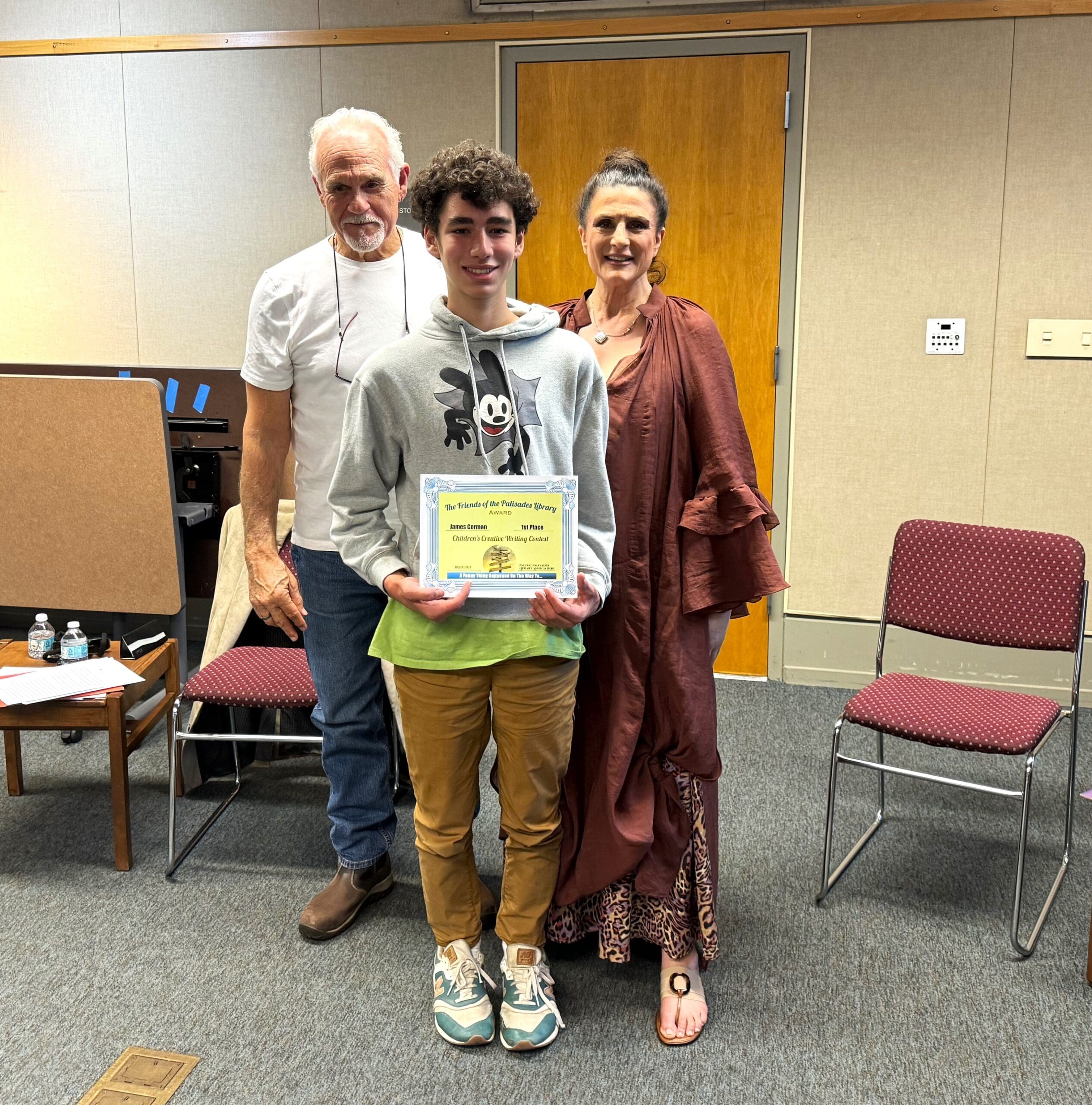
Harvard-Westlake student James Corman won the annual writing contest in the high school division. He is joined by actors Bill Jones and Christine Kludjian.

The annual summer youth writing contest winners were announced at a ceremony at the Palisades Library on October 9. The contest, with the theme “A Funny Thing Happened on the Way to . .. ” opened in June and closed on September 5. Submissions were judged on creativity, originality, effort, plot and theme.

The top three stories in each of the categories were read/acted by professional actors Bill Jones and Christine Kludjian.

In the Authors category (High School), first place went to James Corman who attends Harvard-Westlake. Second went to Audrey Yael Smith, who attends Palisades Charter High School and third went to James Marks who attends Milken Community School.

A Funny Thing Happened on the Way to the Ground

By JAMES CORMAN

It’s hard to explain what it feels like to be a dogwood in full bloom, but I will try. My flowers are my access to the world. Through them I feel slow breezes blowing late at night. I feel warm, soothing sunlight on my petals at sunrise and sticky drops of dew accumulating on my flowers at dusk. I feel ticklish as fuzzy bees buzz through me on their search for pollen. On my petals I feel the cool spray of hose water when I’m watered each afternoon. And I grow tall towards the sky, standing proud, because I know my petals are beautiful. I can feel it.

My leaves are my ears. Through them I hear birds chattering, waiting impatiently for my flowers to turn to drupes. I hear dogs barking in the summer and howling in the winter. I hear the patter of ants patrolling my leaves as I eavesdrop on their secret conversations. And I hear people. Toddlers, most insightful, notice the changing colors of my leaves through the seasons. People of all ages speak about my flowers. “How beautiful. Dogwoods were everywhere when I was young,” elders remark. “What a stunner,” passersby state. I try to be humble, but I bask in the compliments. Despite the praise, I will never forget what people did to me years ago…

I heard footsteps through my leaves. Someone was fast approaching. I heard panting, and my suspicions were confirmed: a runner. Then it happened. A yelp and howl below me. Was a dog near? I heard a thump. I could not feel, as it was winter, and I had no flowers. But I knew what happened. My roots had grown thicker that year, up through the sidewalk, and my branches had grown astray. I was in wild form, and I had tripped a runner. I felt a rush of shame inside of me. I had hurt someone and felt despicable. Sadness gushed through my trunk, into my branches, and my bark began to crack. Slits and holes opened up across me, and thick, amber sap flowed from me. Until that day I never knew trees could cry.

A week later, I heard a truck pull up beside me. Its engine grumbled, and I felt a shiver run down my bark. “Did you bring the chainsaw?” A deep voice huffed.

“Yup,” another replied. “Its branches are everywhere. No wonder she fell.”

“We should cut down the whole thing. It’s an ugly tree, anyway,” the first man replied. Were they talking about me? I grew nervous. But no, I consoled myself. I was not an ugly tree. Sure, I was not in full bloom, but come springtime I would be gorgeous. Suddenly I heard the sound of a thousand bees, and within seconds, the chainsaw was moving through me. Even without flowers, I could feel. Pain. A fierce, fiery pain rushed through me, hotter than August heat. Was I going to die? They were cutting me down. There would be nothing left of me. Nothing left to hear crooning mourning doves, to feel spindly spiders in my flowers. Nothing left of me to listen to families complimenting my beautiful blooms. There would be nothing left of me, and there was nothing I could do.

“Timber!” The man shouted, and I braced myself for my demise. I began to fall. Any moment I would hit scorching pavement and perish. But a funny thing happened on the way to the ground. I felt a shift of energy, my soul moving swiftly, deep underground, into my roots. My roots! They branched down from my stump like a thousand rivulets, bringing up water and nutrients. Indeed, my roots brought me life.

Six months later, a sprig had grown up from my trunk, and soon it was a sapling. Despite my traumatic experience, I felt wonderful. I had quite literally regained my youth. But it was a special kind of youth, because I had wisdom, too. In Spring, I grew one flower. The old me would have been ashamed. My blooms were my pride, and I would have shunned myself for producing but one measly flower. But I stood tall, displaying it to the world. I needed no compliments that year. I was alive, and that was enough.

Posted in Kids/Parenting, Schools | 2 Comments

Southbound PCH Closure Alert

Cars were detoured off PCH onto Moomat Ahiko before the McClure Tunnel.

The City of Santa Monica issued a Pacific Coast High closure at the McClure Tunnel, today, at 7:40 a.m. releasing the following statement “Due to a brush fire, East and West Bound Santa Monica Freeway will be closed between the McClure tunnel and 20th Street until further notice.

“Lincoln Boulevard is closed to north- and south-bound traffic from Westbound Olympic to Eastbound Olympic until further notice.”

Then the City released information about a traffic accident on Ocean Avenue between California and Santa Monica Avenue—closing those lanes of traffic, causing further traffic problems.  At 9:14 a.m. that accident was cleared and the lanes reopened.

An updated 9 a.m. alert about the brush fire noted that Eastbound Santa Monica Freeway remains closed from the McClure Tunnel to Lincoln, but that all other street closures had been lifted.

Southbound PCH traffic was reportedly backed up to Malibu. KFI traffic advised people to take Topanga or any other possible road to access the 101 Freeway. The station noted that the earliest PCH might open would be 10:30 a.m. and that there had been fire damage because of a homeless encampment to a Caltrans sign/structure, but did not specify, what it was.

As always when PCH is closed south of Pacific Palisades, drivers look for alternate routes, jamming traffic on Sunset and Temescal Canyon Road.

With PCH closed, drivers looked for alternate routes, including Sunset Boulevard.

Posted in Alerts | 4 Comments