Support Revere by Running

Paul Revere Middle School will host a 5K Fun Run at 8:30 a.m. on Saturday, November 2. The course will go around the field and the school. The entry fee is $25.

Everyone running is urged to bring a friend and come dressed for running/walking or wear one’s most creative/silly/scary costume.

There will be music, raffles, prizes and snacks (coffee for parents). Beloved PE teacher Paul Foxson said, “It will be a fun morning and a great way to jump start the weekend.”

The event starts at 8:30 a.m. sharp, but people are asked to arrive at 8 a.m. for check in and to warm up with Foxson.

There will be prizes for the five fastest runners, the best individual costume and the best family costume.

The first 100 students to sign up will get a free 5K T-shirt.

And for Revere students there is an added bonus, all students who run or walk the course will get a “Mile Pass” for PE class. The P.E. class with the most participants will win a pizza party.

Questions? Email : [email protected]

This event is being sponsored by the parent PRIDE Booster Club and the money raised will go back to the school. To register: https://fundraise.givesmart.com/f/511y/n?vid=18a0gc

Posted in Schools, Sports | Leave a comment

“Emeka:1985” Debuts in Westwood

Cast members and the playwright of Emeka: 1985.

By LAUREL BUSBY

Contributing Writer

When Chijioke Elizabeth Obi’s 16-year-old father came to the United States, he was a talented Nigerian who had earned a scholarship to study economics at a North Carolina university.

“My dad was the last of 10 kids,” Obi said. When he left home, “my aunts and cousins said he was a super jolly, really, really nice, open-minded and carefree person.”

Unfortunately, his kindness was exploited by a seeming friend who abused his trust. This event, which her father revealed to her once and then refused to talk about again, became the inspiration for Obi’s new play, Emeka: 1985, which premiered this month at the Los Angeles Performing Arts Conservatory in Westwood.

To honor her father, who died five years ago, Obi transformed his coming-to-America story into a play centering on an immigrant and his daughter struggling to connect because of misunderstandings about his past. While Obi had an incredibly close relationship with her father, she researched challenging parental relationships of immigrants to bring reality to her storytelling. She also imagined a scheme in which a naïve young person might get embroiled by an unscrupulous person. In addition, Emeka: 1985 includes a peek into the love story of her parents, which ended in tragedy when her mother died unexpectedly during a trip home to Nigeria.

The characters “are really personal to me and inspired by my family members and people I’d heard about from my parents,” said Obi, 32. “I feel like I’ve put my life on the stage.”

A standing-room-only crowd on October 2 included many Nigerian immigrants who were obviously stirred by the play, gasping when Emeka made poor decisions and chuckling at the play’s sprinkling of Igbo words and cultural references. The resonant emotional performance of Ayodeji Adejugbe as Emeka in his later years also affected the audience, many of whom stayed after the play’s end to ask questions of the actors and Obi.

The overall ensemble gave strong and poignant portrayals, including Akil Williams, a gentle soul who made the younger Emeka loveable, Anna Maria Orlu, who played his wife with warmth and brightness, Ure Egbuho, who brought empathy and passion to the role of his daughter, and Vincent Banye, who made the disreputable Festus fun to watch.

The cast was filled out by the lively Daniel Edu who bounded onto the stage as Emeka’s best friend Lynwood, Ayodeji Fatigun as Emeka’s gruff mentor, Ela Rodriguez as the caring nurse, and Armando Torres, a skilled chameleon who took on three roles.

“I am so incredibly proud of what we accomplished together,” Obi said about the production. The cast and crew’s “unwavering dedication, commitment, and energy brought Emeka 1985 to life in a way that moved hearts and made an impact far beyond the stage.”

A scene from the play Emeka:1985.

For Obi, the premiere is only the beginning for Emeka: 1985. She plans to both lengthen it and raise funds for a longer run. The L.A. native, a graduate of Cal State Long Beach, caught the playwriting bug while living in New York City working on her master’s degree in social work at Fordham University. Her first play, the comedy Betrothed, premiered this April in Long Beach.

The following month, she began crafting Emeka: 1985, finishing it a little over a month later. Obi’s fast pace of development and performance is part of her ethos as is her intense personal connection to her work.

“The time we have together is so limited,” Obi said. “I don’t want to live without doing what I want to do and saying what I want to say…. Things don’t have to be perfect, but I have to try. There’s no time to waste in my life.”

Posted in Reviews | 3 Comments

City Going Broke Because of Lawsuits and Settlements. Pickleball Noise, Next?

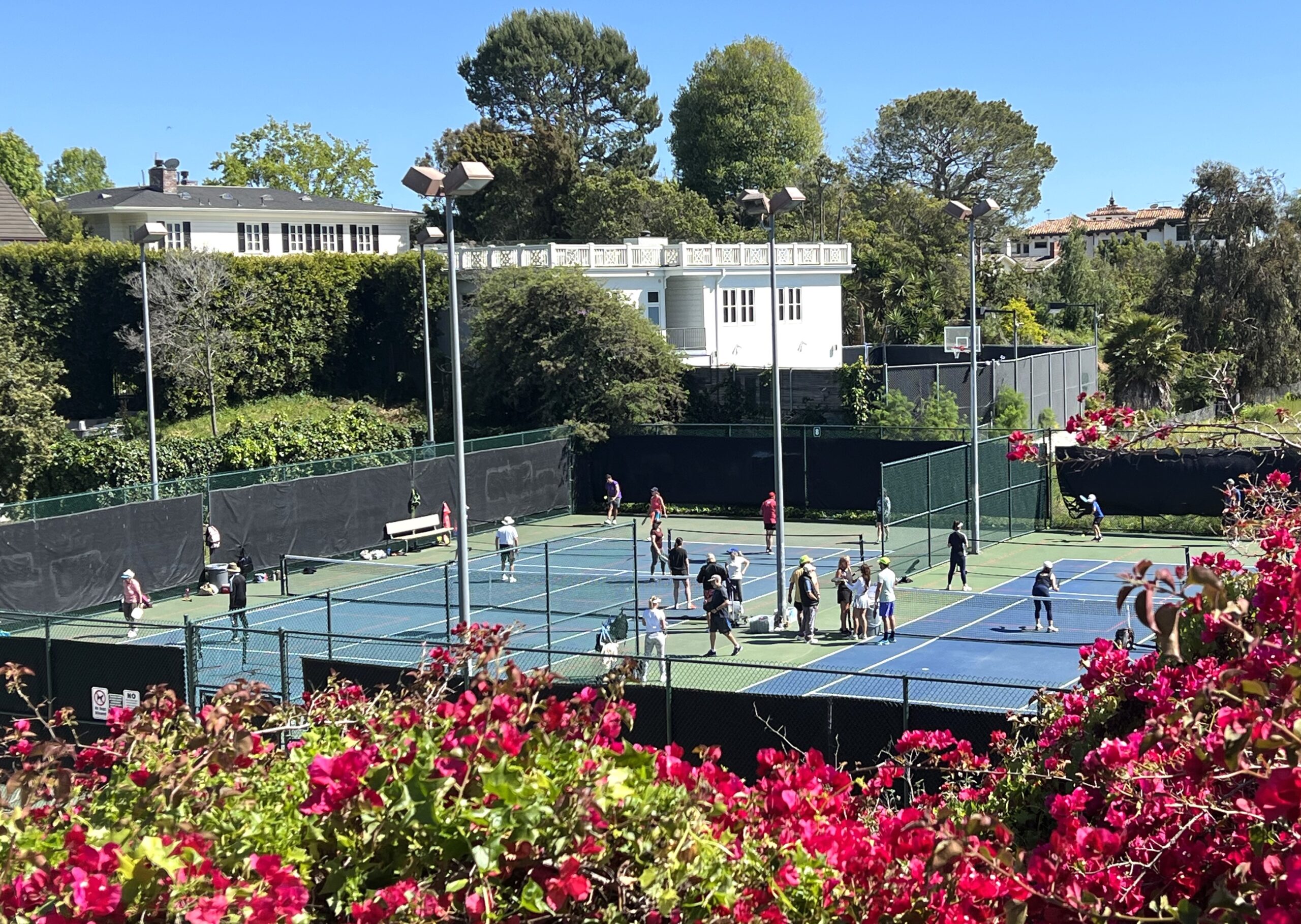
Pickleball USA did a sound analysis on Courts 7 & 8 and said there was no way to mitigate the noise for the residences above the court.

Los Angeles has budgeted $87 million for lawsuits and settlement for the fiscal year, which started in July.  A month later, the City of Los Angeles agreed to pay $38.2 million to resolve allegations that it knowingly failed to meet federal accessibility requirements when it sought and used Department of Housing and Urban Development (HUD) grant funds for multifamily affordable housing.

Three months later the city has already paid out $97 million. Some went for claims against the police, but one person received $10.5 M when a fixture at the top of a streetlamp fell on a person’s head and another person received $7.5M when he/she lost arm after attack from an adopted animal shelter dog.

The money for payments comes out of the City’s General Fund: it does not come out of individual City Departments.

Perhaps residents may want to be aware of another possible lawsuit with the Palisades Recreation and Parks Center over a sound ordinance.

Pickleball players lobbied to play on the tennis courts in Pacific Palisades. They now are allowed to play, for free, on Tennis Court 7 on Tuesday and Thursday from 9 a.m. to 1 p.m. and 4 to 8 p.m. Additionally, players can also sign up to play in the gym on Monday and Fridays, but they have to pay a fee to play there.

Unfortunately, Court 7 is next to two residences, and the noise from pickleball breaks the residential area LAMC noise restrictions PC415 and LAMC116.1.

When those same courts were first proposed for pickleball, services from a registered acoustical engineer recommended by Pickleball USA, were made available as a courtesy to Recreation and Parks.

Not only was the noise above the recommended level, but if one tried to put up a sound-absorbent wall, it would need to be at least 17 feet high, according to the engineer.

At the Park Advisory Board (PAB) Meeting October 16, Jasmine Dowlatshahi said that court was now available for pickleball, and that RAP was going to give $200,000 to put up a fence around the court.

CTN sent a query to RAP General Manager Jimmy Kim and other RAP officials on October 18, asking:

1) Since there’s no way noise standards at Court 7 can be met (even with a wall), is the City worried about legal action from the neighbors?

2) Where is the money coming from for the wall? The outdated lights at the tennis courts are not energy efficient and not focused on the courts (light pollution).  PAB has asked if the lights could be replaced, but was told there was no money.

No one from the city has responded. After all, what’s one more lawsuit?

Posted in City, Parks, Sports | Leave a comment

What is it? #44

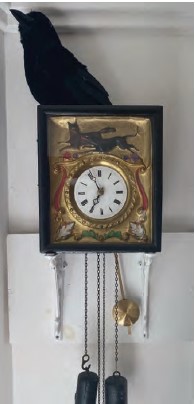
This is a French country wall clock from the late 1800’s. The clock has graced the walls in Daniele’s family’s residences in Nancy, France, for about 100 years.

These clocks have a motor and a regulator.

The motor in this clock is a pair of iron weights on a pulley chain. Every morning Paul pulls the chain on the left side down to the ground and over 24 hours the weight on the right side slowly descends animating the hour and minute hands.

The time regulator is the pendulum working with gears with teeth. I’m thinking it’s a Morbier which is the name given to the provincial clocks made in a farm town in France just below the Swiss border.

If they were off 10 or 15 minutes a day it wasn’t so bad because the church bells were used to correct the time.

Of historical interest, Galileo designed the pendulum around 1380. Huygens in Holland built the first pendulum regulated clock in 1657.

(Editor’s note: Palisades resident Howard Yonet has an interesting collection of curios from around the world and with his permission, Circling the News is publishing one a week. About the collector: Dr. Howard Yonet was born in Brooklyn in 1934 and attended Brooklyn College. He went to Baylor Medical School and then returned to do an internship at Bellevue Hospital. Yonet completed his residency at the Manhattan V.A. and the Montefiore Hospital. During this time, he went skiing in Vermont and the Catskills, and while traveling found barns filled with early American pieces. This led to his interest in American Antiques.

In 1965, he married Daniele, who was originally from Nancy, France. During the Vietnam War, Yonet was drafted as a medical officer and stationed in Landstuhl, Germany (1966-1969). This was close to the French border, which meant he and Daniele and could visit her family.

While abroad, the Yonets took weekend trips through France and Italy, purchasing many interesting pieces at flea markets.

The family settled in Pacific Palisades in 1970 and Yonet practiced general radiology until 2006. He continued to acquire antiques and collectables at estate and garage sales and the Salvation Army Store. He also enjoyed looking for collectibles while traveling in Montana, Idaho, Colorado and Massachusetts. Daniele’s family helped add to his collection.)

Posted in What is it? | 1 Comment

Court Blocks UCLA’s Delay, Clears Path for Westside Veteran Housing with Key Hearing Ahead

(This article first appeared in the Westside Current and is published with permission.)

UCLA Jackie Robinson Stadium, located on the West LA VA was closed by Judge David Carter.

By JAMIE PAIGE

On October 23, veterans advocating for housing at the West Los Angeles Veterans Affairs campus secured a legal victory as a federal judge rejected UCLA’s bid to delay construction on the site. As the long-running legal battle continues, the case will return to court on Friday, October 25, where Judge David O. Carter will further weigh the future of the 388-acre property originally dedicated to house and care for veterans.

The case before Carter focuses on allegations that the Department of Veterans Affairs (VA) has failed in its responsibility to provide housing for veterans, instead leasing large portions of the land to commercial enterprises and institutions like UCLA and Brentwood School.

The lawsuit, brought by Public Counsel, the Inner City Law Center, and private law firms on behalf of homeless veterans, took a significant turn in September when Judge Carter ruled that the leases with UCLA  and Brentwood School were illegal.

According to court records, these leases did not meet the legal requirement of primarily benefiting veterans—a violation of the 2016 West Los Angeles Leasing Act. UCLA has since appealed the decision, but the case highlights a decades-long struggle over the proper use of the historic land.

At its peak, the West LA VA campus housed nearly 3,000 veterans. However, after the 1971 Sylmar earthquake devastated many of the campus buildings, more than 1,400 veterans were evicted. The buildings were never repaired or converted back to housing, and the VA began leasing portions of the land to non-veteran entities even as the homelessness crisis among veterans in Los Angeles grew. Today, roughly 3,000 veterans are homeless on the streets of Los Angeles—the same number that once lived on the VA campus, underscoring the tragic irony of the situation.

A significant development in the case occurred when Judge Carter issued an emergency order on October 7, mandating the immediate construction of temporary veterans’ housing on the VA campus.  This order includes using parking lots adjacent to UCLA’s Jackie Robinson Stadium, which has been closed as a result of the court’s ruling. “With fall and winter approaching and with thousands of homeless veterans still living on the streets, an emergency exists,” Carter wrote, emphasizing the urgency of the situation.

UCLA, however, sought to intervene and delay the construction of the temporary housing units. Attorneys for the university filed their motion after veterans’ claims challenging UCLA’s lease had already been litigated, arguing that relief ordered by the court would burden the university and delay other plans. But on Wednesday, Carter rejected UCLA’s bid, ruling that the university’s motion came too late and would only stall efforts to address the housing crisis.

“Allowing a late-stage intervention at this point would undermine a carefully negotiated plan and harm those who stand to benefit from the relief already underway,” Carter wrote in an 18-page order denying UCLA’s motion. “This harm is not just to the parties, but to veterans who have been suffering from mental and physical disabilities, homelessness, and 13 years of litigation.”

The judge criticized UCLA for seeking to relitigate issues that had already been resolved. “UCLA seeks to reopen a case that has already been litigated and stall the collaborative process the parties have tediously worked towards,” Carter wrote. He added that the university’s delay prejudices disabled veterans, including those who brought the lawsuit and others who stand to benefit from increased housing on the VA campus.

The developments stem from a month-long trial in August, during which a group of unhoused veterans with disabilities sued the VA over its land-use agreements. The veterans argued that they were entitled to housing on the VA campus, but private leases, including those with UCLA and Brentwood School, prevented the construction of much-needed housing. Judge Carter, a Vietnam War veteran himself, found in favor of the veterans, ruling that the land must be used primarily to serve veterans.

The VA had argued during the trial that it was out of space on its campus, claiming that its promise to open 1,200 housing units by 2030 was the best it could do. VA attorneys warned that additional relief ordered by the court would strain its resources and complicate its ability to address veteran homelessness effectively. Carter, however, rejected these arguments, finding that veterans are entitled to more than 2,500 units of housing on the campus.

In his ruling, Carter directed the VA to build 750 units of temporary housing within 18 months and to add 1,800 permanent units to the 1,200 already planned. He also ordered the VA to begin devising “exit strategies” for tenants like UCLA and Brentwood School to ensure that the land is restored for veteran-focused purposes.

Mark Rosenbaum, Director of Public Counsel’s Opportunity Under Law program, has been a vocal critic of UCLA’s actions. He characterized the university’s lease as part of “one of the great land scandals in our nation.” Rosenbaum asserted that UCLA’s primary focus was on its baseball program rather than serving veterans. “It wasn’t about earthquakes; it was about greed and putting veterans’ needs second,” Rosenbaum said. “They stole that land from veterans and used it for purposes that had nothing to do with serving veterans.”

Court records show that UCLA attempted to justify its lease by offering veterans free tickets to baseball games and other symbolic gestures, but Rosenbaum called these efforts superficial. “They built a practice field on veterans’ land and kept it secret,” Rosenbaum said, noting that the university was using land for baseball while homeless veterans slept nearby in cardboard boxes.
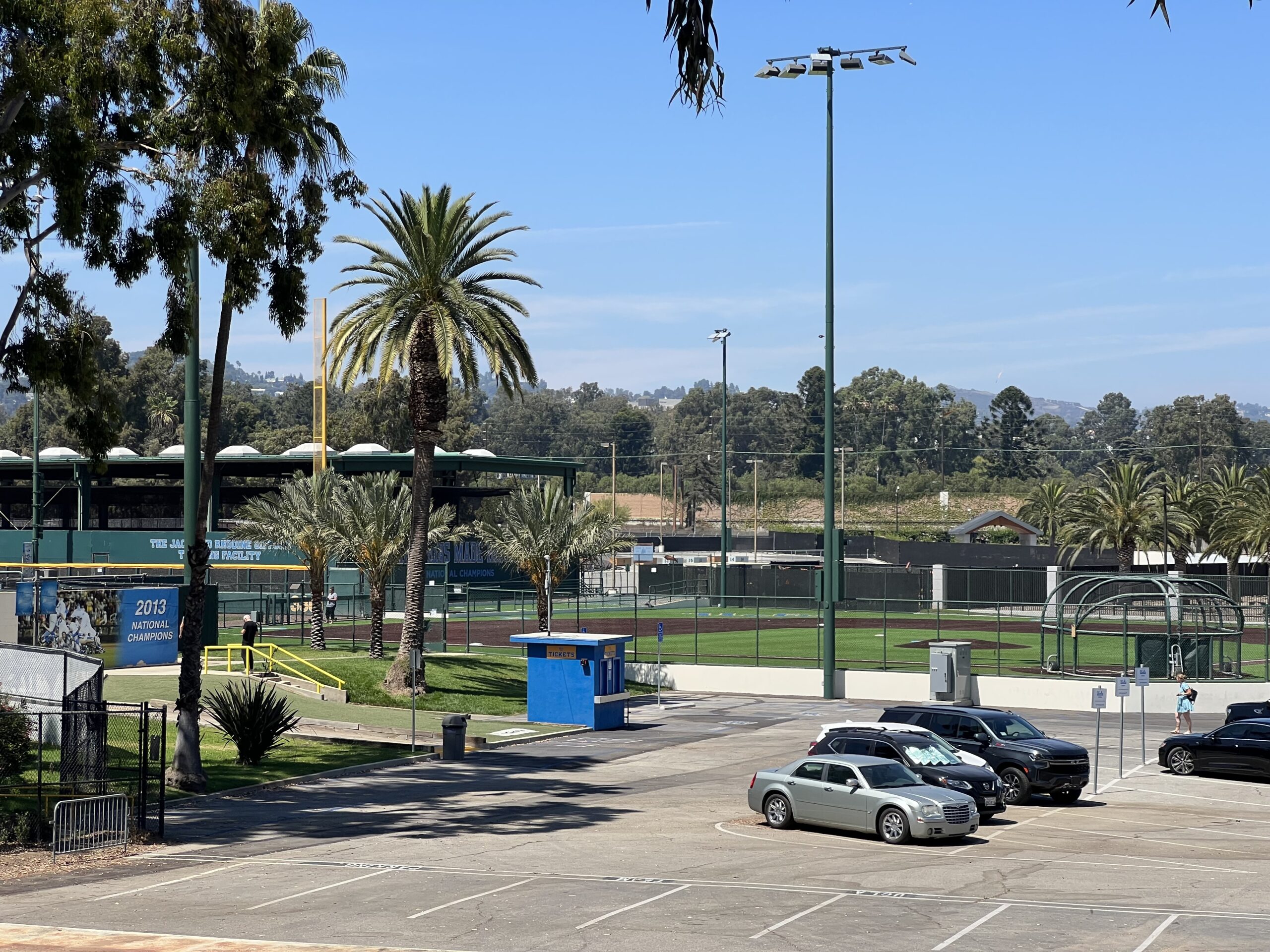
UCLA was allowed to construct an artificial turf baseball practice field on the VA, adjacent to the Jackie Robinson Stadium. It is unclear how this helps homeless veterans.

(Editor’s note: in a March 2023 story “Brentwood School Athletic Facilities Are Built on VA Land” Dr. Steven Braverman, the director of the West L. VA, was asked about Brentwood and UCLA leasing space on land meant for veterans.

Braverman said that the money the schools contribute was important to veterans because of a 1958 law, that states the VA is not allowed to build housing unless it is specifically tied to a treatment program.

Braverman said the money from those schools was being used to rebuild utilities and infrastructure on the VA. Circling the News looked for the 1958 law but could not find it and contacted VA public affairs for clarification, several times, but no one has responded with the law.

CTN had reported that “UCLA signed a 10-year lease agreement [2016] to use the Jackie Robinson baseball stadium on the east side of campus. They will pay $300K rent for the stadium; they will pay $500K for a VA-UCLA Family Resource and well-being center. They will spend $250K to sponsor a homeless mental health and addiction center and $400K for a UCLA Legal Clinic for Veterans.)


Rob Reynolds, an Iraq war veteran and a key advocate for homeless veterans, emphasized the urgency of moving forward with the housing plans. “Judge Carter has ordered the construction of modular housing before the winter weather sets in,” Reynolds said. “These units will give veterans a safe place to stay while permanent housing is being developed.” The modular units, about 350 square feet each, are designed to provide essential amenities such as bathrooms and living spaces.

For Reynolds, the situation underscores the importance of housing veterans close to the VA hospital, particularly those with medical needs. “It’s crucial that those who are more disabled are housed near the VA hospital where they can access the care they need,” Reynolds said. “The longer veterans stay on the streets, the harder it becomes for them to reintegrate.”

On Friday, the court will discuss the VA’s preferred modular housing options and assess the progress made toward the judge’s mandate to provide immediate housing for homeless veterans.

Posted in Homelessness | 1 Comment

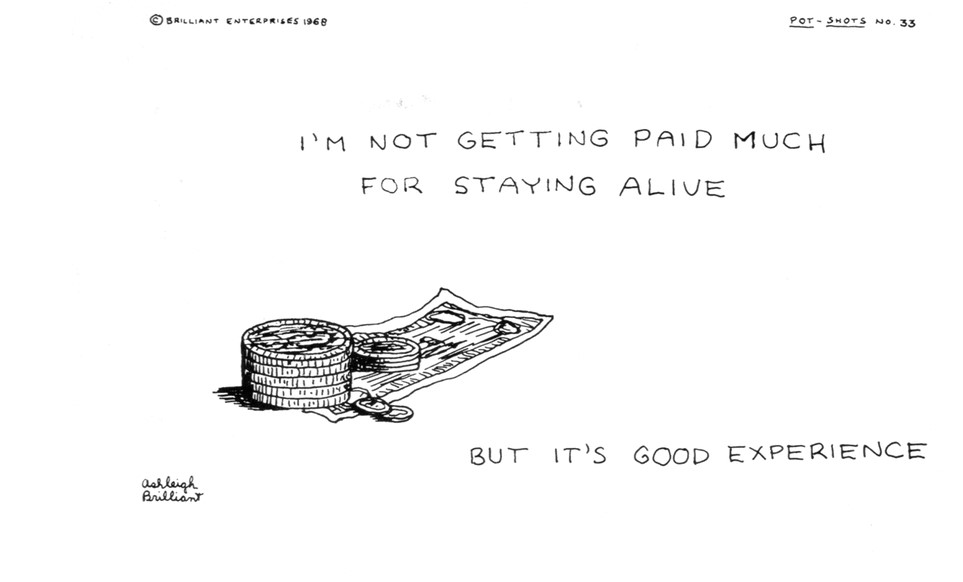
Pot Shot #31


Ashleigh Brilliant writes:

WHAT EXACTLY IS A “POT-SHOT” OR “BRILLIANT THOUGHT?”

Pot-Shots are epigrams, composed according to the following very strict rules.

The length must never exceed 17 English words. Note that this is a maximum. Some Pot-Shots are much shorter. Hyphenated words count as a single word.

Pot-Shots must be easy to translate into other languages. Therefore there can be no use of rhyme or rhythm, idioms, puns, or other word-play.

Pot-Shots should be capable of being appreciated in all times and cultures. Topical and cultural references must be avoided.

Every Pot-Shot should be as different as possible from every other one.

Every Pot-Shot must be totally original, and unlike anything else the author, or anyone else, has ever said before.

The words of a Pot-Shot must be able to stand on their own, and not require any illustration in order to be understood or appreciated.

Whatever is being said should be worth saying and said in the best possible way.

NOTE: These are ideal standards, and I myself have failed to meet some of them occasionally — but in general I have adhered to them quite scrupulously.

Posted in Pot-Shot | 1 Comment

Brentwood Upcoming Events in November/December

A Brentwood resident send the following upcoming activities and events in the Brentwood area:

Every Thursday there is generally a chance to get together with like-minded Francophiles at 10 a.m. and practice one’s French. The next meeting will be on November 7, click here.


Once you’re done practicing French go to the Thursday Sing Along at 2 p.m. click here.

After the election a nice easy afternoon of trivia from 3 to 5 p.m. will take place on Saturday, November 9. People are asked to RSVP, so organizers know how many chairs to set up click here.

Mark your calendar for the December 7 Trivia extravaganza that will be held from 3 to 6 p.m. Trivia participants will be entered in the multiple prizes that include jewelry, soaps, candies, Mexican art, art books, puzzles, DVDs collection, Vintage Travel Journal and locally made items. Participants need to be present to win click here.

Posted in General | Leave a comment

Graveyard Smash this Weekend at Simon Meadow

The Palisades-Malibu YMCA is sponsoring a Graveyard Smash at the pumpkin patch at Simon Meadow, at the corner of Temescal Canyon Road and Sunset Boulevard on Saturday, October 26.

The event is free and the fun starts at 4:30 p.m. and lasts until the pumpkin patch closes at 7 p.m. The smash is a great time to try out one’s Halloween costume before October 31.

There will be face painting and pumpkin painting. Mini pumpkins can be purchased for $2 each, or three for $5, and paint will be available for decorating.

Or go for the “big boys,” select a pumpkin, pay for it and take it to the carving station and turn the pumpkin’s face into a jack-o’-lantern’s ghoulish grin.

There will be trick or treating for all participants at different stations, and all can participate in the costume contest.

There will be light refreshments, water, juice boxes and popcorn, and of course candy and cotton candy at the treat stations. This is a family event, and families are invited to bring a picnic basket and enjoy the fall sunset. One does not have to be a Y member to participate,

And, if you still haven’t picked out your pumpkins for your front steps, now would be a good time to do it. Remember all proceeds from the pumpkin patch benefit the local Y, a nonprofit organization.

Posted in Holidays | Leave a comment

First Flea Market at Pali Pronounced Successful

Mom and daughter look at a bike that was for sale at the flea market.
Photo: RICH SCHMITT/CTN

By HENRY KAMER

Some wondered how the community would react to a flea market at the local high school. Held on October 20, it was highly successful, and residents hope it will become an annual event.

Resident Brian Sullivan discovered a “must-have” end table.
Photo: RICH SCHMITT/CTN

The Pali High Flea Market ran from 9 A.M. to 1 P.M. and was organized by PCHS Party 4 Pali, a parent-led Booster Club for Pali High, which has been organizing parties and events to celebrate the Pali community and raise funds for the school since 2011. Organizers of this event were Pali High parents Patricia Chang, Nicole Magnifico and Johanna Minassian.

Held in the lower parking lot near Gilbert Hall, the street was filled with all sorts of booths selling delicious food, new and used clothes, and toys and random stuff galore.

This reporter discovered a local clothing brand, Pali Life, created by 16 year-old Palisadian, Colton Etheridge, who is a Junior at Geffen Academy.

Colton Etheridge selling Pali Life clothing.
Photo: RICH SCHMITT/CTN

Sales at the various booths benefited a large range of charities, from national organizations like the American Breast Cancer Foundation to PaliHi specific groups such as the track team, run by manager Giada Musumeci and other team members.

The track team booth featured donated second-hand clothes as well as team merchandise. They raised more than $300, which will go towards event entrance fees and new equipment.

There were also several food trucks, including the Palisades’ own Sunset Smash, started by local teens and Pali High alums, Noah Zaret and Dylan Walsh. Also serving was QCuteBao, a delicious dumpling and boba stop, but there were many more food options. People sat at picnic tables enjoying the sunny day and live music played by a band that included Pali High alumnus and current UCLA student, Matty Gottesman.

Being at the event made me think of the saying, ‘one person’s trash is another person’s treasure,’ as I saw lots of people happy with their purchases, but none more than a couple who loved their new ceramic lamp that was shaped like a rabbit.

Overall, the event was extremely fun and helped to foster a sense of community as it was open to all of the Palisades. Many Pali students also attended, with the Pali Ambassadors helping run the event.

I hope this flea market continues to be a yearly event as I got to meet new people and experience new parts of my community that I had never seen before.

The Palisades Girls Tennis Team had a booth at the flea market to raise money.
Photo: RICH SCHMITT/CTN

Posted in Community, Schools | 3 Comments

Helping the Homeless One Person at a Time

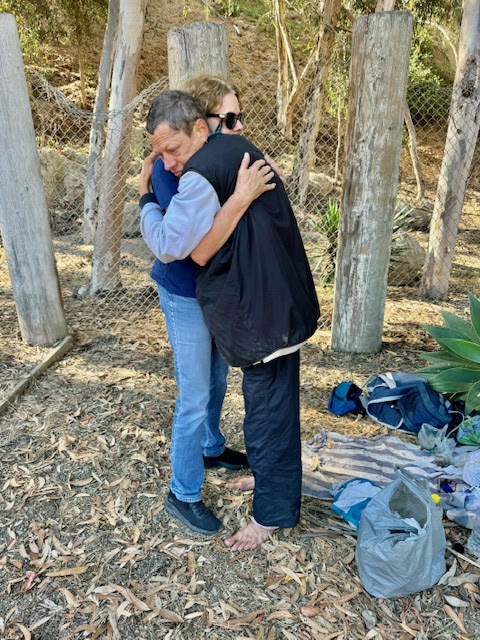
A homeless man was reunited with his mother.

Thanks to the Pacific Palisades Task Force on Homelessness (PPTFH), a missing man was reunited with his family.

Almost daily, Sharon Kilbride, a past president of the PPTFH does rounds on Will Rogers Historic Beach. She speaks to the homeless, she learns their names and she offers them help.

It was on the beach she found Paul in a small camp. He seemed shy, but accepted some snacks, a hygiene kit and a card that directed him to the weekly meet-up at the base of Temescal Canyon Boulevard, which is led by the outreach team from The People Concern (funded through donations to PPTFH).

Kilbride described the young man as sweet and possibly on the spectrum. He became a regular at the Wednesday meetups. He told Sharon that he came from Ontario, but said he couldn’t go home.

“Weeks went by, and Paul was becoming more fragile,” Kilbride said, “and needed daily attention from our volunteers, and our outreach angels Glanda and Taylor (People’s Concern). We all knew he was getting stressed living on the beach and afraid of the dangers of living alone outdoors.”

He had been in the Palisades area for about eight weeks, when the PPTFH received an email. “Hello, my name is Carol.  My son, Paul, has been missing for nine weeks.  I was in contact with West Coast Care, and they say they saw him around Will Rogers State Beach. I have been out there a couple of times with no luck.” The mother had created a flyer and attached it to the email.

Kilbride said, “When I received this urgent email on August 19, my heart skipped a beat since I knew exactly who Paul was, he had been in the Palisades since June. I immediately called Carol and told her not to worry.”

She told the mother the steps that the outreach workers had been taking and that Paul was safe.

Kilbride said the mother was elated and weeping on call. The mother told her that Paul had disappeared previously and had been found in Santa Monica.

Carol had spent several days coming to this area and walking the beaches and the bike path looking for her son. She said she had filed a missing person’s report with Santa Monica Police and then contacted West Coast Care, which serves folks along the Palisades Beaches.

Josh Hooks from West Coast Care told her to try PPTFH. Carol had never heard of the group but found the website and sent an email.

After speaking to Kilbride, the next step was to arrange for Carol to drive from her home in Ontario to meet her son and see if he would be willing to return home.

On August 20th the outreach team was standing by for the reunification process. They first had to make sure Paul was sleeping in his spot on Temescal. Resident Sue Kohl, who walks that route daily and had given Paul granola bars, verified he was there.

“I arrived at Paul’s spot with one of our Volunteer Response team members Tom and met with our outreach team from the People Concern,” Kilbride said. Paul’s mother arrived and it was decided that Kilbride should speak to Paul, first.

“I went over and started a conversation and warned him how dangerous it was living outdoors.” Kilbride said. “I also warned him about camping in a high fire zone and that the police might ticket him. I told him that he had a loving mother that wanted him home and how lucky he was to have her in his life.”

Paul told Kilbride he missed his mom and then Kilbride waved Carol over.“The rest was a wonderful moment tears and hugs,” Kilbride said and added that his mom brought him his favorite sandwich, PBJ, which he ate quickly.

The outreach team Glanda and Taylor then came over, and they all hugged goodbye and made a human bridge that Paul crossed under to the “Bridge” home. Working together, West Coast Care, The People Concern, and PPTFH were able to build a bridge leading Paul home—a success story should be shared and celebrated.

The outreach workers for Pacific Palisades Task Force on Homelessness, Taylor (left) and Glanda (right) make a bridge for Paul to go under . . ..on his way home.

Kilbride said, “Our volunteer response team members always hope for more of these magical moments.” And she made a plea for more residents to volunteer to interact, hand out granola bars and cards that direct the homeless to the outreach team.

If one cannot physically volunteer, donations are accepted that go directly to the Palisades outreach team and the caseworker that was brought aboard to deal with those that might have mental issues.

Click here.

Posted in Homelessness | 3 Comments