Circling the News to Go to a “New Model”

For nine years, Circling the News has been a free resource. To keep it going and growing, we are taking the next step.

The digital newspaper began as a passion project to make sure important stories in our community were not overlooked. As someone who has lived in the Palisades since 1994 and been associated with local newspapers since 2005, I have always believed strong communities depend on local journalism.

Over the years, Circling the News has reported on stories that might otherwise have gone uncovered. From breaking news in the Palisades to investigative reporting during Covid and coverage of programs affecting our community, the goal has always been the same: giving residents a voice and holding city, county, and state officials accountable.

The cost of reporting, editing, and maintaining the site continues to grow, and moving to a subscription model will allow Circling the News to remain sustainable for the long term.

We plan to switch to a subscription model on Monday, March 30 and for those who want to get in early, by March 13, a three-year subscription is $260, a $40 savings.

This next step will allow us to invest more in the stories that matter most to the Palisades community, including:

*Expanded sports coverage
* More in-depth community reporting
* Subscriber-only stories
* A platform for reader viewpoints and letters
* Continued free obituary notices so families can preserve the history of loved ones

Here is how you can support Circling the News:

Best Value
3 Years – $260
Save $40 and lock in today’s pricing

Most Popular
1 Year – $100
Less than $2 per week supporting independent local journalism

Monthly
$9 per month

Independent local journalism only survives when the community chooses to support it. If Circling the News has been valuable to you over the past nine years, I hope you will consider becoming a subscriber. For those who have donated, you are considered a subscriber. If you have questions, reach out to [email protected].

Thank you for reading and supporting local reporting in Pacific Palisades.

Sue Pascoe, Editor


Posted in businesses/stores | 20 Comments

Governor Newsom Attends Private Meeting in Palisades

Governor Gavin Newsom

California Governor Gavin Newsom was invited by concerned citizens from Ronald Reagan American Legion Post 283 and the Palisades Long-Term Recovery Group to a private meeting in Pacific Palisades on March 3.

At the meeting at the Legion Hall, the Governor asked for an updated progress report on the Pacific Palisades rebuild and the next steps needed to move it forward.

Community members strategized with the Governor on how to work together to receive more state/federal resources. As of now, there have been no federal funds going to Pacific Palisades (or Altadena). A governor is responsible for obtaining federal dollars for his state.

Residents said they were willing to provide current disaster-funding requests to the governor to present to FEMA (Federal Emergency Management Agency) and to HUD. Funding from both agencies is vital to help rebuild the more than 7,000 structures that were burned during the January 2025 Palisades Fire.

It was hoped that with additional information, Newsom could make a new plea to Washington and break the current stalemate.

Adding problems to the release of FEMA funding is an impasse in Congress over funding the Department of Homeland Security and Immigration and Customs Enforcement (ICE). Legislators are not acknowledging that (ICE) is largely unaffected by the shutdown and remains funded – on account of the $75 billion doled out for border operations in the One Big Beautiful Bill Act. Those funds are set to cover ICE for years.

What is affected by the impasse and not funded? The Transportation Security Administration (TSA), the Federal Emergency Management Agency (FEMA), the Secret Service and the Coast Guard.


Posted in Community, Governor Newsom, Palisades Fire | 11 Comments

Ornaments Made by Local Scout Troop Sent to Texas

These Christmas ornaments were handmade as part of a Good Turn Trip by the Scout Aye Aye Patrol.

By VIOLET CURTIS – Special to Circling the News

Five members of the Aye Aye Patrol of Palisades Scouting American Troop 223G met for a “Good Turn Trip.” In Scouting a Good Turn Trip is an event where Scouts host to help the community and to give back to the community.

Members chose to make ornaments for the nonprofit Operation Ornament. We learned about the nonprofit through a friend that lived in Altadena.

Operation Ornaments is dedicated to making Christmas just a little brighter for the survivors of natural disasters by sending them a package of handmade ornaments donated by people from across the USA and world.

The nonprofit’s goal is to let survivors know that they are remembered and loved. In 2025, Operation Ornaments collected 90,000 ornaments and distributed them to two areas across the United States.

The Patrol made ornaments and sent them to victims of the Central Texas floods that occurred in July 2025. In about two hours, we managed to make 36 ornaments from both recycled and store-bought supplies.

We considered making ornaments for Palisades Fire victims but were asked to send them to Texas. Operation Ornaments has identified Pacific Palisades as a distribution site for 2026.

(Editor’s note: The author lost her home and school in the Palisades Fire. Parents of fifth or sixth graders who want to learn more or visit a 223 Troop meeting, can contact Greg Frost [email protected] (Boys) or Scoutmaster Larry Kirven [email protected] (Girls).)

Posted in Community, Kids/Parenting | 1 Comment

LAHSA’s Chronic Financial Mismanagement

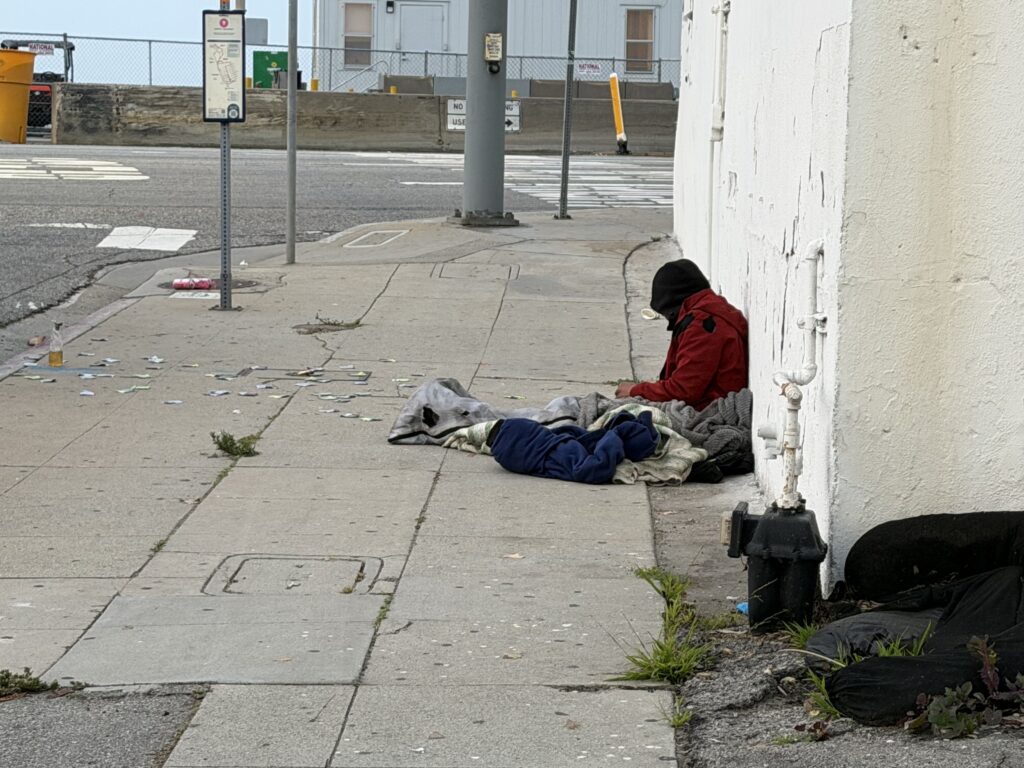
Despite the enormous budget to help the homeless, many are not helped.

(Editor’s note at the Council District 11 Candidate Forum on March 1, the candidates were asked about LAHSA and all expressed concern about the effectiveness of this large agency in helping the homeless. It seemed timely this article appeared in CityWatch on March 2. It is reprinted with permission.)

By TIM CAMPBELL

L.A. County’s Auditor/Controller released a scathing report on LAHSA’s (Los Angeles Homeless Services Authority) financial management in November 2024. The audit noted 16 deficiencies, several of which concerned the way providers were paid.

County auditors found LAHSA often paid providers late, demanded little or no proof of performance, and used restricted funds to improperly pay bills because there were insufficient funds in the correct accounts.

A few months later, the audit firm Alvarez & Marsal (A&M) issued an independent assessment of the City of LA’s homelessness programs. That assessment included a review of LAHSA’s invoice review process, since LAHSA pays providers and then bills the City.  Like the County Auditor, A&M’s review found several systemic problems, including a culture that encouraged paying invoices with as little oversight as possible.

These reports were bad enough, but this past week the news got worse.  On February 20, LAist reported LAHSA owes providers at least $69 million in late payments.

Provider executives are complaining they will have to cut back on services or close down entirely because they are not being paid.
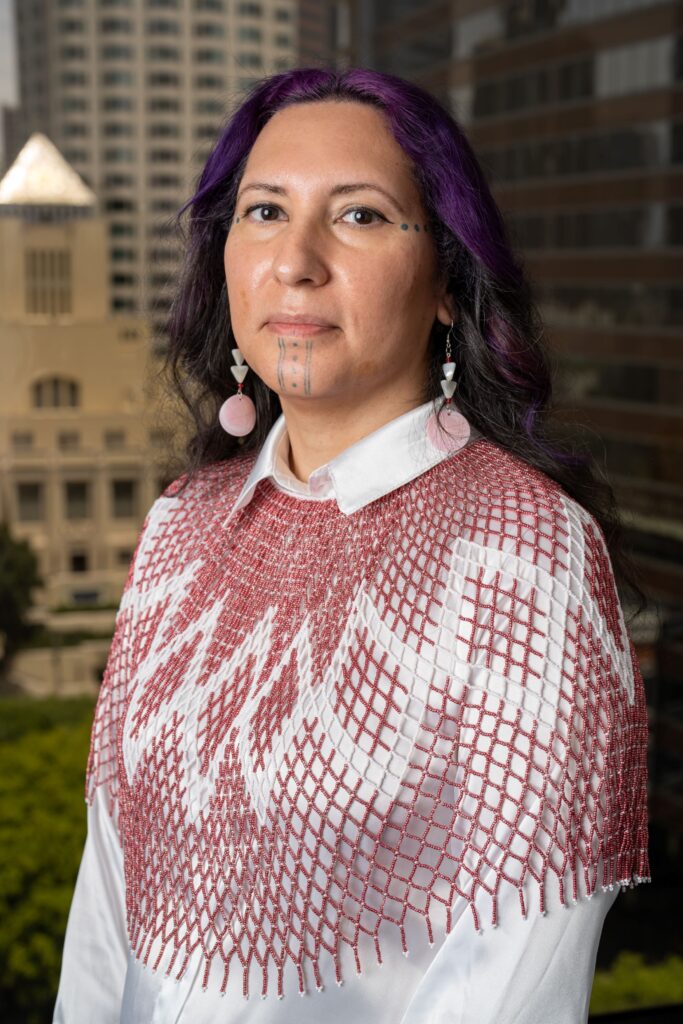
LAHSA CFO Janine Trejo

The large nonprofit HOPICS claims LAHSA owes it $20 million. LAHSA CFO Janine Trejo said she has been working on the systemic problems that have caused the backup.

On February 27, the Westside Current published a story saying LAHSA was blaming the City for the payment backlog. The Current reported that since neither Trejo nor LAHSA CEO Gita O’Neill have done anything to improve the problem in the 16 months since the County Auditor’s report, the County Board of Supervisors asked the Auditor to perform a follow-up audit to see why nothing has been done.

The blame game is nothing new in LA’s homelessness universe. In November 2025, LAist published a story about how an 88-space Safe Camping site was unilaterally reduced to 44 by the provider, Urban Alchemy, (UA), and neither the City nor LAHSA knew or took action to reduce the amount of the contract for almost a year.

The reduction wasn’t discovered until LAHSA Commissioner Justin Szalsa and the court-appointed Special Master Michele Martiniez performed their own onsite inspections. Urban Alchemy claimed it reduced the number of beds when a City representative said the site’s budget was going to be reduced.

A UA spokesperson said LAHSA should have told the City the number of beds was reduced, while the City says it was up to LAHSA to change the contract. The safe camping debacle is a perfect example of the finger-pointing a federal judge described last year.

In a June 2025 order, federal Judge David Carter wrote, “The creation of LAHSA has, at times, enabled a cycle of blame-shifting. When data inconsistencies or compliance issues arise, the City points to LAHSA. In turn, LAHSA attributes its problems to a lack of information or cooperation from the City. This dynamic has fostered a system in which responsibility is routinely deflected, allowing both entities to evade accountability, with no single party willing to take responsibility.”

The County’s 2024 audit and A&M’s report are just two in a long history of negative findings about LAHSA’s financial mismanagement.  In 2007, a HUD audit found LAHSA paid ineligible expenses and could not provide documentation to support its cash match for other organizations. HUD auditors cited LAHSA’s use of a poor financial management system for the problems.

In 2018, LA County’s Auditor-Controller made 16 findings of deficiencies meeting its recommendations from a previous audit, including solving an ongoing problem with sufficient staffing and contract oversight. In 2021, the County Auditor did a series of follow-up audits and found the same problems it described in the 2018 audit. If one thing is consistent, it is LAHSA’s steadfast refusal to implement changes that would make it fiscally responsible.

LAHSA’s poor fiscal management has created a vicious circle. The County Auditor said Finance allows providers to send invoices whenever they feel like it, and in whatever format they choose, so the Accounts Payable staff are getting bills at unpredictable times and in formats they may have to decipher before processing. This creates cash flow issues because no one knows when they can expect a bill to come in or how long it will take to approve.

Therefore, LAHSA can’t match the revenue/funding stream to the expenditures, so it scrambles to find money wherever it can, which is why auditors found LAHSA moves money around improperly among restricted funds. The fact LAHSA itself submits funding requests to state and federal agencies late just makes it worse. The mismanagement is systemic and habitual.

LAHSA’s financial problems are just one manifestation of a much wider and more serious issue.  Almost every person in an executive or senior management position in the City, County, or LAHSA has risen up through the ranks of LA’s homelessness industry.
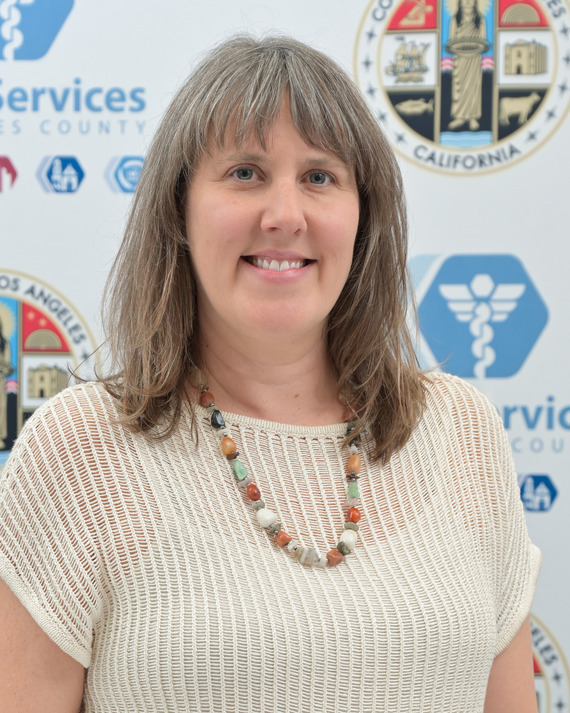
Sarah Mahin

Sarah Mahin, the County’s choice to head its new Department of Housing and Homelessness, was LAHSA’s Director of Policy and Systems and ran the County’s Housing for Health program before being appointed to her new position.

When I reviewed the professional biographies of LAHSA’s executive team, I found at least 10 people came from St. Joseph Center.  Dr. Va Lecia Adams Kellum, LAHSA’s former CEO, was St. Joseph’s CEO before she took the LAHSA position.  A whistleblower complaint filed by two former LAHSA managers who said they were pushed out so Adams Kellum could hire her friends from St. Joseph Center was settled for $800,000 last year.  One of the two managers who filed the lawsuit is Kristina Dixon, LAHSA’s former CFO. She claimed she was pushed out when she questioned Adams Kellum’s use of public funds for things like alcohol at a LAHSA holiday party.

The person who replaced Dixon was current CFO Janine Trejo.  Although she was not one of Adams Kellum’s former St. Joeph Center appointees, her career is steeped in LAHSA’s corporate culture.

According to Transparent California, Trejo has worked for LAHSA since at least 2018. Under her watch, the County auditor found serious problems in its 2024 audit, and it appears nothing has changed.

Interestingly, in 2024, Westside Current reporter Angela McGregor asked LAHSA if Trejo has a CPA certification or other related qualifications to manage nearly $1 billion in taxpayer money; McGregor received no response–not even a standard resume. Evidently, Ms. Trejo is so immersed in LAHSA’s “business as usual” culture she has been unable to substantively respond to the County’s audits.
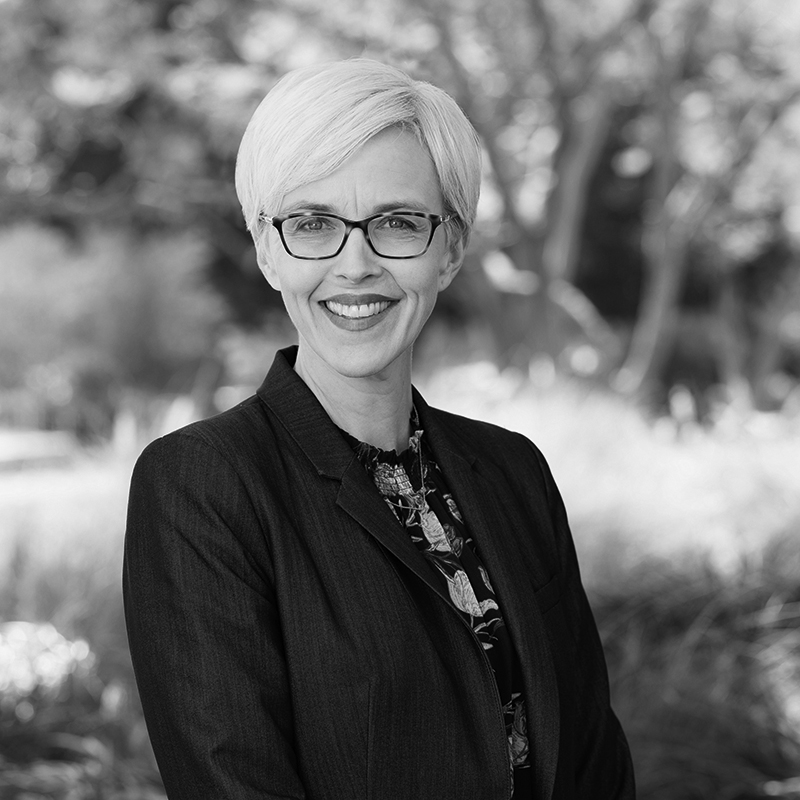
Amy Perkins

LAHSA’s Board of Commissioners is not immune to insider influence.  Amy Perkins, the Commissioner appointed by Supervisor Lindsey Horvath, is Horvath’s Deputy for Homelessness. She also directed LAHSA’s Housing Central Command, which claims it is “a robust cross-agency collaboration committed to streamlining the rehousing process and maximizing utilization of the Permanent Supportive Housing inventory and federal and local grants.”

It’s hard to take cross-agency collaboration seriously if neither the City nor LAHSA can keep track of the number of campsites at a single Safe Camping location.  As for her role in maximizing the availability of permanent supportive housing, perhaps she can explain why thousands of housing units have lain vacant for as much as two years while City and County agencies dither about occupancy. Other Commission members, with one or two exceptions, represent the advocacy and development communities, which have a vested interest in maintaining the status quo.

The point isn’t to question the competency or honesty of specific executives or managers, although some of their actions are certainly questionable.

The point is that nearly all decision-makers and those who are supposed to exercise governance come from the same environment. They simply cannot comprehend doing anything differently, and that includes imposing accountability on providers or on themselves.

Trejo was a LAHSA finance supervisor, so she rose up in an organization that sees nothing wrong with paying providers from improper funds or paying them with minimal documentation. Judging by her inaction since the County’s audit, she is behaviorally unable to even conceive of the changes needed to improve the Authority’s financial operations. Perkins, who is steeped in the milieu of the existing structure, cannot comprehend that performance measures and outcomes are more important than processes.

We cannot expect the people, who created the organizational disaster that is LA’s homelessness universe, to fix it.  Nor should we tolerate a system that makes maintaining providers’ revenue streams its most important mission.

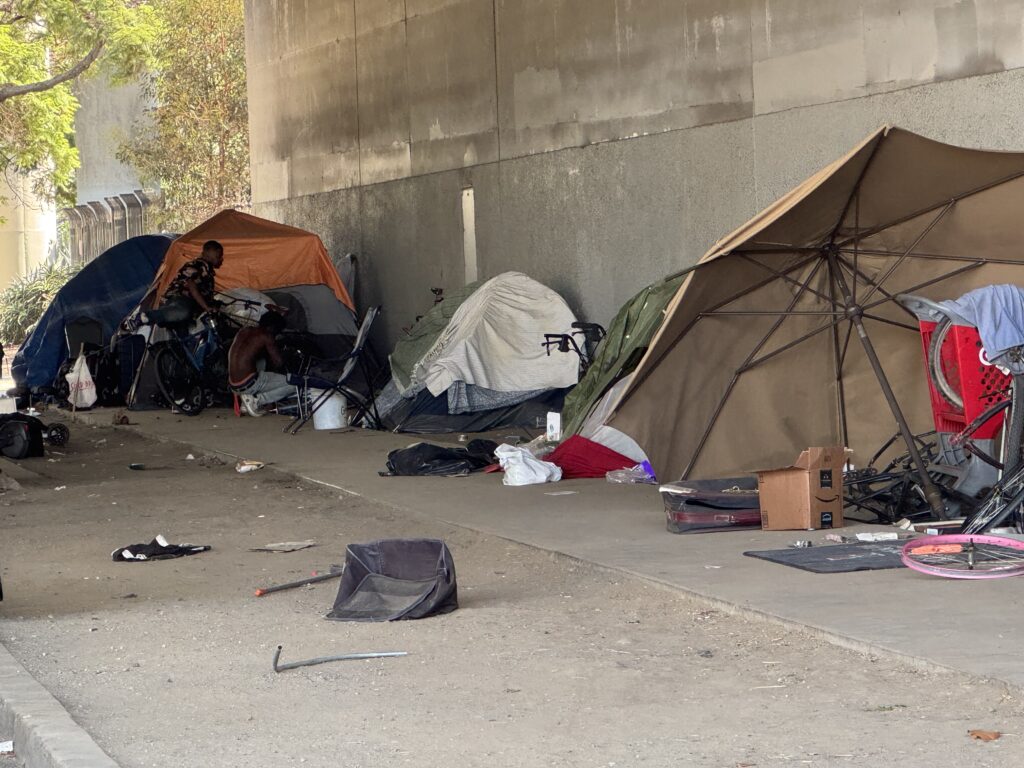
If 20 years of audits and reports have taught us anything, it is that we need leaders who will challenge the status quo and demand the fundamental changes that are needed to help the 73,000 people who sleep on LA’s streets every night.
(Tim Campbell is a longtime Westchester resident and veteran public servant who spent his career managing a municipal performance audit program. Drawing on decades of experience in government accountability, he brings a results-driven approach to civic oversight. In his iAUDIT! column for CityWatchLA, Campbell emphasizes outcomes over bureaucratic process, offering readers clear-eyed analyses of how local programs perform—and where they fall short. His work advocates for greater transparency, efficiency, and effectiveness in Los Angeles government.)

Posted in Homelessness | 1 Comment

Pali High Boys Basketball Wins City Title


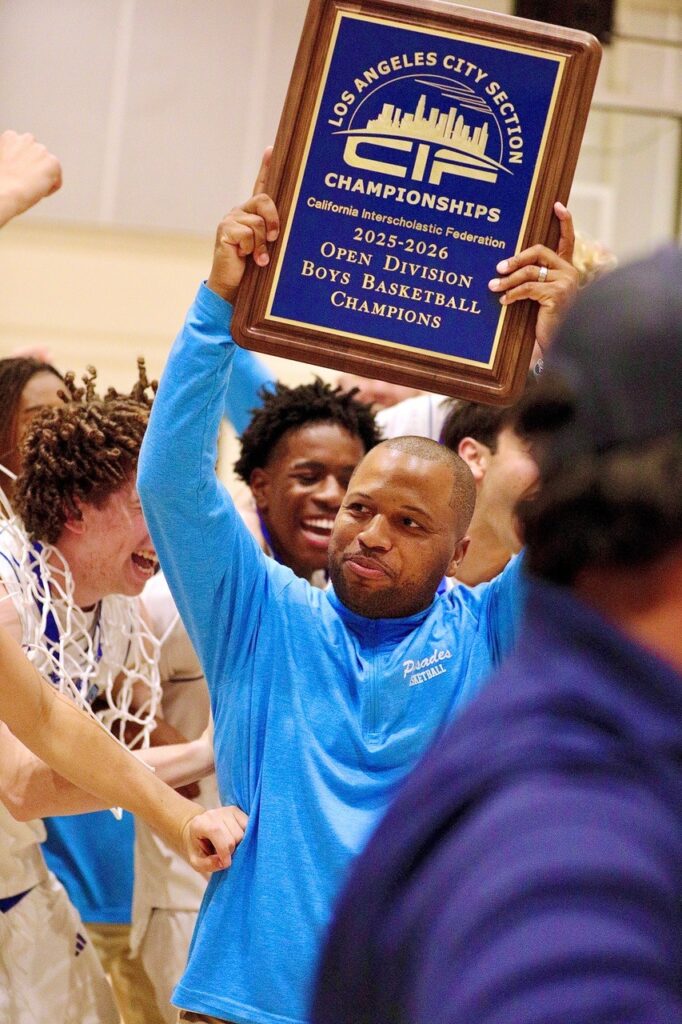
Jeff Bryant holds the plaque high after coaching the Dolphins to the City championship in his second season at Palisades High School.
Photo: STEVE GALLUZZO

By STEVE GALLUZZO

CTN Contributor

When Jeff Bryant took the job as head boys basketball coach at Palisades High he could not have imagined the journey he and his team would take over the next 22 months.

The adversity created by the Palisades Fire bonded the team in a way only tragedy can and that cohesiveness culminated in the program’s first upper division City championship in 57 years.

“We’ve accomplished two of our goals, winning league and City, now we’re going for the state,” Bryant said. “We’re not done.”


Palisades center Julian Cunningham wins the opening tip in February 27, 2026, Friday night  City Section Open Division final.
Photo: STEVE GALLUZZO

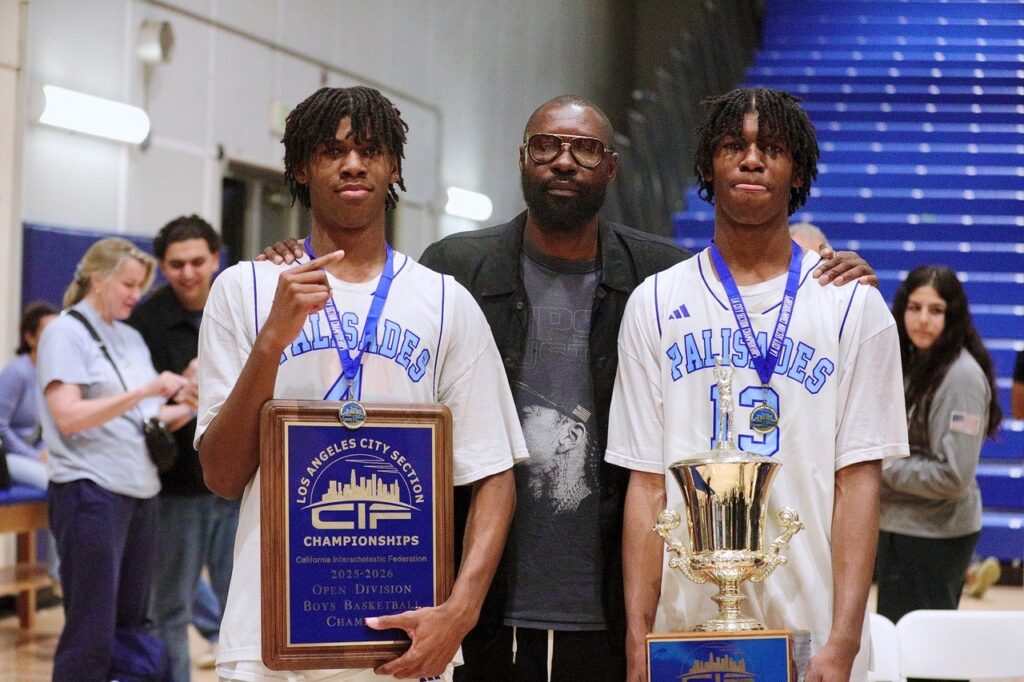
Following in their father’s footsteps, OJ and EJ Popoola brought pride back to a community they have embraced since moving to the area in the summer and their storybook fantasy of a section title became reality Friday night at Southwest College.

OJ scored 19 points and his twin brother added 17 to pace the No. 1-seeded Dolphins to a 75-56 victory over second-seeded Cleveland in the Open Division final. It marked Palisades’ first City title since taking the Division I prize in 2020 under Donzell Hayes, a teammate of Chris Popoola on the Dolphins’ 1995-96 squad which won the outright Western League crown but fell in overtime to Crenshaw in the City 4A semifinals.

“City was the goal from the first day we came here,” OJ said. “It was a matter of getting healthy and on the court at the same time,” EJ added. “We had guys out, we had to practice all over the place, but now we have our whole team and we’ll compete with anyone.”

Raised in Las Vegas, the twins drew inspiration from their older brother Christian, who won three Nevada state titles at Bishop Gorman before graduating in 2017 and went on to play at Utah.

They played for Arbor View High in Las Vegas as freshmen and spent their sophomore year at Voyageur College Prep in Detroit but were thrilled their dad moved the family to Marina del Rey.

“Palisades was one game away from playing for a championship my senior year and now these boys have finished the job,” Chris Popoola said. “We live 20 minutes from campus and we wanted to do this for the community. The next goal is to repeat.”

Junior 3-point specialist Jack Levey, who has been on the team for three years, made five long-range shots (giving him 108 this season) and finished with 15 points while freshman Phillip Reed had 13, junior AJ Neale had five and center Julian Cunningham added four. Senior Elliott Okpala came off the bench to net the team’s last two points on a pair of free throws.

Palisades never trailed, taking a 7-0 lead less than a minute into the game and widening the margin to 17 points by the end of the first quarter. The Dolphins led 42-23 at halftime and 64-34 going to the fourth quarter.


OJ Popoola draws contact but scores anyway in the first half of Palisades’ 75-56 triumph over Cleveland. OJ would score 19 points in the game.
Photo: STEVE GALLUZO

Though overmatched, the Cavaliers (20-10) did not give up and outscored Palisades 22-11 in the fourth quarter. Sergine Deme scored 19 points and sophomore sensation Charlie Adams had 13. Both teams made the Open Division semifinals last winter.

“After all we’ve gone through going back to last season we stuck together so it’s definitely satisfying ,” added Bryant, whose team has played but a handful of times in its own gym in his two years at the helm. “You spend so much time away from the family. I’ve been chasing a championship since I started coaching.”

Before Palisades’ game, Bryant watched his alma mater Sylmar win the Division II crown and gave longtime Spartans coach Bort Escoto, whom he played for, a warm embrace.

Bryant began his coaching career as an assistant at West Ranch in 2017. He took over as varsity coach during the 2019-20 season and piloted the Wildcats to three Foothill League titles and the Southern Section Open Division playoffs in 2023.

“It was so cool seeing coach win right before our game,” Bryant said. “It made me want to win even more to make him proud.”

Bryant is only the sixth boys basketball head coach in Palisades history and joins the program’s first coach, Jerry Marvin, as the only two to claim upper division titles. Chris Marlowe, who went on to lead the USA men’s national volleyball team to gold at the 1984 Summer Olympics, scored 29 points in the championship game against Cleveland in 1969 back in the days before there were multiple playoff divisions.

After beating Narbonne for the City Division I title, the Dolphins’ 2019-20 team advanced to the SoCal Regional Division IV final but lost to Bakersfield Christian, falling one win short of a trip to Sacramento for the CIF state finals which got canceled days later because of the COVID-19 outbreak.

Regional pairings were released Sunday and Palisades (20-11) was awarded the No. 8 seed in Division II (the third-highest after Open and Division I) and hosts No. 9 Mira Mesa, the San Diego Section Division I champion, in the first round Tuesday at 8 p.m.

The Dolphins are riding a 12-game winning streak which began with a 91-54 rout of University on January 21.

Palisades’ girls’ squad, which has been idle since losing in the City Open Division quarterfinals on February 12, is seeded fifth in Division IV and hosts No. 12 La Palma Kennedy on Tuesday at 6 p.m., right before the boy’s game.


Twins EJ and OJ Popoola with their father Chris, a 1996 Palisades alum, at Friday’s game at LA Southwest College.
Photo: STEVE GALLUZZO

Posted in General | 1 Comment

Enrollment Open for Corpus Christi School for 2026-2027

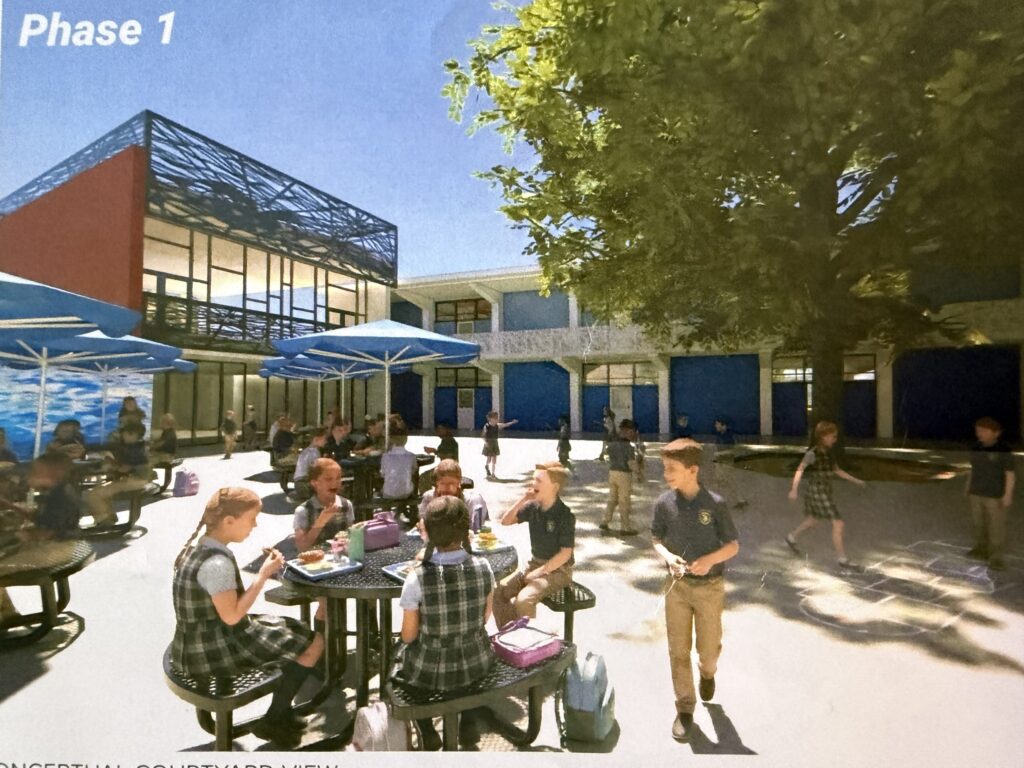
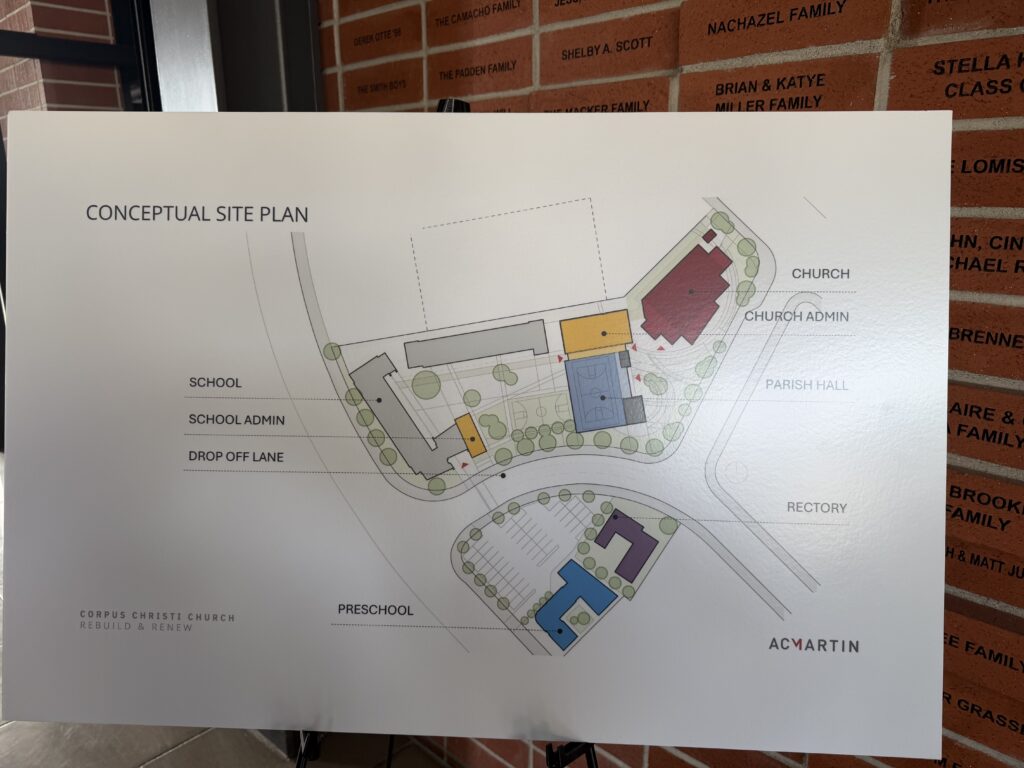
This is how the campus will look in August.

About 50 people gathered to hear Corpus Christi Principal Paola Sessarego explain the plans for the elementary school to reopen in the fall of 2026.

As people gathered in the entrance foyer that leads to the main office (unburned) and to the parish hall (burned) on February 23, they could see construction workers in the yard and the classrooms.

Although the January 7, 2025, Palisades Fire destroyed the church, rectory and parish hall, the two-story classroom building was left intact, but smoke damaged.

Students and families were forced to find other schools to finish the school year and the 2025-2026 school year. Principal Sessarego kept up with her students by visiting these schools and at each school she was asked, “What do you do to these kids at Corpus? These kids are so well-behaved, so kind.”

Sessarego told those assembled that “this is the spirit we have at this campus.” She said community service was important because it took the focus away from “me, me, me.”

Now, plans are underway, not only to restore the campus but to make it better, the principal said.

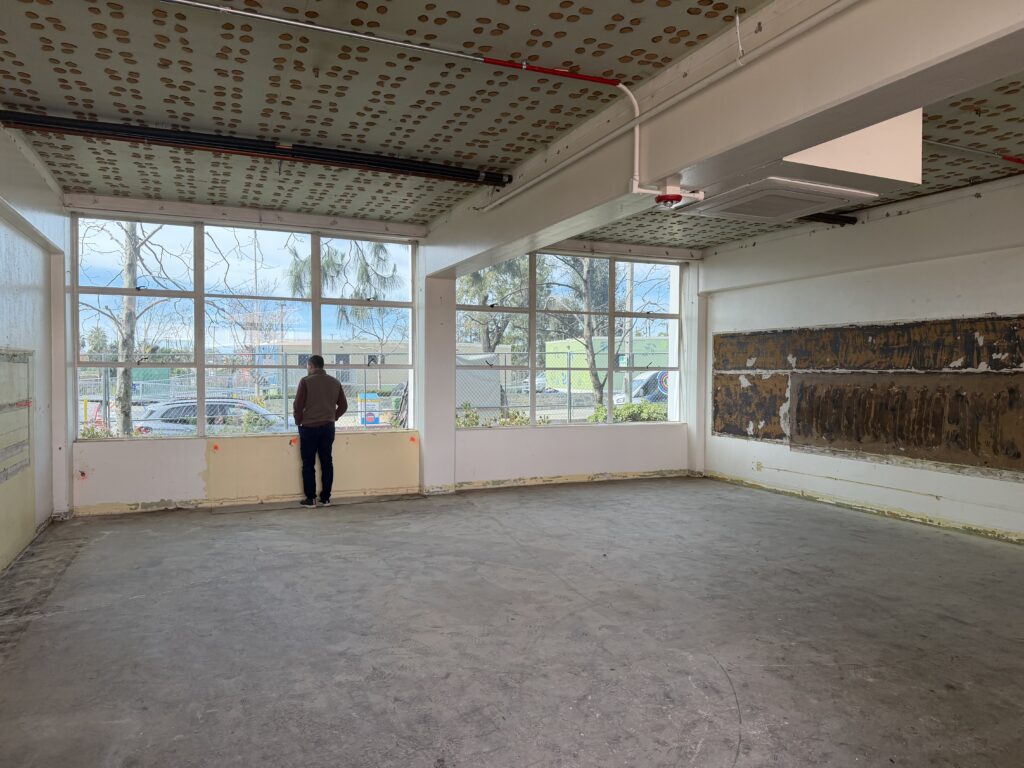
Classrooms are being remediated and new windows installed.

The classrooms have been taken down to the studs, the windows will be replaced and equipped with Hepa filters and ozone modules and “we’re adding a STEM classroom,” Sessarego said. She noted the playground will be replaced and there will be grass, which is “more kid friendly.”

The conceptual site plan shows that classrooms will have a courtyard view with wider room for play.

The classrooms are the buildings in grey, which are still standing. The red building will be the new church. Across the street, a new rectory will be built and a new preschool. There will be a parking lot.

The area that served as a church parking lot, which was also utilized as a playground, will now be the location for the church – at the northernmost point of the property.

The Parish Hall (in blue) and Church administrative offices (yellow)  will be north of the school and next to the church. The principal is hoping the Hall can easily be put up, so it could be used as a site for mass.

Across the street, at the site of two former homes, a rectory and a nunnery (both burned), a replacement rectory will be built. A new preschool building will be built next to the rectory. The remainder of the lot will serve as parking.

Sessarego said that “more than a school and church, the idea is to bring the community back.”

And “the new church will be a more traditional church,” she added.

A parent asked about construction at Ralphs, a large supermarket and parking lot on one side of the Corpus complex that had burned. Sessarego said they had been told the grocery story wasn’t starting construction for about five years.

The principal said that most of the teachers want to come back. She said teachers and administrators are hoping students, who might be settled in other locations, will return to their home school this fall.

“We want you to see the vision and go on this journey with us,” she said.

Monsignor Liam Kidney was in attendance and asked for a timeline. He said, “Our focus is getting school started.” The classrooms will be done by August.

Next, for construction will probably be the preschool and rectory. The overall timeline for everything to be completed is estimated to be five years, with the church the last structure finished.

“It’s a huge complex we are building,” Kidney said.

To apply for the 2026-2027 school year, visit: click here.

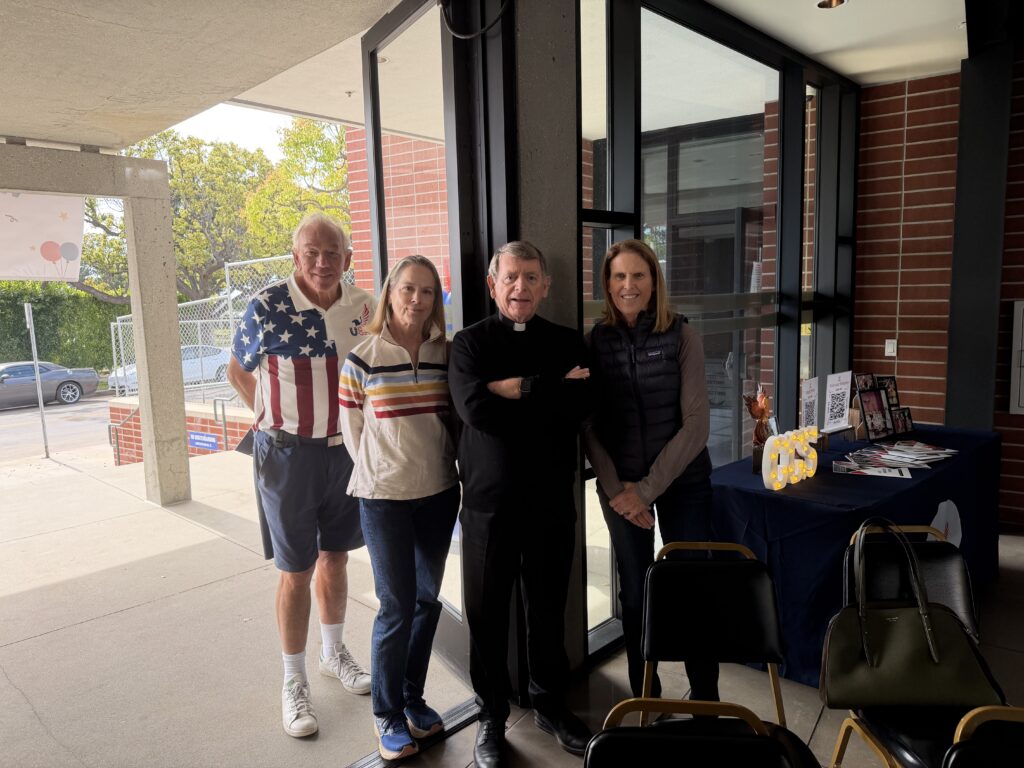
Monseigneur Liam Kidney welcomed parishioners to see the school plans.

Posted in Schools | 1 Comment

Palisadians Travel with Mayor, Councilmember to Sacramento to Discuss Insurance

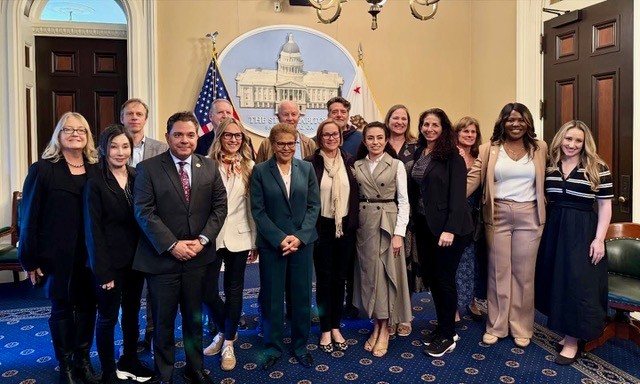
A delegation of Palisades residents traveled with Mayor Karen Bass and Traci Park to Sacramento to speak about insurance.                                                                                                                                                Photo: ROSEANNE LANDAY

A delegation of 11 Palisades residents traveled with L.A. Mayor Karen Bass and Councilmember Traci Park to Sacramento on February 9 to advocate for Palisades Fire Survivors.

The delegation represented 1) single-family homeowners who lost their homes, 2) underinsured households, 3) condominium and townhome owners, 4) HOA board members, 5) mobile home residents, 6) apartment building residents, and 7) families whose properties suffered fire and smoke damage.

Residents covered their own transportation expenses and participated on a volunteer basis. Individuals attended in their personal capacities as community members and wildfire survivors

During the visit, the delegation met with legislative leadership, insurance committee chairs and staff, senior representatives from Governor Gavin Newsom’s office and California Department of Insurance officials.

Key legislative proposals discussed included:

  • SB 876 (Padilla) – Wildfire Catastrophe Claims Reform Act
  • SB 877 (Perez) – Fair Claims Practices and Transparency Act
  • SB 878 (Perez) – Insurance Payment Accountability Act
  • AB 1680 (Calderon) – Make it FAIR Act
  • AB 1642 (Harabedian) – Wildfire Environmental Safety and Testing Act
  • SB 894 (Allen) – California Wildfire Resilience Program

Delegates advocated on three issues:

1)Wildfire insurance claims reform, including enforcement and transparency improvement, 2) Long-term insurability as communities rebuild, particularly in high fire-risk zones, and 3) Mortgage forbearance and rebuild financing gaps, including credit reporting and repayment concerns.

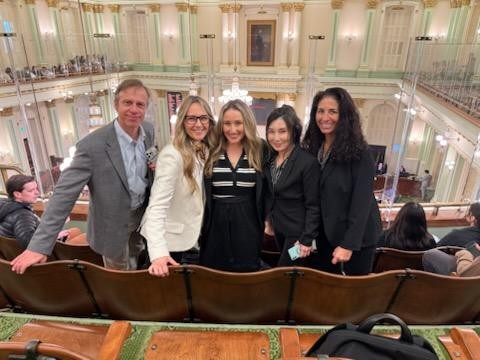
Residents spoke to individual legislators about insurance issues.
Photo: ROSEANNE LANDAY

Legislators were told that multi-unit housing, such as condominium and townhome HOAs, apartment buildings, and mobile home parks, are often classified as commercial properties and can fall outside certain residential insurance protections and government programs.

Residents also described delayed claims processing, shifting adjusters, disputed valuations, contamination testing challenges, underinsurance gaps, insufficient ALE/LOU, and the additional financial exposure faced by underinsured multi-unit housing, all of which complicate and may stall rebuilding timelines.

Several delegates also raised concerns about wildfire-related contaminants — including substances classified as neurotoxins and carcinogens — and emphasized the need for rigorous, standardized testing protocols prior to scope-of-loss determinations and remediation.

Another concern presented to legislators was about mortgage forbearance under existing law and the need for relief protections aligned with extended rebuild timelines. Governor Gavin Newsom recently announced an agreement with lending institutions to extend mortgage relief for wildfire survivors, subject to federal approval. Participants emphasized the importance of ensuring those protections are durable, enforceable, and inclusive of all Palisades communities.

Legislators were told that residents are willing to rebuild to higher fire-hardening standards and invest in defensible space and other mitigation measures. However, there is currently no standardized mechanism to ensure those investments translate into durable, long-term access to insurance coverage.

In addition to multiple survivor testimonies, the delegation presented findings from the Ground Truth Initiative, a resident-initiated rapid-response survey of single-family homeowners that gathered nearly 500 responses within 72 hours. (The survey was independently organized and funded through Palisades Rising.)

The homeowner survey data reiterated delegates’ experience with ongoing claims, inconsistent smoke and contamination coverage, significant underinsurance gaps, uncertainty around long-term insurability, and construction funding shortfalls tied to both insurance and mortgage constraints.

Residents described the meetings in Sacramento as constructive and implementation-focused.

The City’s delegation emphasized that Pacific Palisades and Eaton can serve as learning environments for how California coordinates recovery, insurance reform, environmental testing standards, mitigation investment, and mortgage protections going forward.

Participants stated that the goal is not only to improve outcomes after a loss, but to ensure all housing types can rebuild safely and efficiently, stabilize, and remain insurable over time.

The City of Los Angeles and residents plan to continue engagement with legislative offices, the Governor’s administration, and the California Department of Insurance as wildfire-related legislation advances and recovery efforts evolve.

Click here.

Participants and their focus:

  1. Elissa Ashwood – Standing homes; multigenerational families
  2. Rita Ciolek – Tahitian Terrace Residents Association
  3. Steve Cron – Senior citizen financial recovery and underinsurance challenges
  4. Martin Hak – Insurance claim recovery friction points; future insurability; rebuild funding gaps; senior resident financial recovery challenges
  5. Allison Holdorff-Polhill –: Insurability; total-loss rebuild challenges (among the first homes rebuilt post-fire)
  6. Rachel Jonas – (State and federal mortgage relief)
  7. Grace Kono-Wells – (Mobile homes and mobile home parks; immediate no- and low-cost rebuild funding; insurance inclusion)
  8. Roseanne Landay – (Condos, townhomes, apartment buildings, affordable housing, seniors, and essential workers; access to low-cost capital for rebuilding multi-unit housing)
  9. Tim Schneider – (Standing homes; insurance claims practices; future insurance affordability and availability)
  10. Marianne Wisner (Rigorous toxin testing prior to scope-of-loss determination and remediation; regulation of remediators)
  11. Felix Werner (HOAs; Palisades resident news coverage)
Posted in City, Community, Palisades Fire | Leave a comment

Obituary: Dr. Bernard Murray Churchill, Noted Urologist, Beloved Husband, Father

Long-time Palisadian, Dr. Bernard Murray Churchill, MD, died on January 25, 2026, at home, surrounded by family. He was 86 years old.

Bernie, as everyone knew him, was born in Calgary, Alberta, Canada in 1939.  He received his medical education at Harvard University and the Universities of Alberta and Toronto. He served as Chief of the Department of Pediatric Urology at the Hospital for Sick Children in Toronto for 20 years beginning in 1975.

With wife Margaret, the couple moved to Pacific Palisades in 1995, so Bernie could work at UCLA Medical Center. He was the Director of the Clark Morrison Children’s Urology Center, until his retirement in 2015.

He was the 25th recipient of the American Academy of Pediatrics Urology Medal for career accomplishments, and throughout his career was often cited as the “World’s Leading Expert in Pediatric Urology.”

Bernie’s legacy will continue in the lives of the thousands of patients he treated and the well over one hundred doctors he trained throughout his career.

The couple were active parishioners of Corpus Christi Church, where Bernie was a member of the men’s prayer group.

Throughout his life, he was an avid skier, tennis player and sailor, all passions that he passed on to his children.

The doctor is survived by his beloved, and loving wife of 63 years Margaret Rose Churchill (née Shandro), four sons, Michael Bernard, Patrick John, William Brian, James Alexander and seven grandchildren Noël, Victor, Thomas, Claudia, Lukas, Xavier and Evangeline.

Bernie’s funeral mass will be held Saturday, March 7, at 12:30 p.m. at St. Martin of Tours Catholic Church, 11967 Sunset Boulevard, Los Angeles.

In lieu of flowers the family appreciates donations to the rebuilding fund of Corpus Christi Church, the link to which can be found click here.

Posted in Obituaries | Leave a comment

Candidate Forum Mostly Civil: Two People Ejected

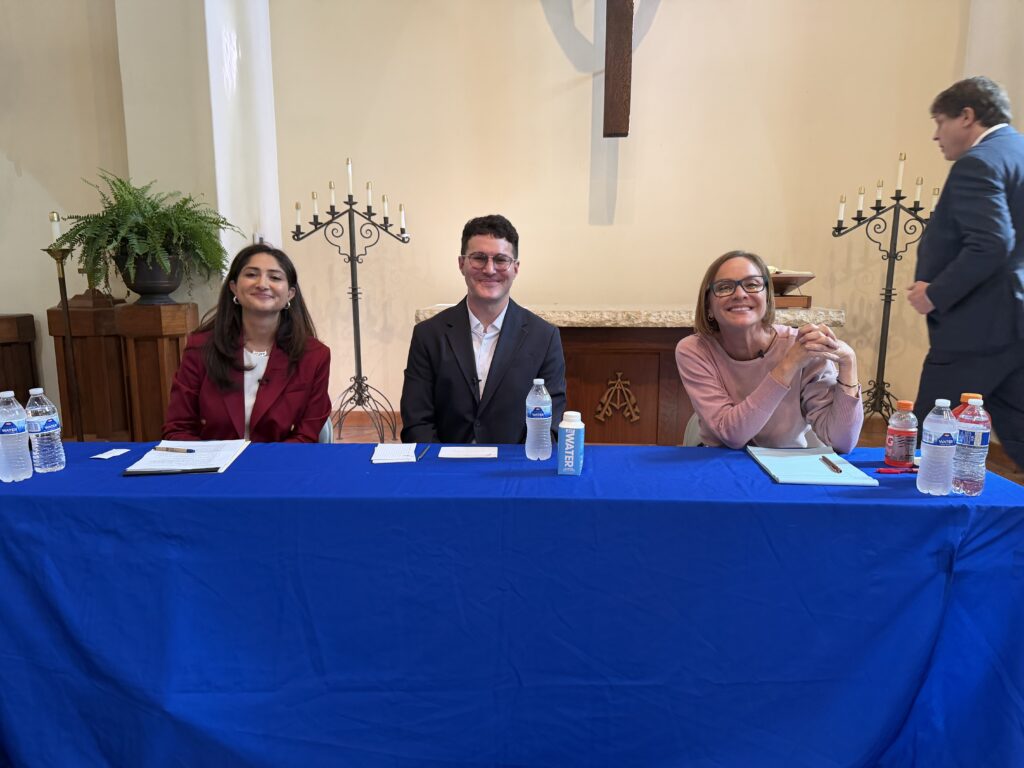
Faizah Malik, Jeremy Wineberg and Councilmember Traci Park answered questions during the forum.

The Westside Regional Alliance of Councils (WRAC) held a Los Angeles City Council District 11 candidate forum on March 1 at the Venice First Lutheran Church.

Three candidates were on the dais: incumbent Traci Park and challengers Faizah Malik and Jeremy Wineberg.

Wineberg has lived in Pacific Palisades 40 years. Malik said her husband and kids moved back from the East Coast in 2017 and moved to Venice in 2019. Traci said she moved to Venice in 2012.

Before the debate began, CTN spoke to a Venice resident in a pew who said, “How can you go back to a DSA (Democratic Socialist of America) councilmember. We had [Mike] Bonin and he wrecked the district.”

Malik is a candidate supported by the DSA, which is the largest socialist organization in the United States and is “a political and activist organization, not a party; through campus and community-based chapters, DSA members use a variety of tactics, from legislative to direct action, to fight for reforms that empower working people.”

Also in the pew was a senior citizen from Minnesota, who had come to event with his daughter, who is working for Malik. He asked, “Is usually this crowded for a candidate forum?” I told him “no” – and then he was hustled out of the pew away from the reporter and replaced with an avid Malik supporter.

ABC7’s Josh Haskell did an excellent job of handling the forum.  Each Westside Neighborhood/Community Council was allowed one question and  candidates had not seen questions before the event.

ABC7’s Josh Haskell moderated the forum.

POLICE:

Haskell asked, “Do you support current funding for the police department? And should we increase the budget?”

Malik said we should look at how the money is being spent. “We’re spending so much money, we should be funding alternate responses.”

Wineberg agreed with Malik.

Park said “we have 8,600 sworn officers for four million people; we are dangerously and critically low. They are understaffed.”

A man in the audience stood up and started shouting at Traci. He was removed. Audience members had been told prior to the forum that any outbursts would not be tolerated.

MENTALLY ILL/ADDICTS

Haskell asked about the mentally ill. Wineberg said “There should be rehabilitation centers and we should treat them like our neighbors.” Malik said “We should ensure the mental health dollars are going to the people.”

Park said that there needs to be mental health and addiction treatment centers and added that people on the streets, who wanted help, had been helped.

An audience member started screaming out “How many have you helped?” And the woman was ejected.

AFFORDABLE HOUSING:

The State Housing mandate was the subject of a question from Mar Vista. There were three different opinions: Wineberg said we had to take care of neighbors, Malik said that we are facing an affordable housing crisis on the Westside and that more housing near transit centers is good. “We have to get to yes,” she said.

Park said that her issue with mandates is that they were written by state legislators that have never visited some of the Westside areas, where geology can be an issue and flexibility is needed.

VENICE DEL PROJECT:

The controversial Venice Del Project was the next topic. Wineberg said “It has already been approved, why are we not doing it?”

Los Angeles axed the project (120 low-income apartments) a year ago when it voted to reject a long-term lease from the city to the developers, the nonprofit Venice Community Housing Corporation click here.

Malik said the project was absolutely needed and that it was being developed by a “reputable nonprofit.”

Park said that it was a project started by former councilmember Mike Bonin and that it “was plagued by back-room deals.”

She had not finished talking when Wineberg told her that her time was up. Haskell told him “Candidates can’t say when time is up” and Haskell told Park to finish speaking.

PALISADES FIRE:

The Pacific Palisades Community Council’s question was about the Palisades Fire and the next steps. Wineberg said. “We need to staff the Palisades so that someone is there every day.”

Malik agreed, “we need to support residents. We need to address climate resiliency and do community planning.”

Park, who has been the Palisades biggest advocate and seen all of the challenges faced by residents said, “I don’t know where to start. There’s ALE (additional living expenses—rent), mortgage and recovery. There are insurance and financing questions.”

DENSITY:

Asked about added density Wineberg, who lost his home in the Palisade Fire, said “let people come home first.”

Malik that that added density would be good for Palisades teachers, and families could have ADUs on their lots.

Park said that no additional density should be added to the Palisades until the evacuation routes are figured out.

FORMER COUNCILMEMBER MIKE BONIN:

Candidates were asked, “Do you think Mike Bonin did a good job?” .

“I voted for him,” Wineberg said.

“I have never been Bonin’s lawyer,” Malik said, and added that Park had alleged that. “This race is not about Mike Bonin. We need to move forward.”

“Did he do a good job?” Park asked. “Obviously not. I’m here.”

Then an interesting paradox occurred, Wineberg started attacking Park, which brought applause and cheers from Malik’s followers.

SB 79 AND 41.18

Asked if they supported SB 79, Wineberg and Malik were yes, Park said community safety was first. (SB 79 development projects override local control to develop sites zoned for residential, mixed, or commercial development within one-half or one-quarter mile of transit stops.)

Candidates were asked about enforcement of 41.18 (homeless are not allowed to camp in a sensitive area, such as a public park, library or school).  Wineberg started to speak and then stopped because he said, “I’m getting laughed at.”

Malik said “41.18 is a tool made to manage public spaces, but it does not solve homelessness.”

Park was clear about enforcing it. “There is no planet where kids should be stepping over needles and addicts. You just can’t be that close to schools.”

In the closing remarks, Wineberg attacked Park to huge applause from Malik supporters. “What has gotten better under Traci,” he said. “It was the worst disaster in history, and she used the fire to look better, she turned tragedy into headlines.”

Malik said “The status quo is not solving problems. I want our city to provide opportunities for all of us.”

Traci asked people to set aside the rhetoric and look at the results. “The weight of responsibility is incredibly heavy and I’m running one more time to get results for you.”

Posted in City, City Councilmember Park, Community | 3 Comments

Councilmember Park to Host AECOM: Summary from Mayor’s AECOM Meeting

Traci Park

There will be a virtual townhall meeting to discuss the AECOM report with Councilmember Traci Park from 5:30 to 6:30 p.m. on Monday, March 2 click here

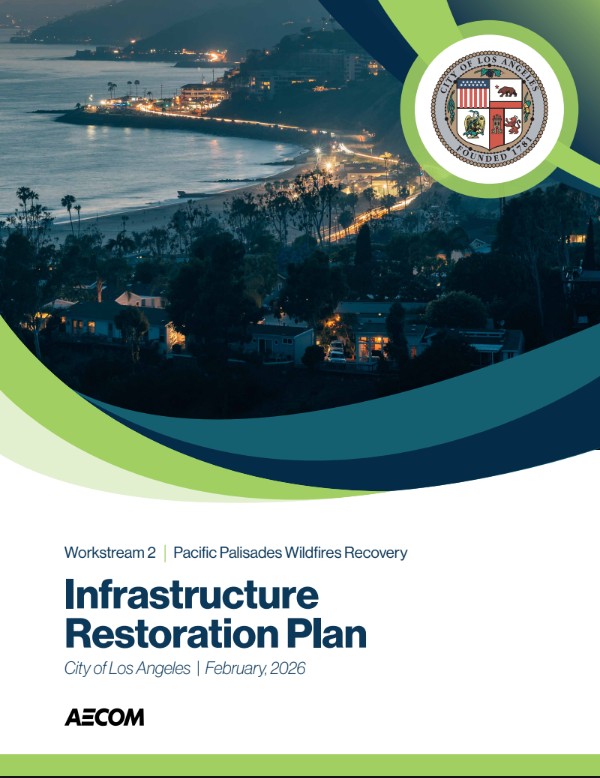
L.A. Mayor Karen Bass hired AECOM, after the Hagerty consulting firm was hired, paid about $2 million and replaced. According to some reports, AECOM was hired for as much as $30 million and was intended to provide:

  • A comprehensive rebuilding master plan that is informed by the community.
  • An infrastructure reconstruction plan for the phased deployment of all utilities above and below ground, in tandem with widespread commercial and residential construction.
  • A logistics plan for materials management in coordination with local builders and suppliers.
  • A master traffic plan to manage an increased number of builders, trucks, construction materials, and other activity as more and more property owners begin the rebuilding process.

The nearly 1,000-page report was released to the public at the end of February. The Mayor’s office held a zoom two-hour meeting to go over the document. Several AECOM representatives shared their findings in three areas:

1)public infrastructure restoration, 2) wildfire resilience and 3)logistics and traffic management.

The first area addressed electric, gas, telecommunications, water and storm water. First it documented the existing conditions and recommended phased rebuilding. It pointed out that the initial phase was short-term recovery during the emergency response, then mid-term recovery with infrastructure restoration and long-term recovery.

Summing up the 342 page document: everything was mostly wiped out in the Palisades after the fire. DWP worked to restore water and gas to surrounding standing neighborhoods and now there are plans to underground utilities. There is no money for infrastructure from the City of Los Angeles. There had been hopes that FEMA money might come to Los Angeles and be used for the rebuild, but that hasn’t happened, yet. It is proposed that community meetings and workshops be held to discuss plans.

The AECOM paper concludes “As reconstruction advances through the coming decade, Pacific Palisades will emerge as a community where infrastructure systems are hardened against wildfire, adapted to climate change, and designed to support sustainable growth.” There is no timeline in the report.

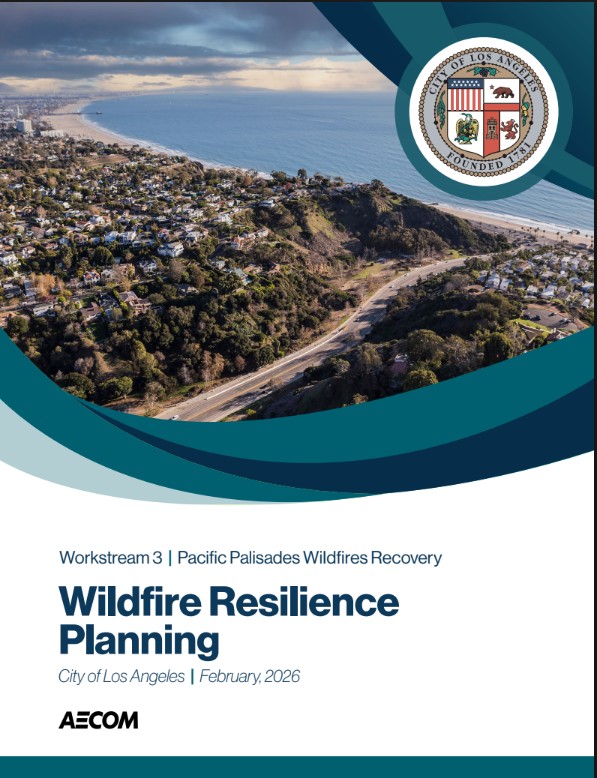
Regarding Wildfire Resilience, that 200-page document lays out the fact that 24,636 people lived in Pacific Palisades, that the population is predominantly white (81%) and the median age is 48. The report notes that “Before the fire, Pacific Palisades was a thriving, close-knit community with a mix of single-family homes, condominium and apartment buildings, three mobile home parks, the bustling Palisades Village shopping center with community-serving amenities and civic institutions, several schools, the Palisades Recreation Center and Palisades Branch Library, and a smaller commercial node at Sunset Boulevard and PCH.”

According to the Wildfire Resiliency, there needs to be planned vegetation management, a water supply, an electrical power system and evacuation capabilities. The report, after offering a few suggestions such as community defensible space, and creating fuel breaks notes that it “is not making any assessments as to whether if any of these potential approaches had been available during the fire, that they would have had any effect on the availability of water to firefighters during the event.”

Water recommendations included increasing the size of the pipelines serving the Palisades and to increase water pressure in higher elevations, adding a sea water pump as an emergency source to refill Santa Ynez Reservoir ( which was empty), underground utilities, replace wood poles and have public safety power shutoff available.

Essentially, parkland had not burned since 1978, there was an inadequate water supply to maintain pressure in hydrants at higher altitudes, and it is suspected that electrical fires from wooden poles and wires arcing may have set secondary fires.

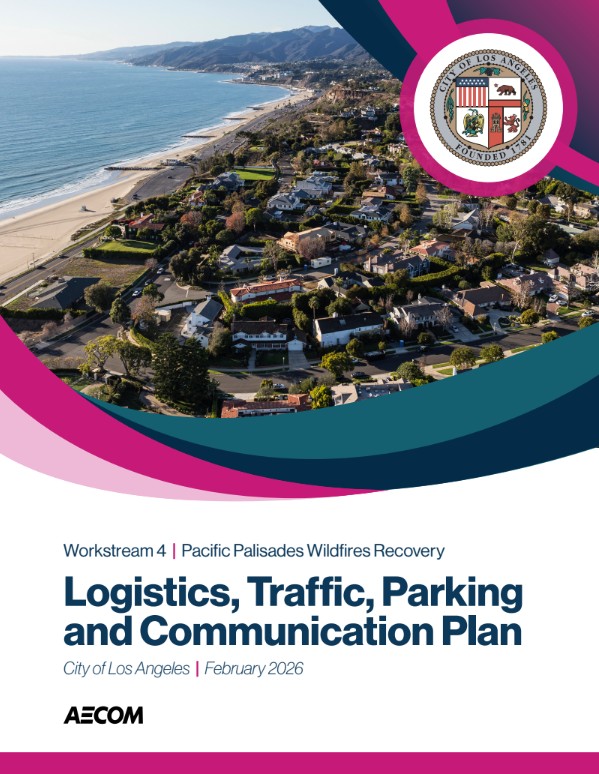
The final 633 page report deals with logistics, traffic, parking and communication.

The report notes it use Evidence-Based Decision-Making, which includes validated data to guide lane closures, logistics routing, parking management, and public notifications, effectively replacing reactive decisions with predictive management.

It also points out what residents know:  “Sunset Boulevard, Chautauqua Boulevard, and Temescal Canyon Road serve as the community’s primary east–west and north–south connectors. Any uncoordinated closure on these routes could have significant regional impacts on mobility and emergency access.”

There are not ample evacuation routes out of Pacific Palisades.

Street intersections were examined as possible choke points, but the report missed Via de la Paz and Sunset and Swarthmore and Sunset, which are both essential to the Alphabet Streets. The former has been closed by DWP, the later has been closed by Rick Caruso, even though it is a public, not private street.

There was fear that construction would tie up the few roads, but since rebuilding is not happening at the same time it has been a nonissue (except a tied-up Chautauqua as workers began the commute home.

A caller wanted to know if a street is deemed too narrow will you widen it or recommend parking only on one side? The answer was “We made no recommendations to widen because it would cut into neighbor’s property.”

Firetrucks can’t make it down some of the narrower streets and one caller wanted to know if that meant that parking would only be on one side of the street. AECOM’s Jordan Karp said, “It’s up for consideration.”

Another caller wanted to know about a requirement for only being able to build if a firetruck can turn around on a road – which for many of the areas in Palisades is not available. The caller was told that smaller firetrucks, those with a 350-gallon water tank had been purchased.
People wanted to know if infrastructure could be completed so streets could be repaired.

DWP’s Theodore Zeiss said that utility is working on a master schedule now and as soon as it was done, a community meeting would be held. A person building asked, “what should I do about undergrounding. “Install the combo panel,” Zeiss said. He was also asked about water lines. “We will start with power, but we will have water, too,” Zeiss said.

“When can the roads realistically be repaired,” a caller asked.  “Residents are getting flat tires from current street conditions, what can be done?”

Streets L.A.’s Ana Tabuena-Ruddy suggested calling 311 and setting up a service request. “They will expedite if you’re in a fire area.

“Streets will be repaired progressively,” Tabuena-Ruddy said, meaning as soon as the infrastructure is done those streets will be repaired. She was also asked when the City would remove fire-damaged trees. “If there is an immediate concern, call 311,” she said.

A caller asked, “How many permits have been issued and what is the time to complete a home.” Allen Manalansan, a structural engineer with Building and Safety said that 2004 permits have been issued, but the time to complete a home depends on the resident.

The host of the AECOM presentation, Deanna Weber, said at the close of the online presentation “We’re creating a single source of truth. We’re creating it now.”

The recording will be made available according to the Mayor’s office and once it is, it will be linked to this story.


Posted in City, Palisades Fire | 2 Comments