
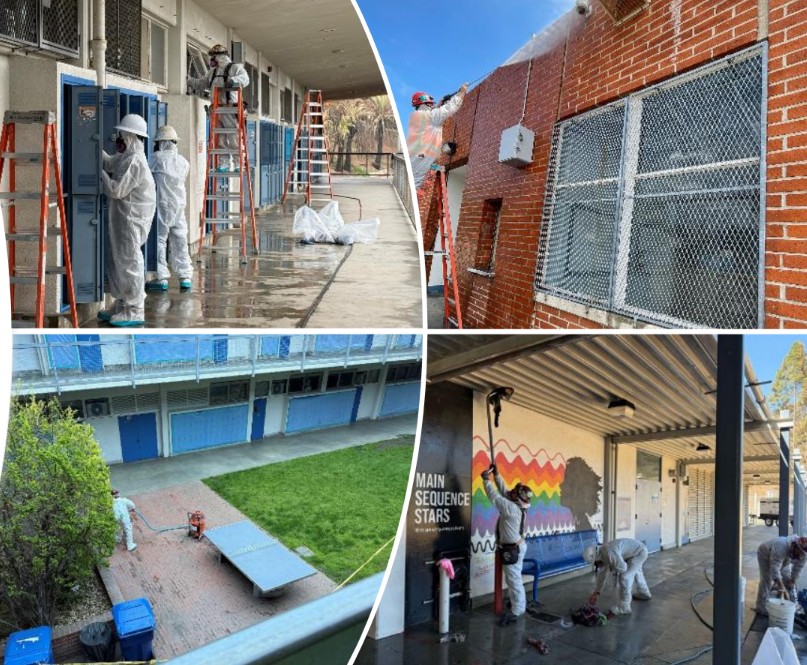
The entire exterior of Palisades High School was cleaned after the Palisades Fire.
A summary of environmental testing results of Palisades High School will be presented to the community at 6 p.m. at a virtual meeting on Wednesday, January 21. The zoom link is lausd.zoom.us/j/88251697116 and the meeting ID is 882 5169 7116
PLANNED SPRING SEMESTER:
Faculty and staff returned to Palisades Charter High School in Pacific Palisades at the corner of Bowdoin and Temescal Canyon Road for a professional development day on January 12. Students returned to the Sears building (Pali South) on January 13 for the start of the spring semester. Students will return to PaliHi Main Campus on January 27.
When students return, lockers will be reassigned. Buses will be rerouted from Santa Monica to the Palisades.
Maggie Gilbert Aquatics Center pool repairs and the athletic field repairs at Stadium by the Sea are slated to be completed by the end of January.
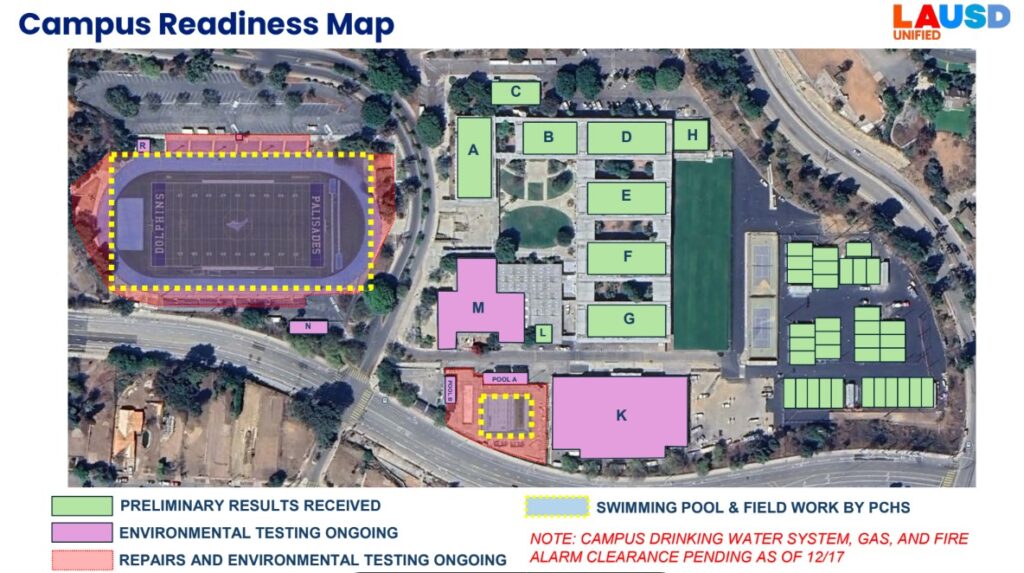
Environmental clearance is anticipated today January 19 for Buildings A, B, C, D, E, F, G, H, L and interim housing units.
Work is currently underway in Building M (food services/auditorium), Building K (gym), pool and pool buildings, football field and stadium buildings.
Power, low-voltage systems and phone service had been restored. Drinking water is still undergoing testing. (If needed, plans are in place for the school to have bottled water and delivered meals like Pali South).
Repairs to gas service are ongoing and if needed, temporary heating units will be provided for classrooms.
Fire alarm testing and clearance is anticipated to be completed this week.
There is a 46-page report on the environmental testing and cleaning completed by Citadel EHA, a consulting firm specializing in environmental, health, safety and sustainability services, based in California click here.
Citadel performed testing at the Palisades High School Campus with 29 certified asbestos consultants and site surveillance technicians, 15 lead inspectors/assessors and five certified industrial hygienists.
From February to March 2025 an environmental assessment was done, followed by a remediation/decontamination effort through AIR, Inc. (Asbestos Instant Response, Inc.)
An additional pre-occupancy testing was done by Citadel EHS through November 25, with a subsequent “punchlist” of areas given to AIR to clean from December 25 to present. AIR, Inc, has professional certifications in microbial remediation, structural drying, fire and spoke restoration, water damage restoration, asbestos and hazardous substance removal.
To start the high school remediation, all exterior surfaces were cleaned. Then interior surfaces were cleaned with initial HEPA vacuuming, wet wiping and a final HEPA vacuuming. The school heating and HVAC systems were clean and remediated.
Multiple LAUSD divisions (OEHS and FETU) and third-party entities were involved in the inspection and environmental testing process, including Citadel EHS and TRC (remediation and materials management services). Any area that did not initially meet clearance levels was recleaned and retested.
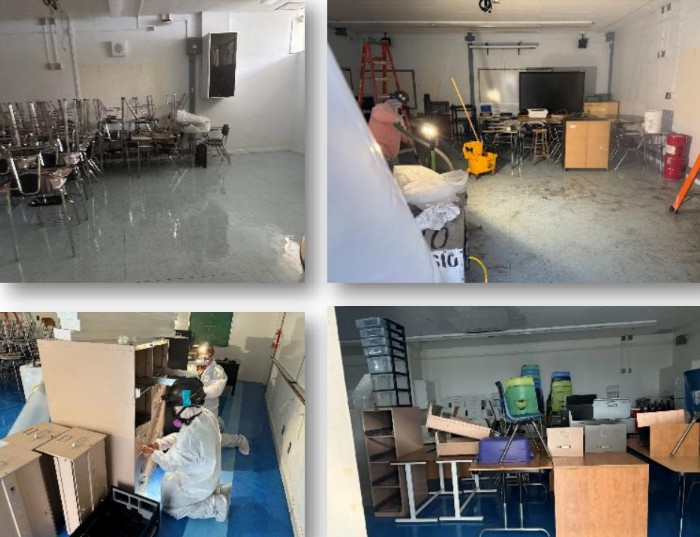
The interior was cleaned, tested and recleaned if it was necessary.
SOIL SAMPLES:
Soil samples were taken from more than 120 locations on campus and its perimeter. The conclusion: Site-wide concentrations of suspected wildfire-deposited compounds did not exceed applicable EPA/DTSC screening levels and Dieldrin, a legacy termite control, a non-wildfire pesticide was remediated to health-protective levels. Complete soil data can be found on the LAUSD OEHS website click here.
POST-CLEANING/REMEDIATION RESULTS:
Polycyclic Aromatic Hydrocarbons (PAHS) was not detected in post-cleaning samples.
Metals were not detected in most samples and low-level detections (at or slightly above laboratory reporting limits) of copper, nickel, zinc, antimony, and barium were found in several samples. But these metals are nearly ubiquitous in building materials, hardware, and furnishings (ceramics, tile, glass, paints, varnishes, coatings, flame retardants, etc.), and the very low, near-detection limit concentrations observed are consistent with background levels in indoor environments and are not expected to pose a health risk.
Lead, Arsenic: Lead was detected in two samples; arsenic in one sample; and affected building were recleaned, with no detection in subsequent resampling.
ATHLETIC FIELD:
Duststream® samples were below risk-based soil screening levels. Comparing vacuumed-dust concentrations to soil screening levels is therefore a health-protective surrogate for evaluating ingestion risk from accessible surface particulates on this field, whether it comes from natural or artificial turf.
AIR MONITORING:
The school has four monitoring locations and real-time information is available at click here.
A summary of post-fire cleanup and assessments that were completed at PaliHi, Palisades Elementary and Marquez is available on the LAUSD OEHS website (oehs.lausd.org) click here.
Dieldrin, which is a “probable carcinogen,” was banned back in 1987 when I was at Pali High. Stunning to see that it is still found in elevated levels at the school. Shame on the chemical companies that have unleashed these toxins into the water and soil without regard for potential long-term impact.