
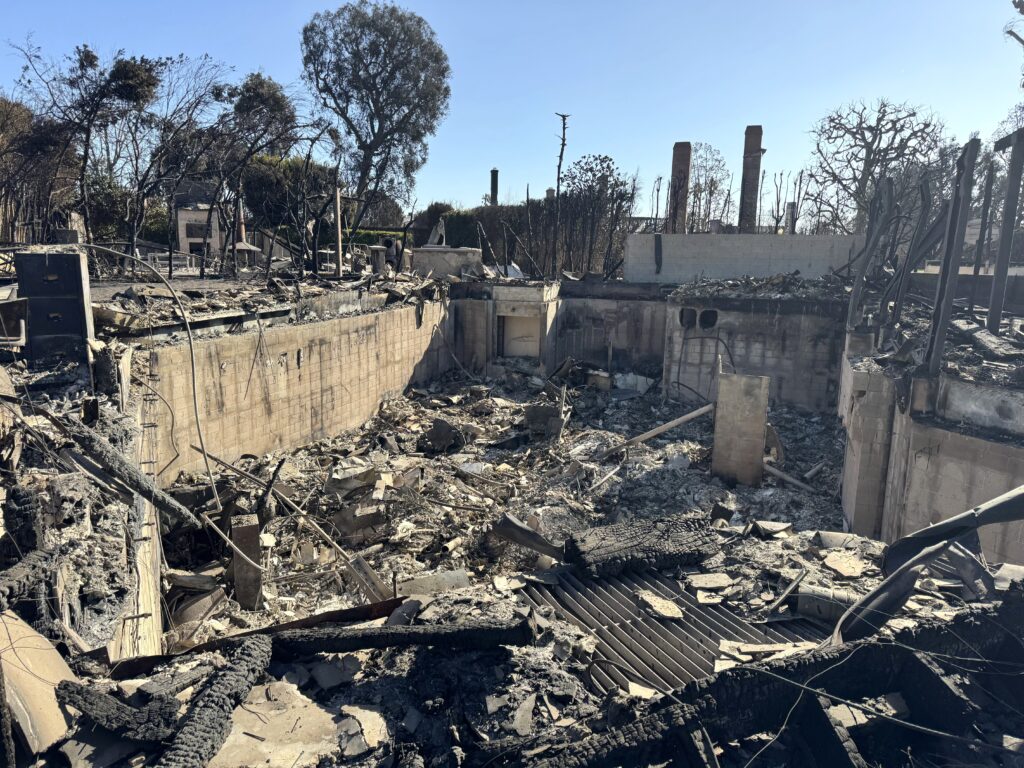
Whole neighborhoods were destroyed during the January 7 Palisades Fire.
One resident who is trying to find the funds to rebuild said he thought the City would pass a building permit waiver for people who lost everything in the Palisades Fire today during the December 2 meeting. “Why wouldn’t they?” he asked.
About 100 residents made the trip to City Hall to tell their stories of lost homes after the January 7 Palisades Fire and the need for help. They were given a minute to speak. As they spoke, some councilmembers looked at their phones, chatted with aides and read reports.
After about an hour, the Council President Marqueece Dawson-Harris closed public comment, even though there were still about 40 people who had not been heard. He said it was done out of time constraints, so the council meeting could proceed.
Under Item 23 on the agenda, were two different recommendations to waive building permit fees. This portion of the meeting is about 2:55 into the tape click here.
The first was from the Ad Hoc Recovery Committee that all permit fees be waived.
A second recommendation was from the Budget and Finance Committee, which proposed waiving fees for single family homes and duplexes for those building only up to 110 percent. The second motion was from the City Budget and Finance Committee, headed by Councilmember Katy Yaroslavsky, who has no finance background. Prior to becoming the rep for CD 5, she was the senior policy for Supervisor Sheila Kuehl, where she helped create the Clean Power Alliance and also served as the General Counsel to the Climate Action Reserve.
The committee Yaroslavsky heads, thought the cost to waive everything was cost prohibitive and voted to only waive permit fees on single family homes and duplexes.
President Dawson Harris asked the CAO (City Administrative Office’s assistant) Yolanda Chaves to explain the costs. She said that Budget and Finance option of waiving fees could cost $86 million, the other option would cost $278 million. She said that money would come out of the general fund. (As a reminder L.A. spent $767 million on homeless costs in 2024 and $289 million in legal settlements.)
When Chaves was asked if a small business wanted to rebuild to 110 percent, could permit fees be waived? Or if someone wanted to build 150 percent, would they get permit waivers up to 110 percent and then have to pay the rest? She didn’t know.
The CAO also assumed in the projected waiver costs that everyone would rebuild, which is not accurate. Some lots have been sold, and other people can’t afford to rebuild because they have a mortgage on a burned home and don’t have enough insurance because of California state policies.
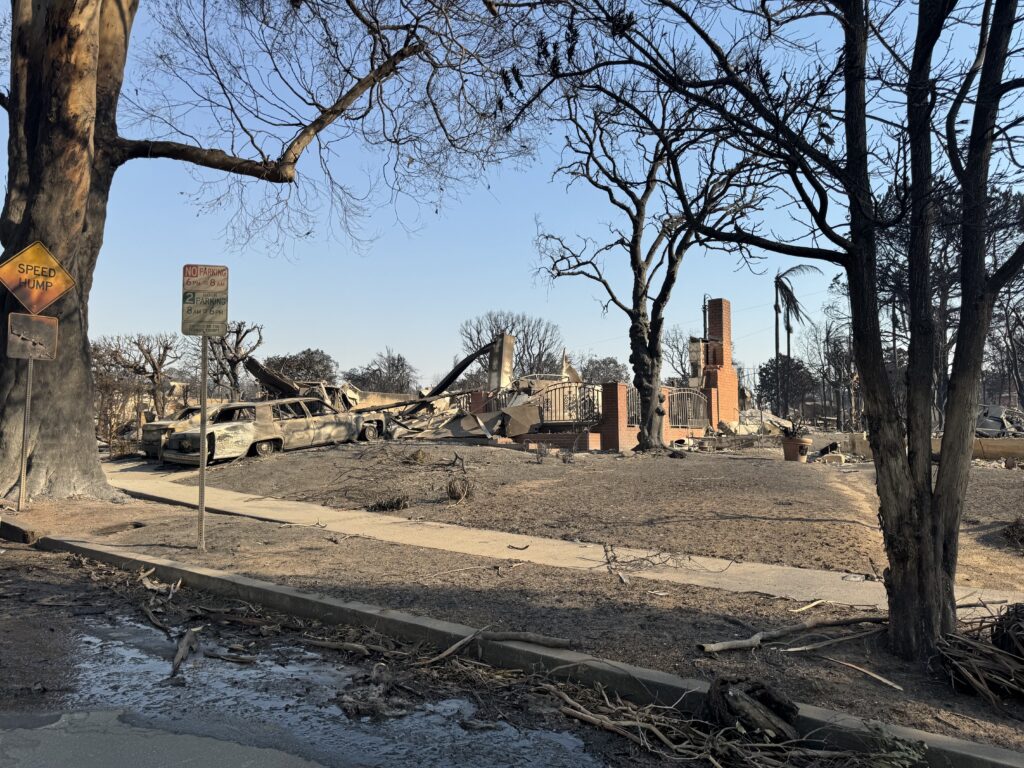
The Alphabet Streets in Pacific Palisades were decimated in the January 7 fires.
Councilmembers were worried about the City budget and being able to provide services to their districts. They seemed sympathetic to Palisadians who had lost everything, but the cost of waiving permit fees was something they had trouble with.
One resident described the hearing today as “A City Council Rope-a-Doping.”
Another resident said it “demonstrated the council’s incompetence.”
Pacific Palisades Community Council President Sue Kohl, who went to give public comment said, “We waited patiently for about two and half hours, having faith that there would be a vote. However, when it came down to it, it seems the financial officer had figures that were way out of line with reality.
“They didn’t want to vote after all this time until more detailed financials are made available,” Kohl said. “So it was frustrating, as there has been plenty of time for all of that already. We were disappointed to say the least.”
The council asked the CAO to come back with more information before it took a vote about waiving permit fees, even though LA. Mayor Karen Bass had issued an executive order about it in April. Eleven months after the fire, there are still no real decisions from the City.
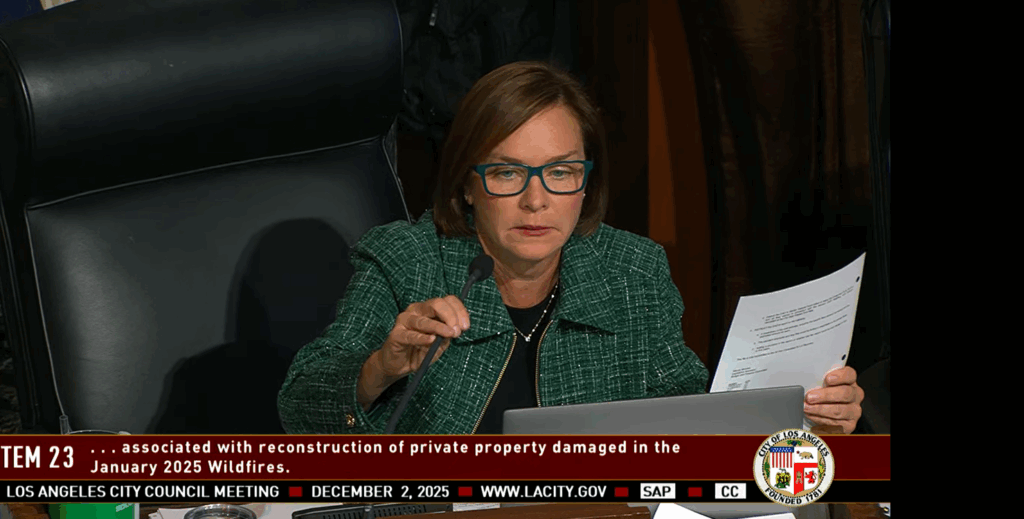
Councilmember Traci Park spoke eloquently on behalf of Pacific Palisades residents:
As you can see, this is a critically important issue for so many people. Colleagues, a simple reminder: absolutely nothing about this rebuild is voluntary. Not for anyone who lost their home or their property on January 7th. It does not matter whether it was a home rented or owned. Absolutamente nada.
On January 7, their entire lives were taken from them — their homes, their churches, their schools, their memories, their futures. In a catastrophe through no fault of their own.
People survived terrifying evacuations, leaving behind everything they knew and loved. Literally no one chose this. These are people simply trying to rebuild their lives. Thousands of them were underinsured or uninsured — again, through no fault of their own. Hundreds lost everything in the days before the fire reached them. They now face total loss, and their temporary assistance is about to expire. They are running out of options.
I personally know too many who are holding on by a thread. They are teachers, artists, small business owners, nurses, builders, office workers — people just like the rest of us across Los Angeles. Some are grandparents. Some are brand-new families starting out. Some have been there for generations. These people are our friends. They are our neighbors. They are Angelenos. We owe it to them to take care of them simply because it is the right thing to do.
And while I appreciate the fiscal concerns raised by the Budget & Finance Committee and its report, restricting the fee waiver to single-family homes and duplexes — which is plainly what the report does — only repeats the falsehood that the Pacific Palisades is some island of affluence. What we lost is so much more.
We lost rent-stabilized mobile home parks that I have been fighting tirelessly to help rebuild despite challenge after challenge. We lost dozens of townhomes, nearly a thousand units of RSO housing, income-restricted senior condos. We lost modest older single-family homes. And for so many of these properties, the 110 percent limitation does not make sense. Labor costs, material costs, the need to hire architects and contractors — these families have lost everything.
Unlike the budget committee’s narrow view, the Recovery Committee report captures the full breadth of housing and property types lost or damaged in the Palisades fire. We should not be picking winners and losers — saying we’ll waive fees for you if you own a single-family home or duplex, but telling others: too bad you owned a mobile home, too bad you lived in an ADU, too bad your building was multifamily, too bad your business sat on Sunset Boulevard in a historic block and served generations of Angelenos.
And worse, I cannot find a sound reason for this distinction. According to the CAO’s own report, the fiscal impact of waiving fees for multifamily or commercial properties is less than for single-family homes.
Perhaps in the grand scheme, waiving these fees does not feel like it will make the difference between rebuilding or not. But for those deciding whether they can return home or leave Los Angeles forever, showing them we have their back may be enough — enough to convince a retiree to stay and rebuild, enough to convince an apartment owner to restore units so displaced tenants can come home.
Colleagues, the only meaningful course before us is to stand up for these victims — victims who, through no fault of their own, had everything stolen from them in this catastrophe. There is precedent for this.
My request is simply that we do the right thing and adopt the Ad Hoc Recovery Committee report. If, when it comes to a vote, the motion is instead limited to the Budget Finance framework, I ask you to at least consider a friendly amendment that would:
- Include a sunset date of January 7, 2030.
- Waive rebuilding fees for ineligible property owners whose fees were already suspended under the Mayor’s Executive Order. Commitments were made; the City should not now act as a collection agency.
- Expand the “like-for-like” waiver to include condos, townhomes, apartments, and mobile home parks.
- Remove the 110 percent rebuild restriction for single-family homes and duplexes, given the economic realities families face.
- Ensure that for all properties, fees up to 110 percent of the original structure are waived before any charges apply beyond that threshold.
A question that many residents wonder, “What would it take to get the City Council to act with fairness and urgency?”
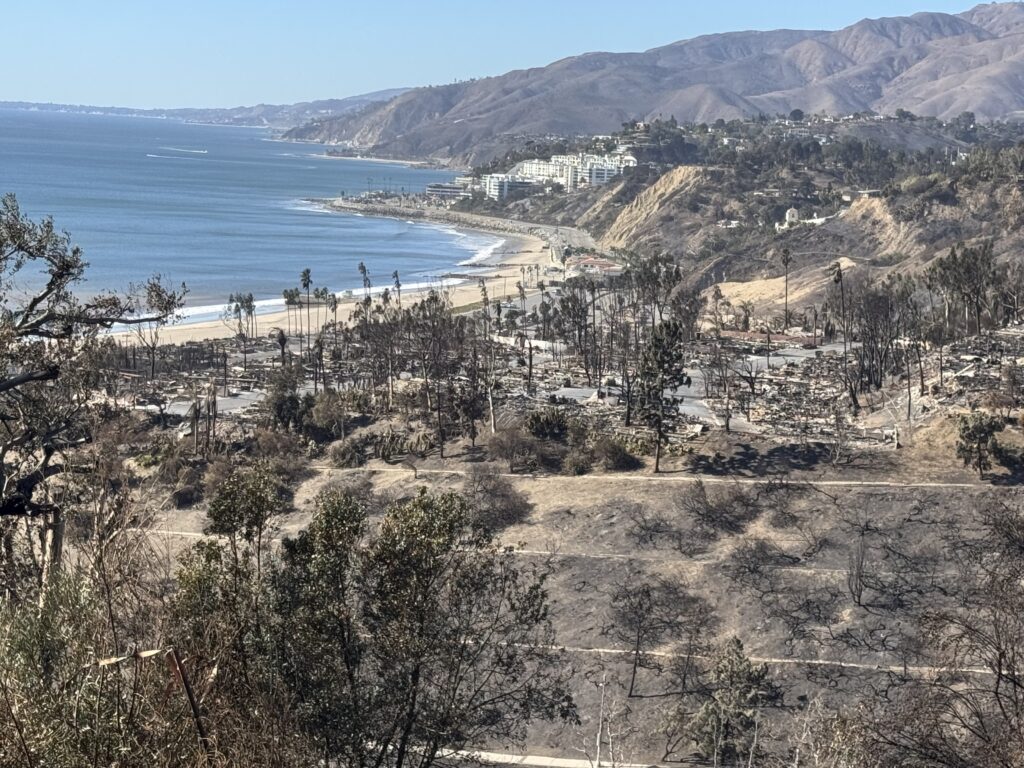
The three mobile home parks below the El Medio bluffs were destroyed in the fire.
The optics on this whole analysis are completely backwards. The City is acting like they would be “losing” $86 million to $278 million by waiving fees — but that’s not their cost. That’s our cost. Homeowners pay almost everything: electricians, plumbers, contractors, materials, engineering — the City’s actual cost to process permits, inspect a site, or flip a power switch is a tiny fraction of what they’re charging.
Does anyone at City Hall even know what it really costs to issue a permit or conduct an inspection? Of course not. And worse — they don’t care. Their plan is simple: charge as much as possible and slow-walk us every step of the way. Need more staff? They’re not hiring more inspectors — but they are paying over 120 DWP employees between $500,000 and $800,000 a year (Transparent California). If the City is broke, it’s because they overspend on themselves, not on police, fire, sewers, or the infrastructure we actually rely on.
Meanwhile, drive by PCH and Topanga — you’ll see half a dozen DWP workers killing time on their phones. Nice guys, but they’re not empowered to help anybody. That’s the real problem: Los Angeles has neglected and exploited Pacific Palisades for decades.
Honestly, at this point, Pacific Palisades needs to become its own city. LA has failed us long enough. What do you think?
Traci Park delivered a well prepared previously written speech. She did not speak extemporaneously. That suggests/means that she was aware that many on the City Council were not fans of the fee waiver. Now she gets to face some committee of possibly hostile council members and argue for “more” money. Yet the council members may only offer Traci Park a series of time-limited, declining value exploding offers that only provide “less” money. Compared to the undefined offer she could have accepted yesterday in council chambers, she is gambling that she may be able to convince a possibly dismissive committee to fork over more money. And there is no evidence to suggest that it is a good gamble. Traci Park had a bad deal in her hand and instead she opted for who knows what in the committee bush. It is possible that the committee gamble could payoff for 90272. Or it could be that yesterday’s bad deal was the best deal 90272 will ever get. If the CAO was not prepared to support Traci Park yesterday it is unlikely that the CAO will support Traci Park’s committee gamble.
Thank you to all the Palisadians who came to City Hall today to speak before City Council in support of waiving plan and permit fees for all Palisadians— including single-family homes, duplexes, condos, townhomes, mobile homes, and small apartment buildings— as well as waiving fees for the first 110% of larger rebuilds and prorating fees beyond that threshold. Going into the meeting, we did not have enough votes for the ordinance to pass. After many Palisadians showed up and spoke as to how this tax was an obstacle to our community’s recovery and after Traci’s excellent advocacy, it seemed as though we had moved some members closer to the “yes” column. However, due to the blaring incompetence of the CAO & LADBS, the members who seemed to have come over to our side wouldn’t vote on Traci’s revised ordinance without a more accurate financial analysis. I am hopeful we will get there in the end, but unfortunately, it is going to take a little more time and effort.
First of all, the city is not actually “losing” anything. Had our homes not burned these fees would not be part of their budget anyway. In other words, if the fees remain
intact, it’s actually a windfall for the City.
Second, if were not for the lack of preparedness and the ineptitude of the fire department, many of our homes would’ve been saved.
Third, the city took in $650 million in donations for fire victims and very little of it
have we seen. Instead pet projects of the mayor were rewarded. Why wasn’t that money put aside and used to cover permit fees?
Fourth, only about 70% or so of residents are going to rebuild so they need to adjust the supposed loss accordingly.
Fifth, it is stunning that the city spent $787 million on the homeless situation which is about is $78,000 per homeless if you consider about 10,000 homeless in the City.
Finally, it was extremely disrespectful the way the council members did not give their full attention to these homeowners who showed up at the meeting. It shows a complete lack of concern for us as constituents and I hope in the next election many Angelinos will hold the mayor annd City accountable voting for a clean sweep of this particular group of council members. Other than our own Tracy Park, they have shown to be extremely inept themselves at managing a city.